
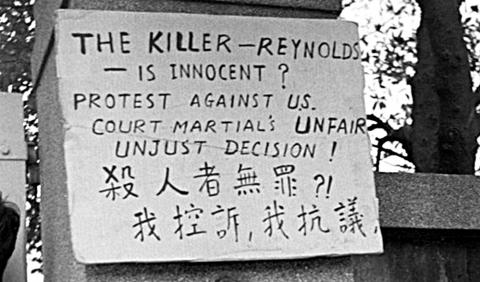
On 24th May 1957, a Chinese widow and her daughter began an angry vigil outside the US embassy in Taipei. Ao Tehua held up a bilingual sign protesting at the decision by a US court martial to find her husband’s killer innocent. Asked to move on, she pointed out that the street outside the embassy was Chinese territory, and it was her right to stand wherever she pleased. By the time a force of twenty-two police officers arrived to persuade her, a mob of 400 onlookers had gathered. A local reporter interviewed the tearful widow on tape, and then broadcast her words through a loudspeaker to an increasingly fractious crowd.
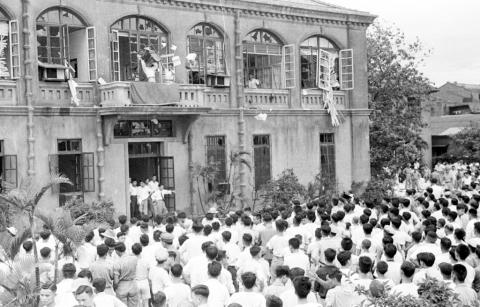
By the afternoon, the crowd had grown to more than 2,000 people, storming the embassy gates. They smashed the windows, ransacked the offices, and patrolled ominously outside the iron door protecting the staff in their panic room. The Stars and Stripes was torn down and shredded, and the flag of the Republic of China raised on the embassy flagpole in its place, to loud cheers from a crowd that now numbered six thousand.
In a moment of gripping cinematic tension, eight men bolted from the embassy through a gauntlet of “clubs, stones [and] fists.” They reached their escape vehicle, a military jeep, only to discover that one of the rioters had stolen the keys. As the mob charged towards them, their Chinese driver tried to hotwire the car with a pair of pliers and the tinfoil from a packet of cigarettes. Police officers started to push the car down the street, at an excruciatingly slow walking-pace, as the driver tried frantically to jump-start the motor. As the rioters caught up with the still-unstarted vehicle, the men reached the safety of evacuation buses, while the crowd yelled at them: “You killed Chinese. We kill you.”
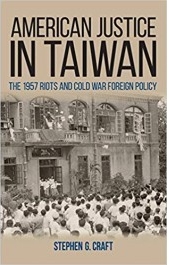
Stephen Craft’s book American Justice in Taiwan is a fascinating snapshot of Cold War politics in Taipei, during the era that the US government vainly attempted to prop up the exiled government of Chiang Kai-shek, in the forlorn hope that it would one day retake the Mainland from Chairman Mao’s Communists. He starts with the shooting that precipitated the embassy attack, a fateful evening two months earlier, when the 41-year-old Master Sergeant Robert Reynolds had rushed out of his house after his wife Clara claimed to have seen a man peeping through the window as she took a shower.
Giving chase in his yard and the street outside, Reynolds apprehended and fatally shot Liu Ziran, an officer in Taiwan’s army and a member of the Institute of Revolutionary Practice. When the authorities arrived, Reynolds confidently admitted to having shot the man whose body was lying in park 200 feet from his house, noting that he had done so in self-defence. That was his next mistake.
In the case of the Reynolds incident, the real issue was a huge disjuncture between Chinese and American legal practice. American law recognised that “a man’s home is his castle” – if Reynolds could prove that the intruder was a threat, he might get away scot-free. Chinese law, however, regarded all violence as a crime that needed to be answered, even if committed in self-defence or without malice. This, observes Craft in an illuminating aside, was why British diplomats were not allowed to drive their own cars in China, as “accidents became incidents.”
So, when Reynolds immediately announced that he had shot the intruder in self-defence, under American law this an argument for his innocence, whereas in China it was an admission of guilt. In similar cross-cultural misunderstandings, the Reynolds inquiry seemed more ready to accept the testimonies of white interviewees, who swore to tell the whole truth, than those of Chinese ones, who were not obliged to swear on a Bible. Following Reynold’s controversial acquittal, it was suggested that he follow Chinese custom in paying compensation to Liu’s family, but his representatives refused, on the grounds that in American eyes it would make him look guilty.
The result was an escalating tension on Taiwan, in which the mob stormed the embassy, and armed military police escorted American children on their school buses, while the authorities warned that “rumour agitation” was a capital offence. And there were rumours galore, enough for a whole mini-series of alternate facts, with claims in the Chinese press that Liu and Reynolds had been secret love-rivals duelling over the same woman. Meanwhile, American intelligence pointed to a number of incredibly suspicious coincidences and happenings, that suggested Ao’s protest sign and the embassy attack itself might have been orchestrated with the help of the secret police, run by Generalissimo Chiang Kai-shek’s own son.
Trying to mollify feelings on both sides, Chiang Kai-shek gave a broadcast in which he called it “one of the most shocking and most regrettable things” that had happened in the last five decades – something of an overstatement, considering that the period included two World Wars. As for the embassy staff, they felt “they have been kicked contemptuously by friends for whom they have risked and spent much.”
Craft’s book is a whodunnit, poking around in Reynold’s testimony, and the forensics of Liu’s death. He delves into gendered arguments in both the court and the press, in which commentators seek to question the evidence on the basis of the attractiveness of Liu’s Chinese wife. Why on Earth, they argued, would he want to look at a naked American woman, particularly the frumpy Clara Reynolds – their words not mine! Why, the very idea was an insult to Chinese womanhood, while the argument in Liu’s defence was an insult to Clara Reynolds.
But Craft also turns the story into an examination of the history of justice for Americans in East Asia, all the way back to the Terranova Incident of 1821, in which a naturalised American sailor killed a boatwoman by throwing a pot at her. He talks through numerous similar moments in the record, where illegal foreign activities have gone lightly punished or even unpunished, as well as similar cases in Japan, which were resolved very differently. For a century, Americans and other foreigners enjoyed the umbrella protection of “extraterritoriality” – the right to be tried by a court of their countrymen, rather than the Chinese. The Americans finally renounced their extraterritorial status in 1943 as part of wartime concessions, only to start re-asserting it in a new form by rushing to claim “diplomatic immunity” every time they needed to. But as Craft notes, in a lovely anecdote, the attitude of the US military was still occasionally tin-eared when it came to local issues.
In February 1957, a visiting American general made the error of asking his Taiwanese hosts why the locals were not celebrating the birthday of George Washington.
“We are not a colony yet,” came the beautifully understated reply.
This is a movie waiting to happen, unravelling from two midnight gunshots in a Taipei suburb, into a consideration of the history of justice itself, the Cold War, and the very real possibility that everyone – Reynolds, Liu, the mob and the embassy staff – were all unwitting pawns in a power-play between Chiang junior and his father the Generalissimo. Craft’s narration expertly zooms in on tiny moments of human interest, like Japanese vagrants scavenging for shell casings on a military shooting range, or junior officers pleading with their jeep drivers to use their horn less into order to make more friends, out to grand pivots in geopolitics. With a winning grasp of historical context, he closes with the October 1957 launch of Sputnik, setting the Soviet Union ahead in the space race, and pushing the US and the Republic of China to entrench even deeper in their reluctant alliance.
Rewarding on many levels, American Justice in Taiwan is a book that offers a sweeping view of thorny issues in international justice, which continue to reverberate today.
Jonathan Clements is the author of A Brief History of China. American Justice in Taiwan: The 1957 Riots and Cold War Foreign Policy is published by the University Press of Kentucky. Pics from Wikimedia Commons.
 The Official Schoolgirl Milky Crisis Blog