
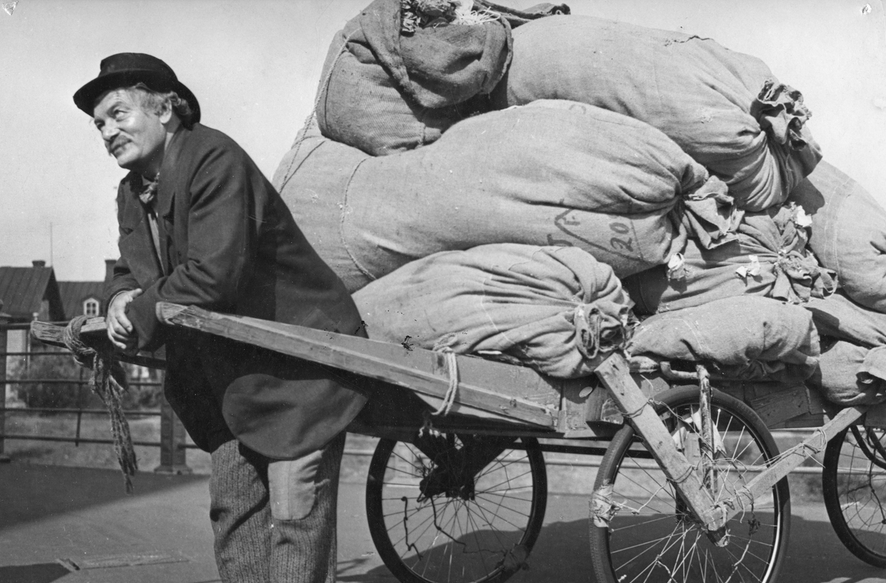
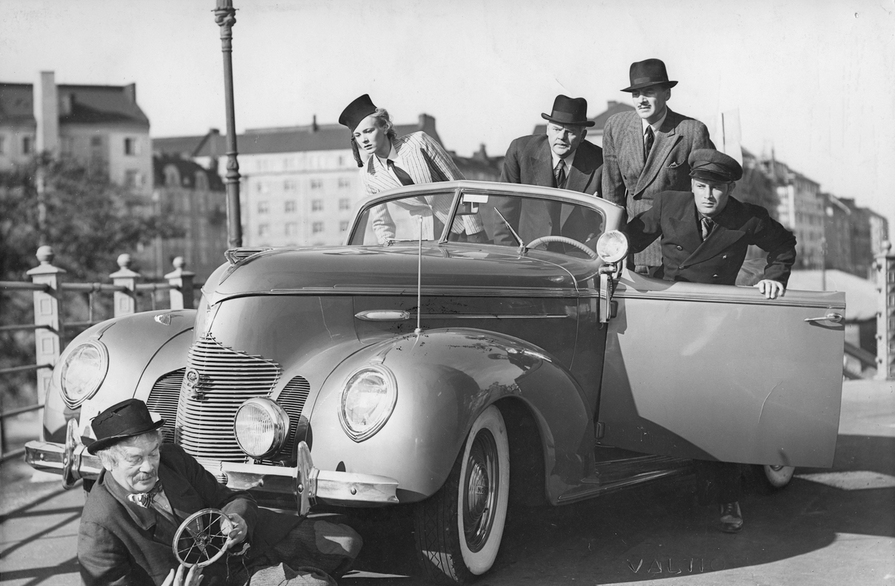
Cheery waste-paper collector Mikko (the ever-reliable Aku Korhonen) falls asleep in a bin and concocts a fantasy lifestyle for himself that incorporates the people who hit him with their car earlier in the day, along with some of the detritus he has found on his rounds – news of a company merger, a nickel-mine find, a lottery win, and the love of a good woman, in the form of Aune (Sirkka Sipilä) the attractive daughter of a wealthy industrialist.
It is, however, all a dream. The viewer has long enough to forget about the framing device that introduced Mikko as little more than a kind-hearted vagrant. We are encouraged to forget about his real-world problems, and instead to fret about the relatively low-intensity drama of whether or not he can win Aune’s heart. It is therefore something of a jolt in the final reel when Mikko wakes up again back in the real world, with Aune a stranger to him, along with any chance of money or power. He accepts this fate with a good-hearted shrug, and goes about his business.
Many Finnish films of the period were obsessed with wealth and social climbing, which made Jos oisi valtaa’s gentle satire somewhat more palatable in the eyes of Finland’s left-wing press. Toini Aaltonen in the Suomen Sosiaalidemokraati called it “a rather modest and childish film” and praised it for disrupting the “postcard truths” of so many other romances and comedies. Paula Talaskivi in the Ilta Sanomat complained that “the dream should have started more clearly as a dream.” And she has a point – it’s not 100% obvious when Mikko’s dream starts. Is it when he is hit by Aune’s car, or when he goes to bed that night, or is it, in fact, that the whole movie is a dream up until the moment he wakes up? We see him regain consciousness in the bin, but we never actually see him go to sleep in it, meaning that an entire chunk of the early film may or may not be the reveries of a woozy rag-and-bone man.
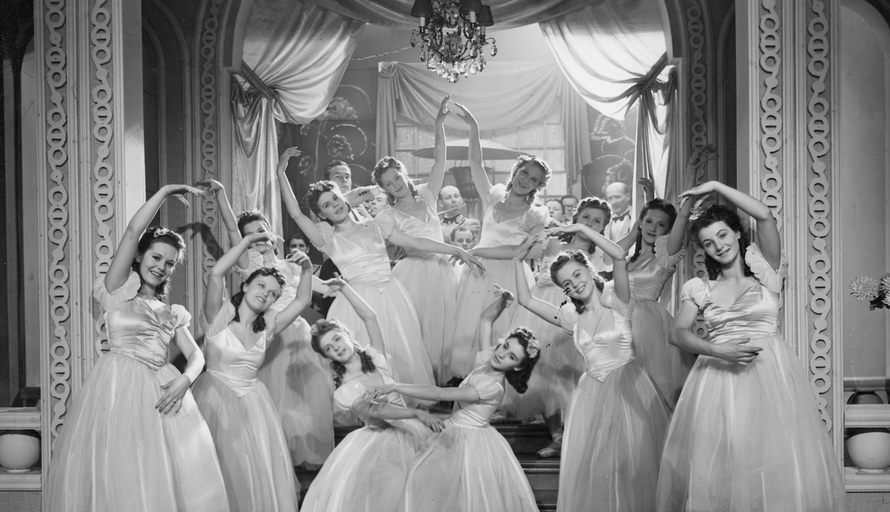
Like many a movie in the period, the film also shoe-horned in as much variety performances as it could, leavening its thin plot with several sequences of puppetry and opera. Olavi Vesterdahl in Aamulehti was unimpressed, noting that even though the film only lasted 93 minutes, it was still dragged down into “slowness and long-windedness” by a surfeit of unnecessary dance numbers and songs, including chunks of Puccini, Strauss and Bizet and a full-on ballet sequence shot at the Helsinki opera house. But one wonders if Vesterdahl had not seen the variety sequences for what they really were – not merely padding for the film, but a scramble to find work and publicity for Finland’s many performers and entertainers, fallen on hard times after a war in which dancing had been literally declared illegal until the soldiers came home.
If I Only Had the Power artfully encapsulates the contradictions of Finland in the days immediately after the end of the Winter War – our hero enjoys a meteoric success, a lavish lifestyle and a romantic denouement, only to wake up in dire straits, his happy ending revealed as a mere illusion. One can readily imagine austerity-era Finns thrilling to its allegory of their predicament, daring to dream of better days amidst the deprivations of the real world… but one would be wrong. The film under-performed at the box office, and it was the last to be directed by Yrjö Norta for Suomen Filmiteollisuus. His contract dropped by the studio bosses, Norta defected to Fenno-Film where his first work would be Maskotti (1943).
Jonathan Clements is the author of A Short History of Finland. He is watching all the Finnish films, so you don’t have to.
 The Official Schoolgirl Milky Crisis Blog