
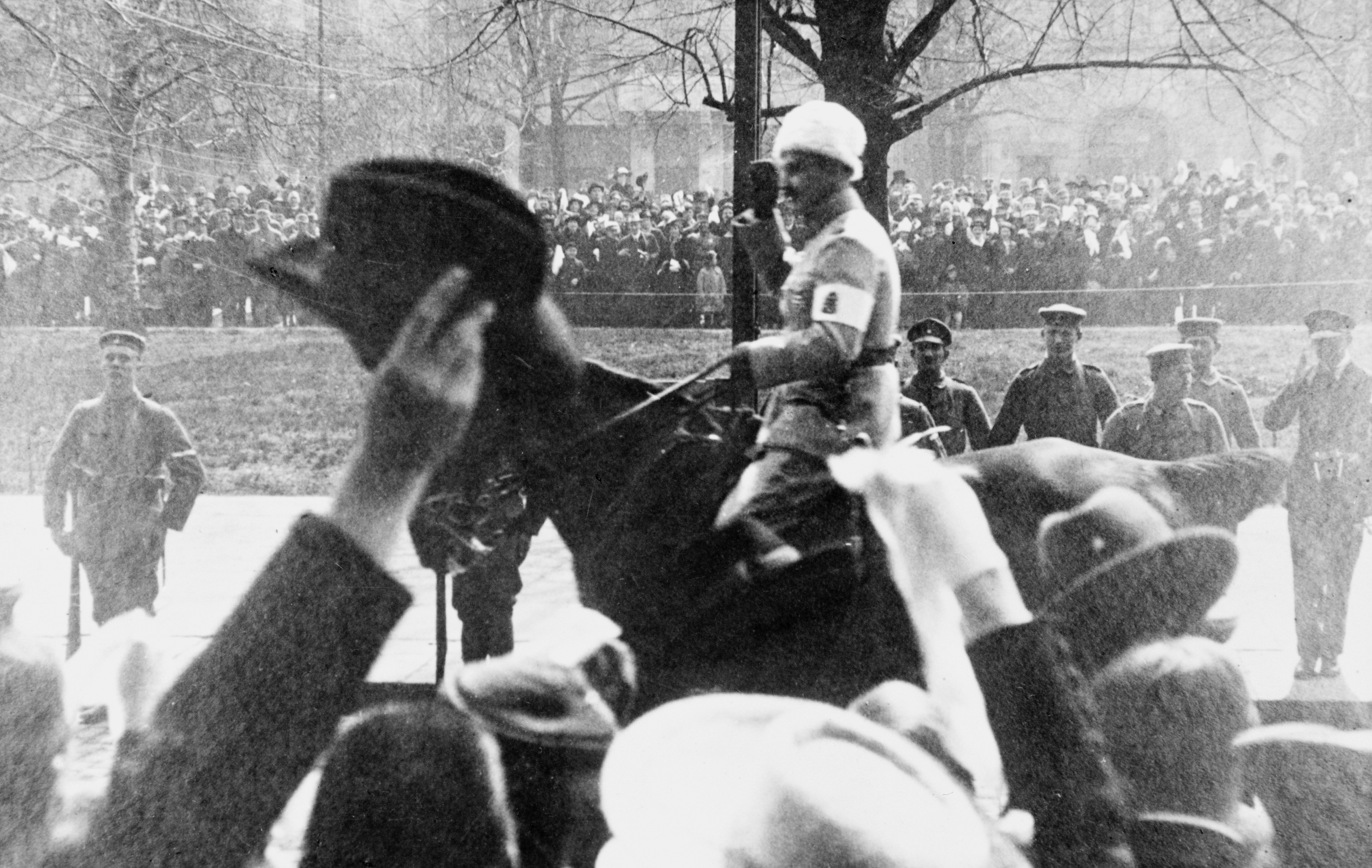
“Mannerheim!… He rode as if in a snowstorm, the air flickering from flowers thrown down from windows, balconies and rooftops. Around him clamored the street with its black banks of tightly packed humanity… Their arms gesticulated, hats and handkerchiefs waved in the wind, from thousands of throats rolled an avalanche of cries.”
In describing the triumphant march of Gustaf Mannerheim into a newly liberated Helsinki in 1918, Henrik Meinander’s Mannerheim, Marshal of Finland: A Life in Geopolitics chooses to quote from Jarl Hemmer’s 1931 novel A Fool of Faith. His choice of perspective reminded me of something I found myself doing in my own Mannerheim book – discarding the approved images of the official record and picking through the offcuts and supposed duds, in search of images that brought with them striking moments of unexpected context. For Mannerheim’s triumph, I deliberately chose an unused image from the archives, “ruined” in officialdom’s eyes by some guy jamming his hat in the air, whereas for me the sight helped convey the excitement with which the victorious general was welcomed into Finland’s capital.
Meinander’s account of Mannerheim’s triumph is one of the highlights of his new book, not for the depiction of the homecoming war hero, but for the nuanced appraisal of the language being used around him. Mannerheim, like many of the politicians in the Finnish parliament, was deeply reluctant to accept unbridled democracy, sure that Communists would try to game the system and drag the newly freed nation back into a Russian orbit.
Much modern writing on Mannerheim is put through a breathlessly teleological focus, as if he is the hero of his own HBO mini-series, propelled inexorably towards military achievement and the leadership of his nation. Meinander zooms in on tiny details that shunted Mannerheim, sometimes randomly, towards his fate, such as his failure to pass the Russian language exam in 1892, which closed off many promotional routes to him within the Tsar’s military, and forced him to concentrate on his existing, equestrian specialty, increasingly outdated in the age of the internal combustion engine. He also picks out some illuminating asides in history that run counter to the official narrative, such as a German report of Mannerheim’s 1918 headquarters that finds the whole thing “rather Russian.” Mannerheim is remembered today as a founder and defender of a free Finland, but Meinander digs up contemporary accounts that frame him instead as the last loyalist to a “White” Russia, failing to turn Finland into the first step of a White counter-offensive against the Reds.
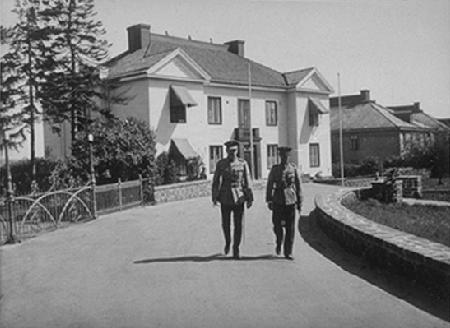
Meinander served for some years as the curator of the Mannerheim Museum, and has plenty to say about the contradictions of a gentleman who is obliged to buy his own furniture. As a member of Finland’s landed gentry, Mannerheim should have been able to fling together his Helsinki residence with a jumble of antiques and heirlooms. Instead, his father’s bankruptcy in his childhood had lost the family much of his possessions, and Mannerheim was obliged to assemble his home from scratch, the manner of the nouveau riche. It is an oddly telling observation from Meinander, and helps explain the very modern way that so much of the house draws upon Mannerheim’s personal acquisitions in his mission across the Far East. It also leads to a lovely glimpse, depending on your point of view, as Mannerheim as an insufferable fusspot or cast-iron planner, travelling Europe with a detailed set of measurements for every room in his house, just in case he ran into a chest of drawers that might look nice on the landing.
Meinander’s Mannerheim is, above all, a creature out of time, a Swedish-speaking aristocrat, trained in the Tsar’s army, catapulted into the highest echelons of a modern, republican state. He rumbles with resentment at what he sees as the Swedes’ failure to come to Finland’s aid, although Meinander is on hand, with a somewhat hurt tone, to point out how quickly history forgets: “no other European country stood up for Finland anywhere near as much as Sweden, a fact that was often disregarded both during and straight after the war….” When Mannerheim issued an order of the day to announce the end of the Winter War, it was only those acculturated to Swedish literature who would have seen the message hidden in his comment that Finland had defended “the West” against the Soviet aggressor, and “we have paid every last penny of the debt we owed.” It was a reference to Originala skuldsedeln (1872), a poem by Zacharias Topelius that chided the Finns for not being grateful to Sweden for its cultural heritage.
Meinander’s Swedish-speaking perspective is the most valuable element of his book, cutting through posterity’s fog to focus on the man who only reluctantly addressed crowds in Finnish after careful rehearsal; who carried crib cards with him in case he needed to reach for unfamiliar vocabulary, and whose interactions with most of his confidantes remained in Swedish, the secret cant of Finland’s wealthy elite. Much of this context has been erased by posterity, particularly in the light of the “Real Finns” (aitosuomalaiset) movement of the 1930s, which tried to purge the Swedish language from public discourse. These days, it’s become something of a running gag that although Finland has two official languages, everything happens in Finnish, and some wag might append to the end of a text “och samma på svenska” (“and the same in Swedish”), as a little afterthought that someone ought to sort that out for the 5% of the country that still claim Swedish as their mother tongue.
Meinander regards Mannerheim as an incredibly lucky figure, afforded the luxury of communicating with the public through ghost-written military orders of the day, while his political bosses are put through the wringer of media attention. In fact, Meinander goes so far as to say that if the Finnish people had been exposed more directly to Marshal Mannerheim on a regular basis, they would have found him snooty, diffident and undemocratic, a very reluctant servant of parliamentary democracy. I have heard much the same from many a modern-day Finn, some of whom are happy to accept Mannerheim as their national demigod, but gingerly opine that if they had ever met him, they probably wouldn’t have got along.
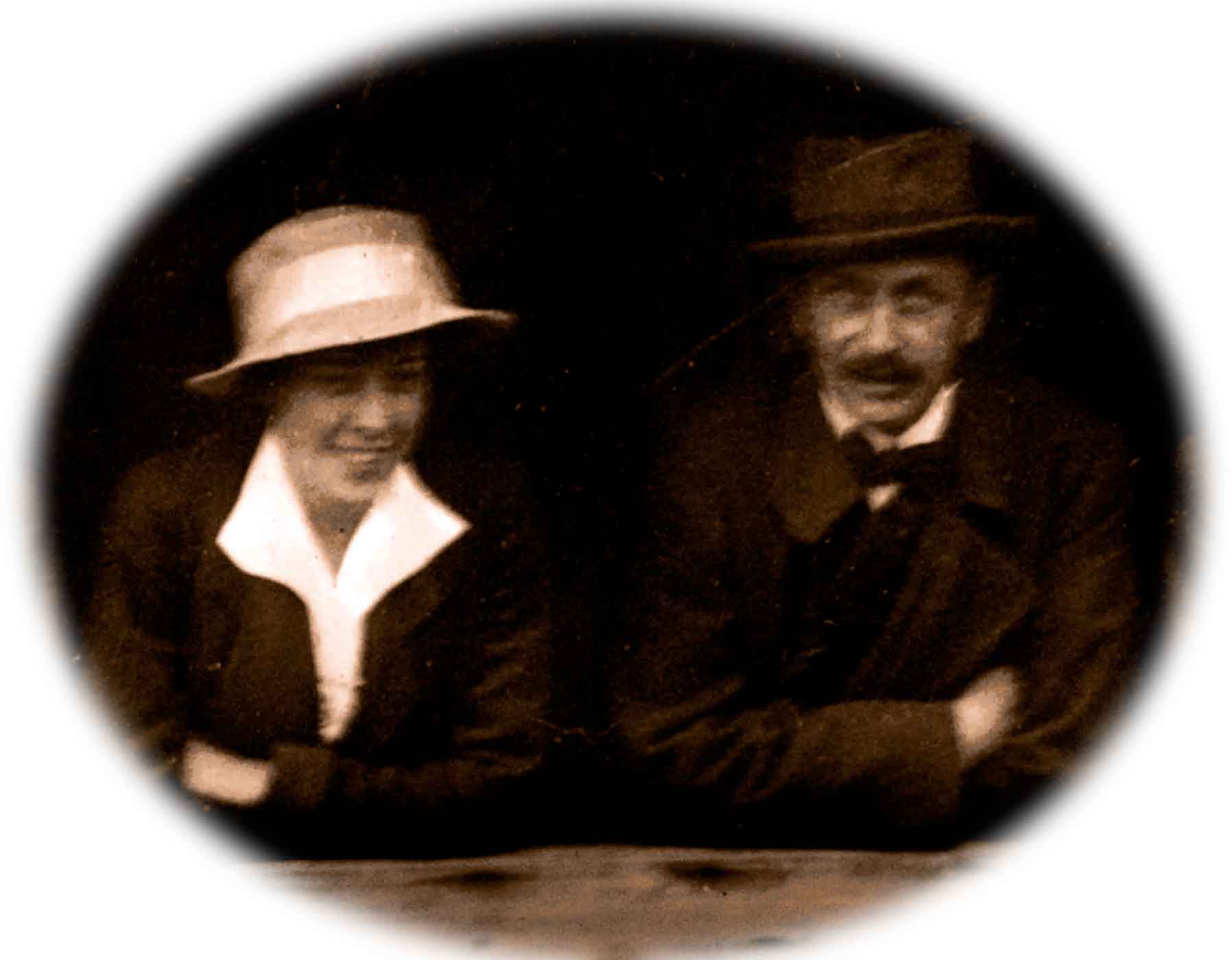
Meinander does not shy away from the upper-class clique of industrialists and magnates with whom Mannerheim hobnobs, and the personal connections that buoyed him up in lean times. Mannerheim’s friendship with his sometime brother-in-law, the millionaire Hjalmar Linder, survived the latter’s divorce from Mannerheim’s sister after he proved infamously uninterested in sex with a lady. Later on, Linder tried to set Mannerheim up with his half-sister, although Meinander takes evident glee in pointing out that while Mannerheim’s published correspondence is fulsome in praise and flirtation with the young Kitty Linder, Kitty herself described her suitor as a frightful “old bore.”
Age is indeed a factor, not only in Mannerheim’s love life, but in his interactions with many of the movers and shakers of the Finnish republic. Meinander observes that at the outbreak of the Winter War in 1939, Mannerheim was 72, literally old enough to be the father of most of the generals serving under him, with an attitude towards strategic planning that was arguably a generation behind the times. Meinander stops short of knocking off Mannerheim’s crown as the Greatest of Finns, but is unafraid to point to conflicts between Mannerheim and his officers, and numerous moments where he dodged becoming one of history’s also-rans by sheer luck.
If Meinander’s book seems to have a personal touch to it, that is all to the better. It is not merely the author’s intimate experience of the Mannerheim Museum and the Swedishness that is often lost to modern readers, but the experience of teaching a younger generation that lacks much of the habitus for understanding the recent past. When discussing Mannerheim and his officers retiring for coffee and cigars, Meinander feels obliged to explain that “the large majority of the male population of Europe smoked regularly,” as if already considering the next elements of the Mannerheim story likely to soon be twisted, confused or forgotten by the next generation of historians.
Jonathan Clements is the author of Mannerheim: President, Soldier Spy. Henrik Meinander’s Mannerheim, Marshal of Finland: A Life in Geopolitics is published in English by Hurst.
 The Official Schoolgirl Milky Crisis Blog