
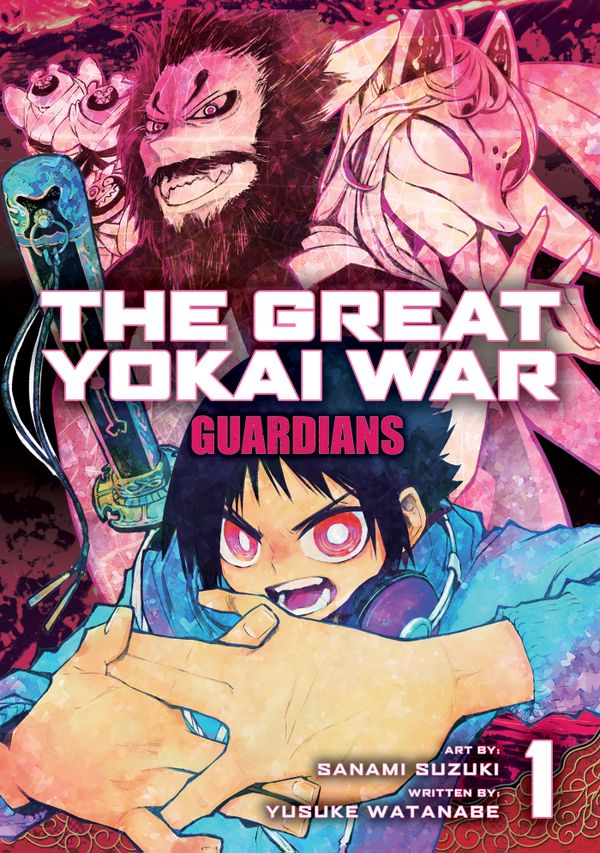
After a giant kaiju threaten to destroy Japan, the guardian spirits of the nation, known as ‘Yokai’ appear before the young boy Kei… They tell him he is the descendant of the legendary monster slayer Watanabe no Tsuna, and may be the only person who can stop the catastrophe. Great Yokai War Guardians is the epic manga adaptation of the hit movie!
Out today from Titan Manga, the first volume of Yusuke Watanabe and Sanami Suzuki’s manga based on the film, The Great Yokai War. The English script was translated by Motoko Tamamuro and I wrote a translator’s afterword in the hope of explaining some of the weirdness, but it was not included in the book, so here it is instead below:
A “night parade of one hundred demons” is a popular theme in Japanese folklore. There is a belief that supernatural beings march through the street at night and anyone who encounters them will perish if they do not have religious protection. Often, these beings are referred to as yokai, a name deriving ultimately from the first and last characters of the Chinese yao-mo-gui-guai (“phantoms-monsters-ghosts-apparitions”) – a catch-all title first used in the middle ages to refer to supernatural creatures.
There are two major schools of thoughts regarding the yokai. One is that they are all gods and those that have lost their respect and status have become regarded as demons. Another is that both yokai and gods have existed from the dawn of time, but that those that gain worshippers are upgraded as gods.
The centrepiece of the first volume of Sanami Suzuki’s manga Great Yokai War: Guardians is not a scene of apocalyptic urban destruction, but a grand conference of all the world’s apparitions, spirits and supernatural beings, playfully and punningly named with a combination of the terms yami (shadow) and summit – a Yammit. At this Shadow Council, we see a who’s-who of monsters, including a Gorgon, Dracula and Cyclops, familiar to Western readers.
But who is Backbeard? Is he some sort of piratic misprint? An eye in the middle of a dark circle, from which a bunch of tentacle-like limbs branch out, he is, in fact, a Japanese creation, first appearing in a 1965 manga by Yukihiko Kitagawa and Yoshio Okazaki. By 1966, he had been co-opted by Shigeru Mizuki’s Spooky Ooky Kitaro in Shonen Magazine, now introduced as the commander-in-chief of all American monsters. Often an adversary – he makes several attempts to invade Japan in the course of Mizuki’s stories – he appears here as a craven foreign dignitary, trying to make a swift buck on the back of Japan’s latest media obsession with the supernatural.
Backbeard in fact, was supposedly killed off in an early issue of the Kitaro manga, but kept returning because Mizuki found his unique appearance so compelling. He is immortalised today in one of the bronze plaques that decorate Mizuki’s home town of Sakaiminato, a permanent addition to Japan’s own mythology of monsters.
Shigeru Mizuki (1922-2015) is a crucial figure in the history of Japanese ghosts and monsters, not only cataloguing folktales from all around Japan, but inventing many of them himself. His works have become so ingrained in the Japanese psyche that one often has to go to his own publications, such as the magisterial Compendium of Japanese Yokai (1994) to work out which ones are his, and which ones belong to the nation.
It’s through the works of Mizuki that Japanese children often first encounter Nurarihyon, the old man who invites himself into your home and takes charge; Yuki-onna, the temptress who waits in the snows to entice passing travellers; the one-eyed, one-legged Ippon-datara that trample-hops onto people on one day of the year; or the zashiki-warashi urchins that haunt storage spaces. Here, we see them all banding together at a peace summit… sorry, yammit, in order to discuss a terrible tectonic event.
The silly humans think it’s just a natural disaster, but it’s really a mass haunting, of all the sea creatures who died during the forming of Japan millions of years ago. In the wake of the Tohoku earthquake of 2011, it is one of many media allusions to Japan’s modern traumas, leavened with a grand monster party, and a pre-teen hero who can save the day.
In an early scene, we see the young boys getting a fortune from a temple kiosk. Omikuji or fortune telling is common in Japanese temples and shrines. Worshippers draw a stick with a number on it and then open a drawer to find the paper with that number on it. In this manga, they draw a stick with the unlikely number 8 million (八百万). Traditionally the Japanese believe a god resides in everything and the expression ‘8 million gods’ means a myriad of various gods that exist in this world. What it signifies in this scene is that the protagonist ‘wins’ all the gods, but as far as he is concerned, all he is getting is the short end of the stick.
Grand Yokai War: Guardians ran in Shonen Ace magazine in December 2020, a few months ahead of the 2021 release of the film of the same name, itself a sequel to a 2005 movie that was based on a novel by Hiroshi Aramata, itself inspired by the multiple monster works of the 1960s. By this point, it is impossible to work out who came up with what, although the Daiei-Kadokawa conglomerate did its best by roping in as many creators as possible as producers. Sanami Suzuki’s manga retains the central motif of a young Japanese boy who discovers that he is the distant descendant of Watanabe no Tsuna (953-1025), the medieval samurai who wielded a sword with the ominous name Onikirimaru (the Demon Slayer).
The manga alludes to a popular legend that modern-day Watanabe family members do not take part in the Setsubun cleansing festival, in which each February Japanese households cast beans into the air to banish demons. Watanabes, it is said, have no fear of demons entering their houses, and need not bother, although tellingly, this story appears only to have arisen in the last few years. Could this, too, be a modern media myth, already sinking into the common ownership of Japanese folklore…?
The Translators
 The Official Schoolgirl Milky Crisis Blog