
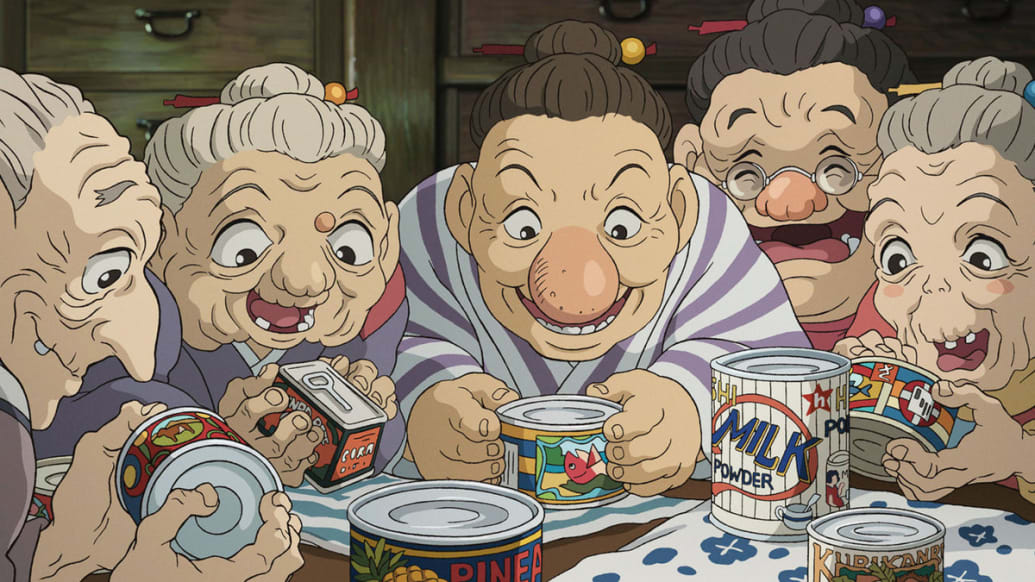
Two months after this column (NEO #232) covered the lack of marketing material for Miyazaki’s The Boy and the Heron, suddenly we are overwhelmed with press images.
I am not a fly on the wall of US meetings, but I can well imagine that GKIDS went to Ghibli and said “Okay lads, you’ve had your fun, but the American press is going to get super-tired with only having one publicity image. You’d better give us something sharpish, or we’re not going to have any publicity at all.”
Ghibli have come back with pictures that are fated to become iconic anime posters, with titles like Girl Buttering Toast, Old Ladies Looking at Tins, Man with Giant Moustache and Bunch of Happy Blob Things.
No harm done. Boy and the Heron is a box office success in Japan, and some coverage is even (gasp!) revealing its plot, which I think should be a new game of trying to explain a Miyazaki film badly. “It’s Back to the Future retold with a castle full of man-eating parakeets.” Or “it’s about a man inside a heron, but not in a dodgy way.” And in turn, this makes it possible to do Art books and illustrated chapters, and film guides and so on.

Magazines like NEO have some pictures they can hang their Boy and the Heron puff-pieces on for now. But Ghibli-level obstructionism is increasingly being felt behind the scenes, on the collectors’ editions that risk becoming a lot less collectable. Some readers may already know that many years ago, Ghibli refused to allow Optimum to put a commentary track on Spirited Away because they don’t care for third-party opinions (in this case, mine) on official releases. That’s fair enough, and is their right, but experiences over the last year or so have suggested that other extras are getting increasingly hard to approve.
I don’t just mean in the anime world. Last month, a licensor refused to allow an article to be added a manga volume explaining some of the intricate folkloric references it contained. This was, apparently, because the contract specified that the work had to appear in English exactly as it had been in Japan, with no extra material, even though it would make no sense to non-Japanese people.
I sense that a lot of these proclamations are coming from licensors who are trying to make their own lives easier, like the person who refused to allow me to write a book-length freebie for a well-known anime because she didn’t want to have to read it all.
She asked if I could write less. Be less extra. Which means you get less extras.
Jonathan Clements is the author of Anime: A History. This article first appeared in NEO #234, 2023.
 The Official Schoolgirl Milky Crisis Blog
Another example of toys being thrown out is ‘Overlord’, as Maruyama stopped approving anime releases of this series because he got sniffy about the English dubs.