
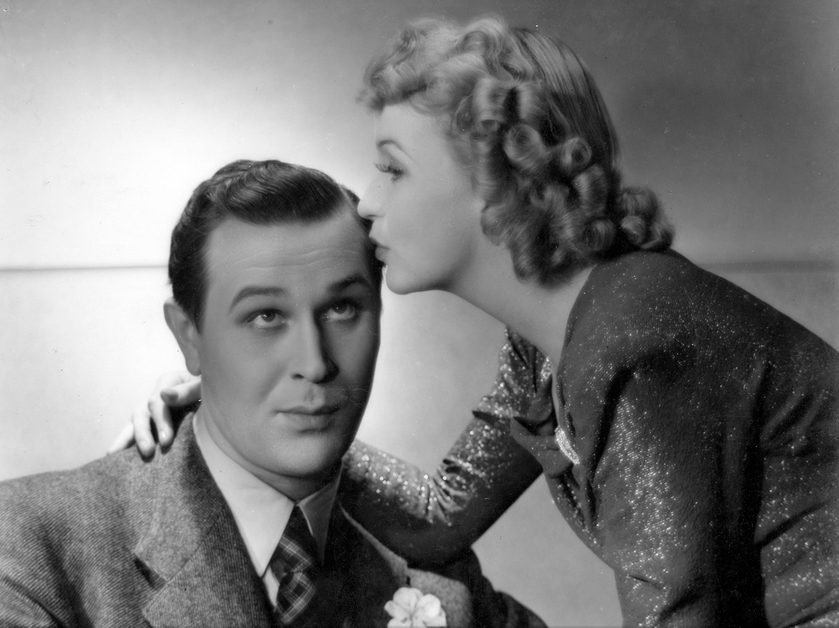
Leila Roine (Lea Joutseno) is shortly to marry her engineer fiancé Lauri Honkatie (Tauno Majuri), and so is conducting the traditional ceremonies of a 1940s Finnish bride-to-be, which apparently includes feeding letters and photographs connected to her former boyfriends into the fireplace. But as she confesses to cousin Mirjami (Kaija Rahola), arriving for the nuptials, she still carries a torch for Esko (Olavi Reimas), an impoverished poet.
Meanwhile, Lauri is fighting off his ex Asta (Hanna Taini), who arrives at his house to plead with him not to marry Leila, but instead to run away with her. The much-missed Esko shows up at Leila’s to present her with a poetry collection dedicated to her, and makes a similar offer to elope.
So, both bride and groom are facing last-minute temptations, but each of them nobly resists. Leila politely declines Esko’s offer, and they part as friends, but is then subject to an elaborate deception by Asta, who persuades her that she and Lauri are not only still an item, but actually betrothed. Mirjami can’t talk her out of it (because Mirjami has been tied to a chair), and Leila gets the wrong end of the stick when she calls a hotel and hears that Lauri is scandalously there…. Although in truth he is innocently lunching with his mother.
With all the parties eventually checked into the same hotel, a series of misunderstandings soon ensue. Lauri befriends Esko, and confides in him about the inconstancies of women, unaware that Esko has been busily trying to get inconstant with his fiancée. With everything liable to fall apart, the Roine family housekeeper Salli (Hilppa Ilvos) helps matters along by enlisting a bunch of kids to let off smoke bombs, propelling everybody into the arms of their correctly mandated future-spouse, including Esko and Mirjami, who have fallen for each other.

Morsian yllättää was the first collaboration between director Valentin Vaala, writer Kersti Bergroth (of Rich Girl fame), and actress Lea Joutseno, who is credited in some quarters as a co-writer – one suspects that modern-day writer’s union rules might prefer to credit her as an executive producer, since saying “What about a farce where everybody gets confused in a hotel?” hardly constitutes an “original” idea. Whatever was done by whoever, this triumvirate of Finnish film movers and shakers would go on to make several more comedies in the 1940s, including With Serious Intent (Tositarkoituksella, 1943) and The Girl and the Gangsters (Dynamiittityttö, 1944).
Shot largely on studio sets to escape the winter of 1941, and hence replicating many of the tropes and set-ups of a dozen other farces that had originally been written for the stage, the film was damned with faint praise in Uusi Suomi, the reviewer for which deemed it “harmless” and mercifully lacking in any actual surprises. Toini Aaltonen in the Suomen Sosialidemokraati instead distinguished something more enduring: a lightness of tone and snappiness of naturalistic dialogue that made it more than the sum of its parts. Paula Talaskivi, the only Finnish 1940s critic whose opinion really counts for posterity, called it a “cheerful frolic” and praised it for what she saw as its “piquant note of parody” – in other words, she saw it not as yet another farce, but a commentary on all the others.
Posterity has brought a mixed memory. Aune Kämäräinen in Uusi Suomi in 1980 commented on its TV broadcast that “we no longer laugh at the same things today as we did in 1941”, nevertheless pleading its case as a shining example of a particular kind of film that needed to be appreciated in its historical context. Other contemporary critics have been similarly forgiving, with Tapani Maskula in the Turun Sanomat noting that Joutseno’s star power gave Hollywood screwball comedies a run for their money, and Pertti Avolakin in the Helsingin Sanomat observing that modern viewers truly needed to appreciate that this was a comedy made in wartime (or its immediate aftermath) specifically to distract and entertain the women of the home front.
One of the little rascals with smoke bombs was played by Kalevi Koski, previously seen in The Man from Sysmä (1938). He would leave child-acting behind to become an orthodontist and professor of dentistry, becoming the first person in Finnish academia to write his thesis in English.
Jonathan Clements is the author of A Short History of Finland. He is watching all the Finnish films, so you don’t have to.
 The Official Schoolgirl Milky Crisis Blog