
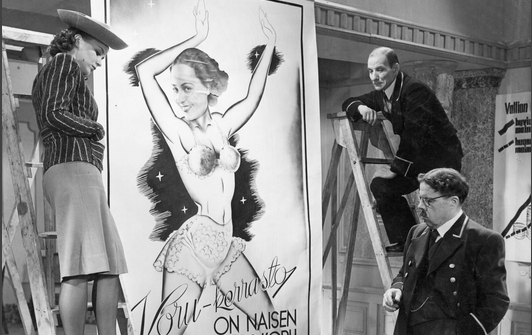
Unexpected controversy arises after the Original Advertising Agency’s new underwear poster is a hit all over town, leading to claims that the pert model featured in it is actually Margit Helleheimo (Birgit Kronström), the daughter of a government minister facing a mid-term election. Hoping to weather the storm, agency head Bruno Blomster (Toppo Elonperä) arrives at Mr Helleheimo’s office to pitch his ideas for a new campaign to push government bonds. This only drags him into political skullduggery, as underling Hilpeläinen (Thure Bahne) schemes to bring down cabinet minister Helleheimo (Sven Relander) by any means necessary, including slut-shaming his daughter.
Summoned to account for his artwork, advertising executive Kalevi (Tauno Palo) lies to spare Margit’s reputation, and claims that he based his pictures on a dancer he met in Helsinki. The doubting minister demands that he present the real model within 48 hours.
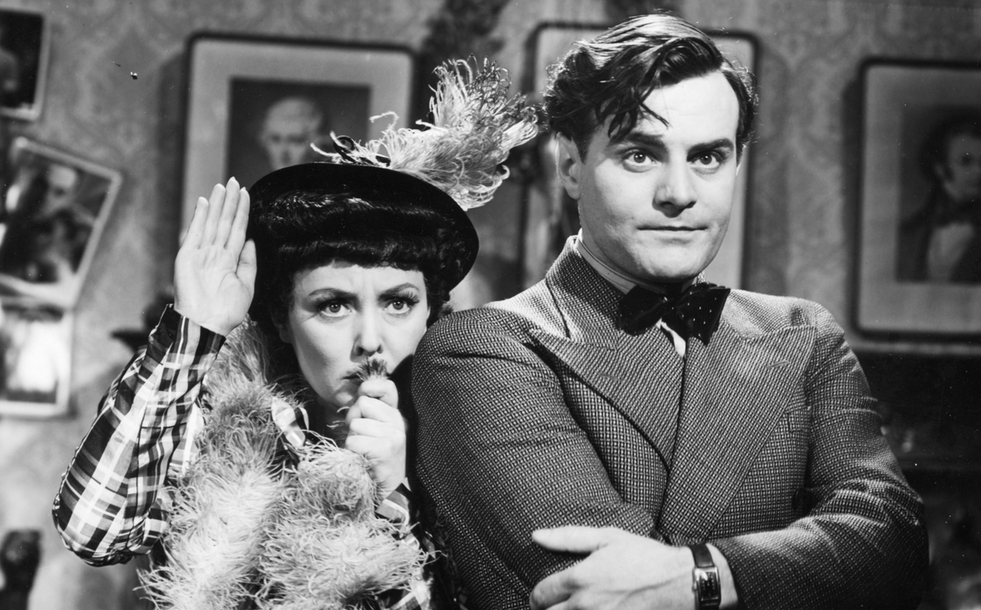
Thrashing about in search of a suitable Finnish woman, Kalevi lurks at the theatre company of the impresario Oikero (Ossi Elstelä), where he is amazed to discover Manta Mutikainen (a.k.a. Baby Peggy), a dancer who is the spitting image of Margit, mainly because she is Margit, who has donned an unlikely disguise to audition for the role of her own double. After a series of quick-change farces that threaten to reveal her true identity, “Peggy” wins over the ministers and drags everybody into a sing-along, whereupon Minister Helleheimo awards the advertising contract, and all is well…
But no! Because Hilpeläinen arranges a dinner date with “Peggy” where he tries to enlist her help with bringing down the government. Later, Kalevi escorts her home and makes his feelings plain by snogging her face off and giving her a dog (not a euphemism). You would think that this might be a happy ending, but now Margit is incensed that Kalevi is is cheating on her with another woman, even though she is the other woman. Eventually, all such concerns are settled, and Kalevi and Margit seek her father’s blessing to get married. When Helleheimo seems about to refuse, Kalevi blackmails him, threatening to disclose his daughter’s modelling past after all unless he relents.
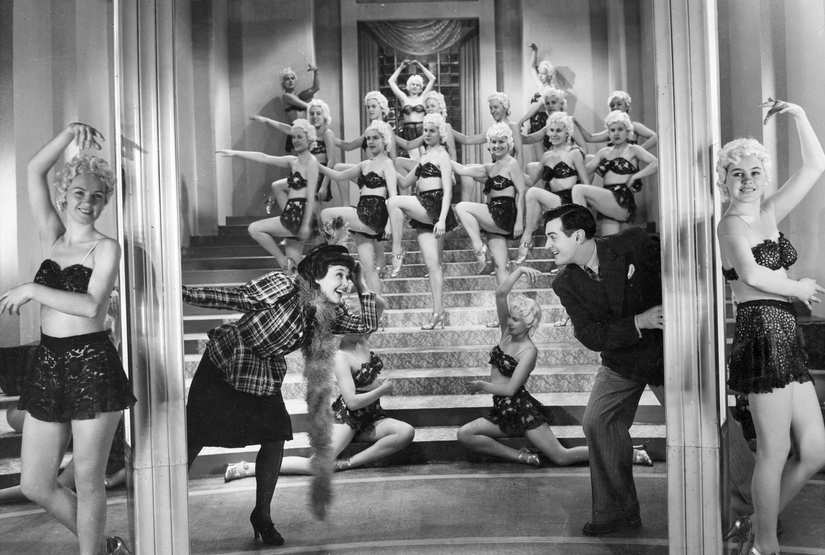
“All is fair in love,” says Margit. “You’re a lucky minister.” And the couple kiss as the thespians kick off in a song-and-dance celebration, presided over by Oikero, who is inexplicably dressed as Napoleon.
Turo Kartto’s script for Suomen Filmiteollisuus’ Onnellinen ministeri was lifted from the 1937 German musical Das Ministerium ist beleidigt, and had previously been performed onstage in Turku in 1938. Suomi-Filmi’s last movie of 1941 turned out to be a remarkably clockwork intersection of daffy plots, jettisoning all the songs from the stage version and replacing them with a bunch of new ones, including “Katupoikien laulu” (Song of the Street Boys), which has become a much-covered classic, albeit with the original reference to the streets of Soho [London] snipped out to make it sound more Finnish.
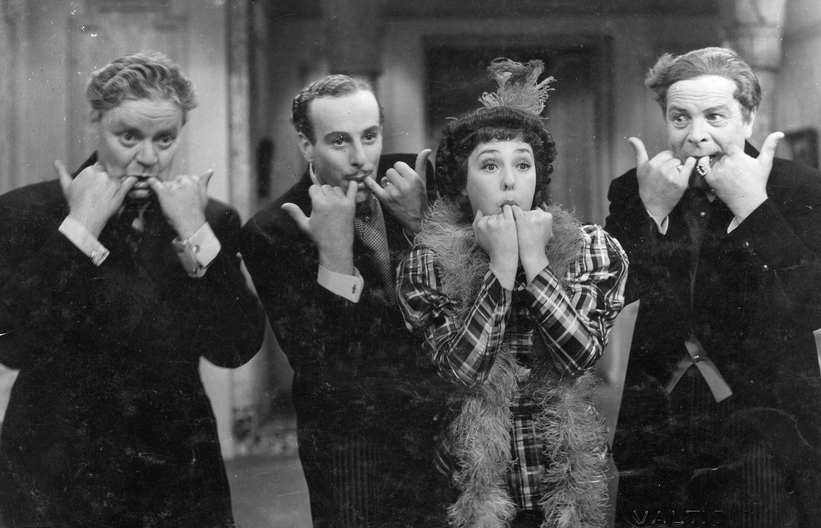
In fact, the film is crammed to bursting point with songs, starting off in the opening scene at the Original ad company, where the wartime starlets, the Harmony Sisters, cameo as singing telephonists, in a four-part harmony about how the boss can’t come to the phone right now. We’ve seen many musicals before over the last couple of years of this watchathon, but this one is the first to my mind that does anything more than ramming songs into the narrative. In The Lucky Cabinet Minister, dance and song are used to tell the story in all sorts of innovative and impressionistic ways – old news in the theatre, but rarely utilised in Finnish cinema until this point.
Take the opening number, “Mainostoimistolaulu” (Song of the Ad Agency). It doesn’t merely set up the bustle of the agency, but incorporates the arrival of Kalevi’s poster, and its distribution all around town. Proud of his company’s handiwork, Blomster walks briskly past admirers of the poster on the street, and buys a newspaper, and the camera focusses on his feet as he walks while reading, his jaunty pace coming to a shocked stop as he reads of the possible collapse of the government he hopes to take on as a client, flanked by a picture of the minister’s daughter in frilly knickers. Back at the office, the secretaries and their busboy (Lasse Pöysti, of The Suominen Family) are dancing around the poster in a Busby Berkley-esque group, alternately worshipping it and imitating it, as if to encapsulate the media fever around it… until the song is brought to a crashing stop by the arrival of Blomster.
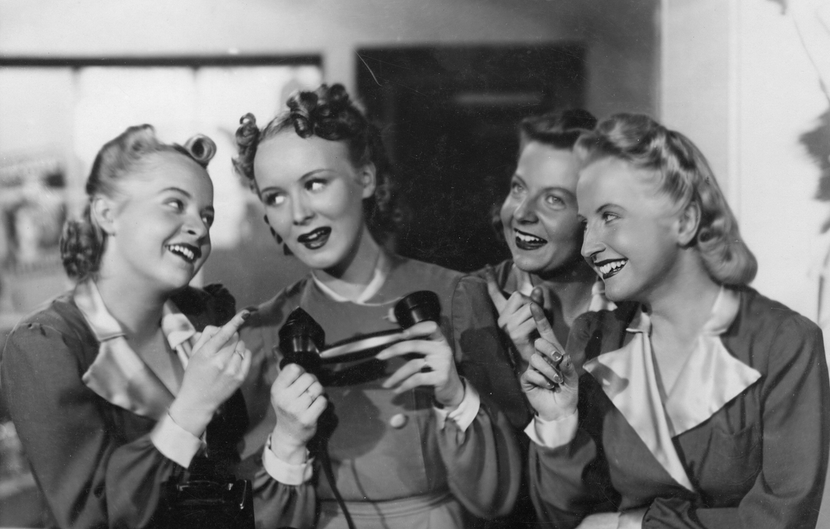
Director Toivo Särkkä smartly leaves much of the singing in the hands of bona fide singers, as seen in a reprise in which Tauno Palo talks his way through his lyrics in a duet with Sirkka Sipilä and the Harmony Sisters. But that’s okay, because we know the Big Guns are waiting in the wings – Palo does eventually acquit himself in singing terms, but Birgit Konström, still coasting on her success after For the Money, has the dual singing and acting chops to carry the film all by herself. One expects that’s why she gets top billing, with a role that seems to have been written for a teenage ingenue, but which only the 36-year-old Konström could reasonably be expected to deliver.
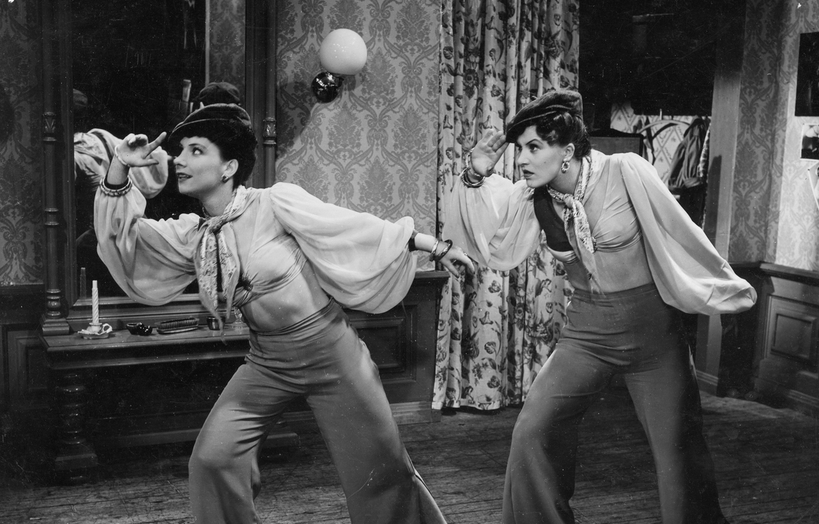
We might detect some vestige of the original theatrical production in the way in which the actors are given times to rest. The Harmony Sisters fade from view after the first hour, to make way for Konström and the Swing Sisters, who obligingly perform a shuffle-dancing striptease while the lead sings “Katupoikien laulu”. Much of the film’s location shooting comprises entertaining but unnecessary sights of the billboard all over contemporary Helsinki, cheekily shoved into a number of iconic spots, including all around the central statue of the Forging of the Sampo.
You would think that several stage incarnations would let the plot and execution be nicely matured by the time it made it to the screen, but this appeared to set many critics against this 124-minute film. Paula Talaskivi, in the Ilta Sanomat, bragged that she’d seen it twice on stage, and was left bored by this cinema version. Toini Aaltonen in the Suomen Sosialidemokratti commented that the original’s Parisian setting had been excised for Helsinki for no good reason, a comment which seems to deliberately misunderstand how films work. Olavi Vesterdahl in Aamulehti offered a far more incisive contextualisation of the film in terms of its era, noting that “idle celebrations and infidelities” seemed to be the touchstones of contemporary Finnish cinema, and that the film did itself no favours by relying so heavily on pratfalls and plot holes. “As such, the film is the lightest kind of entertainment, hardly even that, perhaps more correctly a waste of time from the viewer’s point of view.”
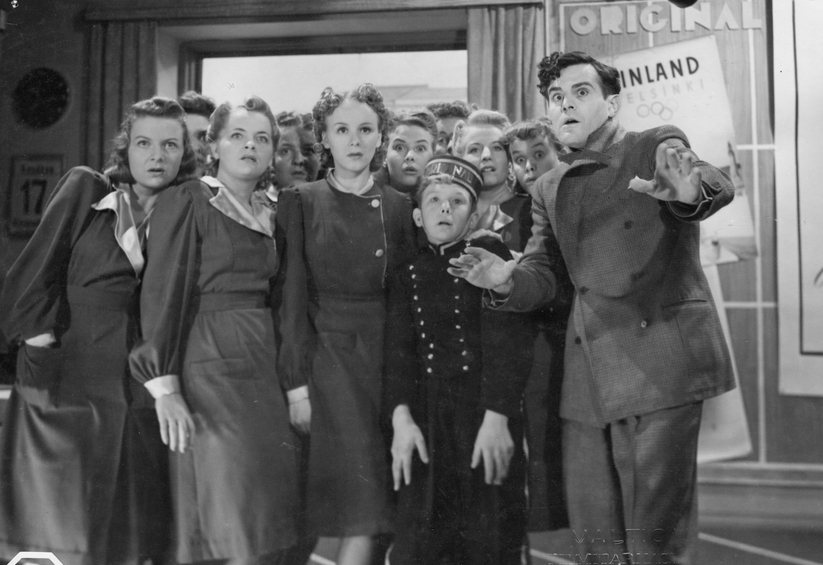
Posterity has been far kinder, with reviewers of the film’s later appearance on TV, untroubled be memories of the theatrical original, universally praising its vim and verve. I certainly found it much more enjoyable than I had been led to expect by the faint-hearted reviews of the 1940s, although in the woke 2020s, it is difficult not to take umbrage at the subtextual hand-wringing about a woman’s freedom to display her body. To be fair, the script depicts Margit as entirely uncaring about it, while the people of Helsinki, upon recognising her while out riding in public, literally break into applause. It is only the menfolk immediately around her who get in a tizz, before revealing how shallow their own perceptions are by failing to realise that Peggy and Margit are the same person. Meanwhile, there are some subtle suggestions of hypocrisy at work, particularly in a scene at her father’s home where Margit has a long conversation with a maid, in front of a massive rococo painting of a bunch of ladies with their baps out.
There is indeed, a certain class of Finnish women who all look the same, and it’s the thin, wriggly bright-eyed blondes usually favoured by foreign husbands (although not me). So much so, that at one Christmas party in 2003 for my beginner’s Finnish class when everybody brought along their Finnish wives, the pixie parade on display was so homogenous that I was genuinely worried someone might go home with the wrong Finn.
I asked our Finnish teacher if there was an equivalent language course where a majority of female students all had identical husbands.
“Yes,” she said with a sigh. “Swedish.”
Jonathan Clements is the author of A Short History of Finland. He is watching all the Finnish films, so you don’t have to.
 The Official Schoolgirl Milky Crisis Blog