
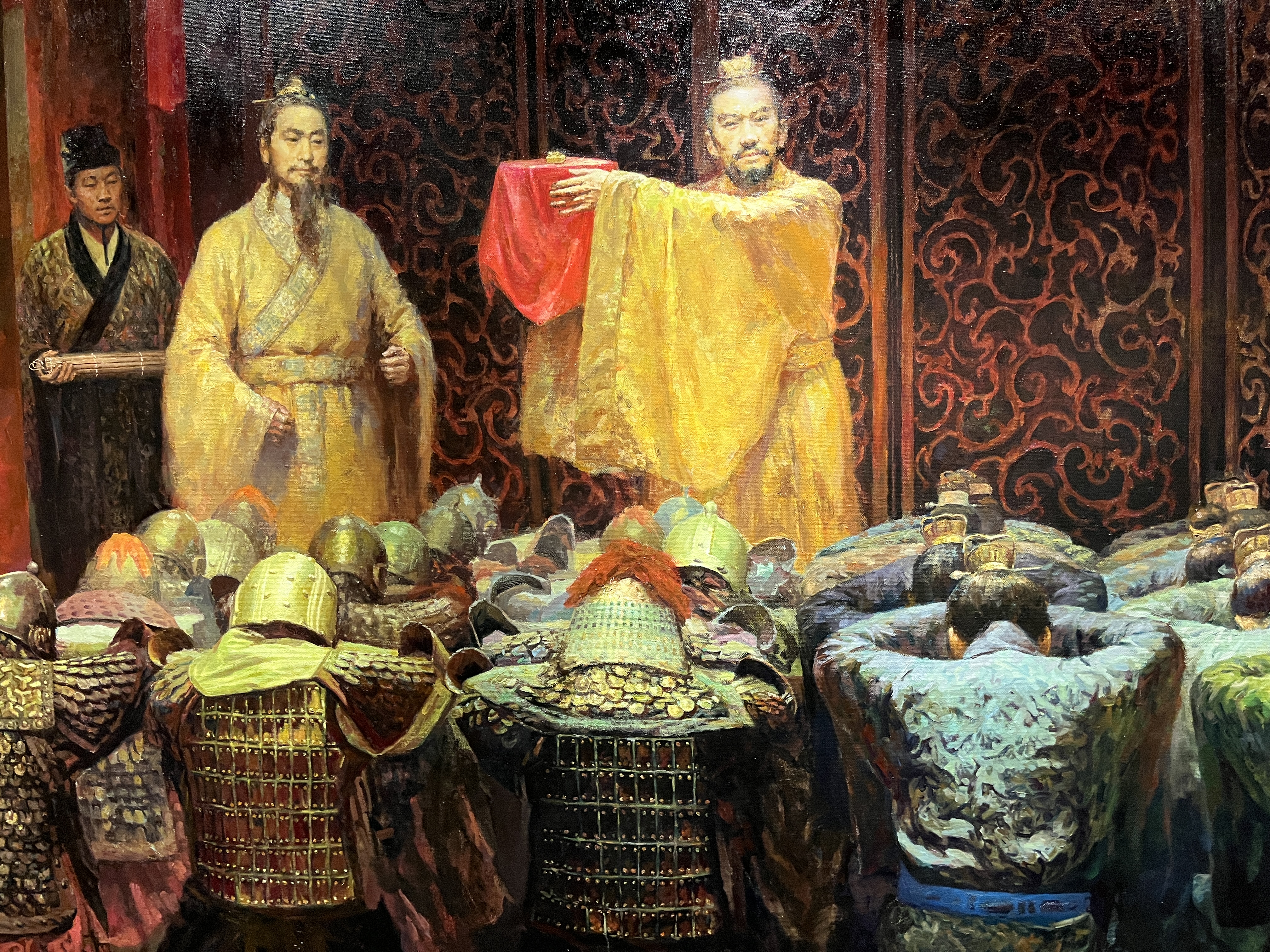
Zhao Tuo was a general in the service of the First Emperor of China, whose march south left him as the satrap of much of what is now Guangdong. By the time the Qin empire fell, Zhao Tuo had practically gone native, proclaiming himself the ruler of a newly envisioned “Nan (Southern) Yue” – a federation of several of the peoples he had conquered, sprawling across Guangdong, Guangxi and into what is now north Vietnam. For this, he is remembered in Guangdong as the first proponent of Guangdong as an independent state beyond China, and in Vietnam as the first ruler of “Vietnam” – Nanyue, in fact, is pronounced Namviet this far south, and when rulers centuries later wanted to come up with a name for a kingdom a little bit further to the south of here, they reversed the characters to make Vietnam.
Zhao Tuo lived to be 103, and he was succeeded by his grandson, who ruled for ten more years, and was himself buried in a marvellous jade suit. By then, there had been some wily diplomacy from what was now the Han empire to the north, including a diplomatic marriage to a Chinese princess, which meant that the court and royal family were all at loggerheads about whether to go even more native, or to give up and allow themselves to be rebranded as the lords of China’s southernmost province. Eventually, it all ended in tears, with a palace coup and a war with the Han, and it all came apart soon after.
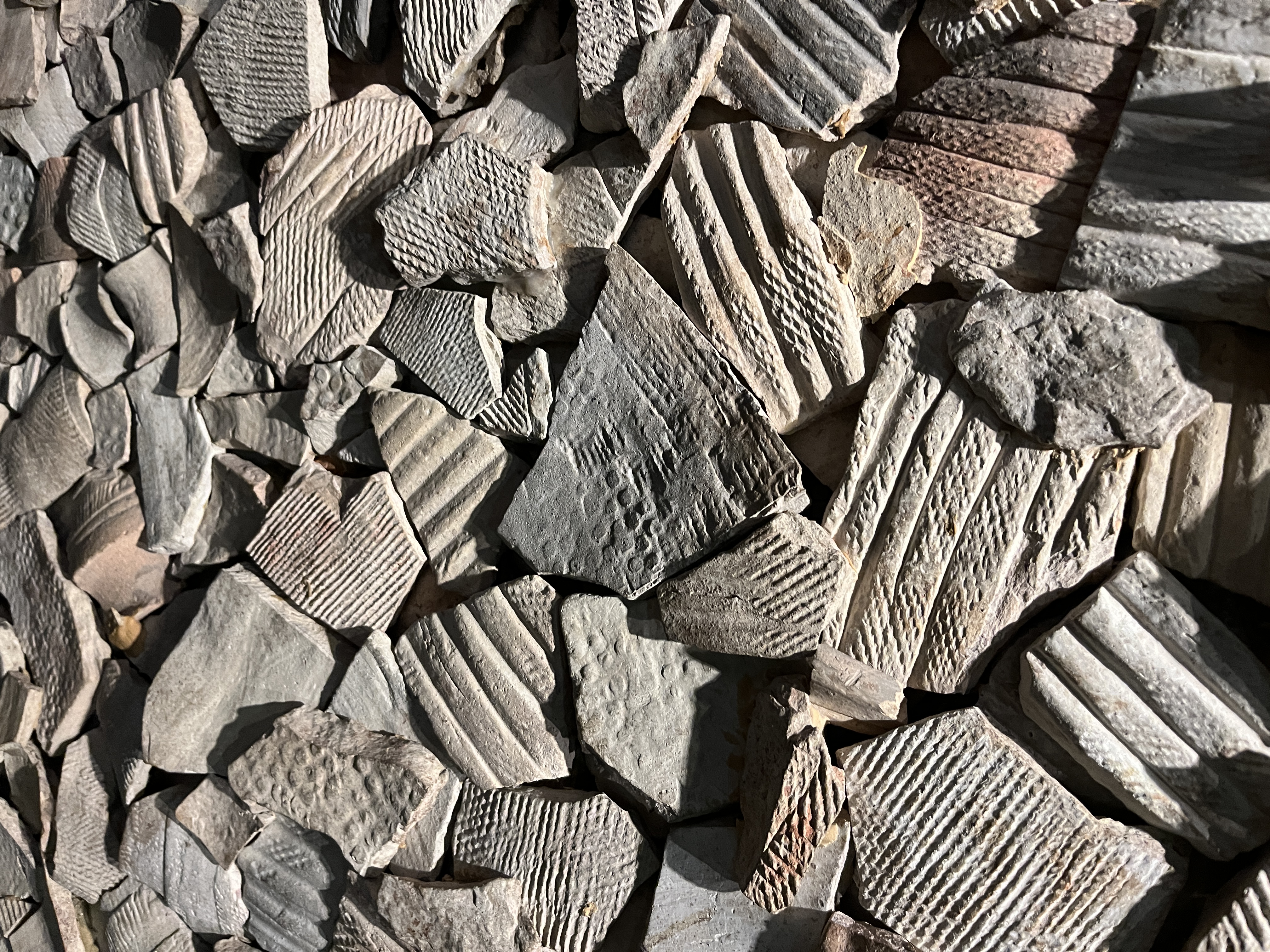
Zhao Tuo and his courtiers lived in an opulent palace, of which very little remains today except smashed pots and a few bits of wood. The museum signage tries very hard to make it sound fun, but glum Cantonese people mope around the site looking at holes in the ground. The most amazing thing for me is the king’s garden, because although none of the shrubbery remains, there is a very clear outline of his sculpted watercourse, a veritable babbling brook that snaked through the garden, and around a bend deliberately designed to create a little whirlpool. It turns out to be the first documented landscaped garden in Chinese history – I can feel the first chapter of a history of the Cantonese people taking shape.
For roughly a century, Guangzhou (Canton) was the centre of a little kingdom with its own unique style, mainly in doubled animal icons where one creature was blatantly visible, and its counterpart was twisted and hidden within the curlicues. Nanyue was known for its swords, and what appears to be evidence of sea trade with ancient Persia.
As with similar sites, like Chengdu, the presence of a quasi-independent state, however brief, and the finding of an iconic symbol to represent it – in this case, an entwined dragon and phoenix – is a hot political potato in China. Nobody wants to talk openly about the possibility of a federal China (an idea once supported by a young Chairman Mao), or of the linguistic reality that it is composed of eight separate “nations”. Ten years ago, such historical curiosities were celebrated as part of China’s glorious ethnic diversity. In the hardline 2020s, as mosques are homogenised and domestic differences denied, such discussions veer towards the Party’s forbidden realm of “historical nihilism.”
And so the museum at the Tomb of the Nanyue king tiptoes around the fact that this 1st century BC ruler, son of the long-lived first king, was the ruler of an independent southern Chinese state. Nor does the museum literature dwell on the actual history of Nanyue, instead wandering off on a time-wasting tangent about a collection of ceramic pillows that helps bulk out the museum collection.
Jonathan Clements is the author of A Brief History of China.
 The Official Schoolgirl Milky Crisis Blog