
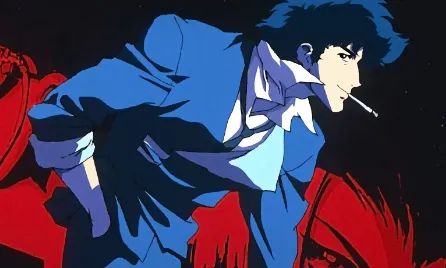
On the original, terrestrial broadcast of Cowboy Bebop, the disgruntled production team signed off with the message: “This is not the end. You will see the real Cowboy Bebop someday.” Shinichiro Watanabe’s vision had been trammelled by a series of restrictions, including timid broadcasters still reeling from the 1997 Pokémon epilepsy incident, and a jumpy censorship regime hyper-sensitive after several widely publicised real-world incidents of supposedly media-inspired violence.
As this book recounts, Cowboy Bebop existed in two versions – the defanged, episodic 12-part light version as first seen on TV Tokyo, and the uncut, adult-focussed 26 episodes with a complete story arc and more mature content that was broadcast four months later on WOWOW. It’s this latter version that was exported abroad, most notably to the United States.
The Cartoon Network had been waiting for months. The Cartoon Network, in fact, had bought it purely on the strength of the opening credits, and in the words of producer Jason DeMarco, “didn’t even know what it was about.” As episodes began to drift in, channel buyers knew it was too racy for the daytime slots, and the arrival of Cowboy Bebop helped propel CN into creating a new late-night block of animation: Adult Swim. Cowboy Bebop closed out the first night’s broadcast, and stayed on the channel for over a decade.
If you were watching the Cartoon Network in the 2000s or the 2010s, at some point you were going to see Cowboy Bebop. You might only catch a single episode, but you’d be sure to remember it. With little merchandise to cash in, its US following was not immediately obvious. The ratings remained a trickle in the graveyard slot, but whereas the average terrestrial anime comes and goes in thirteen weeks, Cowboy Bebop lived on Adult Swim for thirteen years.
Watanabe’s vision was sufficiently retro to be future-proof. The animation didn’t suffer from shonky turn-of-the-century CG or Digipaint. The sci-fi diaspora was suitably diverse to weather changing attitudes. As each fresh crop of viewers identified as anime fans, Cowboy Bebop was one of their gateway anime, not just for them, but for the parents who asked what this anime thing was, and could be shown something that wasn’t cringeworthy.
Even within the industry in Japan it was widely understood that Cowboy Bebop was lightning in a bottle — a fantastic synergy of creative talent that you couldn’t explain with a spreadsheet and copy with a focus group. Cowboy Bebop wasn’t something that you could cynically recreate, and that’s part of its classic status, suffused with, as Yoko Kanno so memorably put it: “the smell of fermentation, like natto.”
This book delves into the whys and hows of such a phenomenon came about, and the nooks and crannies of its various spin-offs. It’s a fantastic account of a show that is now demonstrably older than its current crop of new fans on Netflix. It’s been a long wait, but Cowboy Bebop finally has a critical appraisal that delves deep into its inspirations and effects.
But enough from me. I think it’s time we blow this scene. Get everybody and the stuff together. Okay…
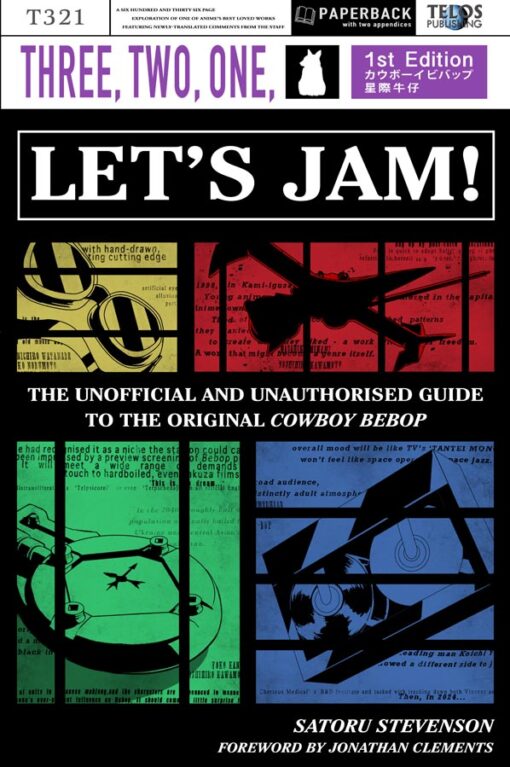
Jonathan Clements is the author of Anime: A History. This text forms the introduction to Satoru Stevenson’s new book 3, 2, 1, Let’s Jam: The Unofficial and Unauthorised Guide to the Original Cowboy Bebop.
 The Official Schoolgirl Milky Crisis Blog
I like to visit Jazz bars when I am in Japan. Sometimes they ask for requests and I always suggest Tank! Sadly none of them have ever known what I am talking about. Maybe it has a different name in Japanese. Or maybe one trumpet, a piano, bass and drums aren’t the ideal set up for it!