

The body has long been an obsession with Shinya Tsukamoto. He has taken it over with metal viruses, in the two Tetsuo movies. He transformed it through violence in Tokyo Fist and Bullet Ballet. With his last film, A Snake of June, he announced that he was renouncing violence, but while Vital may be gentler in its execution, it is still very much a part of Tsukamoto’s corporeal corpus.
Where Tetsuo seemed to allude to J.G. Ballard’s Crash (1973), with its bodies distorted through meshing with metal, Vital seems to owe more to the same author’s Kindness of Women (1991), in which Ballard recounted the stirrings of his emotions as a medical student for the woman whose cadaver he was dissecting.
Vital also references the elusive Blue Bird of Happiness, both in the theme of its title song and in the tattoo of its ghostly female lead. Maurice Maeterlinck’s 1908 play is perhaps better known in Japan than in the UK, both through translations of the original, and its use in the late Hisashi Nozawa’s Blue Bird (1997), a TV drama series about a criminal on the run who finds refuge in the tropical island paradise of Saipan.

Tsukamoto’s actual inspirations for his film are more prosaic: a terrible back twinge that left him bedridden for days, and a chance viewing of Leonardo da Vinci’s anatomical sketchbooks. Tsukamoto first saw the books at the house of Alejandro Jodorowsky in 1992, where he had been perusing the director’s sketches for his abortive Dune project.
“I looked at many of da Vinci’s drawings,” he told biographer Tom Mes, “and I could really sense his curiosity for the interior of the human body.” Tsukamoto’s research took led him to witness actual hospital dissections, not with the ghoulish voyeurism one might expect from the director of Tetsuo, but with a curiously reverent respect.
For his film, he utilised both old and new talents. Leading man Tadanobu Asano is a familiar face in Japanese film, and previously appeared in Tsukamoto’s Gemini as a vengeful samurai. But Tsukamoto and Asano had also worked together as actors in the Quiet Days of Firemen, an obscure Japanese workplace-oriented movie from 1994. Asano welcomed the chance to work with Tsukamoto again, and was surprised to discover a personal association with the movie’s location. Sensing something familiar about the abandoned Yokohama hospital where Tsukamoto shot the bulk of his real-world footage, Asano called his own mother, to discover that the very same Aiji Centre had been the place of his own birth.
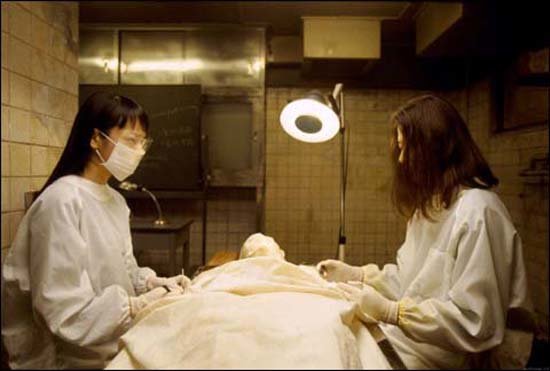
Asano’s female co-stars are less well-known as actresses. Tsukamoto cast the model Kiki for her vulpine eyes, and ballerina Nami Tsukamoto (no relation) for her homespun spontaneity and her ability to dance in the role of Ryoko. As an unknown in the film world, she was also less likely to voice complaints about her role, which would require a full-size cast to be made of her naked body.
Ryoko’s scenes are largely shot in a dream-world, for which Tsukamoto elected to use Japan’s southern island of Okinawa. Other islands are equally idyllic, but only Okinawa offers direct flights to Tokyo for a film unit working against the clock. The island was also the prime location for Takeshi Kitano’s Sonatine, and its use in Vital would lead Tsukamoto to take drastic steps in production. Regarding natural beauty as a crucial element of the film, Tsukamoto elected to shoot on 35mm, a lavish choice for the notoriously low-budget film-maker, and one which required an airtight seven-week shooting schedule to preserve the budget. To shorten the period of post-production, Tsukamoto used digital editing methods for the first time.
In Iron Man: The Cinema of Shinya Tsukamoto, the director discusses Vital as a continuation of his earlier work: “When I finished [it], I somehow felt refreshed, like I’d found a new environment for myself. In Tetsuo II, Tokyo Fist and Bullet Ballet, the protagonists hurt their own bodies trying to find out whether they are living in a dream. In Vital, the protagonist is confronted with a dead body and enters it. In the end, he crossed through the gate, from the agonised, suffocating life of the city; he emerges in the vast realms of nature. One day I would like to make a movie that would take me even further and deeper into nature, far away from that gate. For now, though, I would like to keep exploring just outside that gate, the way I did with Vital.”
This article was originally included in the sleeve notes of the 2006 release of Vital by Tartan Video.
 The Official Schoolgirl Milky Crisis Blog