

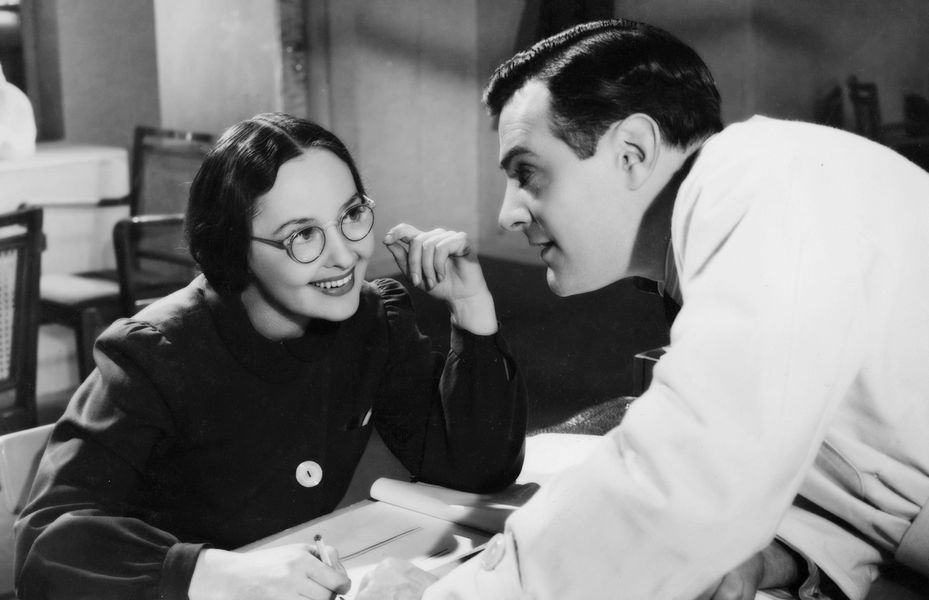
Paavo Kannas (Tauno Palo) is an architect who is struggling to get work done at his interior design office, because of the “trouble” caused by all his beautiful female assistants. His friend Professor Thorelius (Urho Somersalmi) offers to provide him with a plain and efficient girl, but since this is Finland, has to work hard to make his student Hilkka (Brigit Konström) not look like a supermodel. Hair in a bun and a pair of spectacles produce the desired look [actually, they really don’t; she ends up looking exactly like Julia Sawalha, which works for me!], and Paavo settles in for a happy life with his new efficient underling.
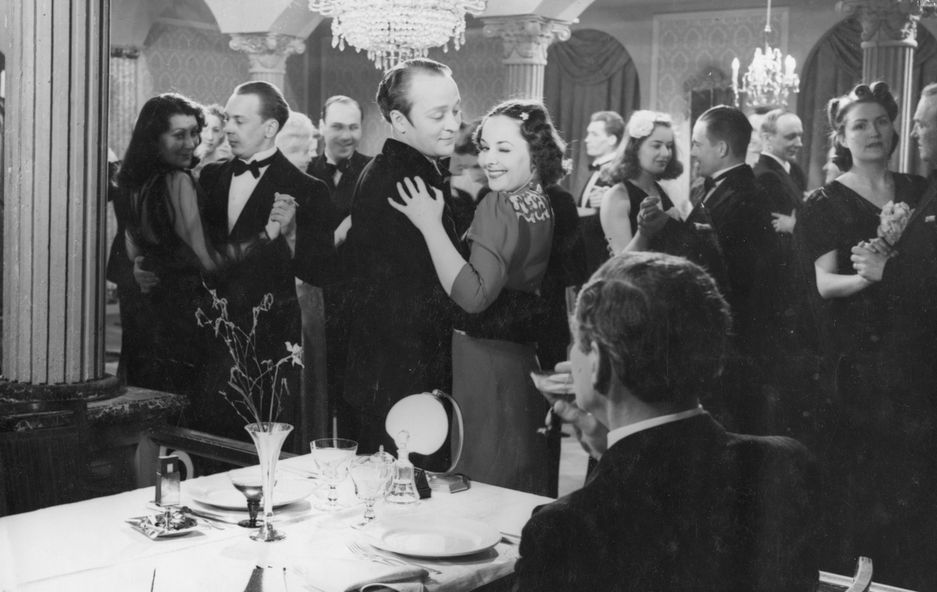
Inevitably, Paavo runs into Hilkka while out on the town and she is not wearing her disguise. Not wishing to lose her job, she pretends to be Miss Pallero, a Karelian girl. Smitten with “Miss Pallero”, Paavo begins to suspect that Hilkka might be putting one over on him, and schemes to put her in a position where she has to take off her spectacles and let down her hair. Eventually, they come clean with one another about their feelings, and get married.
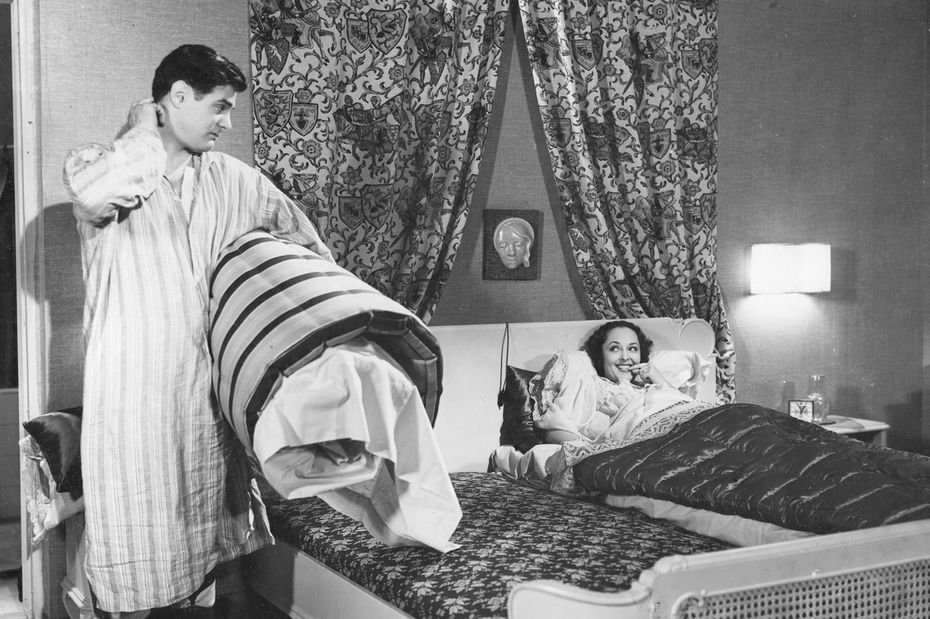
Wait! That’s not the end! We’re still only partway through, because now Hilkka is Mrs Kannas, getting increasingly annoyed at all the pretty young women who continue to flap around her husband. Hilkka drops in unannounced at one of Paavo’s workplaces, and believes that she sees him snogging the lady of the manor, Brita (Sirkka Sipilä). Meanwhile, it turns out that Professor Thorelius has plans on nabbing Hilkka for himself and is inviting her to meet his parents as if they are already courting.
Despite a looming divorce, Paavo and Hilkka must collaborate on a fast-track remodelling job, as the returning Finnish-American Makkonens (Aino Lohikoski and Jalmari Rinne, bellowing and code-switching like a pair of nutters) turn up making brash demands to have their Helsinki residence ready in a single day. The Makkonens reveal that they have only selected the Kannas company because it is run by a happily married couple, forcing Paavo and Hilkka to impersonate their younger, happier selves. Predictably, their feelings for each other are truly rekindled.
While I might jest about how difficult it is to find an unattractive Finnish woman, Marriage, Inc. actually began life as a Swedish play, adapted for the screen in 1941 as Så tuktas en äkta man (This is How to Discipline a Real Man). Seeing its potential, but presumably also realising that it needed to be fully localised, Suomen Filmiteollisuus’ Toivo Sarkka bought the rights, mothballed it from ever having a Finnish release, and instead commissioned his own remake, directed by Hannu Leminen and written by Turo Kartto, who drowned, aged 32, near Espoo shortly before the premiere.
Several moments in the film point to its wartime setting – Paavo mentions that the country is in “an exceptional situation”, and there are glimpses of blackout curtains, wood-fired cars and censored mail. In fact, the film was wrong-footed in production by the drafting of several of its intended crew, leading to a filming delay that required scripted scenes of winter activities to be hastily retooled for the summer. The filmmakers, however, do not seem to have been able to bring themselves to remove a dance sequence – dancing was frowned upon in wartime as an insult to the men at the front, but here seemed vital to move along the plot. The weirdest thing about it for me is the episodic structure, which feels less like a 102-minute feature and more like four TV episodes stitched together. The way that such formatting changes the narrative course makes this film seem strangely ahead of its time, aimed at the shorter attention-spans and quicker resolutions of a television audience, years before anyone in Finland even owned a television.
As also happened during the Winter War, the Finnish press seemed to have a mixed reaction to such fripperies, with some welcoming them as a light-hearted distraction in wartime, and others harrumphing at the very idea of making light of life in troubled times. Paula Talaskivi in the Helsingin Sanomat carefully negotiated these contradictory reactions, calling it flexible, witty and sure-footed, but also decrying “the illogicality, the lack of naturalism, and tasteless scenes…. Moreover, the whole story is not particularly suitable for our environment… In addition, the development of the events is so obvious that it is not very interesting.”
Birgit Konström’s acting is much broader than usual, as if she is playing to the cheap seats in a stadium rather than performing for an intimate camera. Nevertheless, Marriage, Inc. still made me laugh eight decades on, not the least for Tauno Palo’s double-take when a breathless lady customer starts thrusting her boobs under his flustered eyeballs, or the way that Konström feverishly begins rootling around in her handbag to avoid his gaze at the restaurant, and the unintelligibly bubbly Karelian accent she puts on to throw him off the scent.
The movie’s stand-out song “Shamppanjakuhertelua” (Champagne Party) notes the fact that the farce is playing out on both sides of the gender divide, pointing out that men and women can be as shallow as each other when it comes to only noticing surface appearances, and that “men can miss beauty / repelled by spectacles” a somewhat Finnish take on Dorothy Parker’s more concise turn of phrase: “Men seldom make passes at girls who wear glasses.”
Jonathan Clements is the author of A Short History of Finland. He is watching all the Finnish films, so you don’t have to.
 The Official Schoolgirl Milky Crisis Blog