

Born in the early 1900s, Stiina (Irma Seikkula) is a foundling child, left on a doorstep in Helsinki’s Hermanni district, and taken in by Maria Berg (Anni Aitto). Maria is suffering from empty-nest syndrome after her grown-up son Martti (Tauno Majuri) has gone to sea. Stiina is christened at the same time as the neighbour’s son Vesa (Rauli Tuomi), and the two grow up more like siblings than strangers.
After her foster-mother dies, the adult Stiina is working at a grocery when Martti returns from sea. He is impressed with her sunny attitude and charitable acts, and recommends that she study home economics. At college, she shows sympathy and affection for an illegitimate child, remarking that she, too, bears the “Mark of Sin”, despite having no say in the matter herself.
Eventually, she discovers that the frail old lady Helviira (Henny Waljus) works as a backstreet abortionist, and is dying “haunted by the footsteps of all those I have killed.” Tragedy strikes when an abortion goes wrong and the patient, Stiina’s friend Martta (Heilka Helinä) died. The grieving pharmacist’s daughter, Kaarina (Emma Väänänen) reveals that Martta was her own illegitimate daughter, conceived with her fiancé Martti before he went to sea. Or at least, so she thinks. In fact, it is Stiina who was the infant handed to Helviira to dispose of, and Helviira who left the baby Stiina on Maria’s doorstep. Martti and Kaarina are reunited, and Stiina and Vesa are married, two whole families created out of chaos.

I can’t help but wonder if The Mark of Sin (Synnin puumerkki), like the same year’s Safety Valve, is another rumination on the generation that has grown up in Finland since women won the right to vote in 1907. Based on a 1928 novel of the same name by Laura Soinne, its narrative of illegitimacy and discrimination is intensely familiar from many a previous tale of foundlings and single mothers, but whereas such children were McGuffins and plot points in films like The Child is Mine (1940), here they are the protagonists and the agents of their own fate. Many of the tribulations that Stiina faces are rooted in the tensions of the gender divide – a pretty girl without financial security or an official guardian, she is regarded as an easy target by the menfolk of Finnish society. Some of them are genuinely predatory, others are simply unheeding of the pressures she is under simply by being born into her situation.
Writer-director Jorma Nortimo started out as an actor with the rival Suomen Filmiteollisuus studio, before moving into directing – The Mark of Sin was his first movie for Suomi-Filmi, and makes much of Hermanni, a one-time meat-packing district that has been the location of the city prison since 1888. Today, it is a warren of boxy apartment blocks, but Nortimo’s camera thrills in its clapper-board houses, allotments and laundry lines, back in the day when it was not-quite-town and not-quite-country, like so many of the characters that inhabit it.
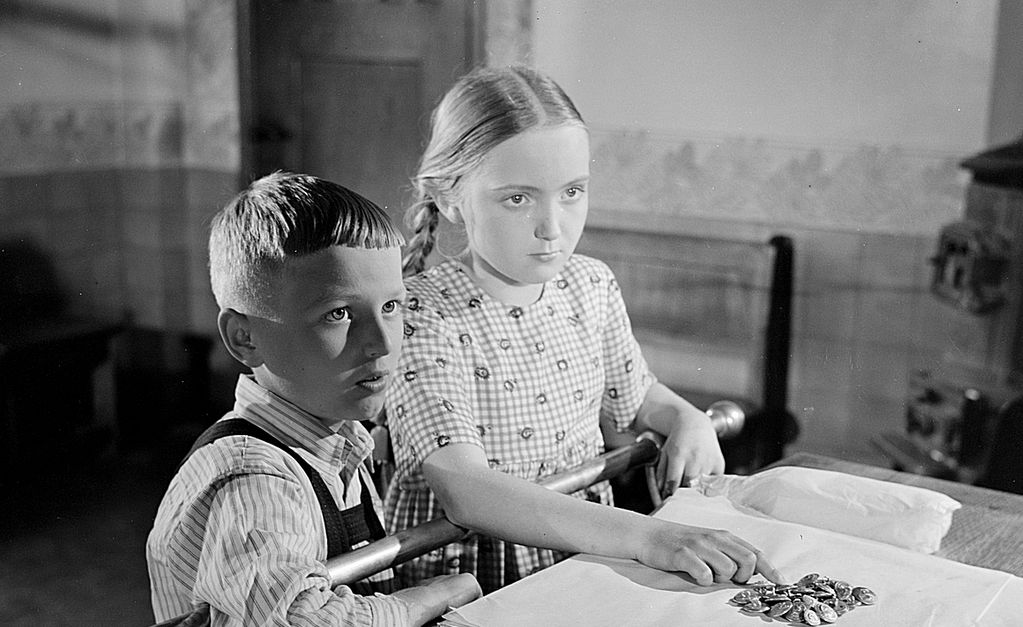
The ease with which a novel can leap across the years is compromised on film, where one actor cannot play someone for their entire lifespan – although then again, they tried very hard with Ester Toivonen in Scorned (1939). Consequently, much of the establishing moments of the first 20 minutes are left in the hands of two child-actors, Suvi Soila (actually Suvi Orko, daughter of the producer Risto Orko), and Orvo Kalevi, who appeared as Orvo Kontio in the same year’s Four Women.
It’s they who have to carry the narrative weight of Stiina being bullied as a child, and Vesa coming to her rescue; as well as the character-defining moment when Stiina tries to offer her button collection as payment for her foster-mother’s vital medicine, thereby winning the approval of the local pharmacist. But as critics were quick to point out, there are an awful lot of defining moments in this film. “There would be enough material for several different films,” observed Toini Aaltonen in the Suomen Sosialidemokraatti. “Towards the end, the viewer becomes so numb that they completely apathetically accept everything, no matter what happens. Nothing seems impossible anymore.”

Others were quick to point out that life in modern Finland was not quite so Dickensian for illegitimate children as the 1928 source material suggested, although I would counter that they might like to ask a few illegitimate children about that. I was present in the room on a fateful day in the 1990s when the father of my then-girlfriend realised that the man he had always thought of as his uncle had actually been his dad. It was a shocking revelation that stopped him in his tracks, as a whole bunch of familial slights and dramas, unspoken tensions and kindnesses suddenly made sense. It also opened a whole new can of worms, since the outed “uncle” had been a Catholic priest.
It all happened in mere seconds, before my very eyes, and it pole-axed him with a dramatic weight you only usually see in movies. It called into question his whole life, years of self-doubt, insecurities and gaslighting, as well as the often-odd behaviour of the people he now realised were his adoptive parents. All of this fell like an anvil on a man who had been born in the 1940s, a whole generation after Finnish critics were scoffing that the drama in The Mark of Sin was all outmoded and forgotten.
Jonathan Clements is the author of A Short History of Finland. He is watching all the Finnish films, so you don’t have to.
 The Official Schoolgirl Milky Crisis Blog