
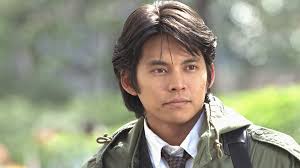
Disaffected computer salesman Shunsaku Aoshima (Yuji Oda) changes careers at the ripe age of 29, becoming a detective at the Wangan police station. Though he is initially ignored by most of the officers, he demonstrates an early skill for empathising with victims and is able to draw important evidence out of uncooperative interview subjects. His chief nemesis is Shinji Muroi (Toshiro Yanagiba), a self-made man from Akita, who has fought his way up through the Police Board Criminal Council despite snobbish opposition from the Tokyo University graduates who make up most of its numbers. Though the two men are permanently at odds, the emotional Shunsaku and the logical Shinji eventually form an uneasy partnership
Their friendship flourishes in the course of several episodes that introduce other members of the team. Old hand Heihachiro is due for retirement but trying to settle some of his outstanding cases. One comes back to haunt him, when an old adversary sends him a booby-trapped office chair, forcing him and Shunsaku to stay completely still while the rest of the office try to defuse the bomb—a steal from a similar setup in Lethal Weapon 3. Sumire is Shunsaku’s would-be love interest in the Department of Theft, whose cold exterior hides an abused past. She attracts a stalker who is convinced that she is the earthly incarnation of the anime character Pink Sapphire (a thinly veiled homage to Sailor Moon) whom Shunsaku and Shinji must stop before he turns into a killer.

Bayside Shakedown is one of the landmark Japanese TV shows of the 1990s. Though the high concept is nothing new, it struck a chord with the Friends and Ally McBeal generation, offering last-chance wish fulfilment for twentysomething viewers that there was still a possibility to change careers and start afresh. The glossy production values and pop video sensibilities glamorised the world of police work— the officers try very hard to play it young and cool. They achieve this through an unobtrusive anti-intellectualism that derides academic achievement in favour of simple attitude and instinct. When a team of criminal profilers arrive at Wangan, they are depicted as hapless college boys whose charts and graphs are no substitute for door-to-door enquiries and knowledge of the streets. There is similar comedy bungling from the Three Amigos, a group of unashamedly brown-nosing seniors who preside over the younger officers with an air of benevolent incompetence.
The series aims several pop culture references squarely at anime fans, including an arrest at an Image Club where visitors can hire prostitutes dressed as famous characters, and the regular recurrence of music from Shiro Sagisu’s soundtrack to Evangelion. Viewers are also advised to keep an eye out for each episode’s token foreigner, including ending-theme song collaborator Maxi Priest, though our personal favourite remains the suspect who can be heard loudly protesting, “But I am from Finland!”

Later episodes adopt a more serious tone, as the team go on the trail of a cop killer who has also seriously wounded police chief’s son Masayoshi Mashita, as well as with the promise of future collaboration between the lowly Shunsaku and the fast-tracking Shinji as he rises through the ranks.
The series stayed in the public eye through a novelisation and several seasonal TV movies, as well as a number of cinema spin-offs that kited it far into the 21st century. Twenty-eight years after it first appeared, it is fated to return yet again with leading man Oda now nearing sixty, cast in the upcoming Bayside Shakedown N.E.W. And for some utterly baffling reason, it has suddenly sidled onto Netflix, where its 4:3 screen size, predating the rise of the widescreen, and its leeched digital-video palette, make it look like what it is: an artefact from a bygone age.
But Bayside Shakedown was huge in its day – a hopeful second-chance for late twenty-somethings that propelled it into the status of a national phenomenon. With a peak audience share of 23.1%, its cinema adaptation was sure to be a hit, with the first movie becoming the third most high-earning domestic movie in Japanese cinemas. But although it was screened overseas on expat TV, and had its following among dorama fans in south-east Asia, it never seemed to attract the attention of the English-speaking world.

Twenty-five or so years ago, I went along to a London screening of the first Bayside Shakedown movie, put on for exhibitors ahead of the big buying frenzy at the upcoming MIP-TV in Cannes. A friend in the business said he’d add me to the guest list as a favour, so it’s not like I was sneaking in. It was a joyous continuation of the series, beginning with a wonderfully evocative depiction of contested jurisdiction, as police units on either side of a canal each try to prod a floating corpse over to the other side so it’s somebody else’s problem. It continued with a comedic account of class differences and office politics within a struggling police station, and finished with a sly reference that replayed the ending of Akira Kurosawa’s High & Low (1963).
The film was only marred for me by the occasional sound of seats flipping up, as one-by-one, the various exhibition reps decided the film wasn’t for them, and got up to leave. When the lights came up, I was alone in the theatre. I walked over to the distributor to confess that I was not a buyer for a video company.
“You are Jonathan Clements,” he said with a smile. “I know because you laughed at the Kurosawa gag. And you stayed to the end.”
Adapted from the Bayside Shakedown entry in The Dorama Encyclopedia: A Guide to Japanese Television Drama Since 1953 by Jonathan Clements and Motoko Tamamuro. Bayside Shakedown, much to everybody’s surprise, is suddenly available on Netflix.
 The Official Schoolgirl Milky Crisis Blog