
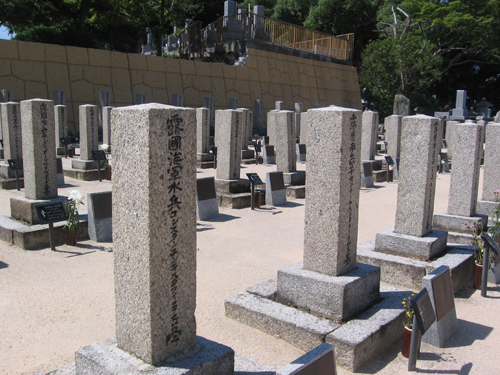
A tram-ride away from the main train station in Matsuyama, set on the side of a hill, there is an array of 98 stone pillars, each bearing the name of a long-dead foreigner. All were Russian prisoners of war, held by the Japanese from 1904-5.
Some 4000 “Russians” were interned in Japan as the war went on. Louis Seaman, a reporter from the Daily Mail, was scandalised at how many of them weren’t really Russians at all.
“The prisoners at Matsuyama were all from White Russia, mostly Finns and Poles, with a decided sprinkling of Jews. Pondering on… the woes of these people in their own unhappy land, the thought was forced upon us that his Imperial Majesty the [Tsar] of all the Russias was emulating with emphasis the illustrious example of David of old with Uriah, in sending these people as cannon fodder to the Orient, where the more killed the better for the safety of his throne at home.”
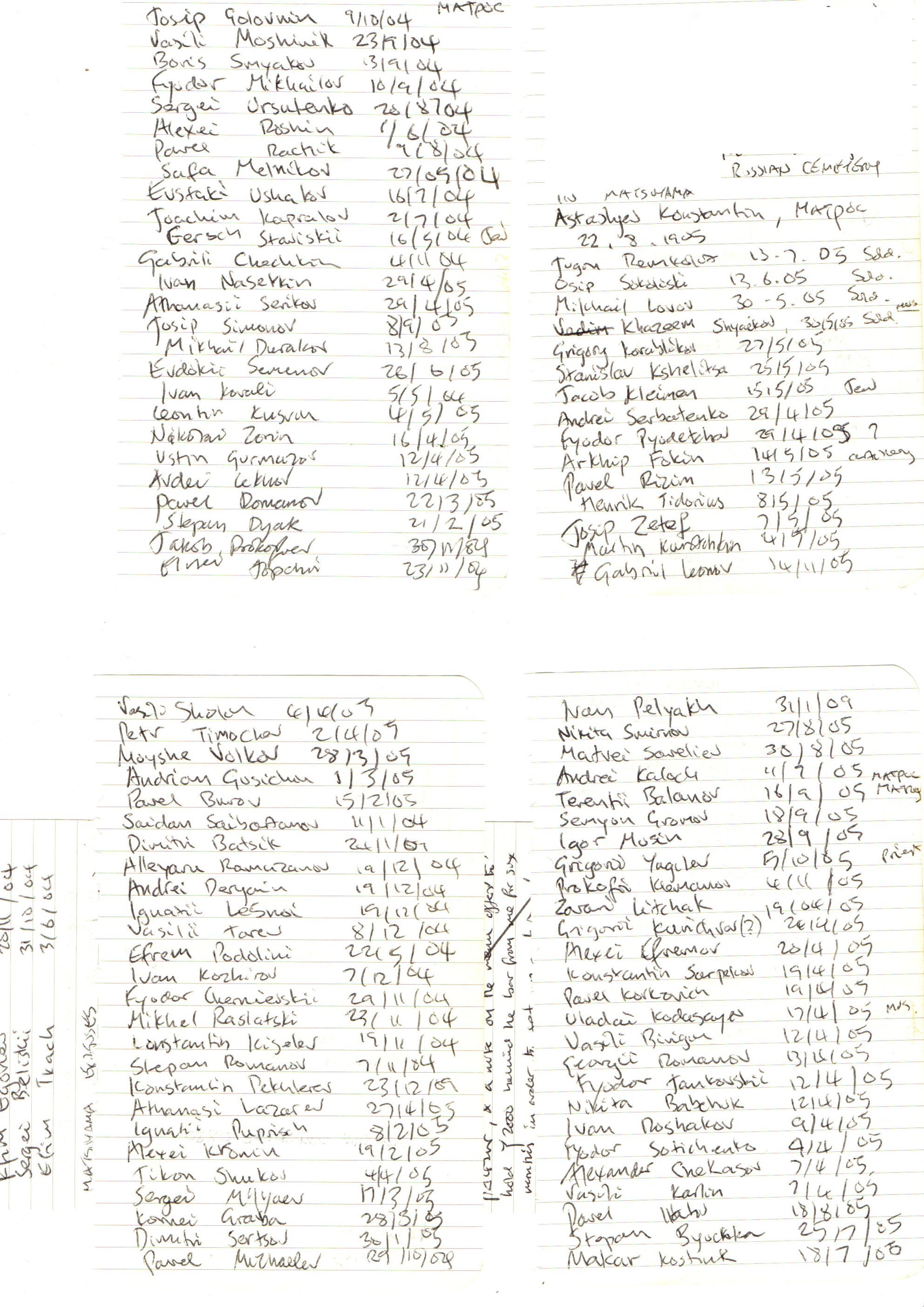
Although many names on the headstones are Konstantins, Sergeis and Dimitris, the graves evoke the multi-racial mix of the Tsarist war machine that was defeated by the Japanese. Uladai Kodasayev (d. 17th April 1905), a Muslim, is plainly from West Turkestan, as is the soldier Khazeem Shayekov (d.30th May 1905). Jakob Kleinman (d. 15th May 1905) is a Jew, perhaps from Poland; Henrik Tadorius (8th May 1905) might have been a Swedish-Finn. Moyshe Volkov (d. 28th March 1905) has a Jewish name but a Christian grave-marker – did he convert or did someone mix things up? All these men died thousands of miles from home as part of the Tsar’s ill-fated attempt to take on the Japanese in Manchuria.
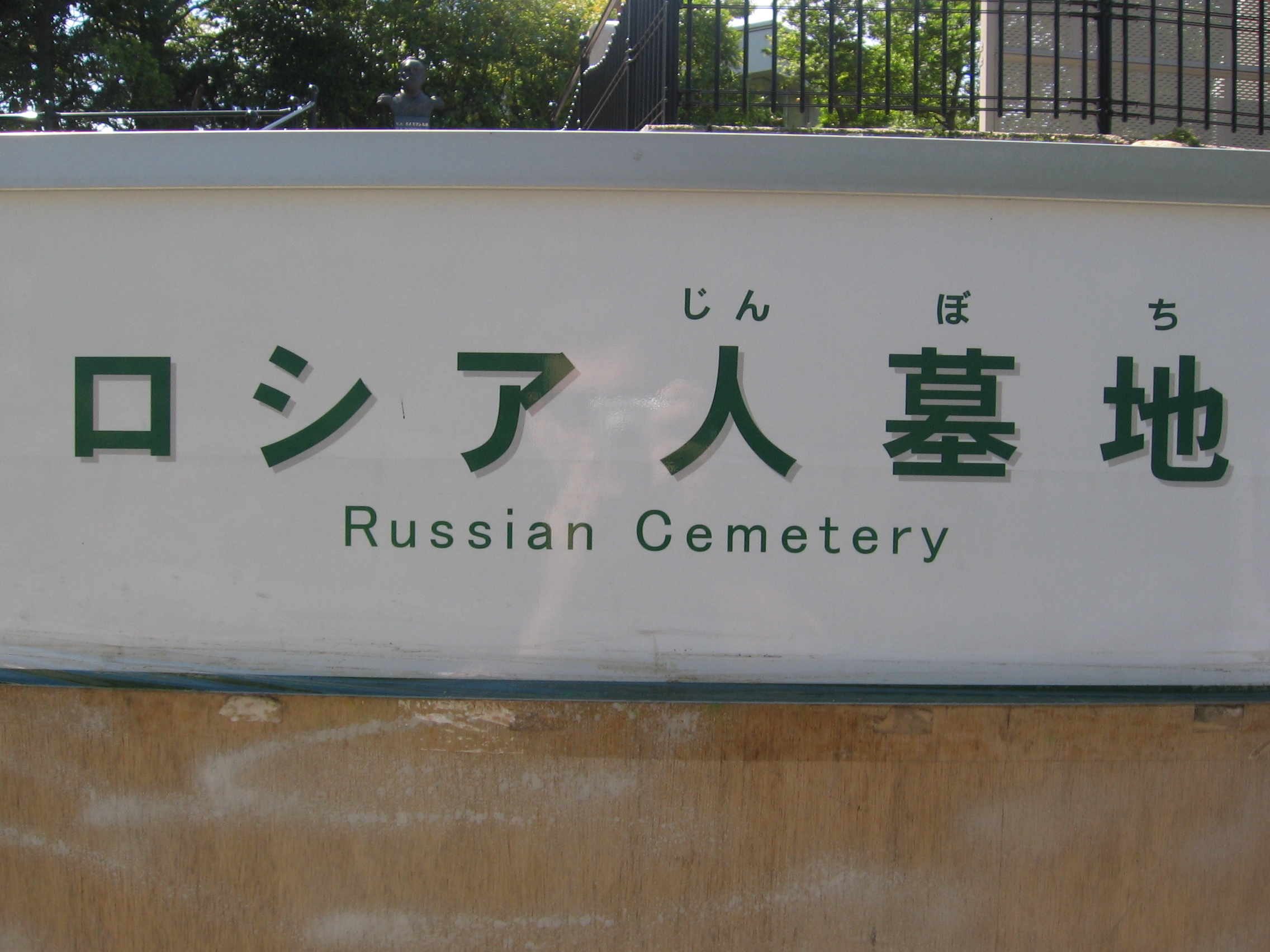
The Russian graveyard is a relatively obscure pilgrimage site in Japan. Even I can read enough Russian to see that the Cyrillic nameplates have been written by someone from Japan, muddling through with a dictionary and crossed fingers. Sixteen years later, as I am clearing out my desk drawer, I find the notebook in which I wrote down the name on every “Russian” headstone in the Matsuyama cemetery. It’s not a whole lot of use to me at the moment, but someone out there in the internet may find it useful, so I have made it available here.
Jonathan Clements is the author of Japan at War in the Pacific: The Rise and Fall of the Japanese Empire in Asia 1868-1945.
 The Official Schoolgirl Milky Crisis Blog
Dear Sir,
There is a PhD student in Poland who is presently writing his thesis about Polish-Russian prisoners of Rus-Jap War. That might be of interest for you, I hope.
Andrew W.