
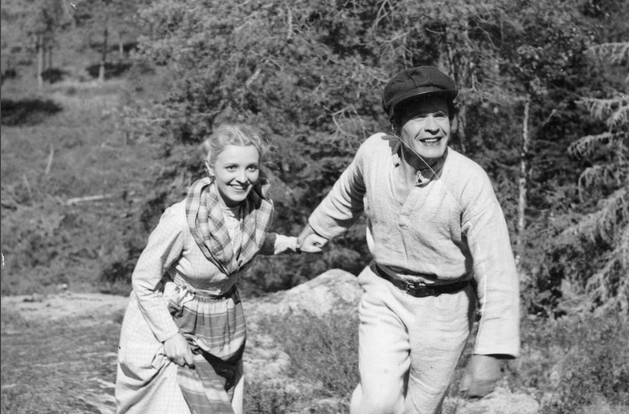
In rural Finland in the 1860s, the young, handsome Taavetti (Eino Kaipainen) takes over his father’s struggling croft, and hopes someday to get himself a wife. He is too proud to sell his prize mare to the landlord Isoaho (Toppo Elonperä) but manages to win the hand of Maija (Ansa Ikonen), a spunky girl from the neighbouring farm at Töyrylä. It later transpires that local boy Jussi (Pentti Viljainen) had rather hoped to marry Maija himself, and regards himself of having been swindled out of a deal that was all but done.
Taavetti and Maija are made an offer they can’t refuse by the logger Veijonen (Veikko Linna), who is prepared to hand them a tidy sum for the lumber from 500 trees on their land. But Veijonen has dastardly deeds in mind, and persuades the locals who witnessed their deal to lie about it. Taavetti ends up getting into a fight over it, and must suffer through a court case in which he is accused of assault and of welching on a deal he never made. He is sentenced to 26 months in prison, where he unexpectedly bonds with his cellmate Antti (Edvin Laine), and becomes an accomplished carpenter.
Maija, who is predictably pregnant, struggles with getting in the crops at Rantasuo farm, grateful for the customary shared-harvesting tradition of talkoot, when everybody pitches in. Old Isoaho comes to her rescue when money-lenders try to foreclose on the farm, and when Taavetti finally comes home, having paid his unwarranted debt to society, all is well, the farm is flourishing, Isoaho has got the mare’s foal in payment for his help, and Maija and the child are waiting for him on the porch.
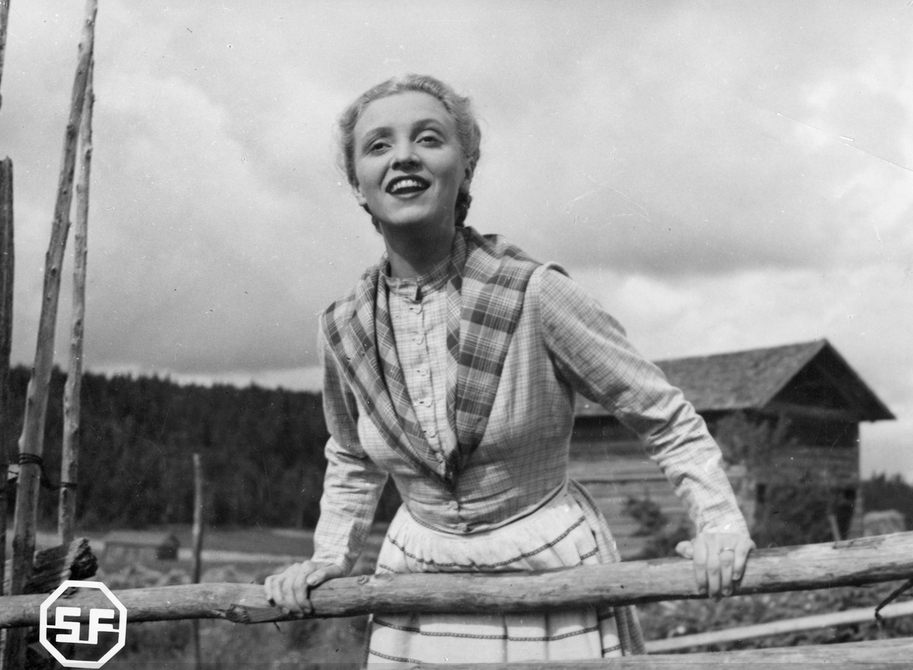
“Finally,” blurted the advertising copy for this adaptation of Urho Karhumäki’s 1923 novel, “we have a film with a strong Finnish spirit, a story of a Finnish forest ranger’s giant battle against vicious nature and malicious mankind – a struggle for which the prize is his own land and his own wife!” There are, after all, many ways to distract a nation at war. Rantasuon raatajat was released on the same day as its studio stablemate That’s How It is, Boys! (1942), but whereas Eino Ketola’s barrack-room comedy made light of war and duty, Toivo Särkkä’s script wades knee-deep into the fertile swamp of nationalism and local pride.
Shatneresque leading man Eino Kaipainen has been here many times before, most notably in Finland, Our Dear Native Land (1940). Here, he is reunited with co-star Ansa Ikonen from The King of Poetry and the Migratory Bird (1940), in an uplifting tale of struggle against adversity that pretends it is about tough times in the Great Famine, but is really all about maintaining a stiff upper lip in the midst of the Continuation War. As Taavetti, Kaipainen is a wronged hero who nevertheless wins through, a model citizen and even a model prisoner, who emerges from incarceration with a new skill and a best friend. Unlike the milksops of many a romantic comedy, he has an unreconstructed masculinity that is unafraid to fight for what he believes in, and a touching faith in the support of his loved ones.
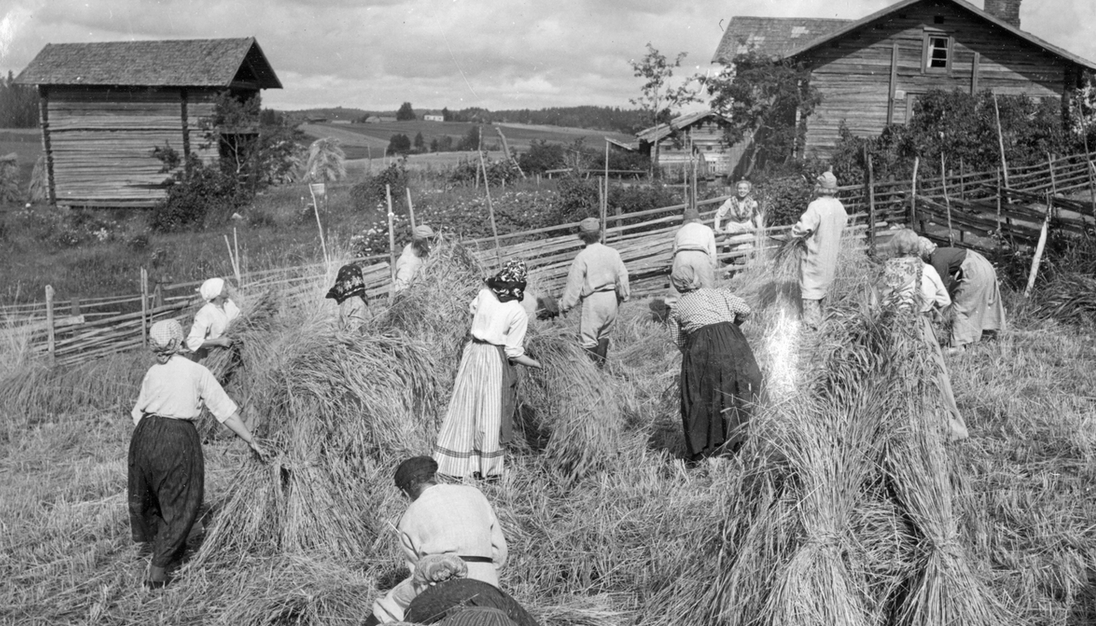
I am particularly taken with the depiction of the talkoot in this film, because such communal mucking-in remains a feature of Finnish life today. They might have all come off the farms two generations ago, but twice yearly in my old street, all the plumbers and computer programmers, schoolteachers and car salesmen still got together to clear the leaves and trim the bushes until we’d filled a massive skip and could sit back for a coffee and a sausage. I once spent a happy day with my neighbour, Seppo, industriously digging a hole, until we were informed by another neighbour that we were supposed to be filling it in. Seppo made time pass, for him at least, by ceaselessly recounting everything he could remember about the songs of Whitney Houston, which was not a lot, because he couldn’t speak English, and I was obliged to translate each one for him. But I digress.
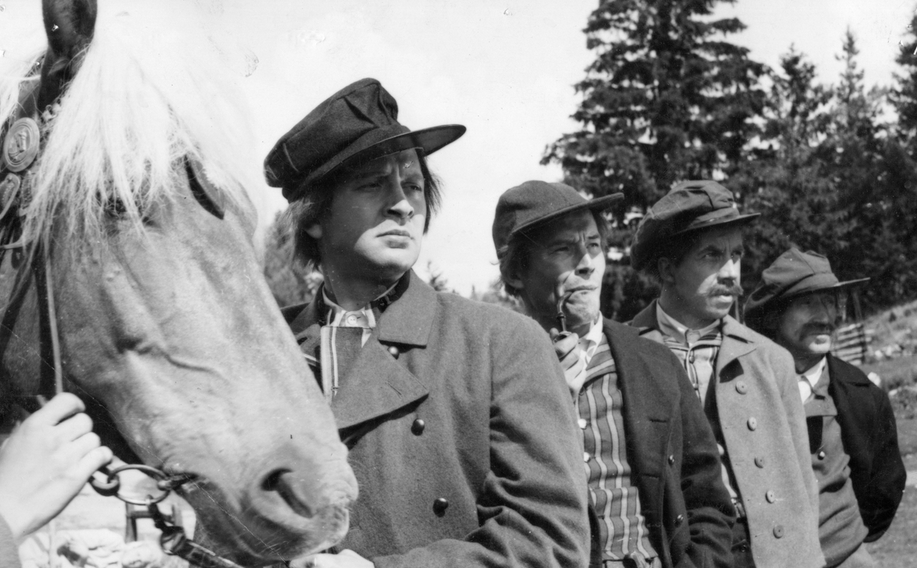
The press loved the film, describing it as a glorious “Christmas gift” from the Suomen Filmiteollisuus studio, and gracefully ignoring the fact that it often played like an obvious retread of Eino Kaipainen’s break-out picture, The Ostrobothnians (1936). At 42, in fact, Kaipainen was now a little long in the tooth to be playing a youthful lead, but he was not yet ready to slip into character work, and his public was not ready to let him. Ansa Ikonen, at 29, can just about get away with it, but the real-world Kaipainen was old enough to be his character’s Dad, and such cragginess can be distracting in a story that is supposedly about two youngsters barely out of their teens.
As ever, it was Paula Talaskivi in the Helsingin Sanomat who was best able to assess the film in both the context of its time, and its likely reception to posterity. “The plot itself,” she wrote, “with its relatively few turns of events and one-dimensional action, is not an exemplary film subject, but as a beautiful, devout film depiction of Finnish rural life, it defends its place well.” In its way, it is just as much as prisoner of its era as That’s How It Is, Boys!, fraught with what now seems to be overblown histrionics and intense passion, which are far more understandable in the context of film-makers and audiences who were facing the beginning of a fifth year of war and uncertainty.
Jonathan Clements is the author of A Short History of Finland. He is watching all the Finnish films so you don’t have to.
 The Official Schoolgirl Milky Crisis Blog