
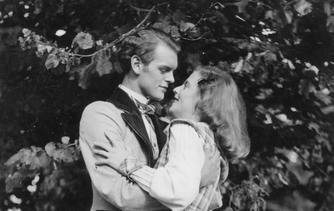
Count Mauritz Armborg (Leif Wager) is packed off to Rome to study the violin, in a devious gambit by his family to keep him away from his true love, the butler’s daughter Katariina (Regina Linnanheimo). He stops just long enough to impregnate Katariina in a roadside inn, and Katariina throws herself off a cliff in grief, only to be rescued by her suitor, the honest fisherman Elias (Eino Kaipainen, formerly a leading man good enough for any red-blooded Finnish woman, now reduced to the supporting cast).
Seven years later, Elias handily dies from the plague (or something), freeing Katariina to dump her son Mauritz Junior (Marjo Kuusla) on a grieving mother, who whisks the boy off to Rome, where he is reunited with his father, who recognises the necklace he gave Katariina. He brings his long-lost son back to the manor in Finland, where his mother (Elsa Rantalainen) confesses to her machinations, all is forgiven, and the lovers are reunited.
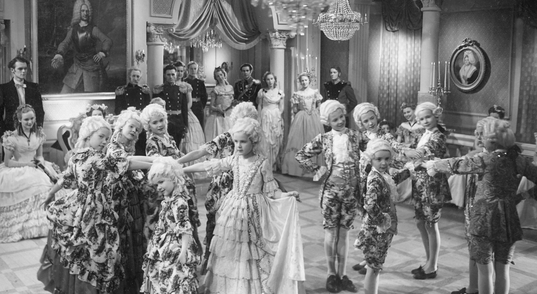
Katariina ja Munkkinienen kreivi had a convoluted path to the screen, beginning as a last-ditch effort to salvage the costs sunk into an abortive historical drama about Karin Månsdotter (1550-1612), the queen consort of Sweden’s mad king Erik XIV. With the royal movie project shut down for reasons unclear, the Suomen Filmiteollisuus company was saddled with an entire warehouse full of costumes, and thrashed around in search of a story that would justify them. Eventually, a ready excuse was found in the form of a romantic novel, serialised in the Oulu local paper Sirpale from 1939-1940, by the same Kaarina Kaarna who had penned the earlier success Beautiful Regina of Kaivopuisto (1941). Nisse Hirn’s script adaptation was deftly polished by Toivo Särkkä with some smart changes for the change in medium – a dinner scene was transformed into a glittering dance, and Mauritz’s desire to be a painter, switched for the more soundtrack-friendly violinist.
And then the whole thing sat in limbo for a year, upended by the Winter War, losing its original director and stars, and finally flung together under Ossi Elstelä, with new face Leif Wager in the male lead. It was Elstelä who called the lyricist Reino Hirviseppä in Viipuri and asked for a “quick fix” – the result, dashed off in the following fifteen minutes, would become the film’s break-out song “Romanssi,” one of the most popular hits of Finland’s war years.
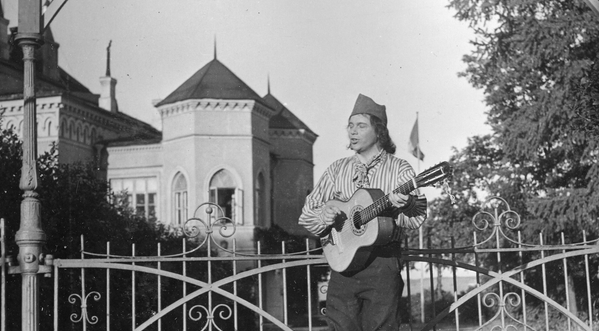
Buildings in Helsinki were found to stand in for the supposed globe-trotting scenery in Italy and Denmark, and the result was the box office smash of 1943, although the critics were less impressed. Hans Kutter in the Swedish-language Hufvudstadbladet ridiculed the novelist’s staple elements of “a man of high birth, a woman of the people, and the obligatory illegitimate child.” Olavi Vesterdahl in Aamulehti was similarly snide, calling it a “worthless pastime” fit only for “soppy schoolgirls and dreamy women.” Paula Talaskivi, the unshakeable oracle of Helsingin Sanomat, lamented the fact that anyone ever bothered to make such drivel any more. Toini Aaltonen, in the Suomen Sosiaalidemokraati was oddly aggressive, in what seemed to be a town-and-country stand-off, lampooning the “naïve” readers of Sirpale for falling for it all, and blaming them for the fact the film got made at all.

The press was more forgiving of leading man Wager, cooing enthusiastically about his chiseled good looks and gentlemanly manners. Talaskivi chided the film-makers for putting the 28-year-old Regina Linnanheimo in the role of a virginal teenager, and smartly suggested that the film might have made more sense if she’d swapped places with Sirka Sipilä, the 23-year-old actress who played Ingeborg, the spinster with whom Mauritz is forced into a loveless marriage. With the Finnish film industry now twenty-some years old, aging stars were becoming a thing – as noted up-blog in The Toilers of Rantasuo (1942), former male lead Eino Kaipainen was now in his forties and here, it seems, finally accepting the move into character roles with a degree of grace, albeit with a distractingly wispy beard.
Also popping in for long-term readers, the radiant Elsa Toivonen as a countess who encourages Katariina to marry for love: “I was sixteen when I was wed; seventeen when I had my first child, and my husband was twenty years older than me.” Elsa Rantalainen as Mauritz’s mother, trying to corner all the Scheming Old Bag roles, is, as ever, oddly persuasive in her arguments for Mauritz to Do the Right Thing.
Shunted onto television in a different era, the film was battered for the unintentional humour provided by all the histrionics. This viewer was left more curious about the implications that the costumes intended for a Karin Månsdotter drama set in the late 16th century should somehow be appropriate for a Finnish movie set in the 1860s. Maybe fashions don’t change so fast in the far north? The film’s finale is set in the year 1867, which is also the year that Månsdotter’s sarcophagus was renewed in Turku cathedral, so possiby the Månsdotter film had an 1860s framing device that would account for a bunch of the costumes.
Jonathan Clements is the author of A Short History of Finland. He is watching all the Finnish films so you don’t have to.
 The Official Schoolgirl Milky Crisis Blog