
Although he was not yet the overall boss at Toei, Shigeru Okada’s responsibility for approving budgets gave him a de facto power to control productions. By the early 1960’s, he’d had enough of the diminishing returns from period dramas, particularly since the “price of horses was going up” and audiences seemed uninterested in more samurai films.
“Television has completely kidnapped all the children, housewives, and the elderly,” he announced at a production meeting. “The only people coming to the cinemas now are youths and men over thirty, and they are drawn by a delinquent sensibility. Wholesome films for the whole family at Toei just won’t get an audience anymore.”
Instead, Okada pushed for his writers and directors to knock up films about yakuza, set in the late 19th century or later, so that they could use the tail-ends of period sets, or real-world locations.
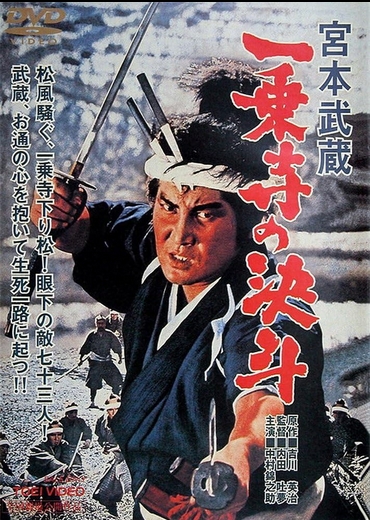
The last major exception at Toei was the five-year span of the Miyamoto Musashi series, for which Tomu Uchida would direct a complete adaptation of Eiji Yoshikawa’s brick-sized novel. The first three films all made it into the top five annual box office scores, leading Uchida to pull out all the stops for the fourth, Duel at Ichioji, in which Musashi would have to face his nemeses at the Yoshioka school in a massive fight.
Uchida became obsessed by a phrase in the script, which he felt obliged to reproduce exactly: “The thick morning mist gradually disappears, and the topography centred around a drooping pine clearly emerges.”
Intent on coming up with a moody swordfight amid rice paddies covered with a thin sheet of ice, Uchida proclaimed that “if it doesn’t exist, we will have to invent it.” Selecting a location near Japanese military training grounds in Shiga, he ordered the art department to make a tree, fixing cedar bark to a steel frame, and then planting it in the soil.
Concrete was poured all around the paddy fields, in order to allow pathways for cast and crew. The art department, realising that water and ice wouldn’t show up on the film stock being used at the time, repeatedly poured wax over the fields so that something would be visible when warriors’ feet kicked through the mud.
Eventually, it took two months to prepare the ground for one twenty-minute fight sequence, which Uchida further extended by insisting on filming for a single “magic” hour each day, so that the dawn light would remain constant. “I want to film the duel only at the time when the sky begins to whiten,” he said, “the same time the actual duel took place.”
This, in turn, meant they had to leave their equipment in place every day, and start setting up at three each morning so as not to waste the day, every day, for two weeks. Unfortunately, Uchida’s efforts amounted to little, since Duel at Ichioji failed to outperform the previous three movies at the box office, and barely broke even. A fuming Okada refused to approve the full budget for the fifth and final film, which was completed with a number of corners cut and shots fudged. It would take years for Okada to be persuaded to return to the samurai epic on film in any big-budget way.
Jonathan Clements is the author of A Brief History of the Samurai. The Miyamoto Musashi films are being released in the UK by Eureka later this month.
 The Official Schoolgirl Milky Crisis Blog