
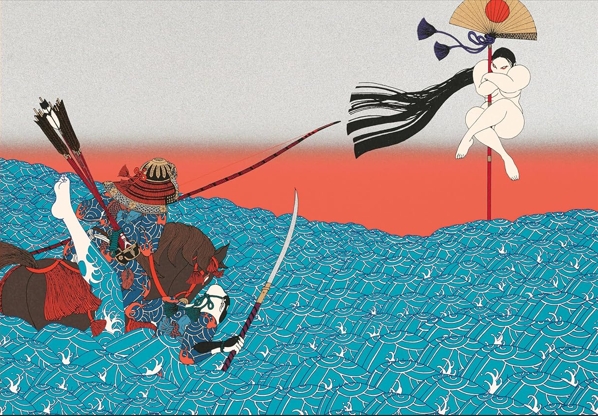
“I stepped ashore,” wrote A.B. Mitford in 1911, “and, rubbing my eyes in amazement, saw myself in a world younger by six centuries than that which I had left behind me. Feudalism is dead, but its ghost haunts me still. I shut my eyes and see picturesque visions of warriors in armour with crested helms and fiercely moustachioed visors.”
His comments are quoted by Natasha Bennett as part of her essay on “Collecting samurai armour in nineteenth century Britain”, which summarises the passion and obsession that the Victorians had the newfound Samurai, a discredited, failing military elite whose swords and helmets, woodcuts and silks were being offloaded on the European market by the crateful. The British Museum’s lavish exhibition Samurai deals in even-handed and intricate care with the sides in a modern battleground, in which the truth of the historical samurai contends with the stories they told themselves about themselves, in ancient war chronicles, in the twilight of the rule of the shoguns, in the long and tragic 20th century, and in modern myths.
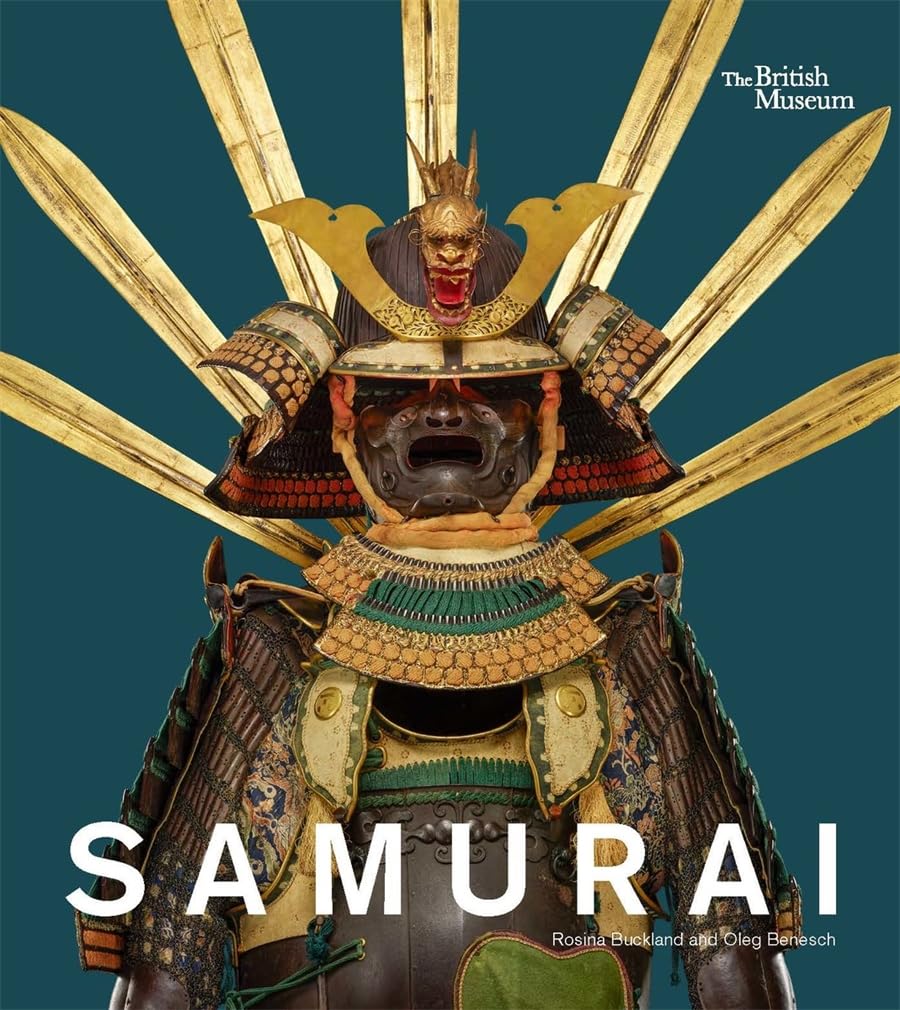
The exhibition catalogue, expertly overseen by Rosina Buckland and Oleg Benesch, gently deals with the expectation that many of the visitors to the British Museum are likely to think of the samurai as figures from a fantasy movie or a heroic myth, rather than real-world people with everyday concerns. One image beautifully encapsulates the attitude not only of Mitford but of the Japanese Imperial Army itself, as Japan’s victory in the very modern 1905 Russo-Japanese War is celebrated with an Army-approved image of three samurai: “the triumphal celebration in the Middle Ages.”
An entire final third of the materials are taken up with the end of the samurai and their incorporation into tourism and popular myth – a tale with as many switch-backs and double-crosses as any military campaign. The curators offer jaw-droppingly beautiful representations of the samurai’s self-celebration, such as a fantastic 1863 portrait of the wrecked Mongol fleet, its drowning sailors clinging to driftwood in a swell caused by a conspicuous sunburst.
One might quibble, as many museum-goers do, that visitors to the exhibition are often paying cash money to see things that they could have seen for free only a few weeks earlier. But while many of these images do have tell-tale donation dates going back decades or even centuries, the whole point of curation is to place such elements in new and interesting contexts, which the British Museum exhibition delivers by the spadeful, with multiple temporary loans from world-class collections like that of the London print-dealer, Israel Goldman.
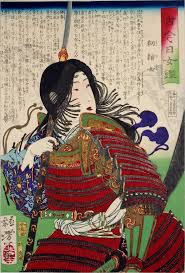
A lot of the coverage so far of the BM’s exhibition online has been weasel-worded rage-bait about the alleged emphasis on “female samurai”, which is not misguided wokery, but an undeniable historical fact. The samurai were a social class – fully half of them were women, otherwise there was no means of making little samurai. Samurai girls were trained in home defence – the use of the anti-cavalry naginata being most prominent – and samurai warlords were frequently entertained by girls doing “sword-dances.” There is even battlefield evidence of female corpses in samurai armour, although the issue, really, is the extent to which women habitually fought on the battlefield, and whether the fearsome Tomoe Gozen, who rides in and out of the Tale of the Heike in three wild pages, was an entirely everyday sight or a one-off nutcase.
The catalogue is peppered with illuminating mini-essays on all sorts of unexpected spinoffery. Hiromu Nagahara, for example, points out the telling implications of samurai photography, both of the grim bruisers to be seen in a shot of Satsuma samurai, and of the dapper men in western suits, who gather incongruously around the leader of the Iwakura Mission overseas, who still clings to his outmoded samurai costume. Mark Ravina writes about the idealised views of the Satsuma Rebellion of 1877, which is either a futile flex by past-it conservatives, or the valiant stand of the “last samurai”, depending on who you listen to.
Chika Tonooka notes that in the wake of Japan’s 1905 victory over Russia, HG Wells decided to name the elite in A Modern Utopia the “samurai.” Tatiana Linkhoeva writes on the attitude of the Soviet Union to the samurai, seeing them as a poisonous tumour that prevented true proletarian revolution from taking hold in Japan. Clemens Büttner offers a valuably Chinese perspective, that Chiang Kai-shek regarded the code of the samurai as the root cause of Japan’s foreign aggression in the twentieth century. But over in Nazi Germany, writes Sarah Panzer, Heinrich Himmler was all for it, telling Hitler that the “SS should become the German samurai.”
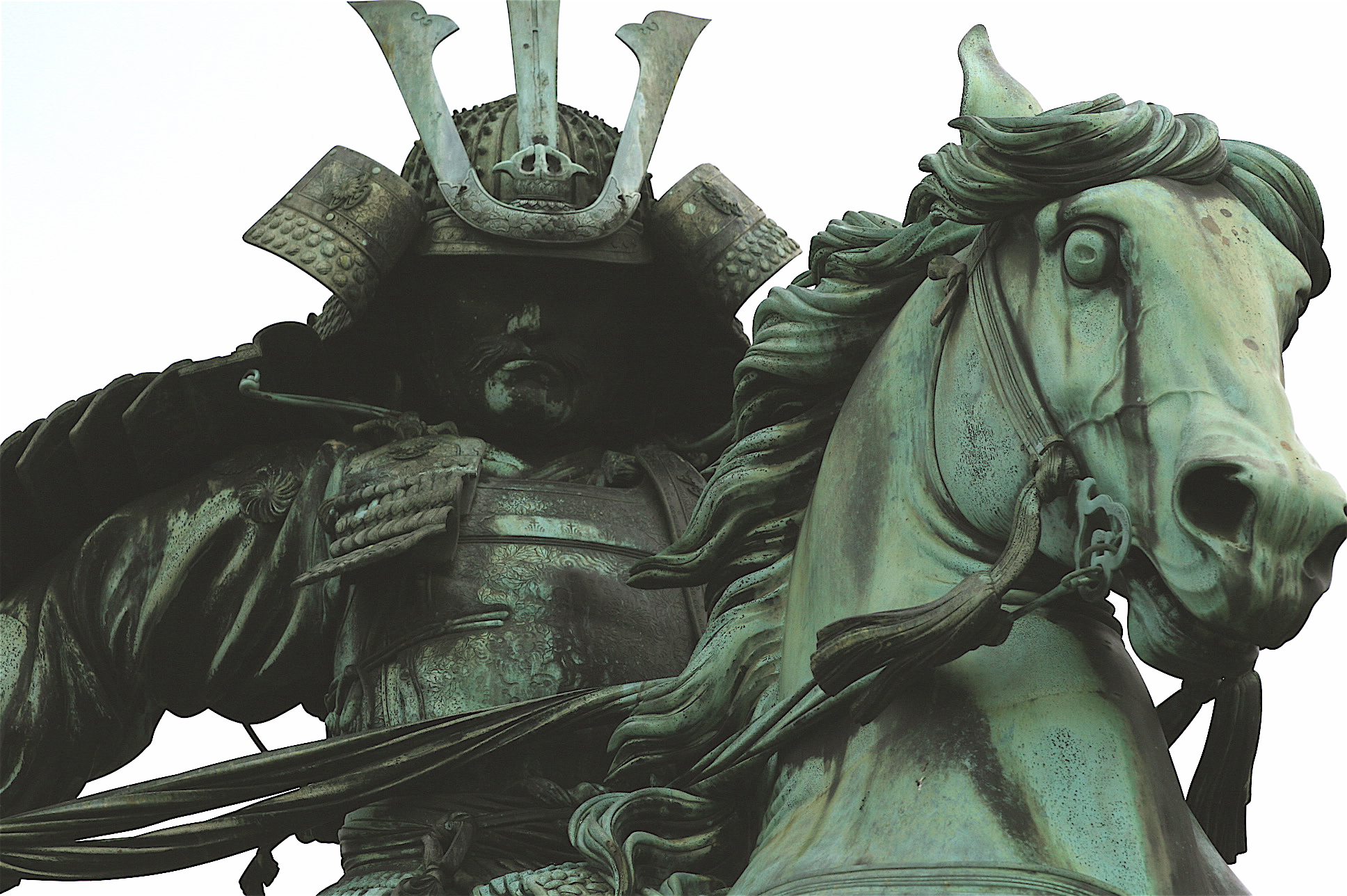
Sven Saaler, whose fantastic book on statues I have reviewed elsewhere, is back to talk about the striking sculpture of Kusunoki Masashige, seen by many a visitor to the Imperial Palace in Tokyo, although from my own observations, many still do not really know who he was. Judith Vitale offers a history of the association of samurai with cherry blossom imagery, which she dates back to the planting of cherry trees at the Yasukuni Shrine in 1879. I lack the space to list them all, but every one is a spark of insight into the long, long tail of Japan’s warrior elite, from Yukio Mishima’s fatal obsession with samurai philosophy, to John Belushi’s crazy samurai character Futaba on Saturday Night Live, to George Lucas’s ransacking of the samurai panoply to create the costume for Darth Vader.
The catalogue, and exhibition, close with such modern icons, often beautifully subtle, such as the katana swooshes to be seen on the shirts of Japan’s football team, the Samurai Blue. Rachael Hutchinson’s closing notes on samurai in video games also drag up the long shadow of the past, when she reveals that Mitsurugi in Soulcalibur was re-skinned as “Arthur”, a blond European knight, for the export of the game to South Korea, where locals were sure not to be all that keen on the sight of a Japanese warrior.
Jonathan Clements is the author of A Brief History of the Samurai, which is also available in the British Museum bookshop if you have any pennies left over. The Samurai exhibition is running at the British Museum until 4th May 2026.
 The Official Schoolgirl Milky Crisis Blog
“or a one off nutter . . .” Lovely turn of phrase. For whatever reason I wasn’t sure if I would go to exhibition – now fully fired up!