
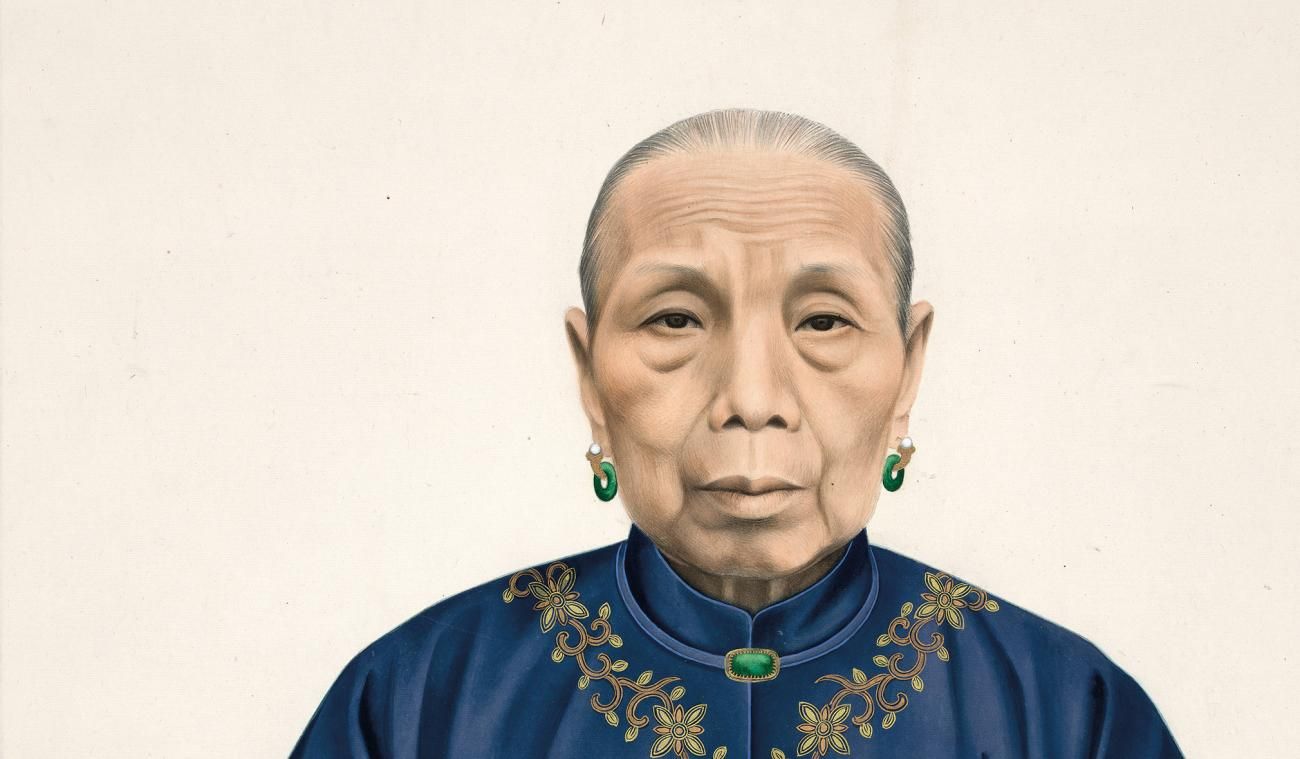
Just back from the British Museum, where I dropped in on the China’s Hidden Century exhibition, the Chinese name of which is “The Late Qing in 100 Objects.” It’s a popularly aimed introduction to the long 19th century, in which the Manchus slowly lost their grip on power, and China was plunged into disasters, wars and ultimately revolution. But rather than concentrate on the more obvious narratives– China’s grasping 17th century expansion in Central Asia, in which the Manchus doubled the size of their empire, or the enslavement, drugging and plundering of the country by foreign imperialists even better at imperialling than the Manchus – it instead concentrates on the material culture and social history of the area. Big events did indeed happen, and do indeed occur at the sidelines here, but China’s Hidden Century is more concerned with the everyday life of the people – the elaborate garments of the Manchu princesses and the actresses that entertained them; a child’s dragon hat; the silly porcelain replicas of ancient Bronze Age artefacts.
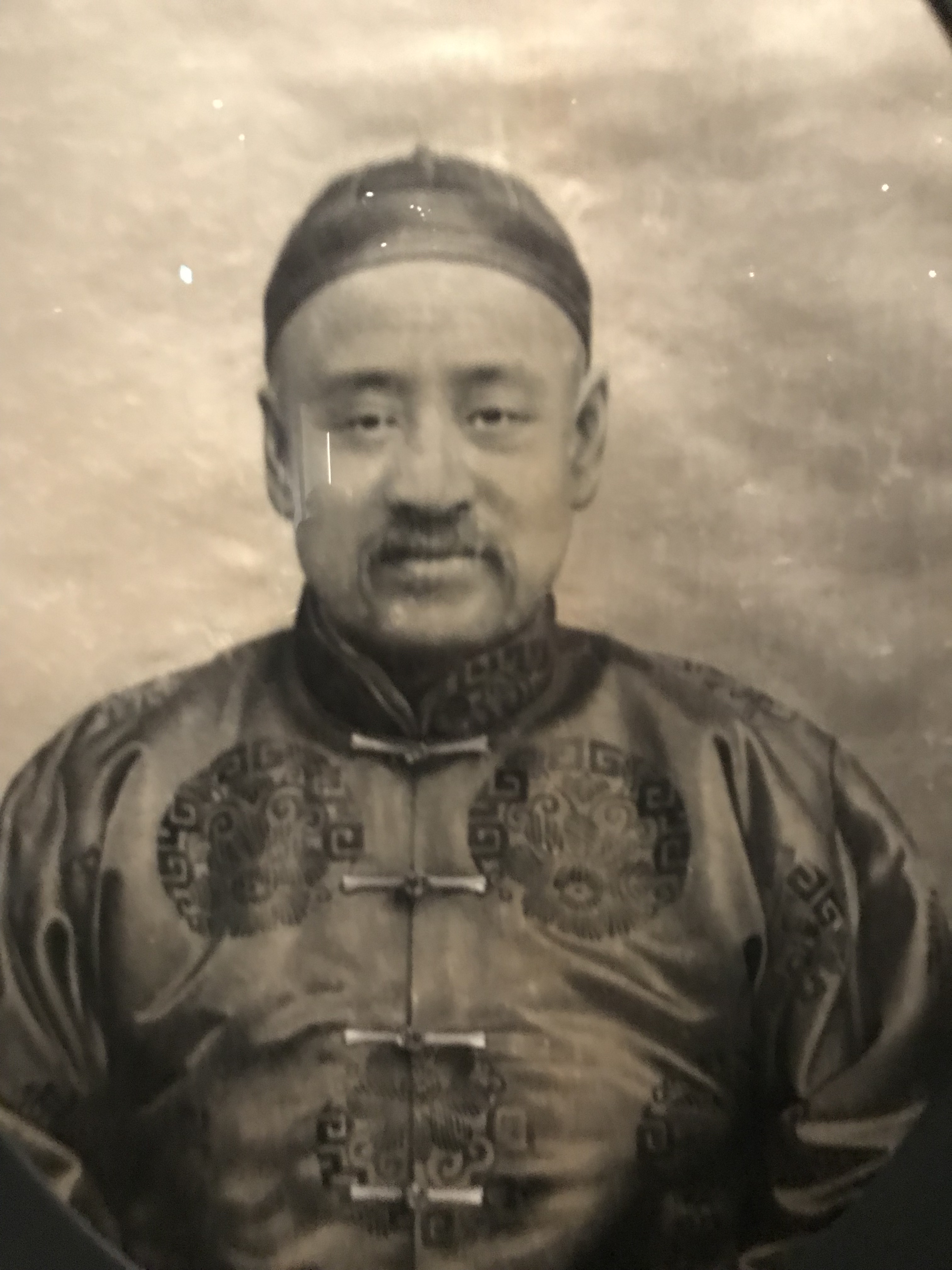
One of the most striking pieces is something many visitors pass by without a second glance: a portrait of a wealthy merchant that at first appears to be a photograph, but turns out to be entirely made of silk threads – an artwork in Suzhou kesi that would have taken months to complete. I once visited a kesi artist in Suzhou, and observed that she spent most of her time snapping at the passing tourists that no, that was NOT ink calligraphy, it was silk. No, that was not a painting, it was silk. And so on.
As the story progresses, the sound picture changes. We first hear background speeches in Manchu, the cant of the ruling class, that segues as the years pass into Mandarin, the lingua franca of the general population. By the final gallery, the words have transformed into Cantonese, reflecting the increasingly southward focus of the drama and events as political and economic forces were felt in China’s far south, where all the foreign contacts were.
At the very end, just before the doors open to the gift shop, there is triple image of the same woman – dressed in Chinese garb, in Japanese kimono, and man’s clothes with a sword. It is Qiu Jin, the fiercely revolutionary poetess who was arrested and executed in 1907 for plotting a bombing campaign to overthrow the Manchus. She appears here, at the very end, presumably as an indicator of just how much had changed in the previous hundred years, how all the seething princesses and bitchy courtiers were suddenly trumped by a new, ardent kind of woman with a heartfelt desire for radical transformation. The tumultuous 20th century begins here, and that is where the exhibition ends.
I was a trifle baffled by the lack of commentary around the imagery of Qiu Jin, which seemed to be intended (as it was in my own coverage of the late Qing) to be the grand flourish of the early republican movement – a glimpse of just how far China had come during the long century of colonial contacts. It was only when I got out of the museum, and saw the recent storm on Twitter, that I realised what had happened.
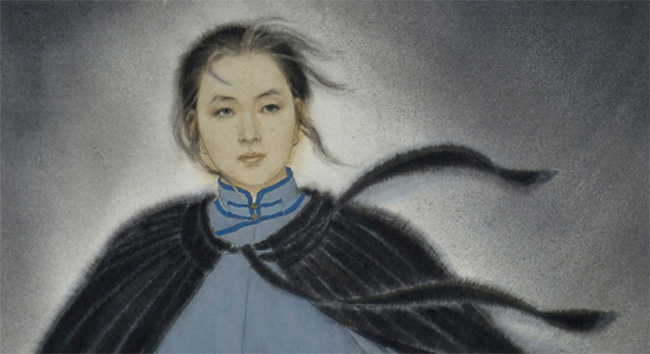
Qiu Jin might have originally been the big finish for the exhibition, but the installation that visitors pass through has been eviscerated in the last couple of days, shorn of much of its explanatory signage after the British Museum was called out by Yilin Wang, whose translation of Qiu Jin’s work had been used without permission or attribution in the exhibition materials.
Wang pointed out that the exhibition, which hoovered up £719,000 in funding and charges £18 for admission, had simply harvested her work without asking. The BM swiftly responded by stripping it out of the exhibition proper, and informing her that there was no need to credit her because it was no longer there.
I have been thinking back through the last few times I have been approached for permissions to use my own work. A composer in Ireland wants to read out some of my haiku translations as part of a concert. An actress in Canada wants to include some in an audio book. An Australian exam paper wants to quote from my biography of the First Emperor. In each case, I thanked them for asking and said that they were free to go ahead with no fee required. But that was my decision.
Wang was not consulted, and such rights are the translator/author’s to grant, not the museum’s to take with impunity. What has made matters worse is that while the Qiu Jin materials have been flensed from the exhibition space, they understandably persist in the PDF guide available to visitors and indeed in the £45 exhibition brochure. I might also observe that none of the mob I have seen assembling on Twitter seem to have been to the exhibition themselves, so don’t realise quite how important the Qiu Jin imagery is – as a Manchu-denying terrorist and revolutionary icon, she shows up at the end, when you think it’s all over, with all of the wow-factor of [REDACTED] in the post-credits sequence of Fast X. She’s not a thing you walk past on the way to the gift shop, she’s the big bang at the end.
Which only makes the BM’s response all the more scandalous. “We’ve rubbed out evidence of our mistake, so now we don’t have to acknowledge it” is only something you can get away when the evidence really has gone. It’s not much of an apology, and I suspect that the fees Wang feels entitled to demand, which might have been zero in good faith, or the price of a nice dinner in everyday publishing practice, are now climbing ever higher as the BM doubles down on what we shall charitably call its mistake.
I dare say that Wang has already made more out of the publicity in pre-orders for a forthcoming book than the BM might have ever offered in acknowledgment for the use of a poem in a museum, but that’s not the point. The point is the principle of the thing: that whoever was at the trough for the £719,000 grant didn’t see fit at any point to push any money in the direction of Wang, whose work not only formed a part of the experience of the exhibition, but also seems to me to have been an integral part of its capstone.
Jonathan Clements is the author of A Brief History of China. China’s Middle Century is running now at the British Museum, London.
 The Official Schoolgirl Milky Crisis Blog