
The National Museum of Chinese Writing looks like a newly landed alien spaceship, decked out with golden animal totems shining in the sun, and supported by striking red columns, the fabled taotie mythical beast that shows up on so many Shang-era cauldrons. The museum is in Anyang, of course, because Anyang was where archaeologists uncovered vast pits of broken turtle shells, inscribed with questions to the gods for the Shang dynasty rulers – a peek inside their archaic Google history, if you like.
It’s also closed today, so we technically have the place to ourselves, although a bunch of surly cleaners and key-jangling security guards seem keen to ruin any quiet moments that we might have. The director films me walking among the oracle bones, and I manage a couple of relatively long pieces to camera about the story of the discovery of the Wastes of Yin, and how Chinese history got 600 years added to itself practically overnight in 1928 after the discoveries in Anyang proved that the ancient stories were actual history and not a myth.
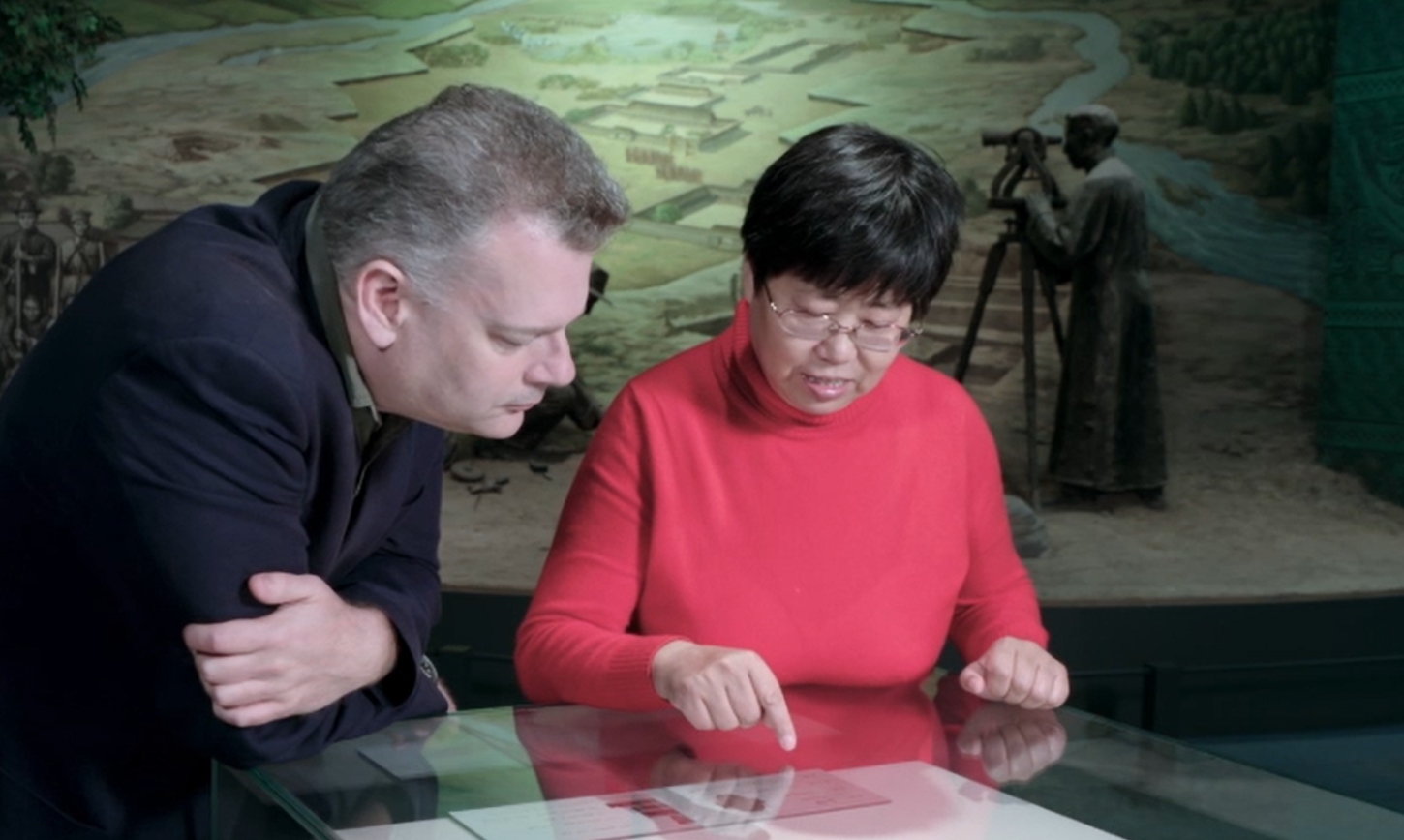
Ms Han is a happy lady who seems very animated and passionate about oracle bones, and subjects us to a 45-minute salvo of words about the meaning of the 150 most easily identifiable characters. She doesn’t seem to have been interviewed on camera before, and is fretful about “saying the right thing.” We have to explain to her what an interview is, which is to say that I will ask her questions, which she will answer. She seems to think that we will want her to give a one-hour lecture to the camera about her work. No, we insist, I will just ask her about stuff.
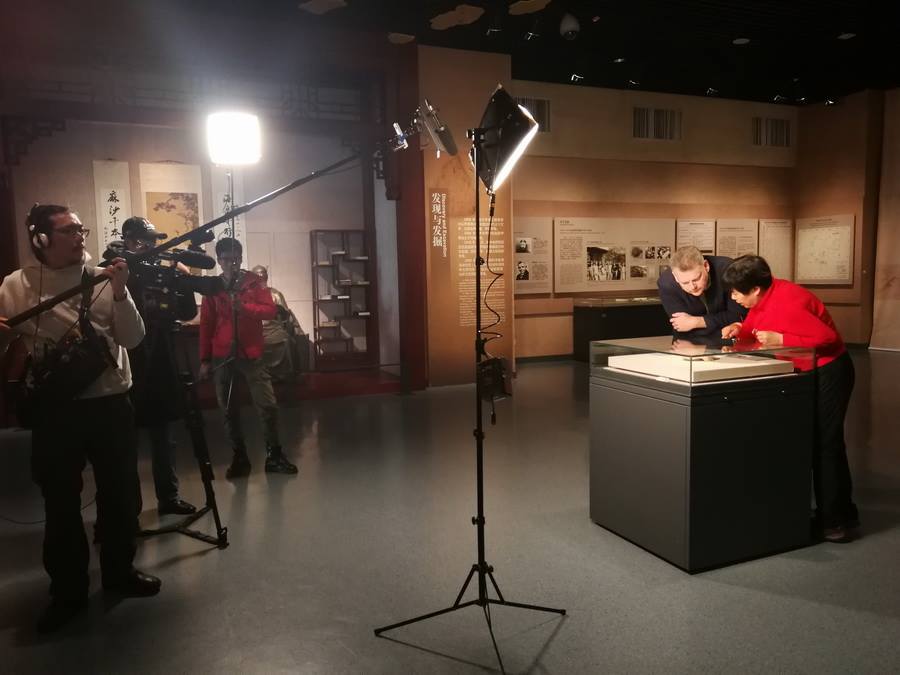
On several occasions, Clarissa the fixer has to practically walk her through the answer that we expect before she will deliver it, even though she just delivered it, word-perfect, off camera. Like a lot of Chinese academic interviewees, she has trouble understanding that we are supposed to be having a conversation, and it becomes easier to just mike her up, not tell her the camera is running, and let her talk away without the chance to get nervous. By the end, the director just wants us to walk through the museum gallery talking, but we keep stopping at displays to talk about the origin of the various characters, and the director shouts at us to keep bloody walking instead of finding out about things.
“Jonathan, stop being interested!” she yells from the other end of the gallery.
But I think Ms Han is enjoying herself. After previously saying that she could only fit us in on Monday afternoon, she has suddenly freed up all of tomorrow morning to invite us over to her college to sit in on a class, so I think she is starting to feel like a bit of a celebrity.
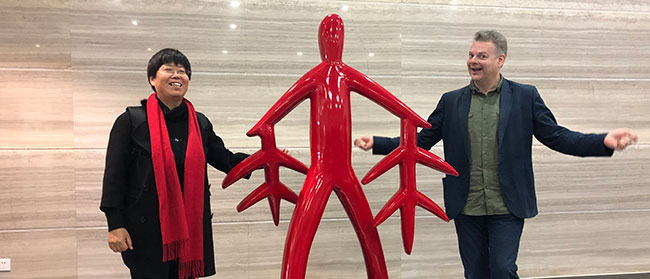
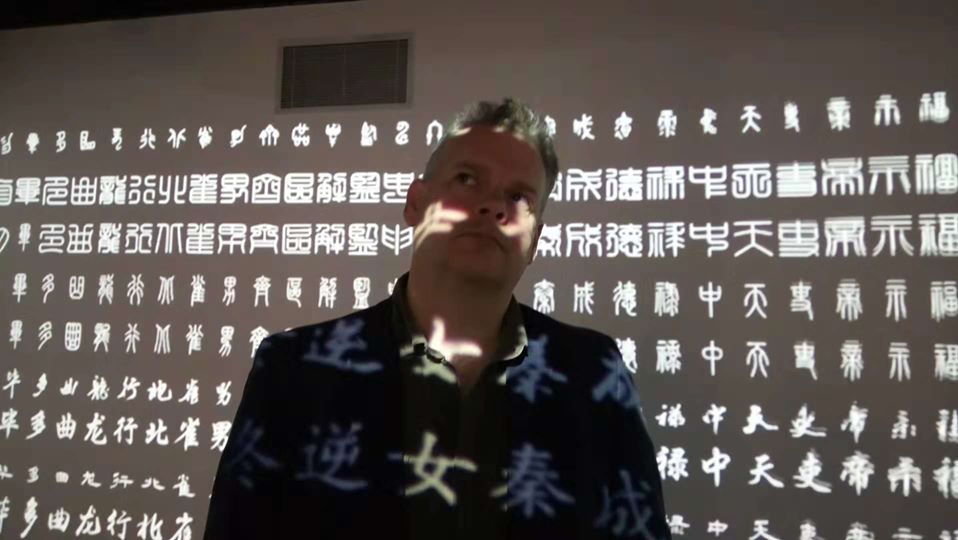
Ms Han’s faculty at Anyang Normal University is built around another museum of Chinese writing, which is far more immersive and engaging than yesterday’s. It’s got all sorts of fun art installations, including a four-wall display of animated characters that can be filmed playing across my face and surrounding me like a veritable sea of words. There are even life-sized statues based on ancient Chinese writing, such as the stick figure holding two oxtails that was the origin of the Chinese word for “dance”.
The Sea of Words, for those not part of the Chinese community, is the name of a famous dictionary of Chinese characters. I have a copy that used to belong to “Uncle” Don Rimmington of the Leeds University Department of East Asian Studies, although I am not sure he knows it ended up with me.
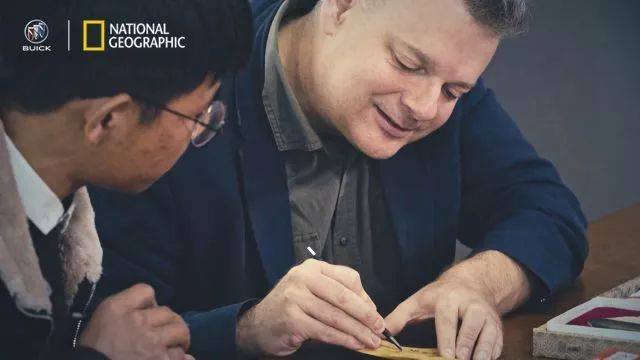
The university also have a little area where students can carve their own oracle bones, leading me to have a nice half-hour with a guy called Zhang, who patiently talks me through the process. He is very excited to see that I am deliberately getting things wrong so that he can correct the way I hold my chisel and the way I hold the bone. Unlike his teacher, Ms Han, he comes to realise that I am doing it to make him look smarter, and not that I am just irredeemably stupid.
Ms Han talks me through the simplest of characters from the Shang dynasty, the most basic 150 of which are simply pictograms.
“The Shang people tried to tag the simple points of difference between similar objects,” she explains. “So what is it that makes a cow different..?”
This is a difficult question to answer in Chinese when I don’t know the word for udders.
“The… nipples?” I suggest.
“No, you stupid boy. Everything has nipples. Cows have horns and a long face. Not like the goat, which has different horns, but still has nipples.”
All right, then. And the horse has a mane and a tail, and a tiger has a stripe. I get her giggling about some of my weirder guesses, and she gets so excited that she starts shouting “NO!” in English every time I get something wrong.
Jonathan Clements is the author of A Brief History of China. These events featured in Route Awakening, S05E02.
 The Official Schoolgirl Milky Crisis Blog