
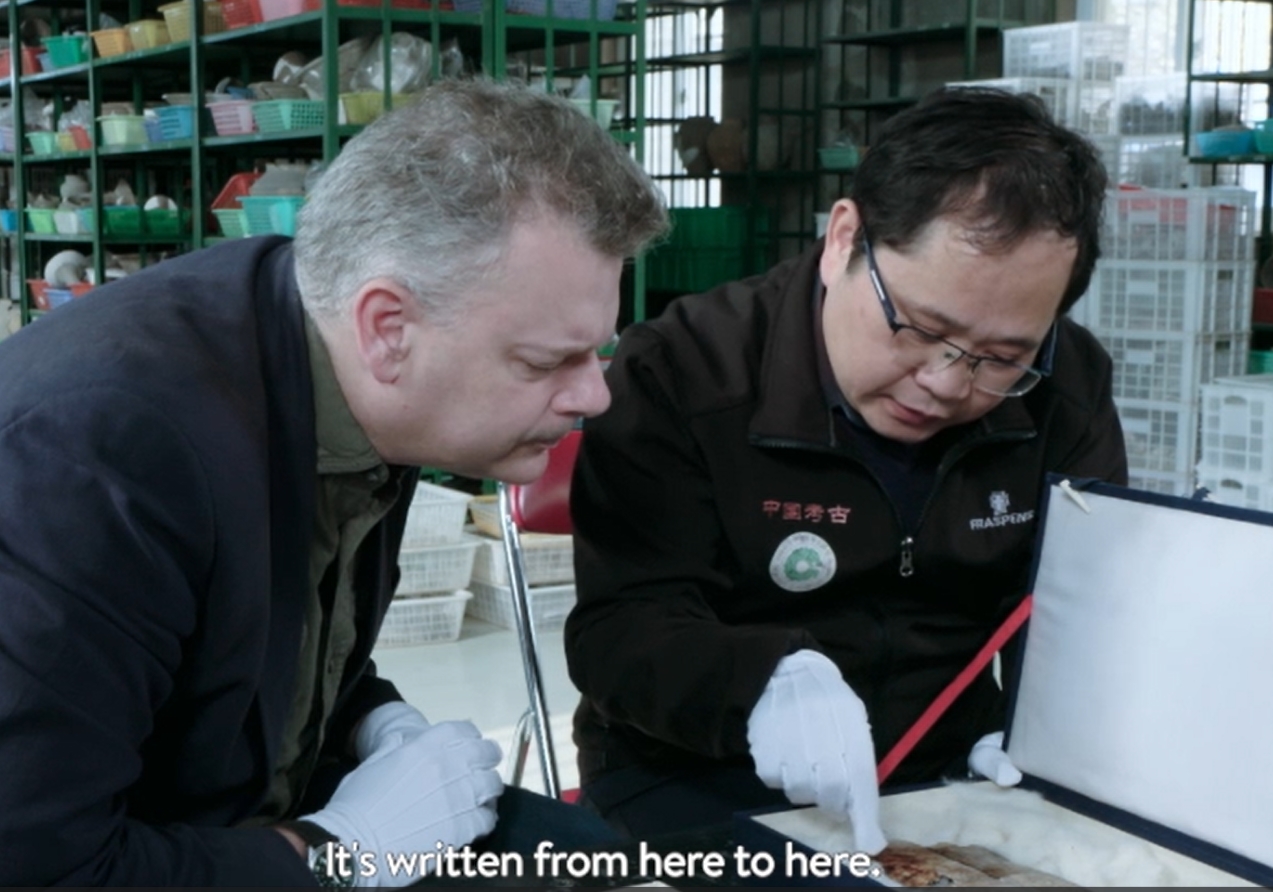
I must be getting good at this. Driving back to the Wastes of Yin, I know more about the site than the crew, because I already shot here once before. So I can direct the car and the van to the right institute, and point out Dr He, because I’ve met him before, and I can tell them that the meeting room is not the ideal place, because there is a warehouse upstairs full of relics that is more photogenic. I can also point out that if they want to get the lens really close to an oracle bone, Dr He has a bunch in a box that he will literally hold up to the camera.
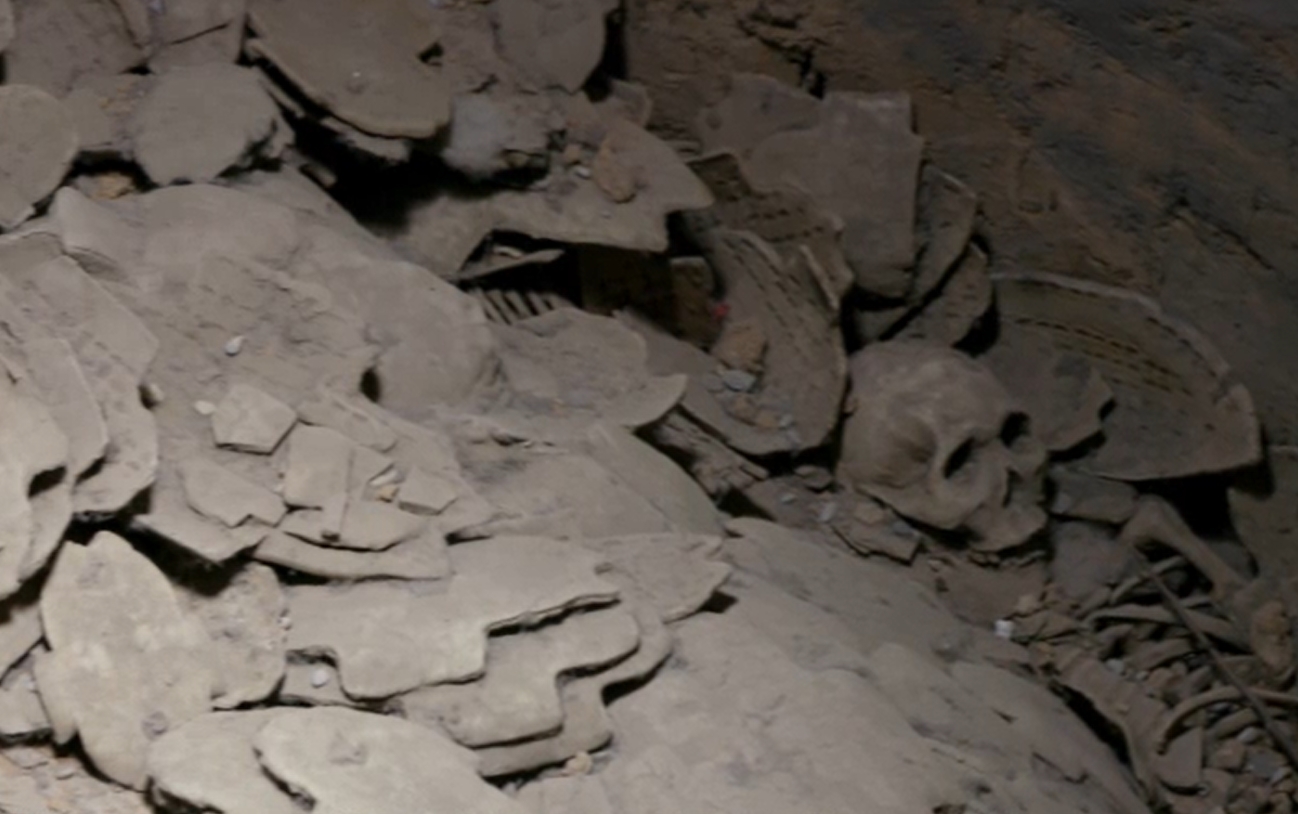
Dr He remembers me from the Chinese chariot shoot a couple of years ago, and so he is immediately at ease and merry. When it comes to the interview, in front of boxes marked HUMAN TEETH, DOG BONES, HUMAN BONES, COW HORNS etc., we rattle through in a single long take. I quiz Dr He about the problems of reassembling oracle bones, and the fun he had tunnelling through a Sui dynasty tomb and a Han dynasty tomb in order to get to the Shang stuff two metres down. He tells me that the size of the turtle plastrons used in divination usually suggest that they came from the river, but some of them were so big that they were liable to be sea turtles, thereby suggesting that the Shang dynasty had trade links as far away as Malaysia.
Of course, that doesn’t mean that there was some Malaysian Marco Polo who travelled all the way to Anyang. These things might have taken decades to drift from village to village until they ended up in the Shang capital. Dr He rattles on non-stop for 45 minutes, which delivers us 90 minutes of footage on two cameras. Time for the pick-ups and then we are out, as if we knew what we were doing.
Turtles are important, says Dr He, because they lived so long, but also as Sarah Allan has argued in The Shape of the Turtle, because they may have signified the shape of the cosmos to the ancient Chinese – a north, south, east and west around a central plain, and in the sky, a big dome overhead.
The Shang people were a bloodthirsty bunch. The Shang dynasty is the most popular topic among Chinese heavy metal groups, because after you hear about all the incest, human sacrifice and torture of the Shang kings, biting the head off a bat looks a bit everyday and soft. The on-site museum has trouble skirting around the fact that their royal graves are full of dead children, chucked in to keep them company in the afterlife, along with dismembered dogs and the usual dead horses, and a special ceremonial axe used for beheading enemies. I’ve read the oracle bones, so I know already about the boiled heads, burned slave-girls and other atrocities littering their tombs.
We finish up in the tomb of Lady Fuhao, the female general who led the armies of the late Shang, wife, or possibly sister, or possibly both to the king Wuding, who entirely by chance turns out to be the guy we know most about because Anyang was the site of oracle bone pits dating from his era. Fuhao’s tomb was miraculously undisturbed; she was buried not only with her signature C-shaped dragon rings and a gaggle of dead slaves, but a collection of bronzes that were already quite ancient when they went into the ground. Some of Fuhao’s bronzes were specifically cast as grave goods (we know this, because they included her posthumous title), but others were seemingly part of what today we would have to call her antique collection.
I felt today that I was really earning my money, and that the crew were really on top form snatching footage, sometimes, when the drone was up, with three cameras running at the same time. What with all the shooting on 4K resolution, as future-proofing against TV channels that might insist on higher quality film in future, we are generating two or three terabytes of data every week. Michelle the assistant producer has to stay up each night uploading it to a server in Hong Kong so the editors can get to work.
Jonathan Clements is the author of A Brief History of China. These events featured in Route Awakening, SO5E02.
 The Official Schoolgirl Milky Crisis Blog