
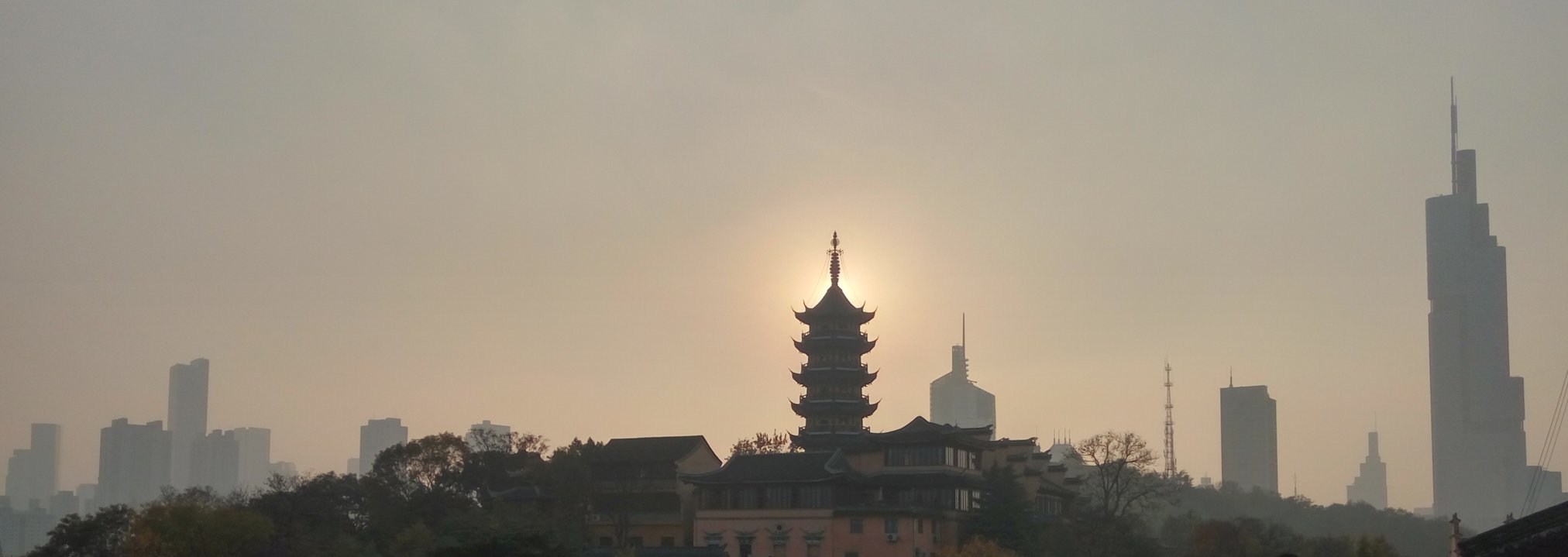
In 886, during the last days of the Tang dynasty, the poet Wei Zhuang dropped in on Nanjing, once a great capital, now a forgotten backwater, its walls in disrepair, and its canals choked with weeds. He wrote:
Drizzle on the river, and the reeds grow high / The Six Dynasties are but a dream, and the birds call in the sky / Cares not the willow by the walls / Ten leagues around in the smoky mist.
Nanjing has improved a lot in the sun. The remains of the walls still bracket a sizeable chunk of Xuanwu Lake, just to the north of the old city, and are dotted with Ming- and Qing-era cannons poking from the crenellations. The park is nice with autumn trees and the Jiming temple looms above outside the city walls. So we ought to get some nice shots that make Nanjing look less like an urban jungle in the rain, and more like a pleasant bit of park life. The Propaganda Bureau should be pleased, as well they should be when the woman who mans the gate to the city walls insists on taking a photograph of us filming the sign so she can send it to her boss.
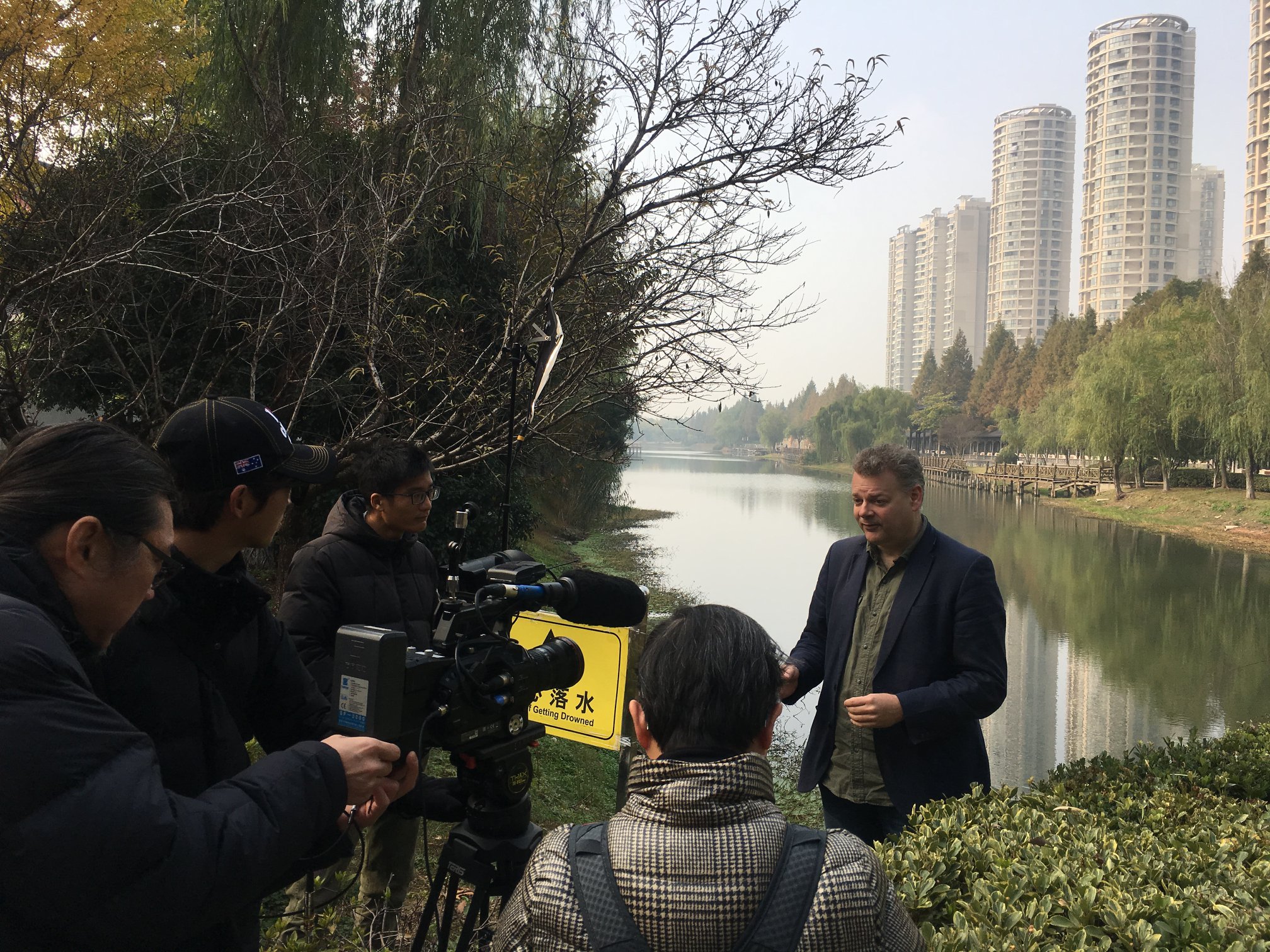
We put on the most ridiculous charade of setting up a shot by the sign, with me not bothering to take off my sunglasses, Mickey the sound man not bothering to boom, and Eric the cameraman not even starting the camera.
“Are we rolling?” calls the director.
“Nope!” says Eric, with a thumbs-up.
“Action!”
“I’m standing here next to a sign,” I say earnestly, “while a woman in a mustard yellow puffa jacket films me with her phone.”
“And cut!”
Michelle rushes in with her clapperboard and brightly says: “Waste of Time Fake Thing, Take One!”
We lurk around the walls for a while, which are picturesque but thick with flies, and then head off to the Longjiang Shipyard Ruins.
The layout will be familiar to anyone who has been to London Docklands. Three long strips of water, each the size of an airport runway, run in parallel through what is now billed as a park. But this park was the site of the Ming-era shipyards where the Treasure Fleet was built, and from where it set sail, down the Yangtze and as far as Africa. The lakes are all that remains of docks four, five and six. One, two and three, of similar size, are buried somewhere under the nearby housing estate.
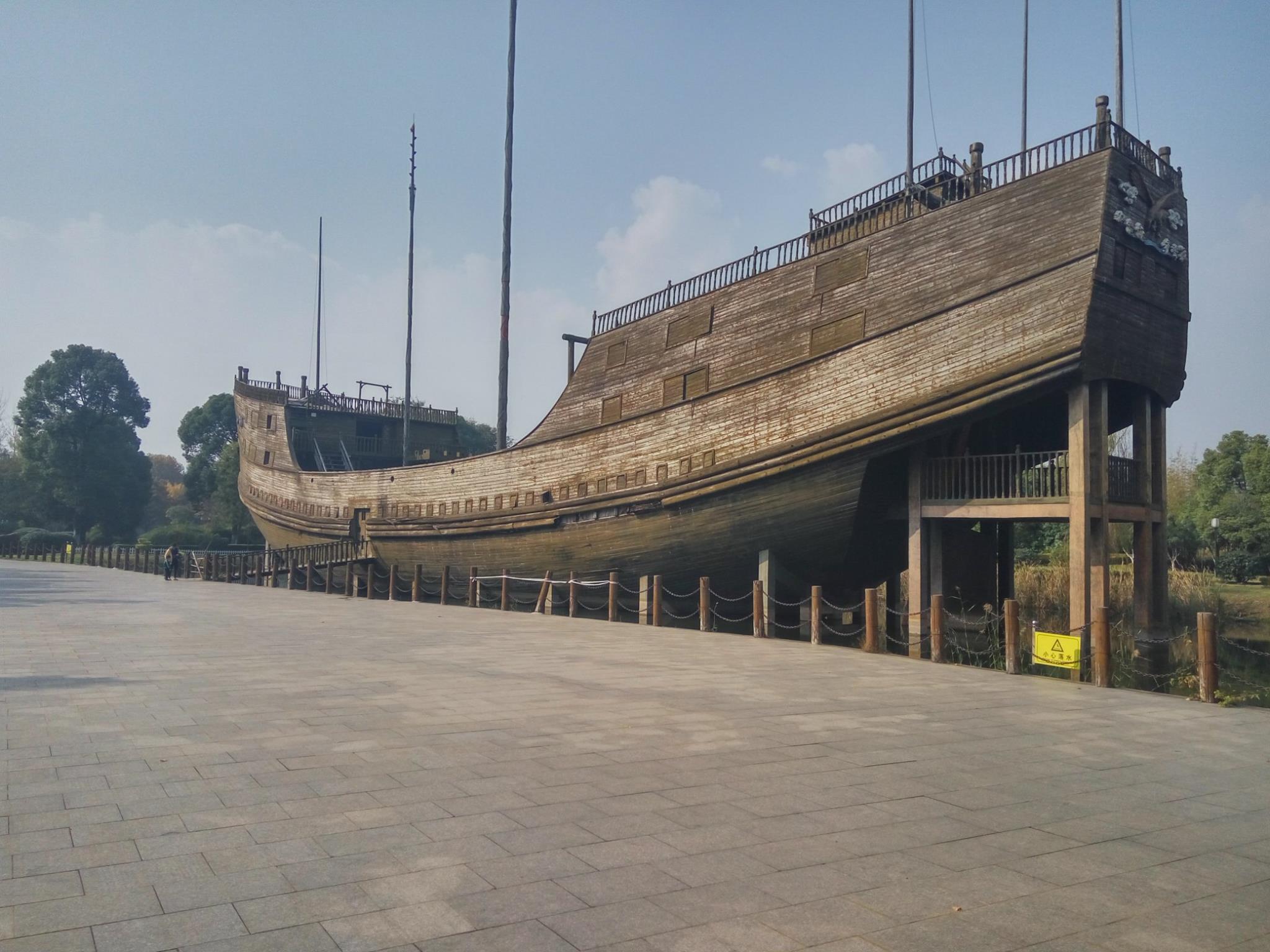
Everybody knows the story of Zheng He, or at least thinks they know: the boy captured at the fall of Yuan-era Yunnan, castrated and shipped off to Beijing aged ten as a slave to the Yongle Emperor. Originally named Ma, short for Mohammed, for he was a Muslim, he was renamed Zheng in honour of his spirited defence of the Zhengcunba reservoir during the dastardly Yongle’s grab for power. Eventually put in charge of the Treasure Fleet, he set sail for the south and the west in 1405 on the first of what would become seven voyages, designed to tell all the natives in far-flung kingdoms just how awesome China was. When he came home, he turned up with a giraffe, so everybody was happy. Just for kicks, I pace out the rudder in the museum, which is 14 metres long, with a flappy bit that comprises the bottom six metres. The people from Propaganda, ever willing to say no to everything, have told us that we can film in the dockyards but that we can’t film the replica ship at one end of it, because it might be moved by the time our film broadcasts. Or it might not.
Suspicious, I pace out the length of the ship and find it to be 73 metres – a perfectly reasonable size for a Chinese trading galleon, but nothing like the aircraft-carrier sized behemoths claimed by some of the world’s more breathless popular historians. The shipyards are very long indeed, but even the artists’ impressions in the nearby museum show several ships being built at once in any single dock. They were not, and never were intended to hold single giant galleons. If they were, there would not have been enough turning space to get them out of the gate and into the Qinhuai River to sail down to the Yangtze and out to sea.
Jonathan Clements is the author of The Emperor’s Feast: A History of China in Twelve Meals. These events featured in Route Awakening S05E06 (2019).
 The Official Schoolgirl Milky Crisis Blog