

Today, Mr Jiao is supposed to be showing me the remaining parts of the process for making hempen Bai Yi clothes. We’ve been shooting the process out of order, so it’s only on day two that we get to harvesting the hemp itself. He takes us to a tiny little patch of weeds at the edge of a cornfield – it is no bigger than a minibus, but turns out to be the only hemp in the village. The director’s plans to have us wandering through acres of it has to be rewritten on the spot.
She decides instead to do an aerial drone pass of the pair of us reaching the patch, where three Bai women in their black wimples and blue tabards are hacking at the copse with sickles. But they are so quick at it that the director has to beg them not to cut it all down before we can get to the wide shot. I am told to stand in the field with Mr Jiao and talk to him about hemp, not the world’s most riveting subject. Our drone is supposed to sail over our heads, recording us and the village above us. Except suddenly I hear a sound like a hedge trimmer hitting a bucket of turtles, and realise that the overhead shot has failed to take into account the presence of terraces. Our Yuneec Q500 Typhoon has scythed its way several feet into a stand of corn before coming to a halt, meekly bleeping a distress signal. Mr Jiao fishes it out and returns it, minus one propeller. Luckily, we have spares.
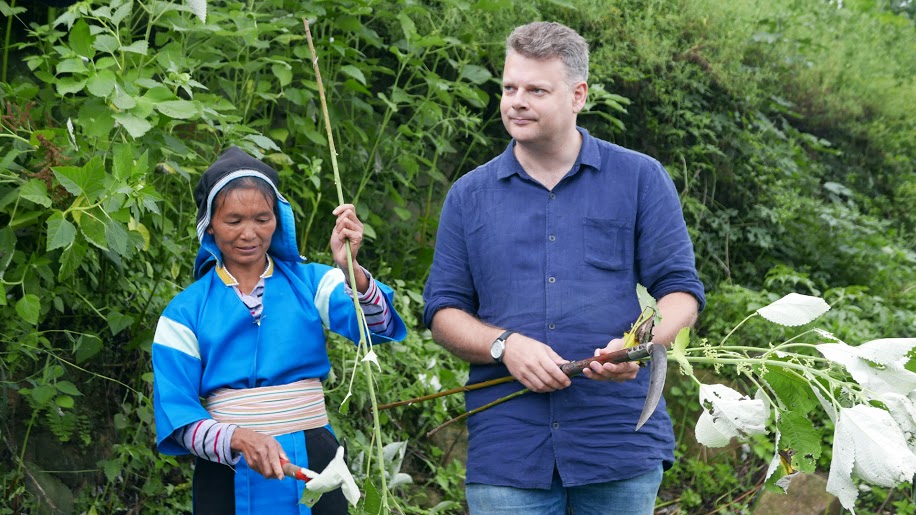
Meanwhile, the wimple-wearing sickle-girls have got bored. One has wandered off entirely, and the other two are stripping some of the hemp stalks to make a basket. They have to be herded back to work. I manfully wade in with a sickle, and hack out a bunch of hemp stalks, stripping their leaves away and casting aside the long stalks. I put the leaves in a basket and head up to Mr Jiao, feeling pleased with myself.
“What are you doing with those?” he asks.
“These are to make the thread, right?”
“No,” he says. “We feed the leaves to the pigs. It’s the stalks that we use to make the thread.”
There is the sound behind me of furious crossings-out in the director’s notebook. As we move on to the huocao stripping and the hemp bark stripping. We are running so late now that the director just puts the camera on the ever-changing numbers of women in wimples, and tells them to get on with it.
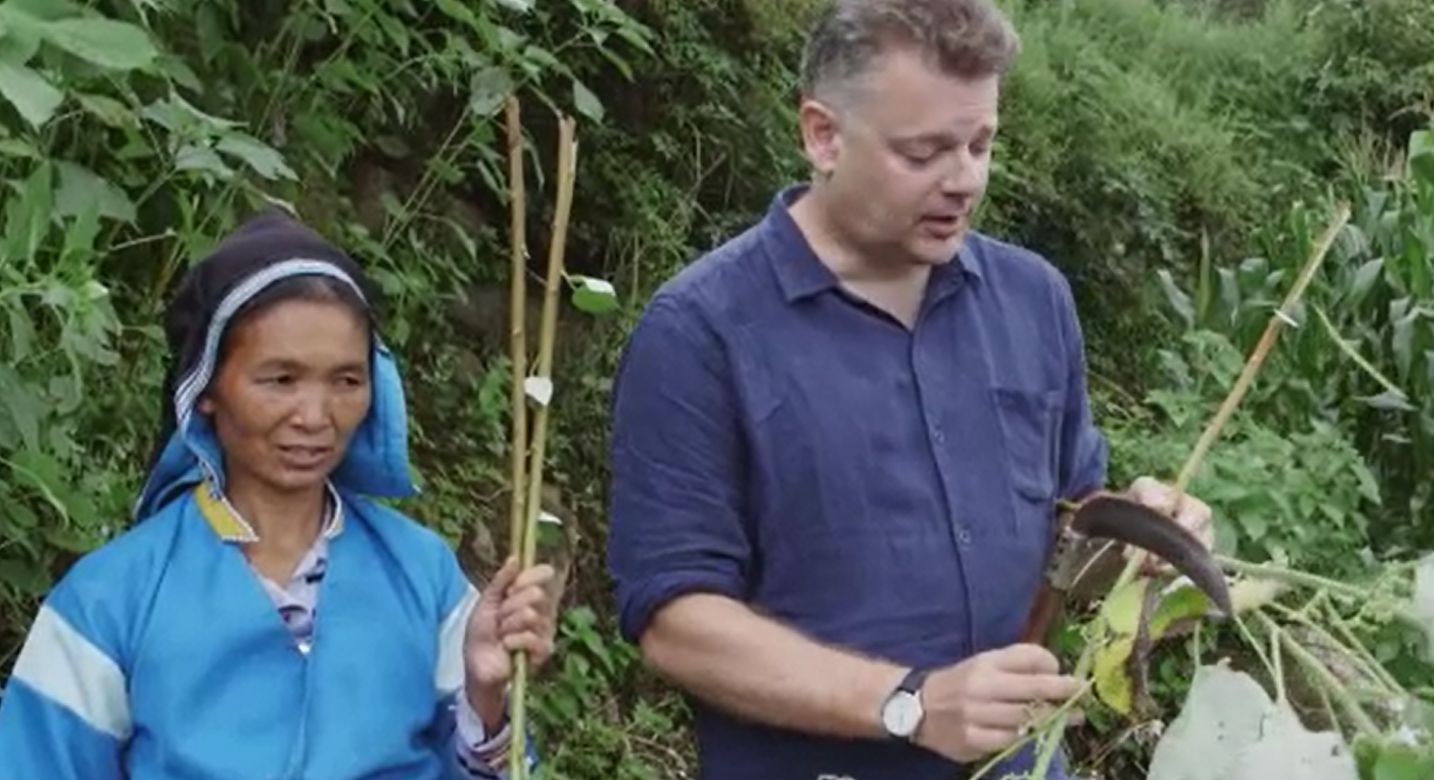
“I can’t help but notice,” I hiss to her behind the camera, “that we have basically spent two days filming a documentary about string.”
At last, we have the result, or rather, one they made earlier. To great fanfare, I hold up Mr Jiao’s Bai Yi traditional tunic, a grotty thing which has not seen a steam iron in the last decade. Making it takes up half a harvest of hemp from their little plot, which turns out not to be theirs at all, but shared by the whole village, who must now wait six months for another crop.
He proudly puts his tunic on, while explaining that it used to be daily wear, but in a common refrain, “nobody can be arsed” and so now they only wear them on special occasions. He tops the ensemble with a blue belt and a man-bag made of leather, which he keeps his phone in.
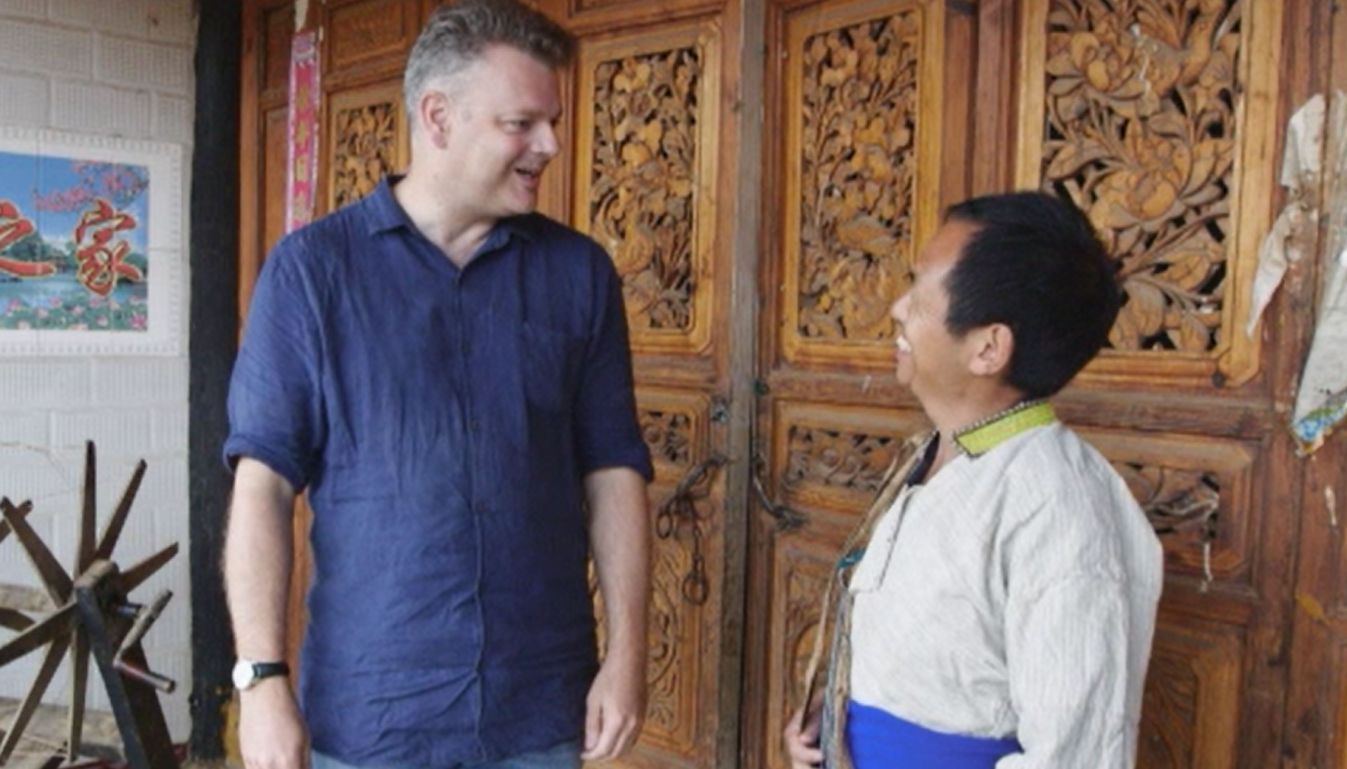
“Suits you,” I can’t help saying, and he giggles in response.
We are already two hours late for the three-hour drive to Xizhou. The director pleads that we can’t stay for dinner, so we are waved off with a sack of pomegranates, some fresh-made poppadoms, and some nan bread. There is a cup of home-made chili sauce that goes with them, but our fixer drops it in a cowpat on the climb up the hill back to the minibus.
Jonathan Clements is the author of A Brief History of China. These events featured in Route Awakening S02E04 (2016).
 The Official Schoolgirl Milky Crisis Blog