
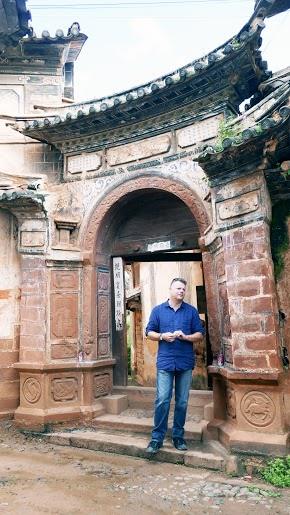
We are now in Xizhou, near Dali, in an area that is largely Bai, and which has somehow embraced heritage in a way entirely unlike the rest of China – I have not seen a skyscraper for two days. Closer to the coast, “heritage” seems to mean that everywhere gets a shopping mall and a car park, and a bunch of hawkers selling plastic machine-guns. But out here, it means that the old architecture is retained, with acre upon acre of quaint pointy-gabled houses, temples and taverns.
Green foothills loom above us on all sides – they will eventually merge into the Himalayas. This is the locus of the old Tea-Horse Route, a lesser-known trade network that sent tea into Tibet to buy ponies for the Chinese market. Salt, tea and trinkets would cross over the mountains into Burma, often carried by porters lugging their own weight or more, singing a song that went:
Six steps up and rest
Seven steps down and rest
Eleven steps flat and rest
You’re stupid if you don’t rest.
I’ve heard that someone would bang a gong at the end of each verse, signalling the next brief stop. Two hours’ drive into the mountains bring us to Shaxi, once the centre of the Tea-Horse network, now a slightly-touristed heritage town, selling wood carvings and Yunnan coffee. The place is plainly on the backpacker trail, and boasts an untold number of boutique cafes, tea houses and restaurants. Lunch is dry-fried beef in crisped mint leaves, Yunnan ham in tofu and goji berries, and tasteless mushroom fronds harvested with a sickle from the nearby canal.
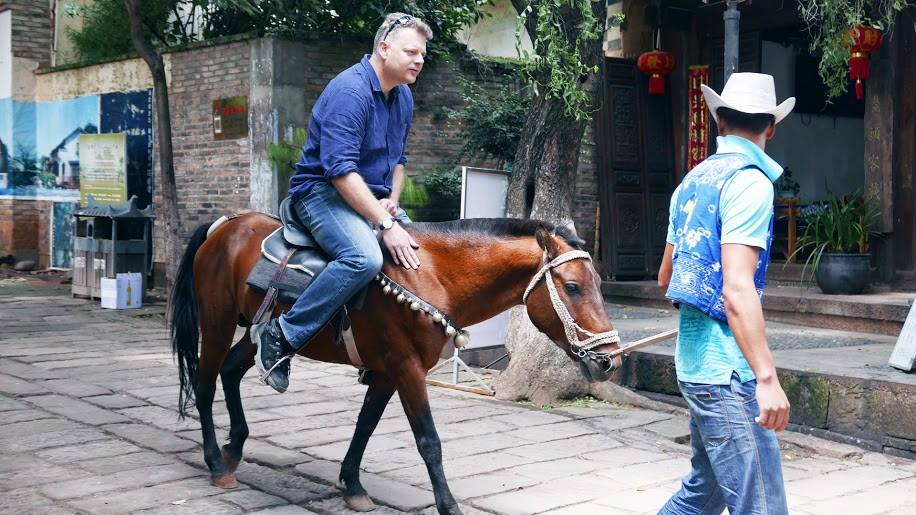
My job is to walk around town reiterating what I’ve just told you, until two Bai dressed like Marlboro Men trot past on ponies. A price is swiftly agreed, and I am hoisted up onto Zhitu (Red Rabbit), an uncomplaining little horse supposedly descended from the pack animals of the old trading routes, so that I can continue my explanation while riding along. I look ridiculous, like a gorilla perched on a sausage dog. I am taught how to say whoah in Bai, which turns out to be waah, something I would probably end up saying anyway if Red Rabbit were to bolt. But we walk through three iterations – a wide-shot, a close-up and a safety, and he doesn’t throw me, and I clamber down and tell him he is a good little horse before I kiss him goodbye.
“Why did you do that!?” asks the aghast director.
“I’m British,” I explain. “We only show affection to dogs and horses.”
Jonathan Clements is the author of A Brief History of China. These events appeared in Route Awakening S02E01 (2016).
 The Official Schoolgirl Milky Crisis Blog