
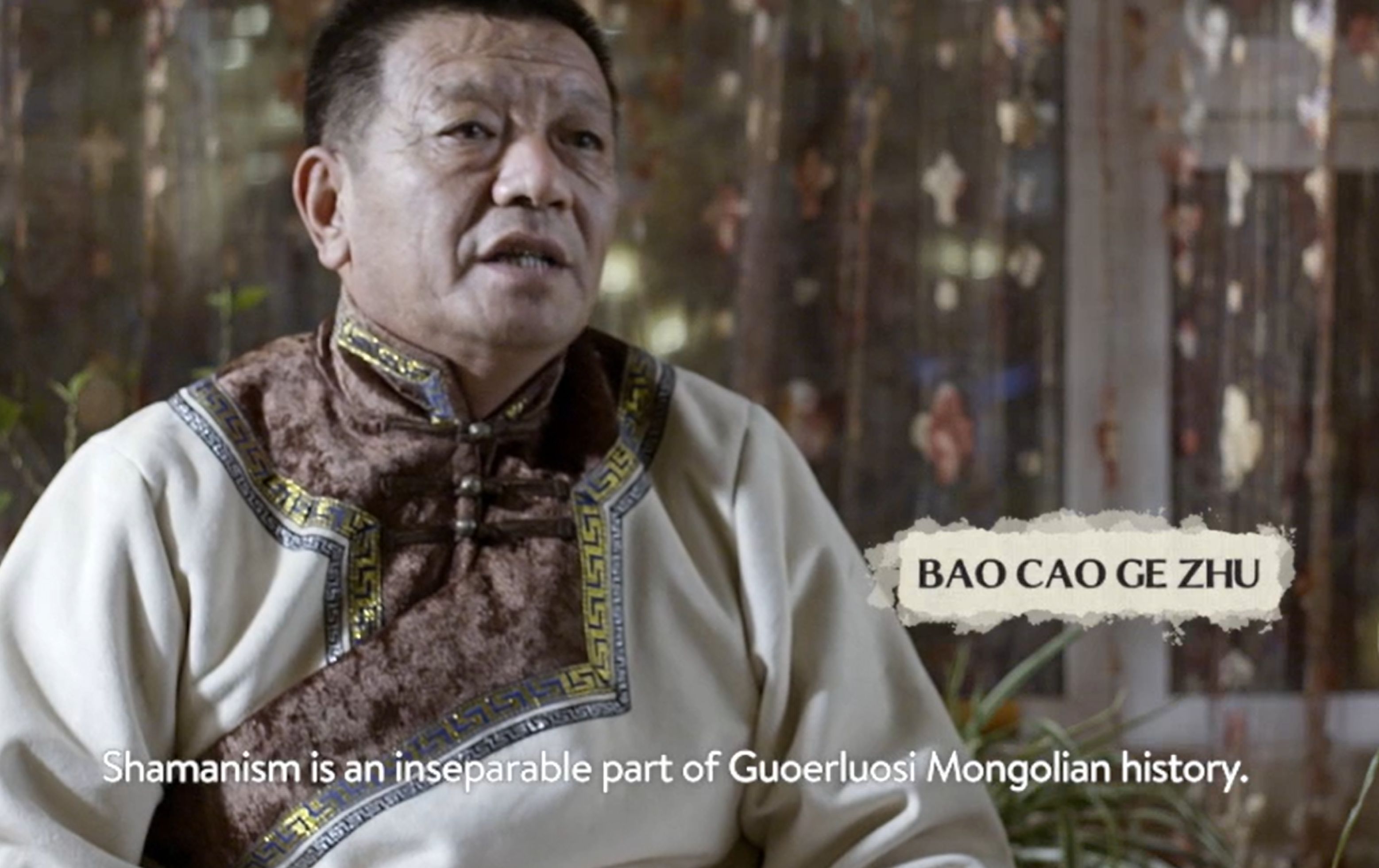
Mr Bao has turned up in a long Mongol robe with a trilby perched incongruously on the top. He is here to talk about the intangible cultural heritage of Mongol epics, which he sings and talks through while playing a sihu.
The sihu is a fiddle-like instrument, like the erhu, with a soundbox at the base, a long shaft held perpendicularly, and four strings, played by a double-stringed bow so that two strings are sounding at any one time. Mr Bao’s performance includes a bunch of little tricks, adding vibrato by shaking the shaft rather than the strings, adding a drumbeat by clicking the edge of his bow on the soundbox while he fiddles, and flicking the strings to make them thrum. All the while he sings and yells through the story of Toqta-Temur, the last non-Muslim leader of the Golden Horde and the great-great-great grandson of Genghis Khan. Toqta spent a large part of his “reign” fighting off civil war with other Mongols and insurgencies by the peoples of Eastern Europe, which leaves plenty of time in his epic to talk about his attacks on the Russians his war with his cousin and former ally, Nogai, to whom he had once rashly given the Crimea.
Late in his reign, around 1304, he and his cousins accepted the authority of the grandson of Khubilai Khan, thereby restoring peace to the Mongol Empire that had, in fact, not been peaceful at all at any previous point. He declared war on Italian merchants in the Caucasus, and eventually married a weeping teenage bride, Maria Palaeologus, the daughter of the Byzantine Emperor. But none of us get much of the above, because Mr Bao is singing in Mongol.
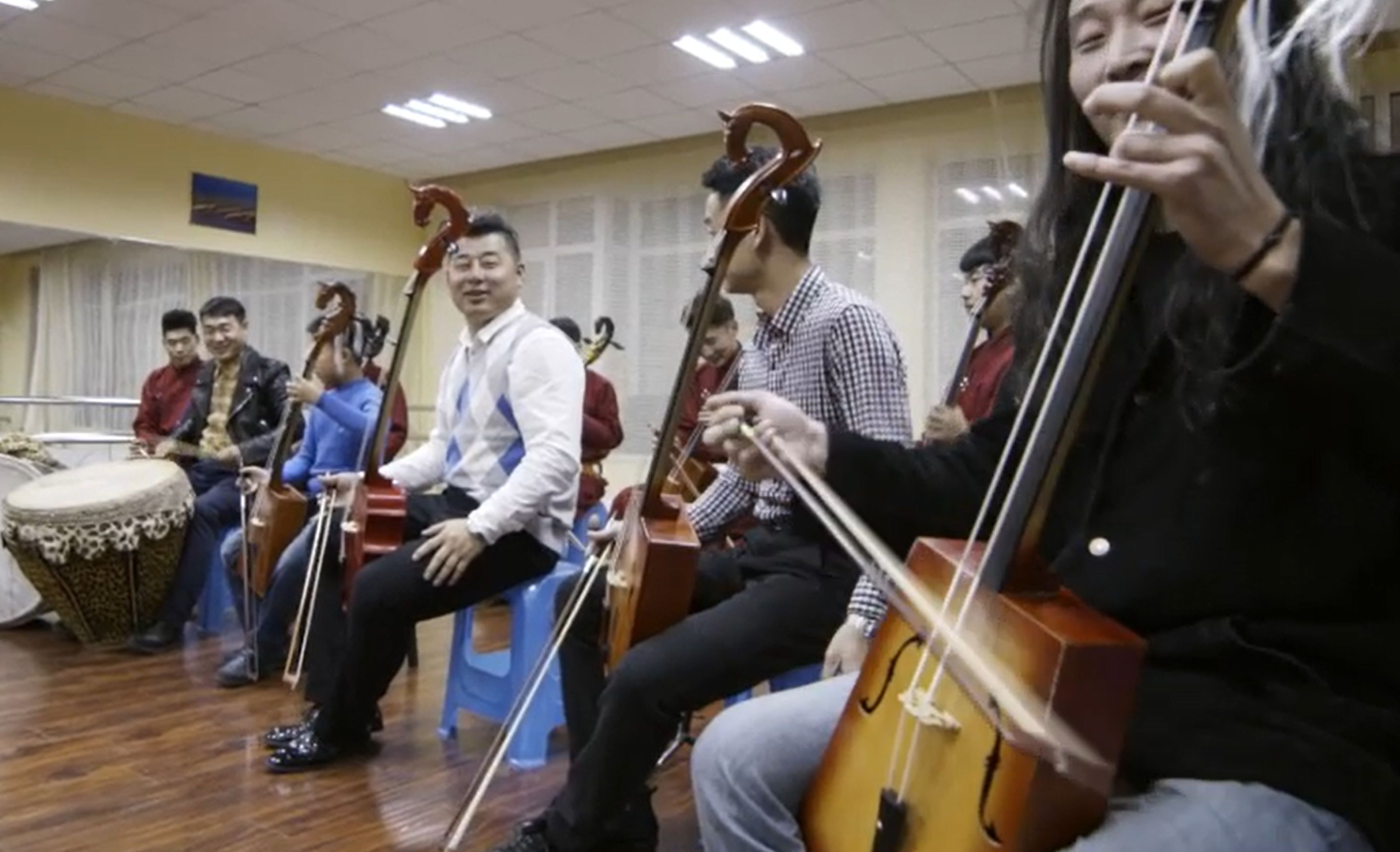
Late in the day, we relocate to the Mandula music school, where a man called Mandula leads the Mandula band. It’s a proper hothouse for the musically gifted. Lessons start at half past seven each morning, with normal schooly-type stuff up to lunchtime. From one o’clock to half past eight each afternoon, the tuition is entirely musical. Mandula is something of a teddy boy, favouring a long purple coat and well-polished winkle-pickers, as well as an impressive mohican. He has something of the rock star about him, but has accreted an impressive array of students – a bunch of youths playing erhus and sihus, as well as a statuesque singing girl in a searingly white slinky dress and a Mongolian dildo hat, several drummers, a man who plays an instrument made from a string of sheep’s kneebones, and a gaggle of groupies. This last group seems to serve no actual purpose, but clutter up the practice hall, sneaking photographs of the camera crew on all occasions. I am sure that within a few weeks, framed pictures of the National Geographic crew will join those already on the wall of his students with various C-list celebrities, and/or clutching prizes for princely sums like £10.
We shoot them playing a 20-minute set that I wish I could have bought on CD, although sadly we will be unable to use the moment when Mandula got bored and decided to break into the Game of Thrones theme – music clearances.
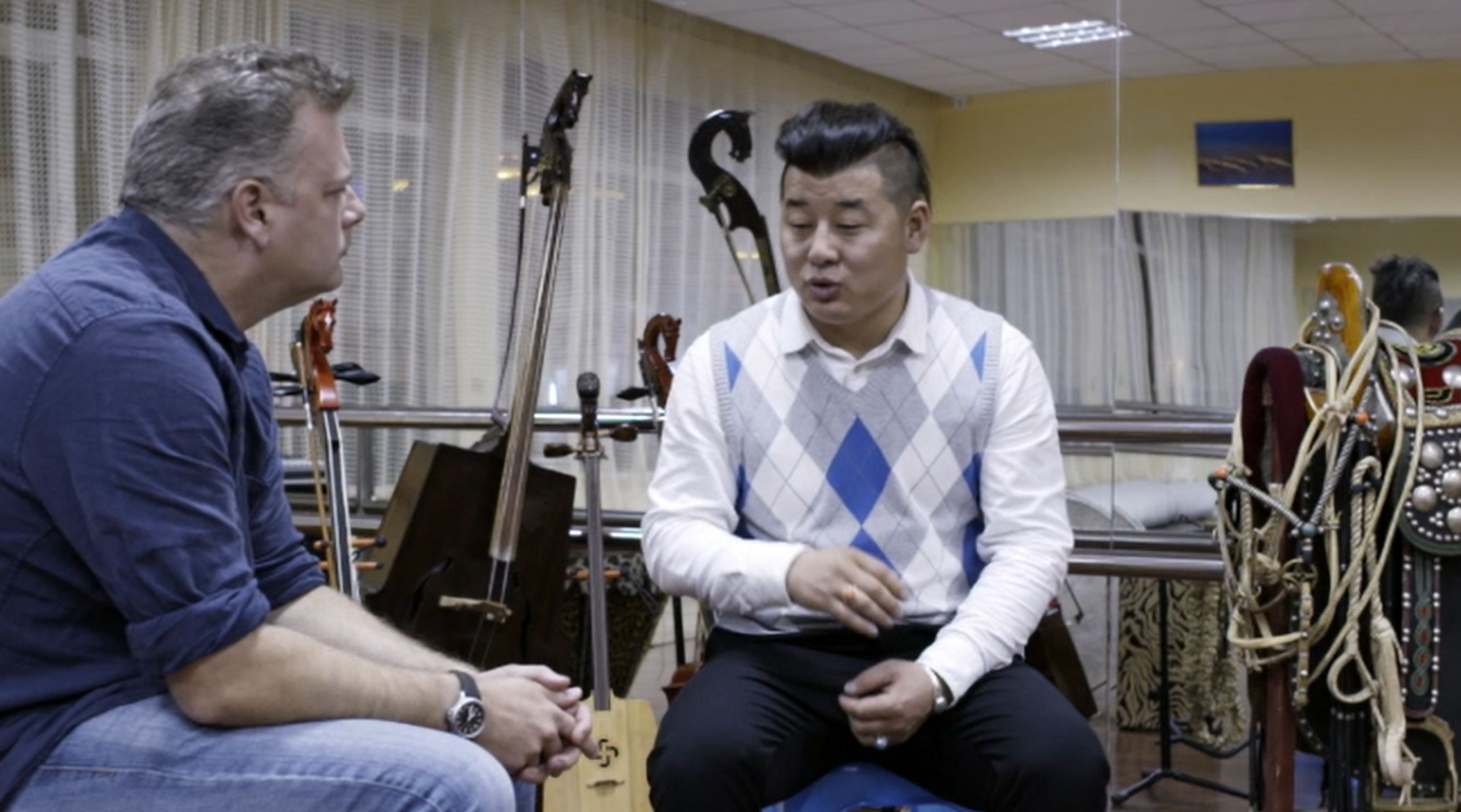
I am really enjoying being with the Mongols. They are easy interviewees, talkative and friendly. One doesn’t feel that one is dealing with a hostile witness, but instead with someone who enjoys the attention and is keen to make a good impression. Mandula in particular, who has written a book of horse-head fiddle music and appeared several times on some sort of national show like China’s Got Talent, has got plenty to say for himself, and gamely tries to teach me how to do the droning Mongolian throat-singing called khöömi. It takes three months to learn, apparently, so there is not much hope of me getting it right in ten minutes, but there is plenty of fun footage of us growling at each other, bibbling our lips and impersonating goats.

Mandula then reveals that as well as leading a band of Mongols, he has attempted to integrate ancient and modern by combining khöömi with rapping. This seems too good to resist, and so the director asks him to give us a whirl. He throws his teddy boy coat behind him, where there is a minion poised ready to catch it, and launches into a beatboxing horror that sounds like a herd of goats falling down some stairs in an echo chamber.
The director gets us to finish by droning at each other: OOooooOOoooOOeeeh, OOowowooowowo, Errrrrrgle. I’ve had worse Wednesday nights.
Jonathan Clements is the author of A Brief History of China. These events featured in Route Awakening (S03E03), 2018.
 The Official Schoolgirl Milky Crisis Blog