
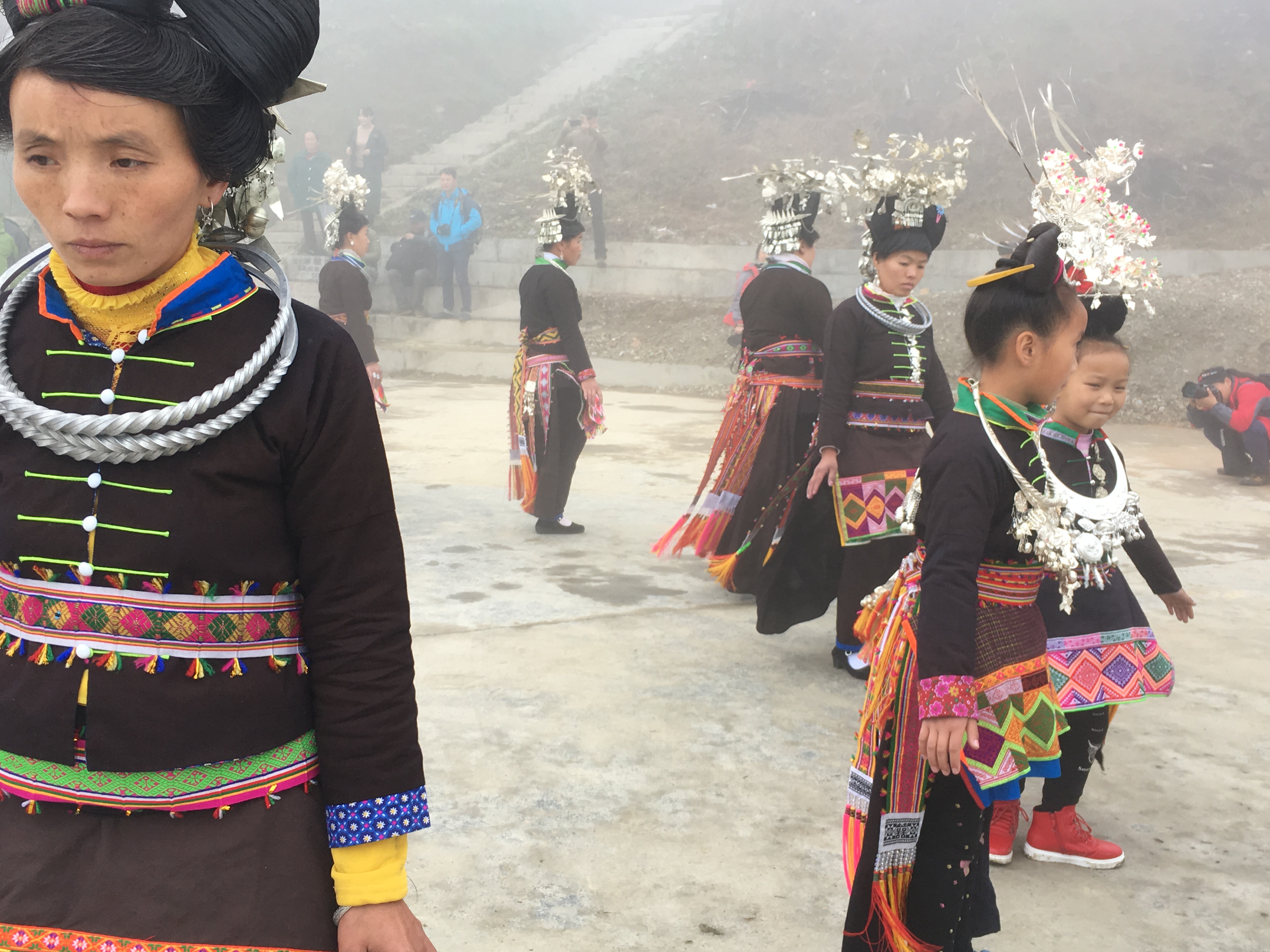
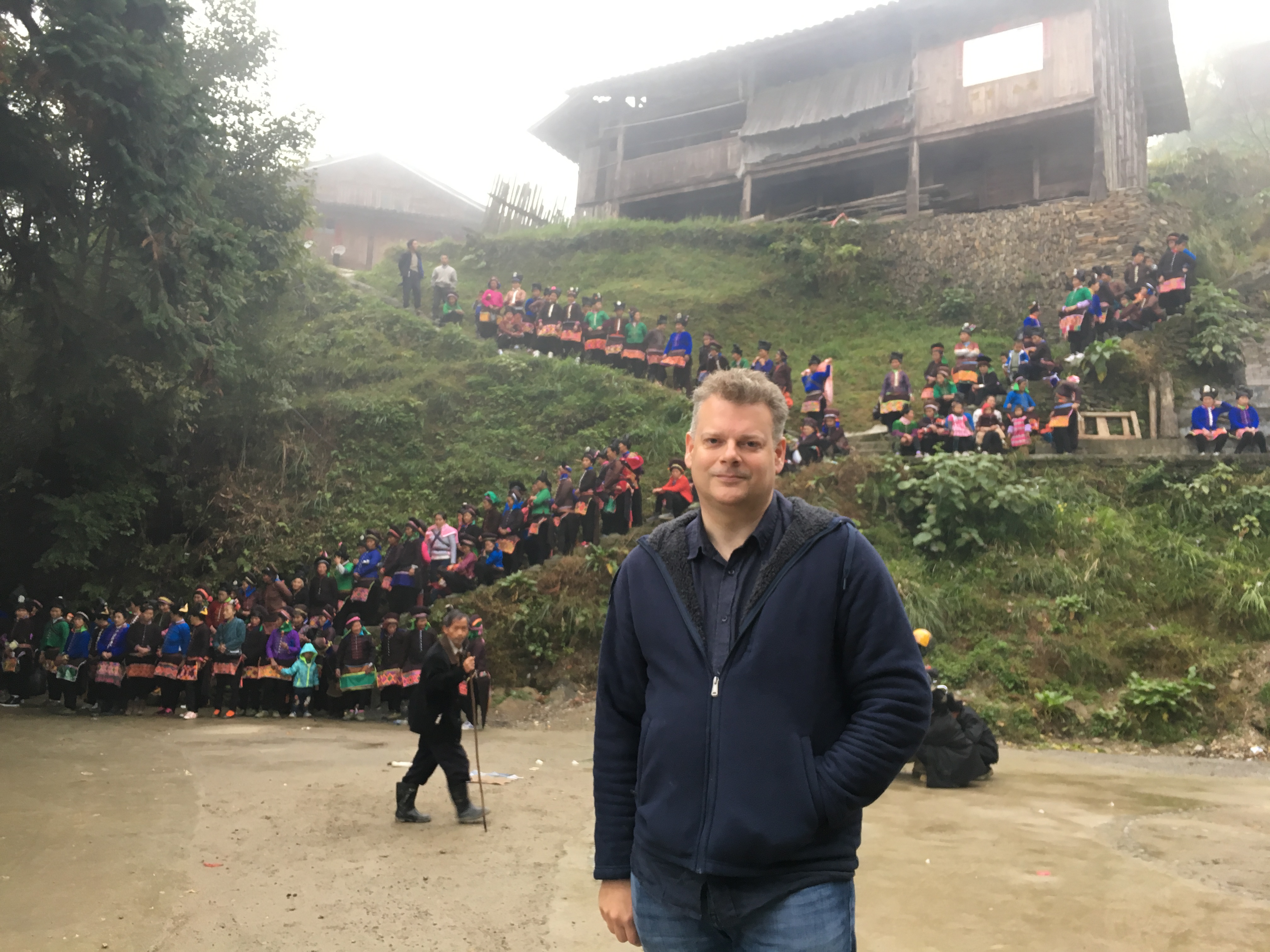
Breath freezes in the air in the morning, and there is no view past the next house, since we are level with the clouds and the whole place is shrouded in fog. I grit my teeth and dowse my hair in cold water in an attempt to get it to assume a reasonable shape. Nobody elsefrom the crew wants to wash.
The fog has not lifted. If anything, it is even worse. We cannot see to the next house, let alone the allegedly stunning vista below. The hill-climbing race has been postponed, if not cancelled, and there is no point in sending up the drone, because all it will be able to film is the inside of a cloud.
With nothing else to shoot, the crew are trying to get footage of the family cooking in their kitchen, but there are already six photographers blocking the view and getting in the way. Some of them are wearing the logo of the Guizhou Photography Club, and have plainly been bussed in with the same vague hope as us of catching something suitably ethnic.
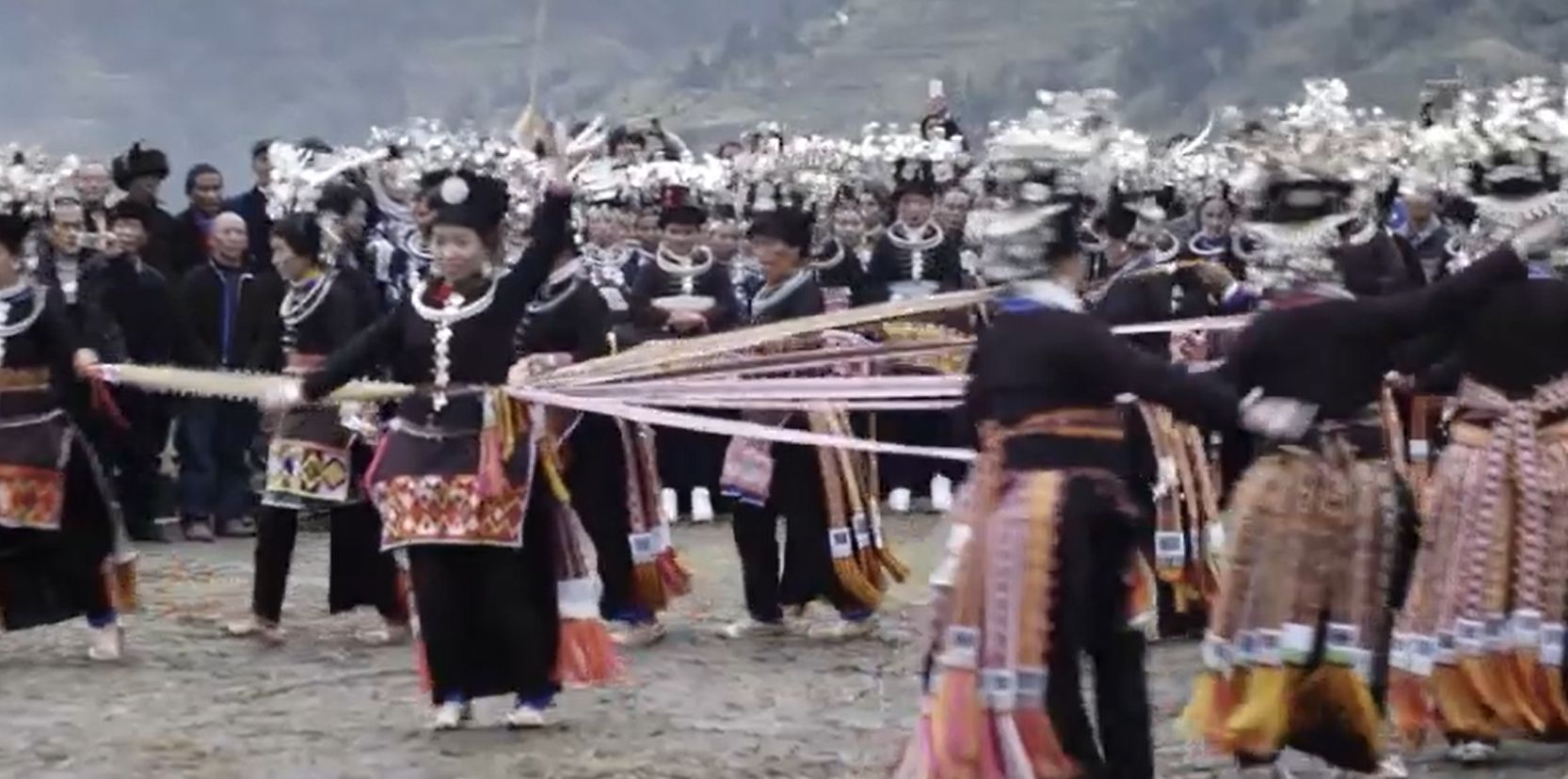
The Miao village women are assembling for the Pheasant Dance in the square. A lusheng band, some of them carrying instruments twelve or more feet high, are blowing a farty, unchanging tune that sounds like The Doors trying to tune up to play “Light My Fire”, with an additional unnecessary tuba player co-opted into the band. The Pheasant Dance involves making a half-hearted motion with one’s hands, as if skipping with an invisible rope, and then shuffling left-left-right-right-left-left-right, endlessly, endlessly, for hours.
There are fourteen or so dancers and a five-man band, already outnumbered by a crowd of photographers, toting expensive Nikons and Canons that they seem ill-equipped to use, with lenses that cost more than a year’s wages for some Chinese. Our cameraman is already getting pissed off with the two dozen, then soon three dozen interlopers, who keep ruining his shots, wandering into the frame and talking over the music. There are even several foreigners – desiccated pensioners with Tibetan jackets and Spock haircuts, grimly pointing their own cameras at the mess.
The village women are crowned with elaborate headdresses topped with pewter birds and foil ribbons, wearing dresses that give them bulky hips, tailing embroidered streamers. The embroidery is all done themselves, serving as advert for their potential wifely skills.
The crew and I lurk around the village gate, where we are soon accosted by a bunch of local characters. There is the drunken, bespectacled man from Beijing, who has plainly necked far too many dishes of welcome booze, and wants to talk to me about Northern Ireland. There is the local Party secretary, whom I have dubbed Man With a Stick, because he walks everywhere with a nobbly branch that he insists is used in massage techniques. And there are two giggly girls from a Beijing college who want their photograph taken with me because they have never met an American before. And they still haven’t.
A Pheasant Dance competition breaks out in a drained rice paddy… well, partly drained, as my shoes soon discover. Different Miao tribes compete over their interpretation of the Pheasant Dance, but since the music is the same every time, and you can’t score them for having better headdresses just because they come from a different tribe, the judges (and indeed the crew) resort to judging them on entirely arbitrary criteria – matching shoes, boob size, and whether or not they look as bored as we are. There really is no contest, since the last group on is the local girls from this village, Maniao, who actually have a bunch of different steps and a Eurovision costume-change gimmick where the outer dancers grab the skirt ribbons of the lead girl, and form a pheasant tail behind her.
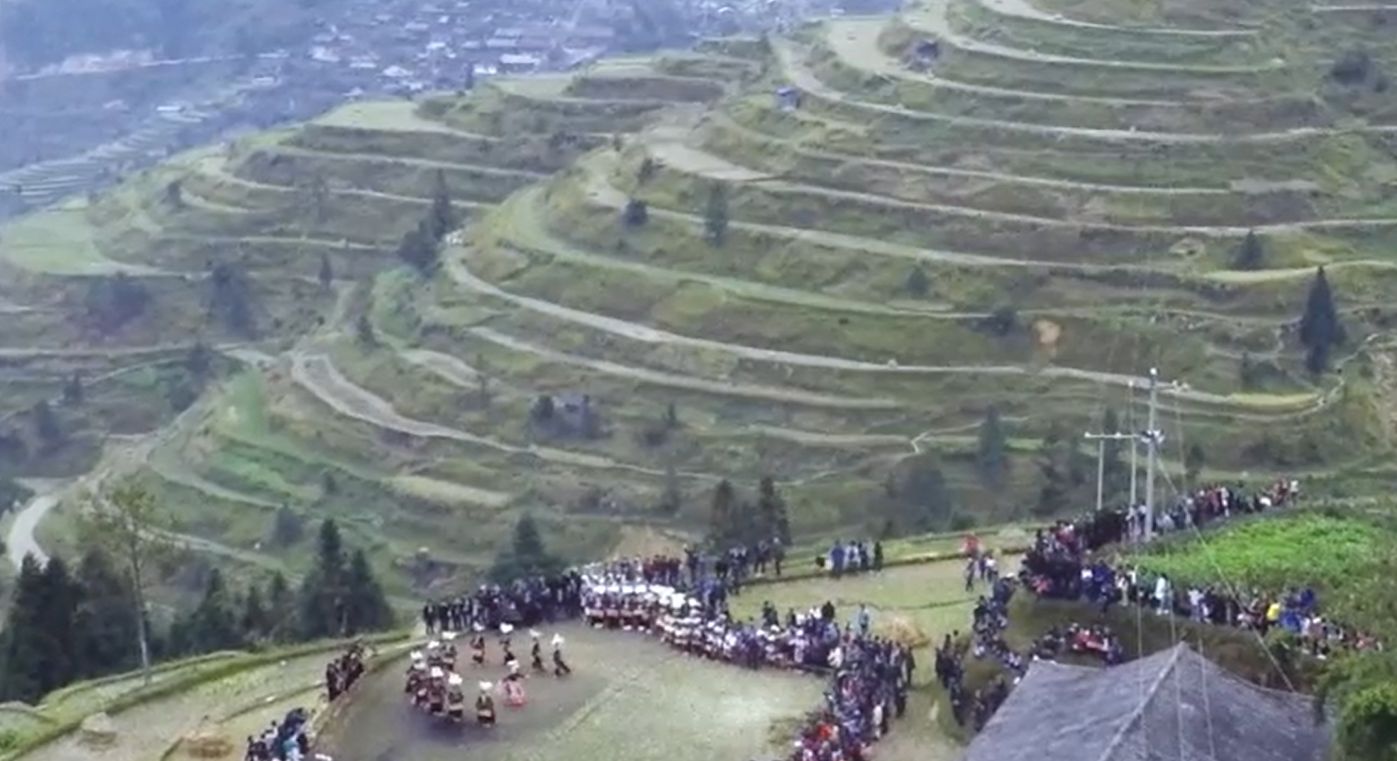
The director is phoning it in from the house, supposedly because we are droning from that vantage point, but actually because the chaos is unfilmable, and she knows that the best our cameraman can do is snatch some cutaways. It’s not like we need new audio when everybody plays the same song; the light is fading; the background looks like a building site in the mist, and the place is full of middle-aged men with preposterously expensive cameras, trying to snatch a “National Geographic”-style bit of local colour, and ironically preventing National Geographic from doing so.
I am perhaps the last to realise that today is a disaster. I have been hired, at least in part, for my curiosity about such things, and I confess that I stayed to watch the welcoming ceremony because I wasn’t going to travel for ten hours and not see it. Our director and cameraman, with an eye on the visuals, probably worked out at lunchtime that there was no point in shooting any more footage today. The rest of the crew just took the path of least resistance.
A huge dance, a swirling circle of all the Miao tribes, is kicking off in the main square as the sun sets, with all visitors invited to join the end of the invisible-skipping-rope conga line. But by the time it begins, I am all alone from the crew, radioing back up to the house with increasingly plaintive reports about the number of dancers and the tribes who have joined the fray.
“Thank you for the commentary, Jonathan,” says the director carefully over the walkie-talkie. “But come back to the house. Today is a wrap.”
Jonathan Clements is the author of A Brief History of China. These events featured in Route Awakening S03E06 (2017).
 The Official Schoolgirl Milky Crisis Blog