

It is the afternoon and I am in a fallow field an hour outside Luoyang. I kneel down in the grass in front of what appears to be a large, football-sized pile of firm turds and announce that I am on an archaeological quest. I then pick up one of the turds and start breaking it apart with my hands.
They are the core samples from a Luoyang Shovel, a device originally developed by medieval grave-robbers for testing the land beneath their feet in search of treasure. Guo Zhenya’s is a three-metre pole, terminating in a long, curved trowel. You push it into the ground, wiggle it around, and withdraw a sausage-sized cylinder of earth, before plunging it in for another go, pushing deeper and deeper.
Mr Guo has an eye for subtle changes in colour. One trowel down, he is pointing to loose yellowish earth that is nothing but common topsoil, churned over every year by the plough. Another trowel down and we’re in darker more compacted earth, backfilled after the local archaeologists had finished excavating Erlitou. Another trowel down, and the backfilled earth reaches a line of sand, which marks the lowermost point of the dig. After this point, we are looking at terra incognita.

“The soil is turning reddish,” he observes. “We could be looking at a Han dynasty tomb. Yeah, this looks like shentu – disturbed ground.” Another few trowels, and we are almost all three metres of the Luoyang Shovel into the ground.
“No,” he says with a shrug. “False alarm. This darker soil is undisturbed. No human being has dug this deep in the last few thousand years. Nothing to see.” Mr Guo was one of the excavators in the Erlitou excavation that stripped this entire field wide open, uncovering a city from some 2,800 ago, laid out in a familiar square pattern, with a royal enclosure, a bronze foundry, and a temple. This was, people still believe, the likely site of the capital of the Xia, the earliest known Chinese dynasty, a people who had only just discovered bronze and seemed to lack any real writing. All we know about them we have got from legends collected in ancient Chinese classics.
Although the Erlitou site was discovered in 1959, excavation there was shut down a few years ago, one suspects because it failed to yield anything as photogenic as the Terracotta Army. It did produce “China’s First Dragon”, a staff or ceremonial item, the wood long rotted away, but retaining an intricate mosaic of turquoise stones, curling like an elephant’s trunk and terminating in a square, symbolic head. I’ve seen a picture of it, but the dragon is in Beijing, propping up an exhibit of ancient Chinese culture in the capital.
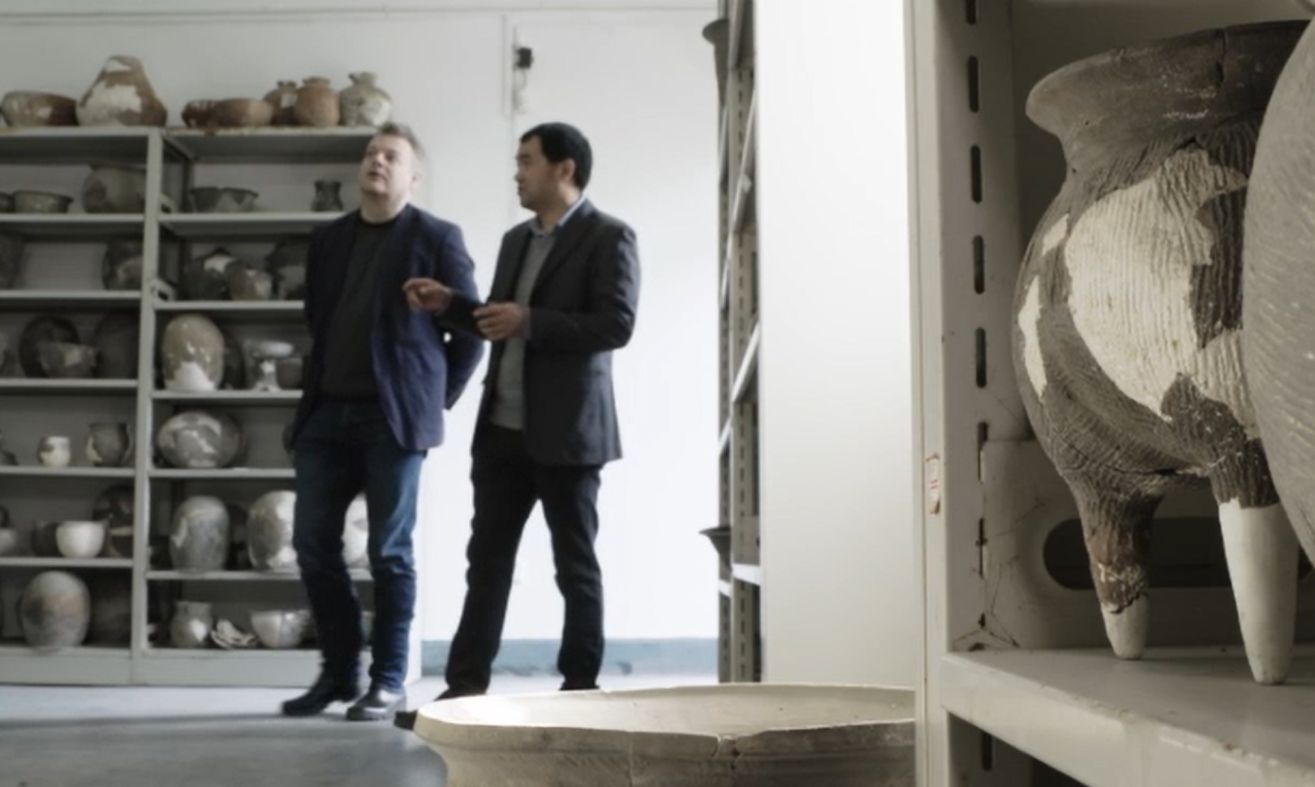
At the research institute, an army of workers are poring over the crates and crates of shards from the site, piecing together its pots, and trying to work out the nature of the bronze ceremonial artefacts that Erlitou seems to have supplied to the rest of the Yellow River floodplain. I’m here to interview the second most important man in Erlitou archaeology, the foremost authority having sworn off television appearances after a bad experience on someone’s late-night comedy chat show.
Zhao Haitao is soft-spoken and twitchy. It takes a while for me to draw him out of his shell, by asking questions about the site that make it clear I know what I am doing – the apparent trade value of turquoise, and the mystery that they have found cart tracks at Erlitou, but no evidence of horses.
“If you ask me,” says Dr Zhao, “the chariots here were pulled by slaves,” thereby literally putting the cart before the horse. I get him talking about pseudomorphs on Erlitou pottery, the potential for other finds on nearby sites, and the likely damage done to the north of the site by a shift in the flow of a nearby tributary of the Luo river, until he is laughing and joking, and holding out ancient ceremonial pots for me to touch.
I’ve noticed several times already on this trip that this is a new and unexpected service that I now perform – simply making it clear to the interviewees that there is someone on the other side who is listening to them and understanding what they are saying. That we are not a gaggle of uncaring camera-pointers with a fat white sock-puppet, but an award-winning crew with a public face who know the difference between the Sui and Tang dynasties; who understand the problems with rescue archaeology, and who don’t blink uncomprehendingly when hit with Chinese terms like liusongshi (turquoise) or renlache (man-pulled cart). I know these things because I was up at 4am reading the Erlitou chapters in the Cambridge Introduction to Chinese Archaeology on my Kindle, but that’s what I am paid for.
Another long day that comprises standing around for interminable hours, before being dragged by a shouty director to stand in front of a tree and extemporise a 30-second piece to camera about sustainability in the Tang economy. But I am doing my job, and coming up with several ideas for actual bits, including a semi-jokey bit where Mr Guo and I take the Luoyang Shovel out of the back of the Buick, its three-metre length seemingly never-ending, like people leaving a clown car.
Jonathan Clements is the author of A Brief History of China. These events formed part of Route Awakening S05E01 (2019).
 The Official Schoolgirl Milky Crisis Blog