
“Do not open your mouth,” hisses Clarissa the fixer at the director, whose Teochew-accented Chinese sometimes risks getting us into trouble. “The man we are going to meet is Mr Lŭ, third tone.”
“Mr Lú,” says the director.
“That’s second tone,” says Clarissa. “You just said ‘Mr Donkey’. Just call him Professor, for Christ’s sake.”
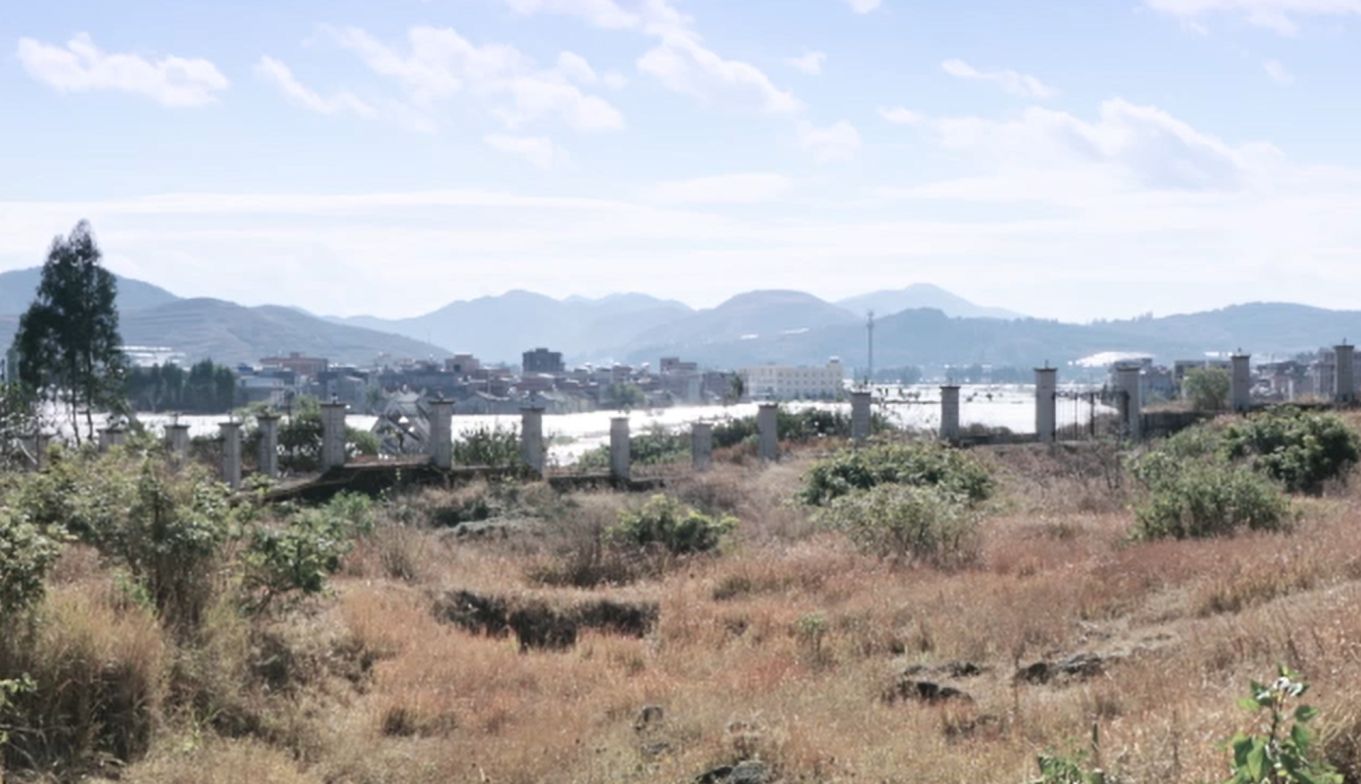
We are interviewing Mr Lu at Shizhaishan, a desolate hillside in Yunnan that once would have had a commanding view of Lake Dian below. These days, it’s blocked by high-rise buildings, and the hillside is walled off by an imposing fence, because it is one of the most important sites in Dian history.

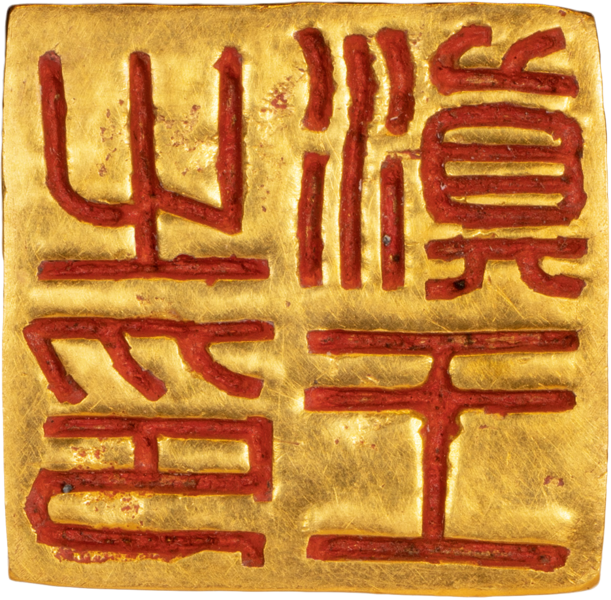
In 1954, archaeologists at Shizhaishan uncovered dozens of graves of the Dian nobility, including one containing a golden seal that bore the Chinese words: KING OF DIAN. A similar seal, denoting the KING OF NA, turned up long ago in Japan, where locals claimed that it had been conferred upon a barbarian kingdom by the Han Emperor Wudi. Nobody took this seriously until the Shizhaishan find, when it became apparent that Wudi had indeed had uncharacteristic gold seals made for the kings of borderland regions that had recognised his authority.
The King of Dian’s seal is in the national museum in Beijing – it officially marks the moment when Yunnan became part of China. The locals in Yunnan have to make do with a replica; just one of several political issues that clearly still needle Mr Donkey.
It is a difficult interview. Our arrival is bodged, because it takes us half an hour longer than planned to negotiate the tight, winding rural roads, and Mr Lu has been waiting by a dunghill with a nameless woman from the Propaganda bureau whom we soon dub the Jawa. Her facial features are entirely covered by a hoodie, mirrored sunglasses and a full-face breathing mask, which is oddly sinister, and turns out to be because she has a streaming cold, and keeps coughing during the interview and ruining the takes.
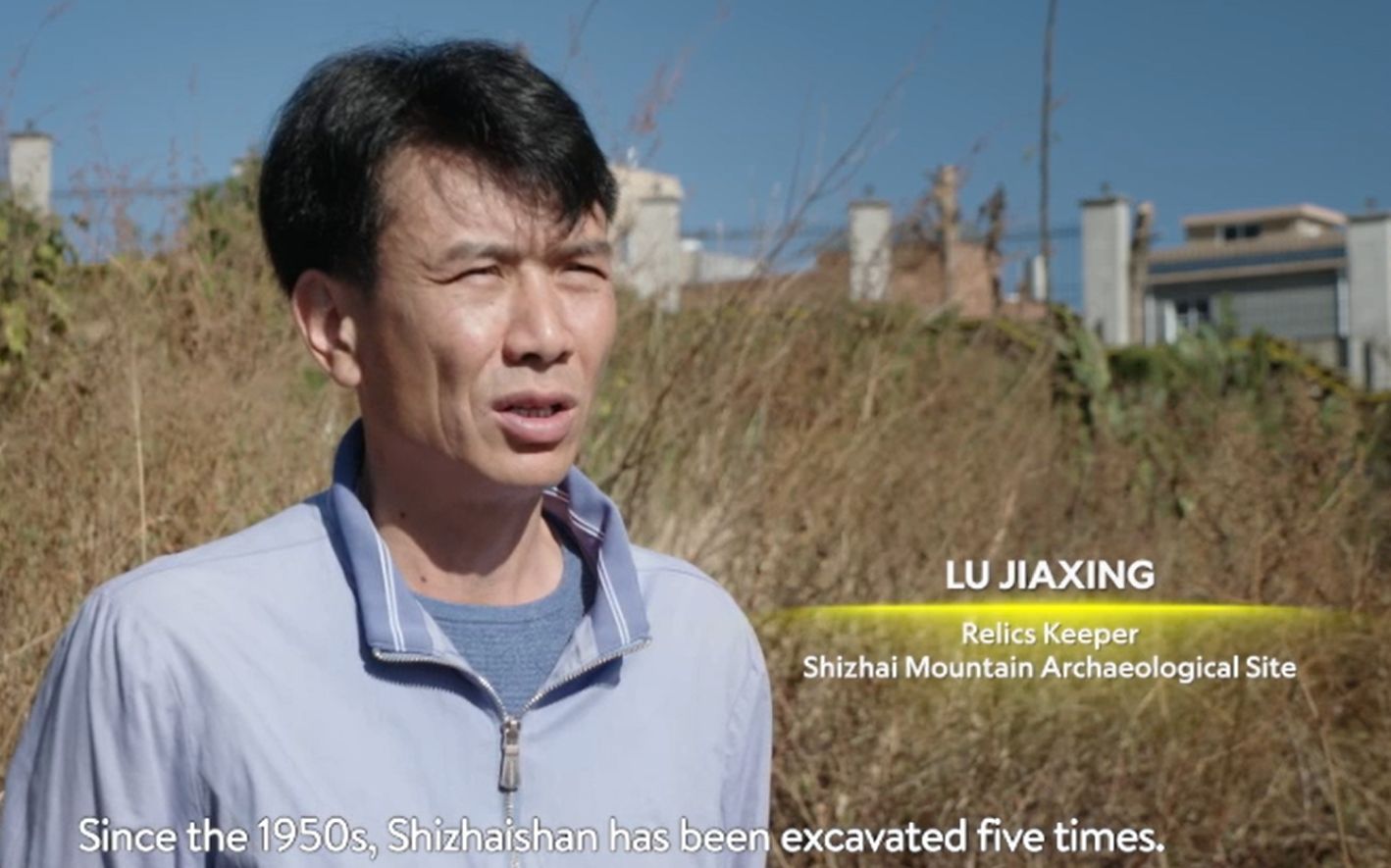
When we arrive, the director isn’t sure who this odd couple are, and entirely ignores them, and we only identify Mr Lu when I walk up and introduce myself. But that’s only the beginning of our problems, because he is everybody’s second choice. The archaeologist who actually led the 1954 dig, and a subsequent find in 1999, has refused to talk to the media, because of a bad experience with an earlier crew, and Mr Lu is reluctant to discuss several important issues.
Interviewees have to be managed, anyway. It’s part of my job to come in at the start, speak Chinese like a performing dog, and make it clear that I am not some clueless puppet, but someone who has read the Grand Scribe’s Records, knows my Han dynasty from my Tang dynasty, and is here to make the interviewee heard and understood. As regular readers of this parish will already know, it can be discombobulating to have an English-speaking film crew unload a literal tonne of gear in a remote village, and start pushing them around, hectoring them to stand on various unsteady hillocks, and badgering them to repeat themselves, answer leading questions, and film things out of order. I am quite used to having the director yelling at me to take three paces forward and stare into the sun, but the people I have to put at their ease are often facing a camera for the first time.
The Jawa doesn’t help by lurking at the sidelines with a camera of her own, documenting our visit for official reports and local media. When the director jokingly suggests that somebody cooks a nearby yappy dog to shut it up, Clarissa rails at the crew to stop laughing, “because someone from Propaganda is pointing a camera at us, and I don’t want them to think we are not taking this seriously!”
“So,” I say, “are there still artefacts buried here?”
“I don’t want to answer that question,” he says, reddening, because the last thing he wants is literal gold-diggers breaking in with shovels. He knows we don’t have time to explain that an “artefact” is just as likely to be a midden or a cow bone as “treasure”, and that’s all some viewers will hear. Nor does he really want to talk about the progress of the site, because funding is not forthcoming. The site has fallen into disrepair, the duckboards around the edge are rotting, and the “guard house” is staffed by a gurning old lady and the aforementioned yappy dog.
Media people refer to “sit-up-and-beg questions” – simple, rather vague queries designed to give the interviewee the chance to say whatever they feel like. But Mr Lu is deeply cagey about his site, and reluctant to describe “his” discoveries in the first person because he is a stand-in for the real boss. I try to get him to talk about simple issues, like backfilling the soil (in Chinese hui tian, literally “returning the field”), but this is a touchy subject for him, because they only backfilled the site because their funding has ended, on what appear to be five stops and starts, including the 1950s dig curtailed by the Great Leap Forward, and the 1990s dig funded by a relics bureau that lost interest once they’d airlifted the gold seal to the capital. I have mentioned before the intricate politics of the Terracotta Army site, where the archaeologists are deliberately taking years to poke around the edges, because if they dig out the central mound and don’t find buried treasure, their gravy-train funding will be over. Shizhaishan seems to prove my point for me.
Eventually, he relaxes. I assure him that “I don’t want to answer that question” is a valid response, and that we will just ask him something else, but we do run into a large number of dead ends with him, and it’s difficult to get anything out of him. We eventually get enough to fill a segment, and by the end he is starting to enjoy himself.

As so often happens, we film our “first meeting” last of all, by which time he is all smiles, and he doesn’t blink at the fact that we do it in reverse order. On the final cut, he will greet me at the Buick, lead me up the hill and through the gate, and down into the pits of the dig site, while the drone soars up above over our heads. But on location, where we are moving the gear back down the hill to the van in stages, we first film us walking into the pit, then walking through the gate into the site, then up the hill to the gate, then meeting each other at the car, and then the drone shot.
The crew’s behaviour can look weird to an outsider. Just because we correctly walk up a hill, it doesn’t mean that a farmer hasn’t wandered into shot behind us, or the sun has gone behind a cloud and ruined the continuity for the lighting, or the cameraman has forgotten to run the film. We take our positions for a third take, and the director nods to begin.
“You can start walking,” I hiss to him out of the corner of my mouth.
“But the director hasn’t said ‘Action’,” he points out.
While we get our drone footage, Mr Lu smokes fag after fag by the cars, and jokes with the crew. Our driver starts chatting up the Jawa, whose mask turns out to hide an attractive and friendly young girl ready to discuss the pitfalls of local television, and not the terrifying figure we had assumed her to be.
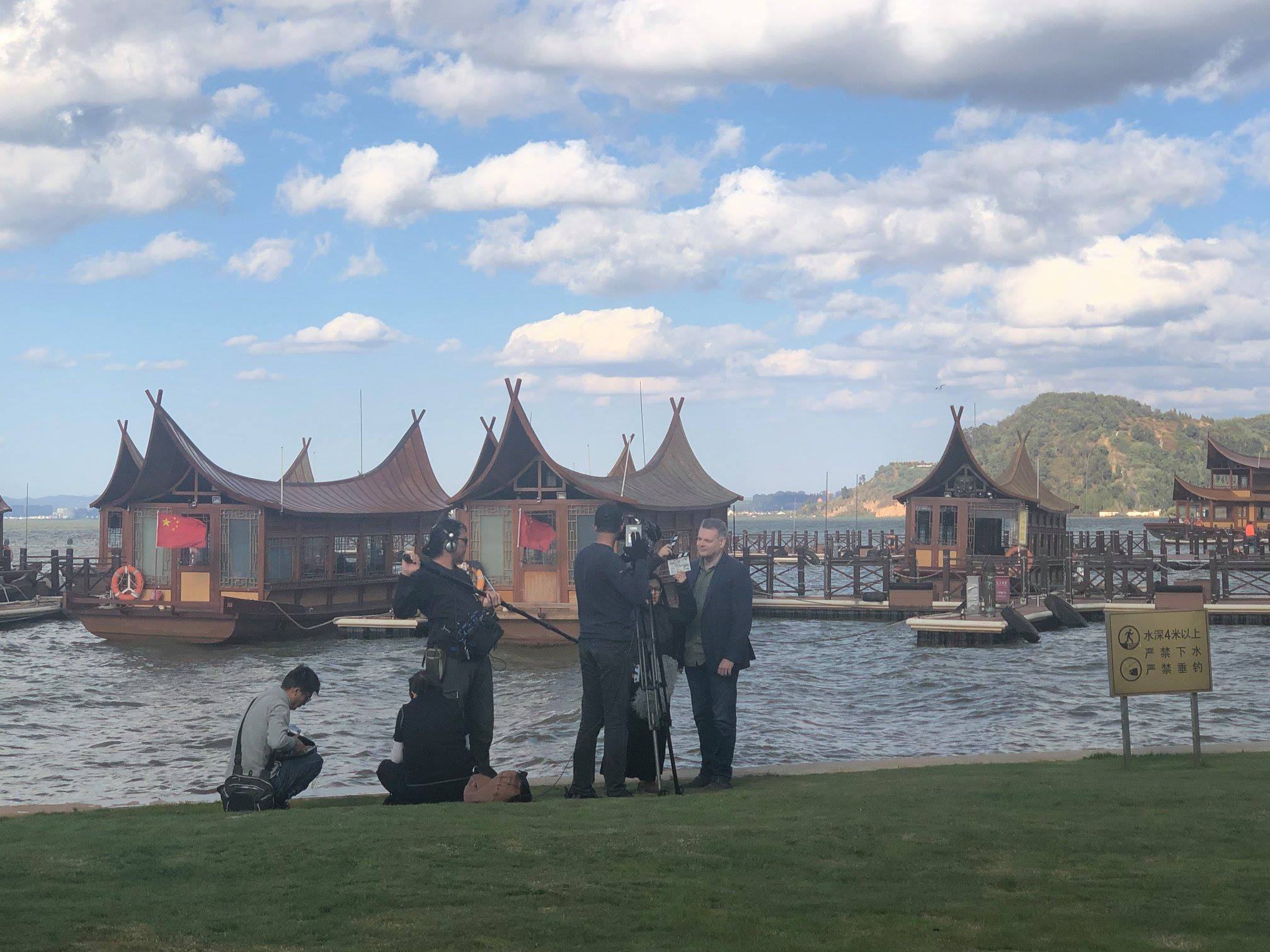
Our backwards shooting schedule continues as the sun climbs. I am dragged off to film an even earlier shot, of me driving through the village to meet him in the first place, and by the time I come back, he and the Jawa have gone. I got the impression with him, as I do with many interviewees, that by the time he came round to appreciating that he was going to be on telly showing off about his life’s work, it was all over.
Spooling through the footage six years later for this article, I realise that Mr Lu didn’t even get his fifteen minutes of fame. There was so little material we could work with that he’s there and gone in thirty seconds, just long enough to point across some waste ground at the place where they found the gold seal.
The afternoon is spent filming the modern legacy of the Dian kingdom. Remember that we knew almost nothing about it until the 20th century. But the archaeological evidence uncovered in the last 60 years has allowed us to discover their clothing, their architecture and their bronzes, enough to supply suitable material for an entire Dian Kingdom theme park by the side of the lake, complete with houseboats, statuary, and a Ferris wheel. I yell a piece to camera in the wind by the lakeside, surrounded by screaming seagulls, and observe that the Dian warriors of old would be aghast at such a use of their culture, particularly since the theme park seemingly lacks a Human Sacrifice Experience.
Jonathan Clements is the author of A Brief History of China. These events appeared in Route Awakening S05E03 (2019).
 The Official Schoolgirl Milky Crisis Blog