
I’m one of the interviewees over at the BBC website for Arwa Haider’s deep dive into the boom in anime music. As ever, only a couple of soundbites made it in, so here are my original answers in full.
- Astro Boy‘s 1960s “Atom March” is often cited as the original anime anthem; would you say that’s true, or do you feel anime music’s roots lie elsewhere?
Yes, the Astro Boy theme was one of anime’s big successes, but the real hit came a couple of years later, when Jungle Emperor (a.k.a. Kimba the White Lion) was released. Slowly warming to the idea of spin-off merchandise, the producers put out anime’s first full-length 15-track LP, which sold 100,000 copies in short order. It made a lot of money for the composer, but created friction at the company when the musician’s union came looking for the lyricist, in order to hand him his royalty cheque. The lyrics to the Jungle Emperor theme had been dashed off by one of the animators, Eiichi Yamamoto, in his lunch-hour, leading to a fierce argument at the studio as to whether he had performed the task on “company time.” The studio eventually won, and Yamamoto forfeited his royalties.
By the 1970s, anime had settled into a groove whereby the ownership of the IP was often split between a manga company, a TV station, and a bunch of other interested parties in the production committee. Music companies got involved as a means of piggy-backing their records into what amounted to a weekly advert on primetime.
- What qualities would you particularly associate with anime music, given its themes incorporate such a huge range of styles?
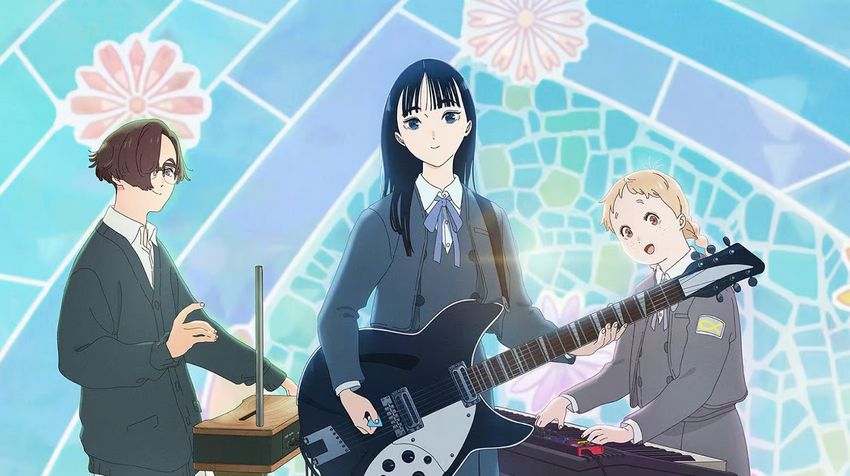
Some anime themes are entirely incongruous, wedged in by a music company on the production company desperate to get airplay for one of their new starlets or band signings. Some are ridiculously heavy-hitters, such as songs by the likes of Oasis or Franz Ferdinand, which can create legal nightmares outside Japan when the rights have to be renegotiated for overseas territories. But anime also has some absolutely superb composers, like Yoko Kanno, who produces fantastic orchestrations, with weird instruments and world-class soundtracks. Someone to watch out for is Kensuke Ushio, whose attention to detail and realism is truly astounding. On The Colours Within (2024) he had to come up with the sound of the in-film garage band, carefully crafting electronic pop inspired by the early days of Joy Division. He even went as far as recording ambient sound in Japanese church halls, in order to ensure that the onscreen rehearsal sessions had the right room tone.
- I’m intrigued by Spotify’s stats reflecting that anime music global streams increased by 395% between 2021 and 2024 – what factors do you think have fuelled its modern surge in popularity?
I can only guess, but the strange attractor in all that is surely Covid. For a year, people were trapped in their houses, leaning on the internet. I had many parents coming to me and asking what streamer they should buy to keep their kids quiet watching anime. You’re looking at a massive spike in the availability of anime to new fans, and the time they had on hand to watch it. And in the four years since, a bunch of young fans have become consumerist teens with a love of anime.
Companies are also keener to monetise music, as well, because sometimes the music is merely the advert for the live event, which is an experience that can be sold, but more importantly, can’t be pirated.
- International versions of seem to be an increasing range of international artist anime collabs (eg, this track by UK rapper Che Lingo for a Crunchyroll season trailer); do you feel the overall sound of anime is changing, or has this music constantly been in a state of flux?
Anime music has always striven to be globally appealing, and it has dragged in non-Japanese performers and composers for decades. In the last decade the rise of streaming has been likened by Japanese producers to the coming of the “Black Ships” of the US Navy in the 19th century. Netflix, Amazon, HBO… these companies are arriving with massive budgets and a desire for a global footprint, although that’s not always worked to the Japanese music industry’s advantage. When Netflix bought Evangelion, for example, they stripped out the multiple different versions of “Fly Me to the Moon” from the closing credits, because most people on Netflix skip the credits anyway, and the international rights would be so much wasted money. There was a sudden flurry of anime musicals in order to find somewhere for the music companies to put their tracks, if they couldn’t get any attention as the credits rolled.
But such companies also have big budgets available to bring in big names, and post Covid, everybody in the arts is more readily hired remotely. Meanwhile, the Japanese are more than happy to work with overseas artists if they like their work. Ludwig Göransson and Rasmus Faber, for example, have a rack of anime credits to their names.
- Finally, do you have a favourite anime theme, or are there just too many to choose from?
My childhood joy was the theme from Science Ninja Team Gatchaman, which I first heard only in an instrumental version on what was known abroad as Battle of the Planets. When I went to Japan, I heard the lyrics for the first time: “That shadow dancing in the sky / the white wings of Gatchaman,” and the haunting refrain: “Earth is alone, Earth is alone.”
I think it’s hard for today’s youth to understand that there was a time before the connectedness of all things, when simply hearing Japanese music would require a long customer journey. I have several albums by Dragon Ash on my car stereo to this day, but I would never have heard of them in the 1990s if they hadn’t provided the soundtrack to the anime Virus Buster Serge. Today, you can find out about them just by asking your phone or your laptop.
Jonathan Clements is the author of Anime: A History.
 The Official Schoolgirl Milky Crisis Blog
Hello Mr. Clements,
My favourite anime music is the compositions done by Yuki Kajiura for the anime “Noir”, and the opening song “Kiri” for the anime “Ergo Proxy” by the band Monoral. I later bought bother their albums “Petrol”, and “Turbulence. Which I still play once in awhile.
^_^