
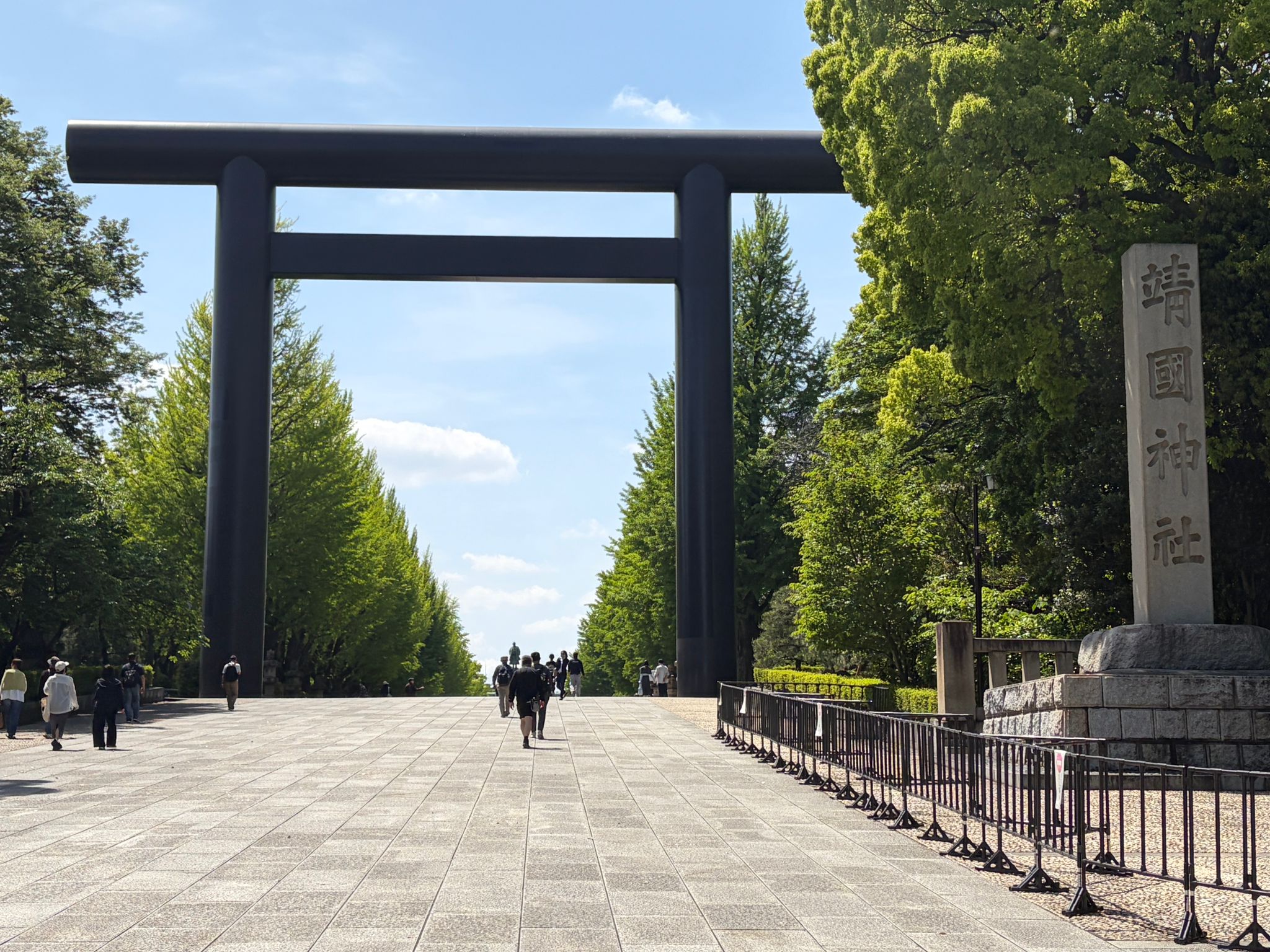
The Emperor Meiji tried to draw a line under the seditious leanings of some of those in his service. Pointedly, in 1879, he changed the name of the “Tokyo Shrine to Summon the Spirits” to the “Shrine to Quiet the State” (Yasukuni Jinja). Like many of the other classical Chinese allusions in 19th-century Japanese politics, this reference tends to be cited out of context, without much consideration of the text being quoted. In the original Chinese, the term is found in an official’s defence of his decision to put a soldier into a government position:
“I have done it to secure the quiet of the State. When you have men who have rendered great service, and you do not give them the noblest offices, are they likely to remain quiet? There are few who can do so.”
Amid the songs of the 1930s, one stands out not for its musical or lyrical achievement, but for its tone. “Mother at the Nine Steps” (Kudan no Haha, 1939) was written for the spring ceremony at the Yasukuni Shrine, where the newest war dead would be ceremonially accepted into its halls. The song tells the story of a lady from the provinces, coming to the Nine-stepped Hill (Kudanzaka) that leads to the venue:
From Ueno Station to the Nine Steps
Frustrated by unfamiliar places
Taking a whole day and relying on my walking stick
I’ve come to see you, Son.
A large gate that can reach the sky
What an honor to be enshrined
In such a magnificent place as a god.
Your mother is shedding tears of joy.
I put my hands together kneeling
I find myself chanting a prayer to the Buddha.
I am taken aback and flustered.
Sorry, Son, I’m such a yokel.
Just like a kite giving birth to a hawk
I appreciate how fortunate I am.
Just to show you your Order of the Golden Kite
I’ve come all the way to Kudanzaka.
It seems oddly ungracious to ridicule a bereaved mother for being a “yokel”, like she hasn’t suffered enough. But for music historian Osada Gyoji, that is part of the song’s subversive appeal. We have gone, in the space of two years, from the unlikely sight of mothers waving off their sons “without tears,” to this broken old woman in the big city shedding tears that are plainly not “of joy” at all, but continuing to put a brave face on her personal desolation.
Extracted from Japan at War in the Pacific: The Rise and Fall of the Japanese Empire in Asia 1868-1945, by Jonathan Clements.


Hi Johnathan. Apologies for posting here but I couldn’t find another way to contact you as I don’t have Linkdin premium. Two things one of the links on you contact bio for linkdin in now goes to a dodgy site muramasaindustries.com . Also very excited for for you new book Japan’s Anime Revolution, the amazon page has a book cover showing. I was concerned that some elements looked AI generated. I could possibly be wrong but as someone who is a great supporter of the arts I thought I would flag just in case
Thank you, Lee. I shall see what I can do about the former. I don’t have any say in the latter!
jc