
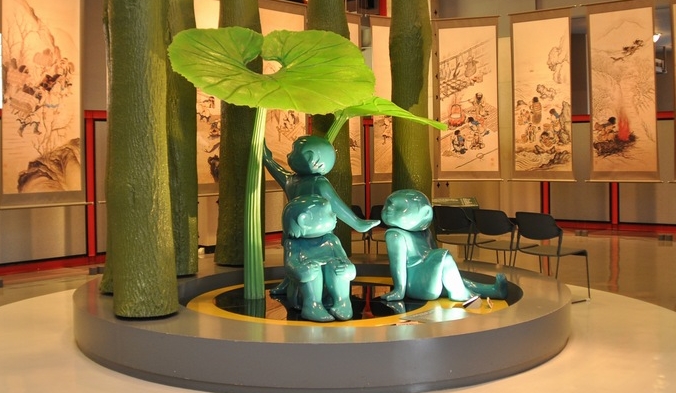
For a long time, it was believed that a folk tradition among Hokkaido’s indigenous Ainu people was some race-memory of a forgotten genocide. The belief that there were korpokkur “little people” whose unseen activities rustled the broad-leafed fuki plants (Japanese butterbur, a.k.a. sweet coltsfoot) were a kind of faery folk, hiding in the undergrowth from invaders who had displaced them.
Their effigies sit at the heart of Hakodate’s Museum of the Northern Peoples, seemingly grown to human size, but really shrinking the human visitor to their level, to consider just for a moment how the world might look to the very small, like The Borrowers.
But modern scholars have repeatedly changed their mind about the korpokkur. These days, it is widely believed that the korpokkur of Ainu mythology are an odd suppressed memories of the Ainu’s own past – a fairy tale told among modern Hokkaido city-dwellers about the people they used to be. Korpokkur legends thin out, the further north you go; they appear to have arisen as the Japanese infiltrated Hokkaido, and the Ainu began to associate themselves not with their old selves, the “people of the land” (yaunkur), but with the new arrivals, the “people of the sea” (repunkur).
Like all hauntings, they occasionally manifest in popular culture. Hokkaido gift shops are dripping with gnomish representations as dolls, fridge magnets and lucky gonks. In 1973, Sumitomo Life Insurance sponsored a 23-part anime series, Adventures of Korobokkle – when I put it on the slate for the Anime Encylopedia twenty years ago, I was not familiar with Ainu orthography, hence the misspelling, although the book does note that it seemed to prefigure a much more famous moment in Japanese animation.
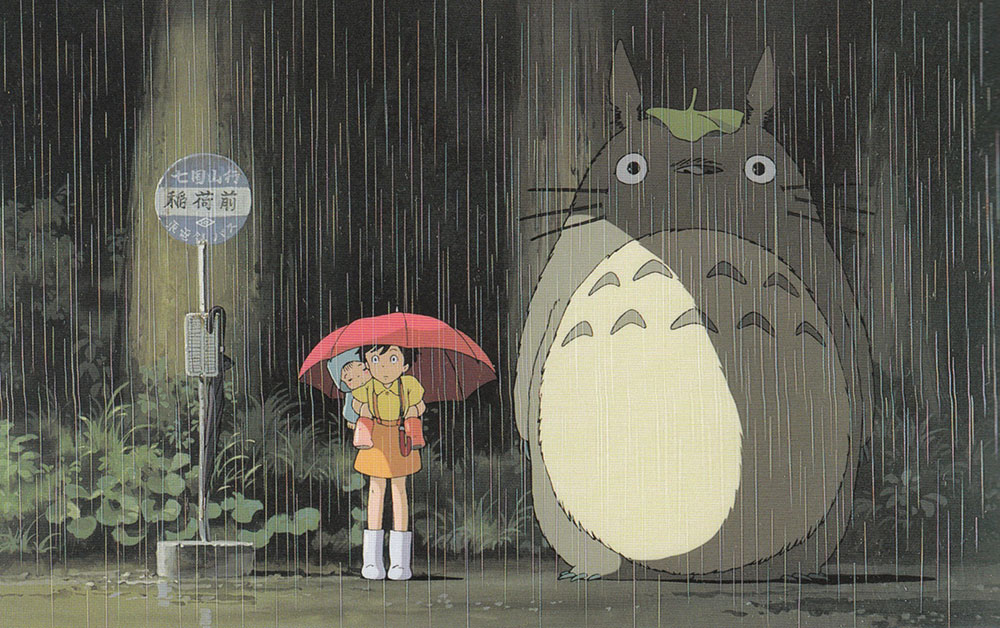
Hayao Miyazaki’s My Neighbour Totoro is riddled with references to the forgotten beliefs of marginalised peoples. Like his later Princess Mononoke, it is seeped in alternate pathways in Japanese history. We see Jomon pottery scattered at the entrance to Totoro’s sacred tree, itself a relic of long-gone camphor forests. Jizo statues lurk discreetly in the background as Mei wanders the countryside, hinting that there is no danger, because this child is under divine protection. And when Totoro himself shows up at the iconic bus stop, he, too, carries the marks of ancient traditions, wearing a fuki leaf on his head.
It is a wonderful moment of artistic playfulness – the least convincing of all “little people”, like an elephant wearing a man-sized baseball cap. But that is Totoro all over: a symbol of ancient, numinous power, manifesting to the children as a fat, cuddly teddy bear, his ominous, fixed Cheshire Cat grin and his obvious claws only unsettling to adults.
“Only when you are a child,” says the theme song, “will he appear to you.”
Jonathan Clements is the author of Japan’s Anime Revolution: Twenty Animated Films That Changed the World.


I wonder if “fairies at the bottom of the garden” are common in a lot of cultures?
They are indeed, PJ. Very similar legends in parts of Taiwan, too.