
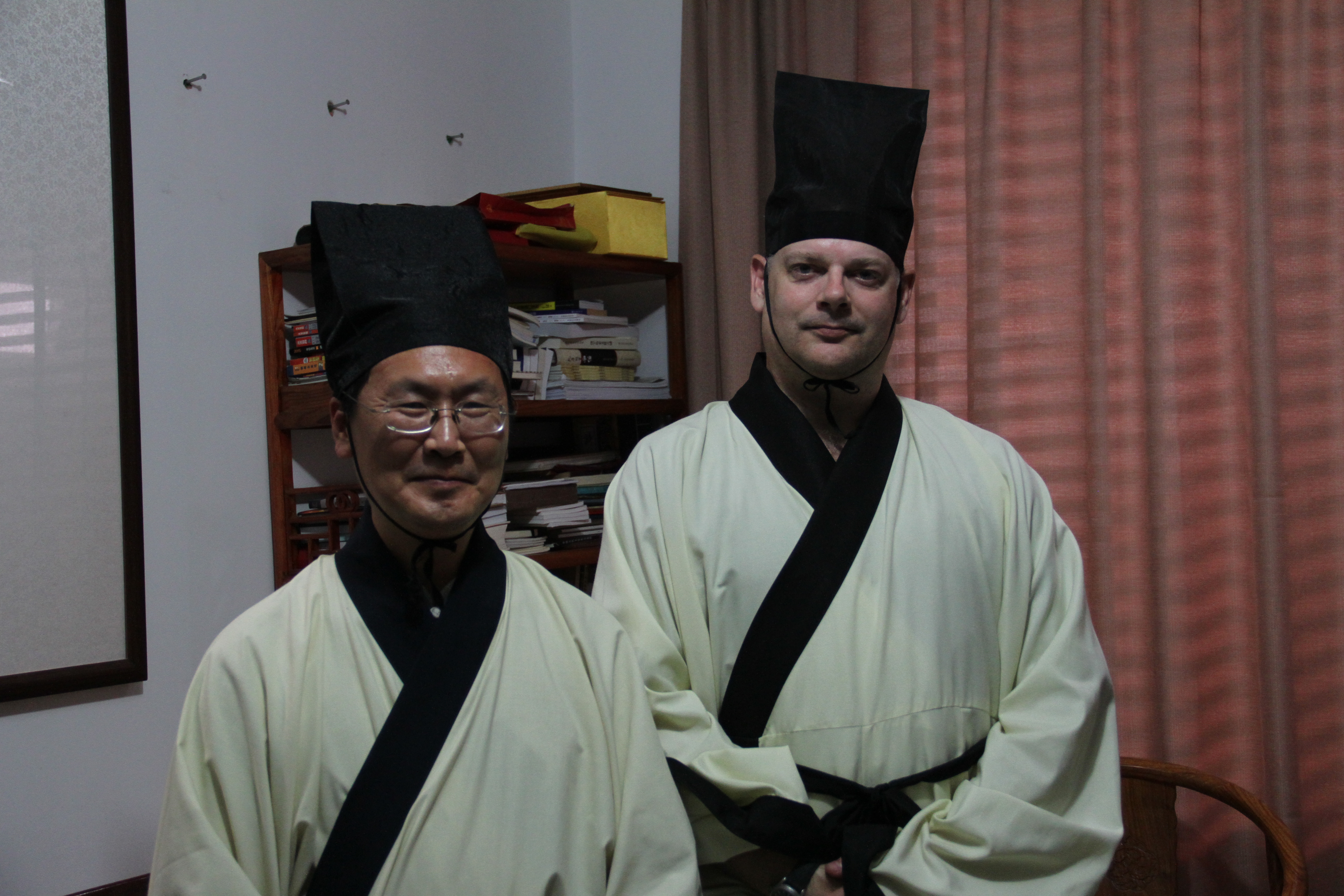
Duan Yanping is waiting at the gate and smiling like a loon. He smiles all the time. I never see him not-smiling, although sometimes he crinkles up his face even more until his eyes are scrunched into little dots. He is the principal of an exclusive private school in Qufu, home town of Confucius, which purports to raise children in the Confucian way. The boarders are as young as five, and I watch them stopping to bow to their teachers as they walk across the playground. Since the teachers are arriving for the day, there’s a whole string of them across the courtyard, and for anyone, child or adult, to get across the open space takes a quarter of an hour, since they keep stopping and bowing at one another.
Today we are here for the Opening Brush ceremony, in which a bunch of six year olds will have red dots painted on their foreheads and then commence a series of “Confucian” rituals to mark the beginning of their education. We’ll see about that, as I say to camera: “I’m curious to see how many of these rituals will turn out to come from later dynasties.”
Most of them, as it turns out. The ceremonial presentation of tea to one’s teachers is all very well, but there was no tea in China in the time of Confucius. Nor were there robes in the style demonstrated by the pupils and teachers, all of whom are attired in the fashion of the Song dynasty. Pupils are presented with a pair of dates each as a symbol of the 00 that goes after a person (1) in order to make the top exam mark, but the very nature of this requires Arabic numerals, which didn’t arrive in China until a thousand years after Confucius.
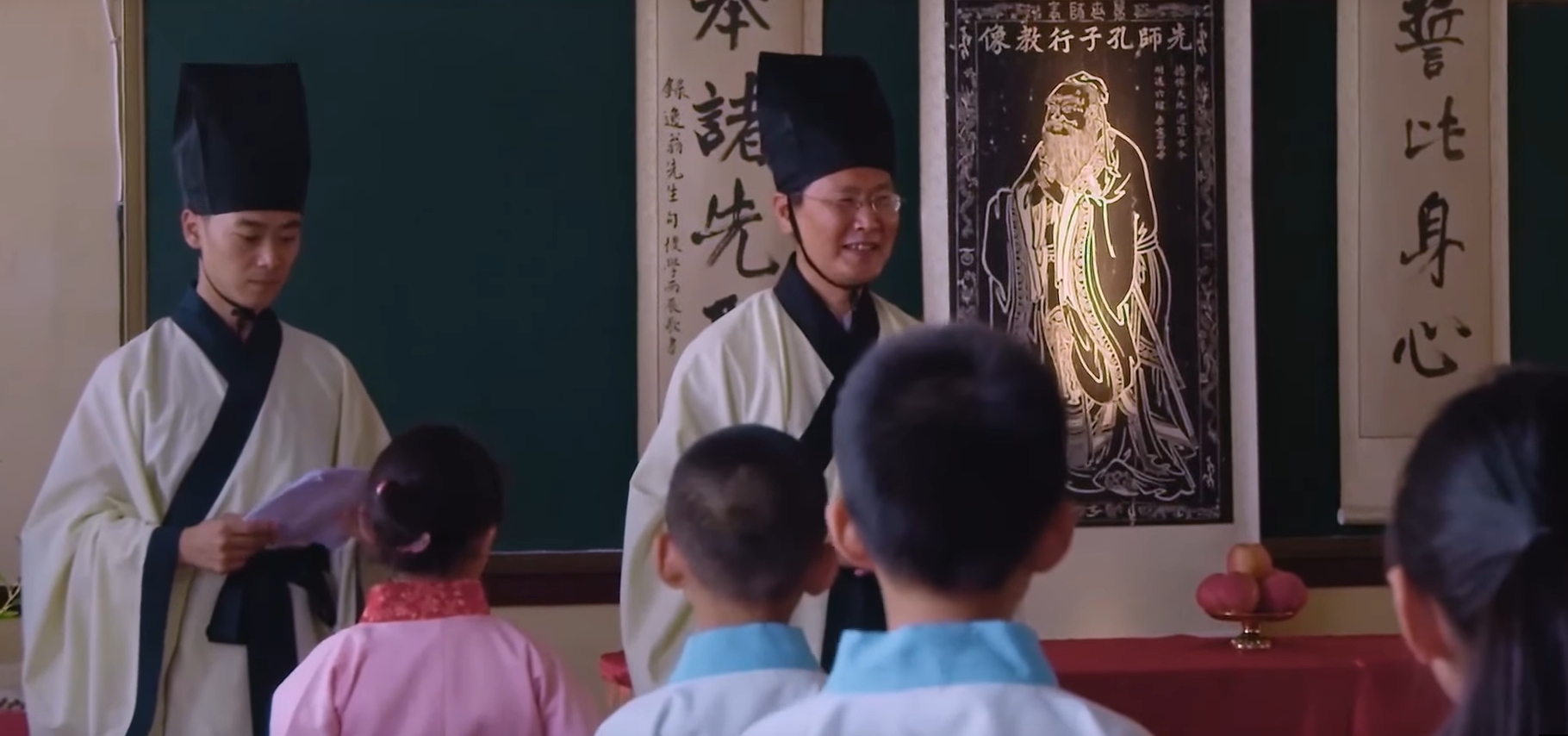
The children are still children. After being exhorted to write their first symbolic character, ren or person, the kids are asked to hold up their papers (paper, also not around in the time of Confucius). The fat kid at the back has got bored and drawn two persons, and then half a wall around them, thereby turning his character into something different. I look up along the long line of diligent students holding up their papers and see: person, person, person, person… MEAT.
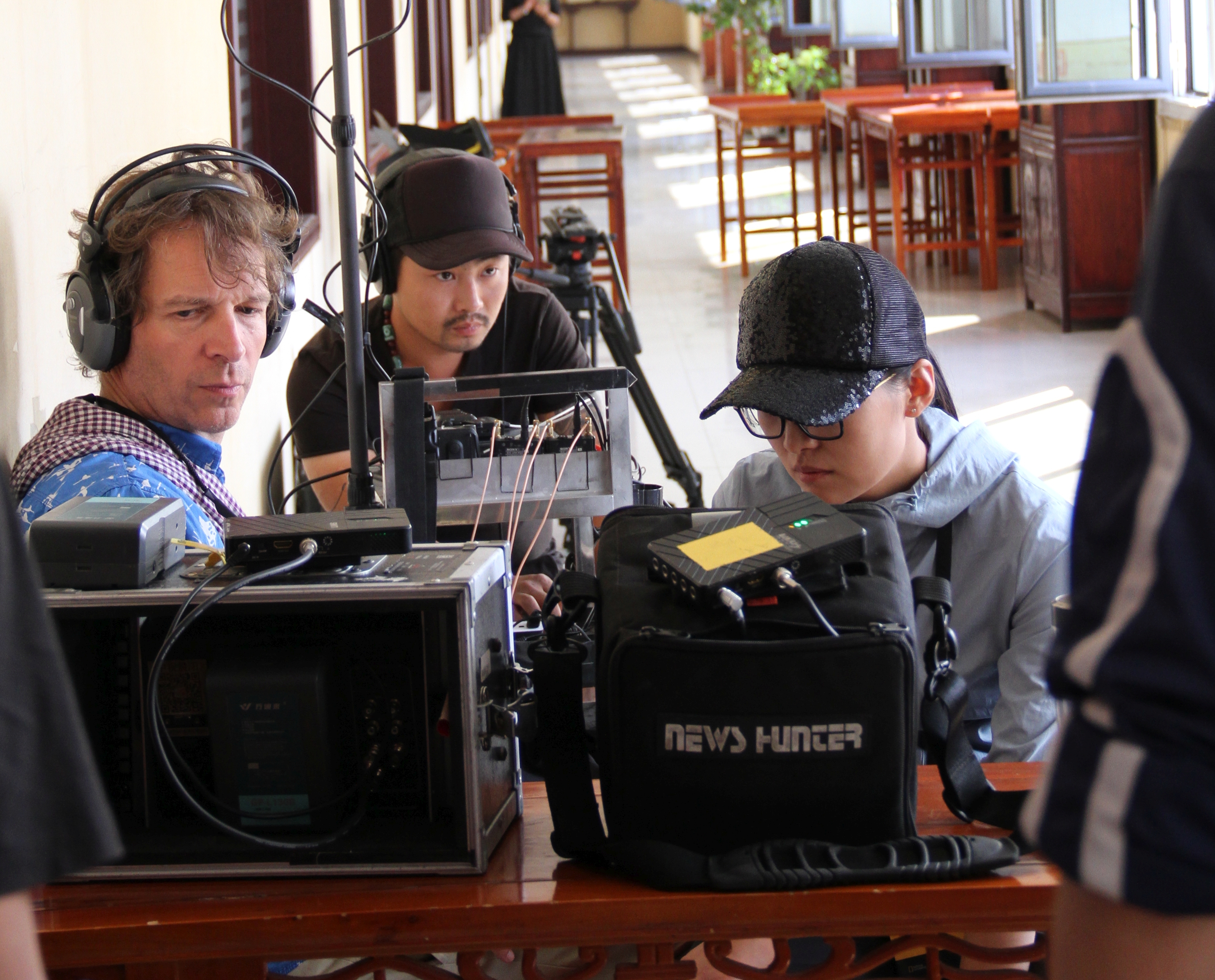
The kids plainly love Mr Duan. His constant smiling even puts me at ease, and the only time I see him stern is when he reminds Jiuqing the producer not to bugger about too long changing batteries, because she is effectively asking a bunch of six-year-olds to stand still behind their desks for an hour, while the crew huddle outside in the corridor staring at their monitors.
I ask Mr Duan what he thinks Confucius would make of the ceremony, and he crinkles his face and tells me that he would be most chuffed. I am not so sure. The younger Confucius, certainly, would have been aghast at so many anachronisms and what, to him, would be regarded as foreign customs. The older, wiser Confucius would have appreciated the effort, but still scandalised at the sight of himself worshipped as a sage, and women in the role of teachers. But I decide not to press Mr Duan too much on that point, because he seems so nice. His school teaches the kids all about The Analects, but also a bunch of musical instruments, the Chinese tea ceremony, meditation (which Confucius abhorred), and a number of other subjects which seem to come under a catch-all sense of Chinese classiness. Send your kid to Mr Duan’s school, and he or she will be spat out the other end able to offer a welcome whiff of refinement to any large Chinese gathering, which is likely to otherwise comprise pig farmers playing with their phones.
Confucius’s grave is empty. In fact, nobody knows where Confucius’s actual burial site was. In the Han dynasty, 500 years after his death, a rising trend in Confucianism demanded a place to pay respects, and some bright spark decided that the best thing to do would be to dump a pile of earth next to the grave of his son Top Fish and stick up a memorial tablet there. But if you really wanted to see the spirit of Confucius, Mr Duan’s school has it up and running, warts and all.
We are treated to lunch in the dining hall, only to discover that, true to Confucian principles, no talking is allowed. Jonathan the director and I have an intricate sign-language conversation about the possibilities of getting a drone up above the temple, while Ruby the Interpreter chomps her way through many scallops that she ends up invisible behind a towering midden of shells.
Yu the Chinese director tells a horror story about the last he had to work with a foreign presenter, on some sort of coproduction between CCTV and the BBC. Whoever this man was (the director wouldn’t say), he insisted that his Korean mistress be officially taken on in a sinecure position, and then proceeded to bang her so hard every night that he wasn’t up until ten the next day. He also insisted on clocking off at precisely 6pm, a state of affairs that endured for ten days before he was fired. So, I must look like a properly diligent pro by waking up when told to, and volunteering to work through till late each night as long as the cameramen don’t mind holding their gear up for longer. Jonathan asked me why I do this job…. Incredulously, like only a moron would sign up for it.
Mr Duan hands me a set of Confucian robes, and we have a fun half-hour trying to tie the strings and put the belt on the right way. I then interview him in the robes, thereby successfully ticking the box for any film shoot that a Clements must be put into a silly hat.
Jonathan Clements is the author of Confucius: A Biography. These events occurred during the filming of Shandong: Land of Confucius (2018).
 The Official Schoolgirl Milky Crisis Blog
We have an old saying in IT- “that’s the nice thing about standards, there are so many to choose from”. Must be the same with traditions.