
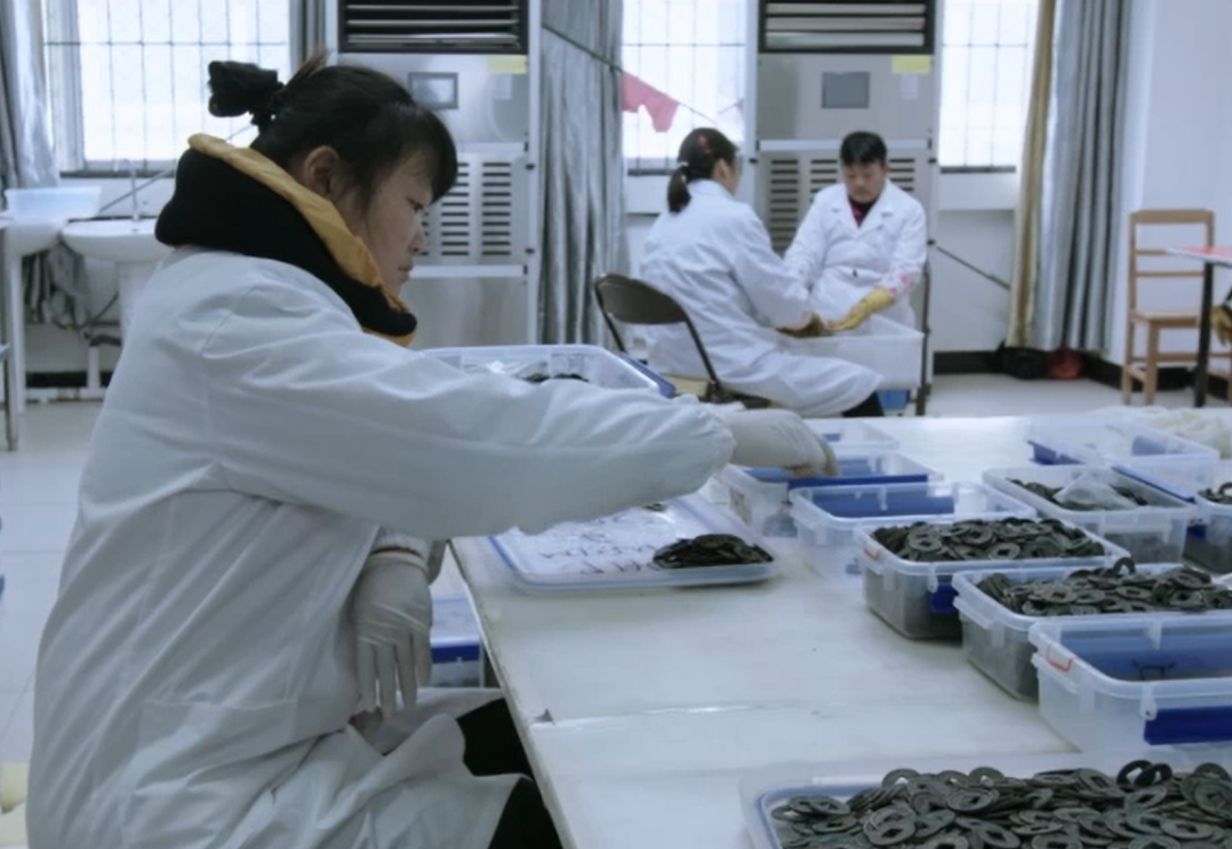
The Chinese are building a posh, modernist museum near the grave site of the Marquis of Haihun. The nearby village has been sinisterly evacuated, the houses already fallen into ruin. The archaeological site is closed to the public, and the museum is just a hole in the ground, but we are here to visit the preservation office, where wood and lacquer items are prepared for restoration.
It’s the closest thing I have ever seen to a prison. A police station stands incongruously in the field outside. The facility itself is a squat white former factory, surrounded by a wall, razor wire and an electric fence. It boasts an inner and outer gate, as well as a guard dog. Inside there are over three hundred motion sensors that beep enthusiastically whenever you try to go out for a wee, as well as uncounted security cameras and a separate echelon of security guards.
“It’s about the gold,” says Xia Huaqing, the head restorer. “Well, sort of. The grave site is famous for all the gold that was found there, so naturally anyone with a criminal intent is going to assume that this place is piled with it. But all the gold’s in the museum.”

Instead. Mr Xia’s facility patiently hosts shelf after shelf, in room after room of lacquer objects. Endless rows of tupperware containers hold goblets, tables and bowls, suspended in a chemical solution that is apparently so toxic that we cannot be in the room with it for more than thirty minutes, even wearing protective gear. Another larger chamber holds the wooden outer slats of Liu He’s sarcophagus, which need to soak for four or five years before they can be allowed to dry… only then will they be ready for restoration.
The longest room, packed with a couple of hundred sealed Tupperware trays that each seem to contain a dozen decayed chopsticks, contains the bamboo slats of the books unearthed from Liu He’s tomb, including the Qi Analects. We are there on the day that one of the archaeologists who uncovered the tomb turns up with two super-watt lamps and a digital camera. Wearing a face mask and googles, his trouser legs wrapped in cling-film against accidental splashes, he straddles each box, trying to get a super high-definition photograph so that his people can start to translate it. I suggest that maybe these two missing chapters from the Analects are the ones that have all the jokes in, but nobody is interested.
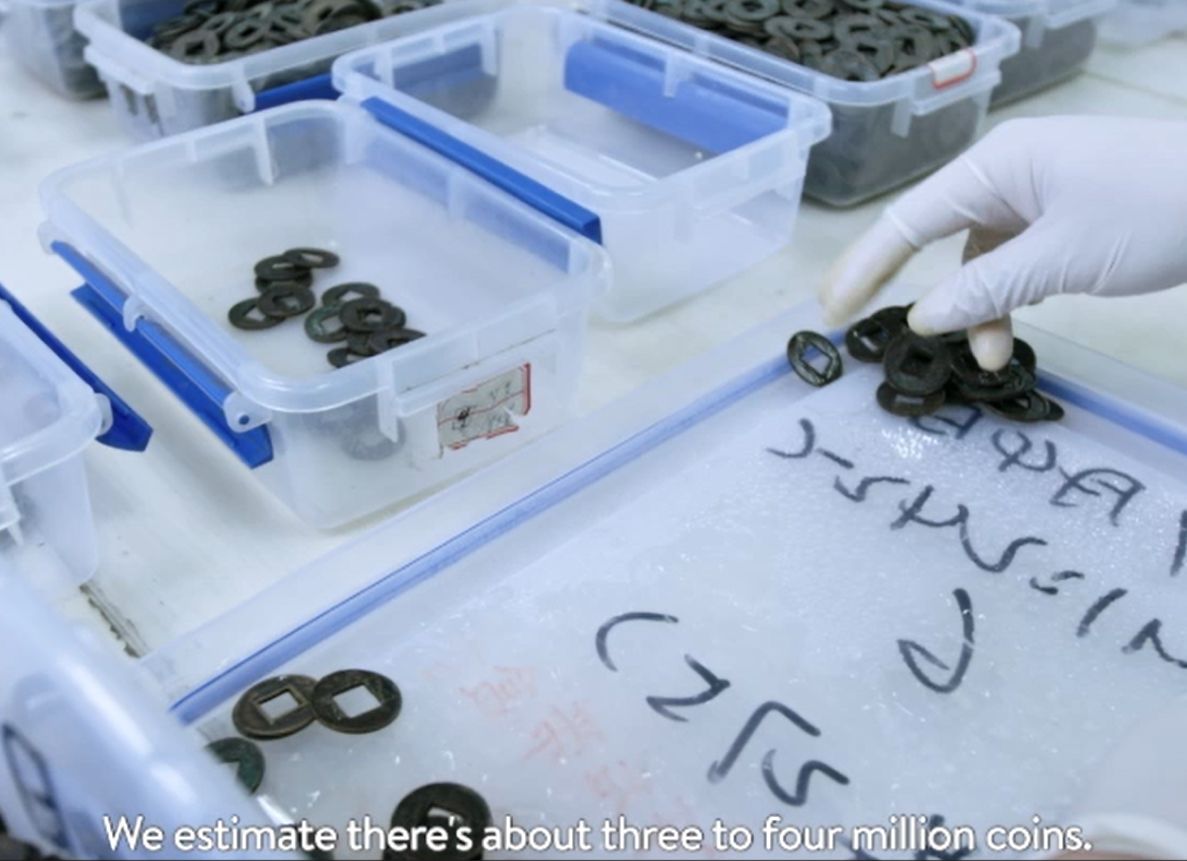
And there are the coins, piles of bronze coins, normally the wuzhu variety, named for weighing the same as 500 grains of millet. Entirely unassuming, everyday bronze Chinese coins that you see all over the place, except the Marquis of Haihun’s tomb contained at least two million of them. Two stern-faced women sit in little aprons, wearing rubber gloves, grabbing a couple of wuzhu coins from a bucket and giving them a desultory scrape with a hard-bristled brush.
“I see you’ve got a pair of scrubbers on the job,” I say to Mr Xia.
“Oh yes,” he says, “they’re at it all day, every day. In fact, this place is so remote, and the security is so tight, that we usually just come here for a whole week, and just live inside the facility. That’s why we’ve got the little allotment.” Little vegetable patches are all over the ground, and in the most unappetising sight apart from the guard dog’s loose bowels, slices of daikon radish are stretched out all over the basketball court and the bins to dry.
It’s Christmas Eve, and so the crew are squired out to the Shangrila Hotel for a Cantonese meal, which includes a roast piglet, its eyes gouged out and replaced by Satanic glowing lamps. Christmas Day, if my memory serves me correctly, begins in a drunken haze at a karaoke bar, with the director and I murdering Ice Ice Baby while the rest of the crew look on aghast.
Jonathan Clements is the author of A Brief History of China. These events featured in Route Awakening S05E04 (2019), although mercifully not the karaoke.
 The Official Schoolgirl Milky Crisis Blog