
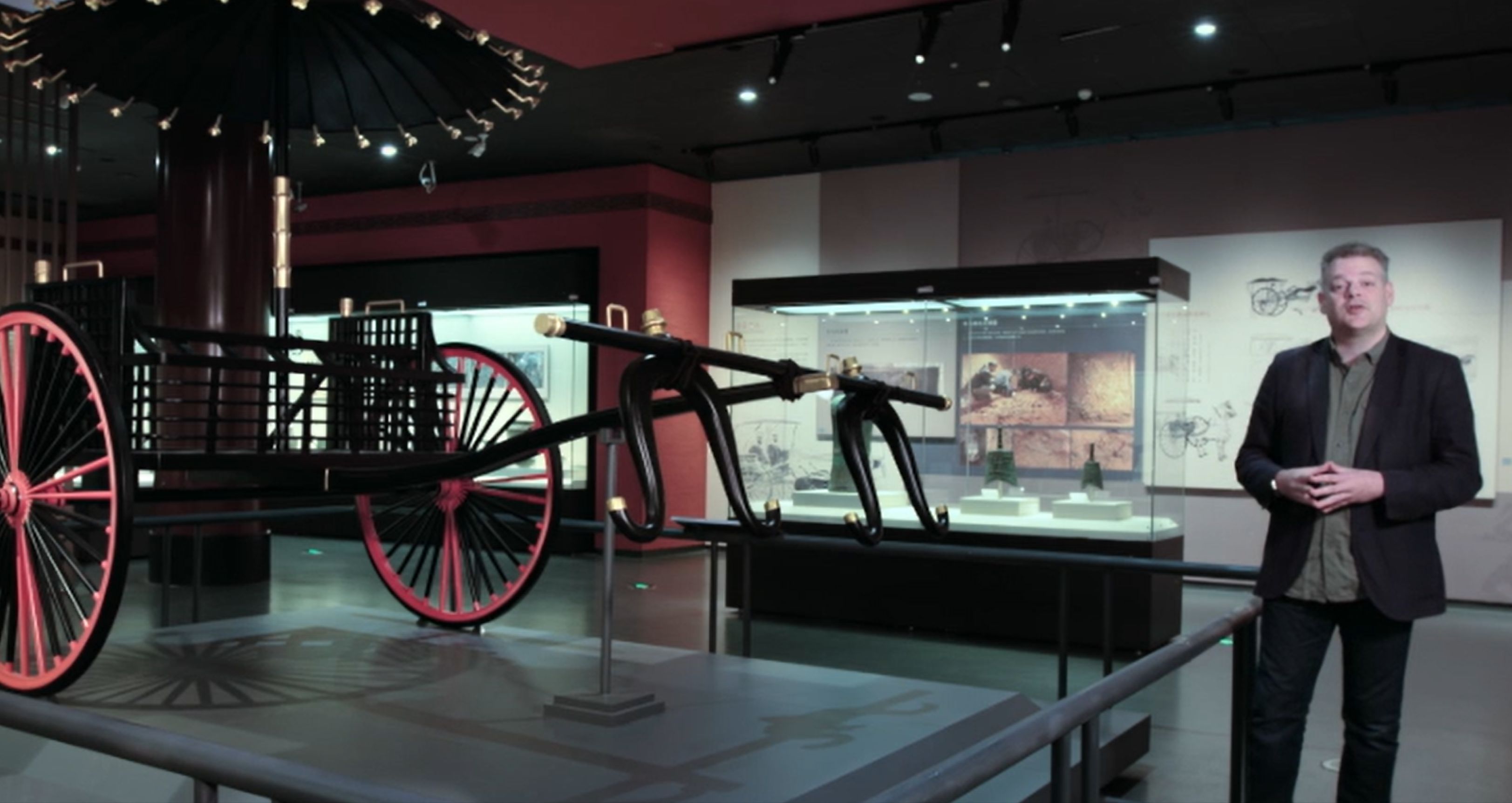
There is an edgy staff dynamic at the Nanchang Museum, which has three times the usual number of security guards because of all the gold in it. This makes them jumpy at the best of times, but one also suspects that they are already all too aware that when the new Marquis of Haihun museum opens in the hinterland [it is now open], they will be surplus to requirements. Or rather, they will be offered a chance to keep their jobs, but only if they are prepared to commute an hour each way to what is currently a slum in the countryside.
This helps explain why the curator is so arsey with Clarissa the fixer, initially refusing to cooperate, then only ringing her back with oleaginous solicitude after he gets a bollocking from his boss. But he is still obstructive, refusing to allow us in to film on Monday, when the museum is usually closed to the public. Everywhere else we have shot, the staff have happily let us film on Mondays, when a Chinese museum is blissfully free of people, give or take the occasional cleaners. Clarissa even offered to pay overtime for the security guards if they would come in, but no, the curator would hear nothing of it.

So we are obliged to fit in my pieces to camera around a huddle of bumbling old couples who have inexplicably turned up with their week’s shopping in rustling bags; breathless girls who giggle at the sight of a film crew and insist on repeatedly taking selfies in the camera’s line of sight, and the constant jabber, key-jangling and walkie-talkie interference of the security guards themselves, who seem blissfully unaware that the harder they watch us, the longer we will take.
I only have a few pieces to do today, but each of them has to be carefully tailored to deal with the available information. One is about a boiler uncovered from the tomb, seemingly an object of zero interest, but suggesting that the Han Chinese had alcohol distillation more than a thousand years before it supposedly arrived in China. The fact that a whole film crew has set up next to an unassuming metal drum soon brings throngs of tourists over, crowding to read the signage and trying to work out why we are filming this and not the gold ingots.
Another piece is about a goose-shaped lantern that contains an ingenious smoke absorption chamber. Here, I earn my money by refusing to call it ecologically friendly, as it is still burning carbon, just not filling the room with smoke.
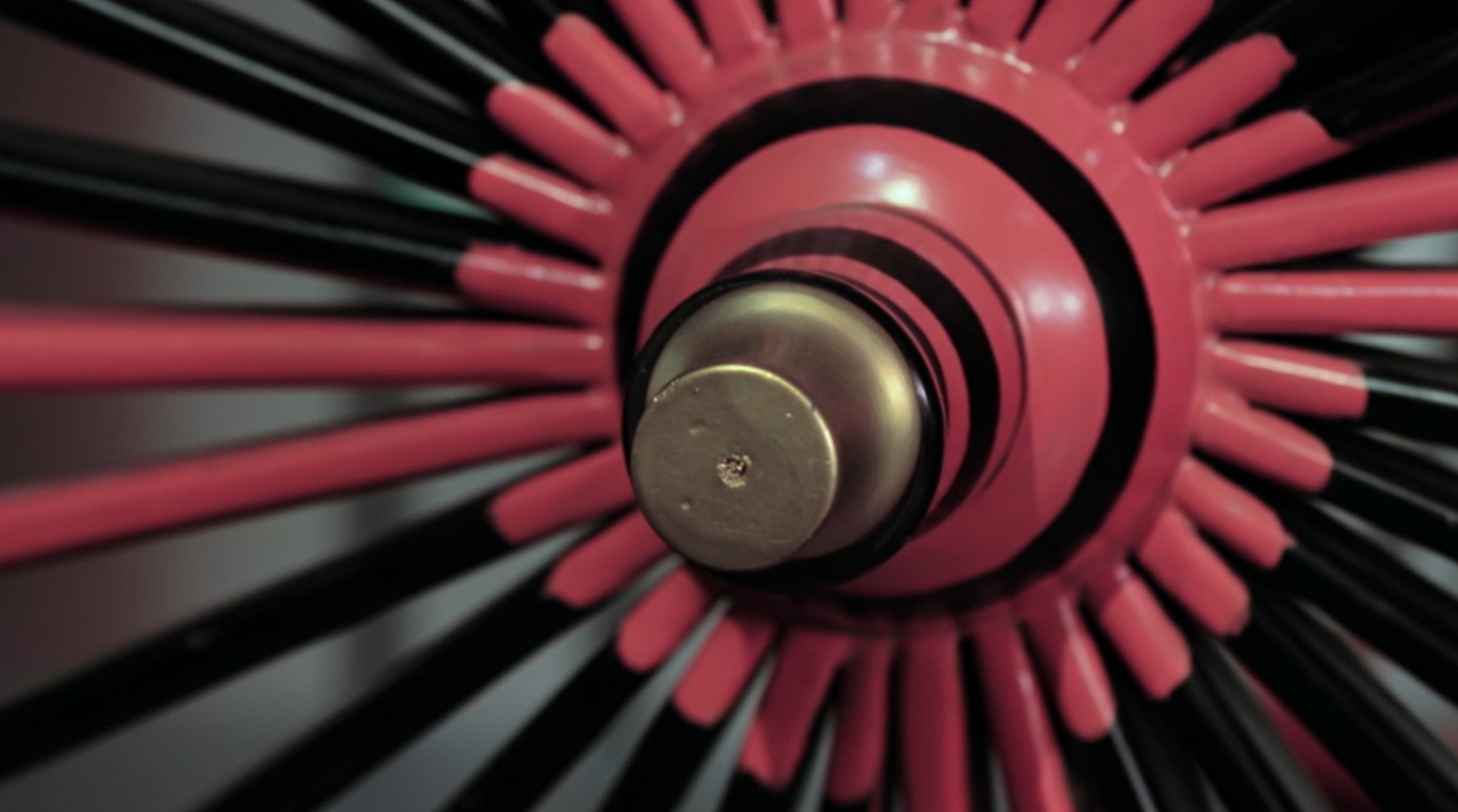
And in a scene that I, and I alone, regard as a hilarious Top Gear parody, I put on my best Clarkson impersonation and discuss the Marquis of Haihun’s pimped-out ride, the Well-Dressed Chariot, a “top-of-the-line sports utility vehicle with gold trimmings, a roaring four horse-power and a built-in drum to annoy the neighbours.” I have to think up this speech on the fly, rehearse it while the director is getting pick-ups elsewhere, and take the assstant producer to one side to photograph the signage for certain terms, so that our Chinese broadcast, when back-translated, matches what the museum says. I pace around the chariot, shuffling the words of my speech to avoid repetitions and redundancies, triple-checking facts and figures and terminology, shadowed by a glaring security guard, who plainly believes that I am just about to vault the fence and hotwire it, presumably driving it away with magic horses. After a while, I decide to see how many times I can walk around the same display before he stops following me. It takes thirty-three circuits.
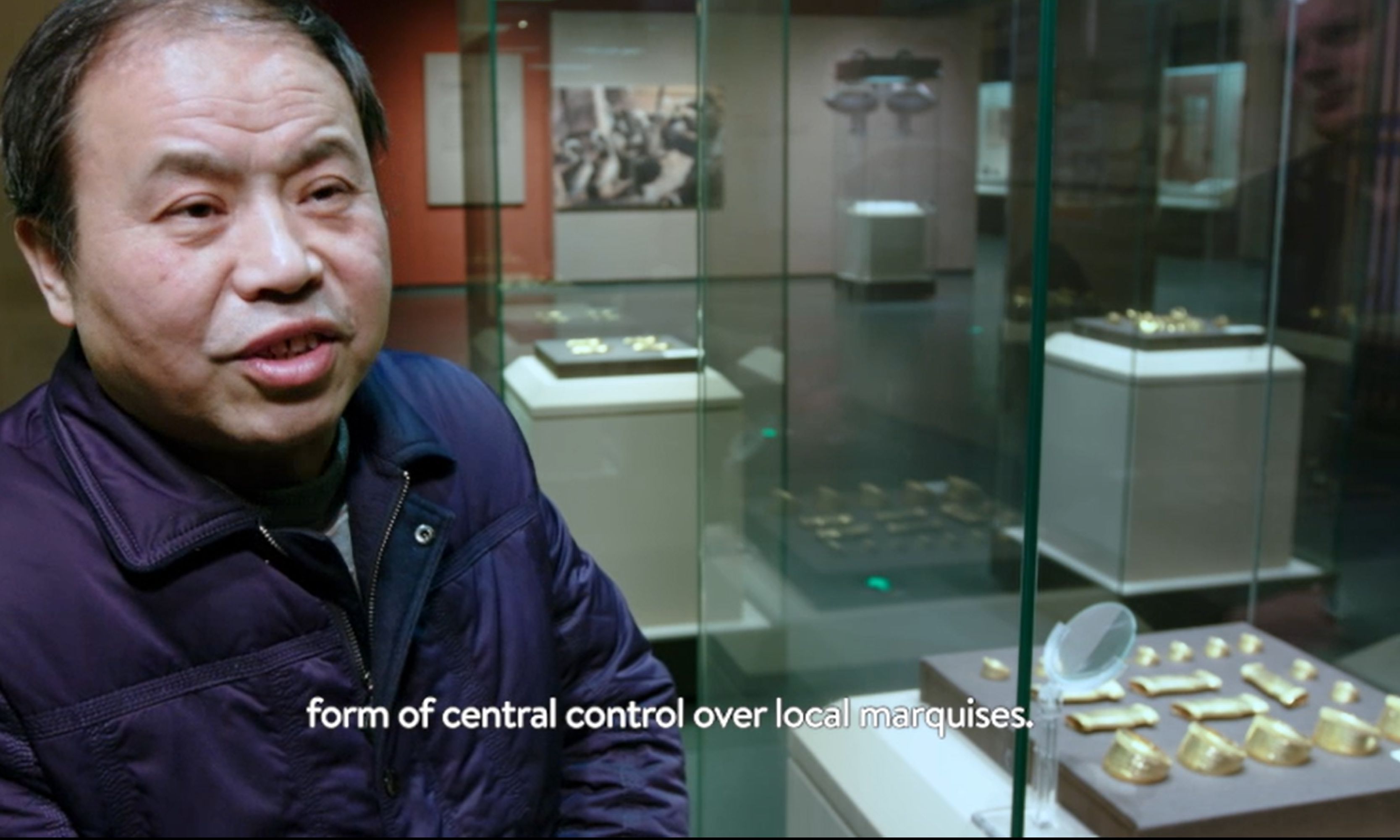
Today’s interviewee, the archaeologist Yang Jun, hasn’t helped by kiting his arrival time from morning to lunchtime, to afternoon, such that a good two hours of my fee today was earned sitting on a bench reading a book. But when he turns up, he is chubby, happy man, ready to talk about how funny it is for him to revisit the Haihun artefacts, separated from him now by bulletproof glass, whereas when he first saw them he was digging them out of the ground with his bare hands.
You would think that the arrival of the man who, to all intents and purposes, found the Haihun tomb, would cause the museum staff to prick up their ears, lean in for some gossip, or otherwise chill out, but they regard him with the same sneering disdain that they have for everybody else.
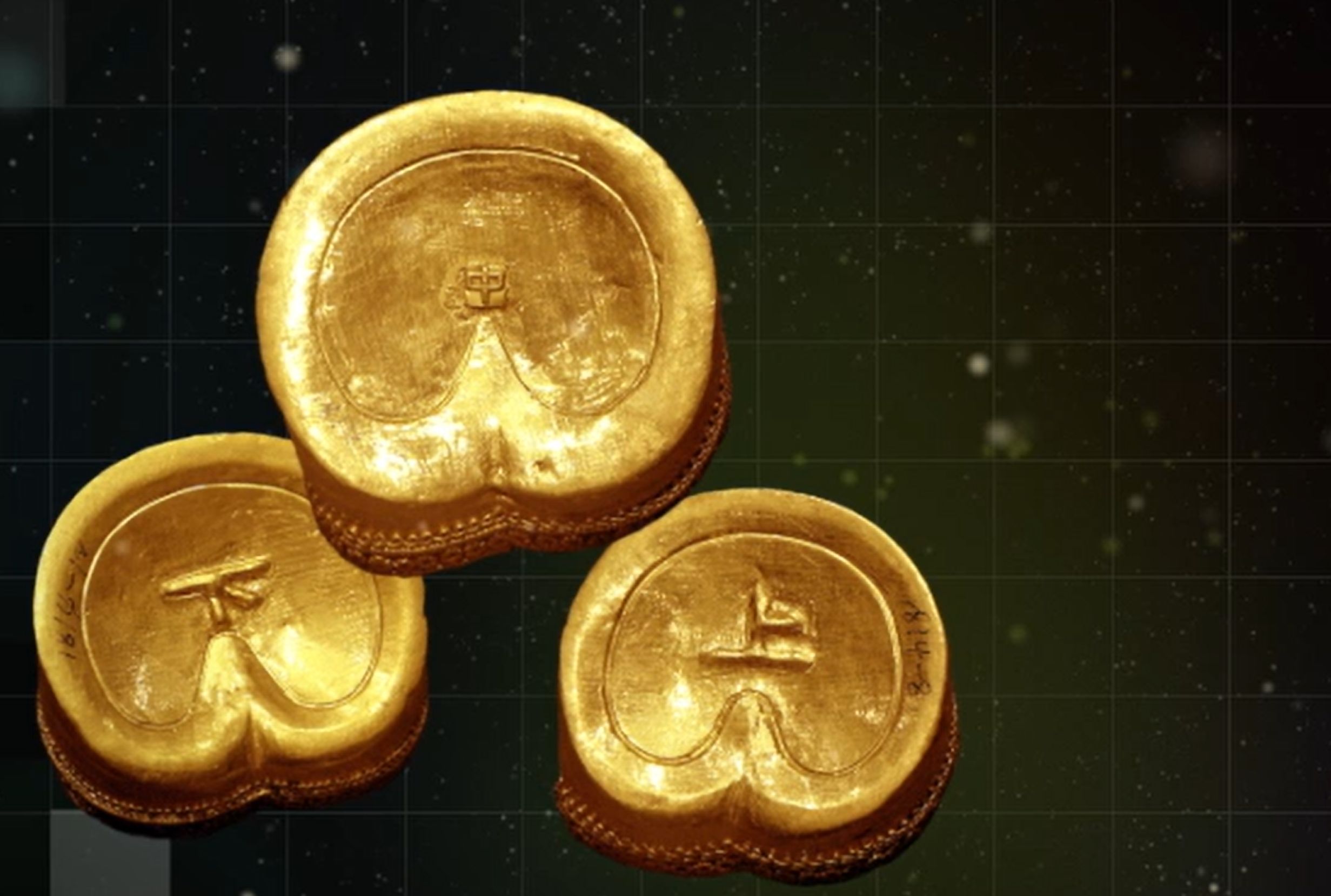
We’re here specifically to talk about the matijin (Horse Hoof Gold), a collection of odd-shaped gold ingots, some filled with Roman glass, that were buried with the Marquis of Haihun. “They weren’t money, as such,” explains Yang Jun, “because he couldn’t spend them. They were imperial gifts, really a reflection not of him, but of his dad, who was the favourite son of the Han Emperor Wudi, and Wudi’s most beloved consort, the Lady Li.” Lady Li was a famous beauty, of whom it was once said that “one look would make a city fall, a second would bring down a kingdom.”
“The thing is that we already know that there was a precipitous decline in the amount of gold in China during the Han dynasty, and I’ve got three theories for that. One is the rise in Buddhist statuary and accoutrements, that hoovered up all the gold around. Another is that trade with Rome was eating away at it.* But the most obvious explanation is that funereal customs changed to the extent that people were buried with their wealth, which the Marquis of Haihun’s grave seems to bear out.”

(*I find this one hard to believe, as the ‘trade with Rome’ was really all about silk going west, and the flow of silver out of Europe into Central Asia. As regular readers of this parish know, there were indeed commodities travelling from the Mediterranean to China, but it’s hard to believe that the Chinese were paying anyone for them in gold).
Although literary finds rarely make for good television, I also bullishly insist on quizzing him about the books found in the tomb. It’s one of those rare moments when the director is sure to dump the footage, but I want to know. Is it true that the tomb includes a copy of the Confucian Analects with the fabled two bonus chapters only found in the state of Qi, and believed lost for the last 1800 years?
“Oh yes,” says Yang Jun, eyeing me curiously as if I am a hamster that has suddenly started discussing Brecht. “So we’ve got the Qi Analects, which has two ‘new’ chapters of Confucius: they’re called Wen Wang (Asking the King) and Zhidao (The Knowledge). But we’ve also got some classics of the Yellow Emperor that people haven’t read before. But everything you see around you is only a part of the find. The gold might be shiny and impressive, but it’s also relatively easy to get out of the ground and put on display. I think the real treasures will take years to become manifest – the previously unseen books, for example, or all the exquisite lacquerware.”
Ah, there it is. The lacquerware, which when this episode airs will be the thing I go looking for more information on. We’ve finally shot the early scene that will send me off to other places, even though chronologically we have already shot those parts. And tomorrow, in fact, will be our final day of shooting, six weeks and 1,500 miles after we started.
Jonathan Clements is the author of A Brief History of China. These events featured in Route Awakening S05E03 (2019).
 The Official Schoolgirl Milky Crisis Blog