
As Matteo Watzky notes in his welcome review of my book, Anime: A History, it’s weird how little it has been discussed in academia. He probably hasn’t helped by repeatedly claiming on social media that I am neither an academic nor a scholar, but it is gratifying to see his assessment that “…for those versed into anime studies and history, Anime: A History is and should remain an essential read.”
His wording might at first seem strange, but it is carefully chosen, and reflects his deep engagement not only with what the book means to him, but with what it could, and should, and might mean to others. It is this self-awareness that leads him to say that some of his comments might seem to be hair-splitting or historiographical nit-picking. They are the sort of arguments that professionals might have about their profession, in the interest of improving it for all, rather than W0RST ANIME BOOK evarrr comments more suitable for TikTok.
As he notes, in the time that he has taken to publish this review, I have actually written an entire other book about the subject, which has also been largely ignored. Partly, this is a case of a very real boycott on account of a cover that everybody hates, including me. But Japan’s Anime Revolution surreptitiously functions as an expansion of Anime: A History, discussing twenty specific films, and incorporating research so up-to-date that it had to be folded in after I had started writing it. It also has whole chapters on Hakujaden, Gundam and Space Battleship Yamato, which he wishes I’d said more about in Anime: A History. I hope Watzky doesn’t take two more years to get around to reviewing that one, but as he points out, there is remarkably little critical engagement with all publications about anime. I have written a lot of it myself, but I can hardly write a review of my own book.
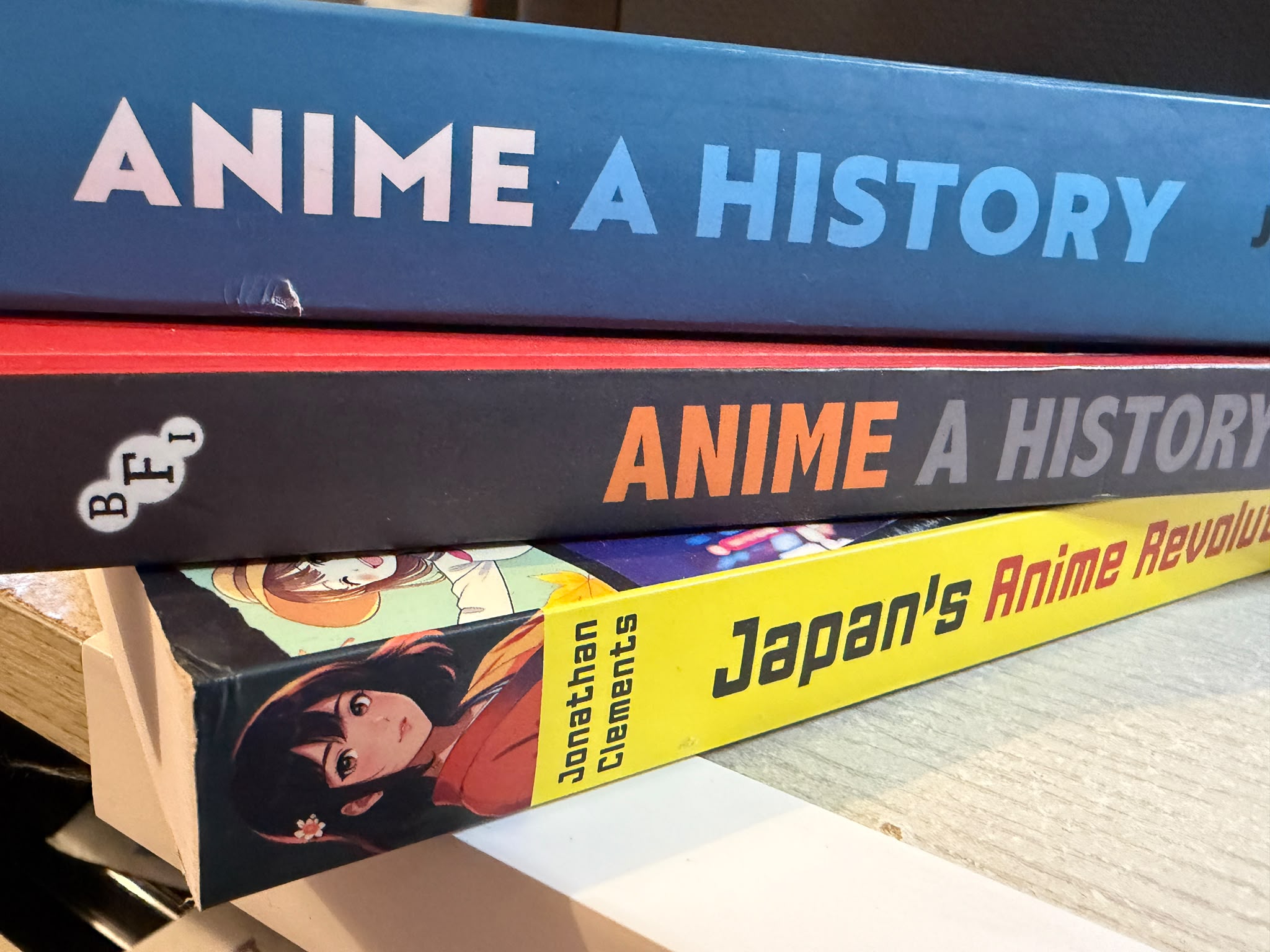
He refers to a “lack of substantial updates” between my first and second edition, which is a weird thing to say when the latter is twice as large. He calls instead for “a history of taste and critical categories: evolving along with forms and exerting an influence on them, these come from people who may or may not act upon their tastes and encourage, or not, certain works over others.” Can anyone think of someone who could write that book? Any takers? I look forward to it. After publishing the first edition of Anime: A History in 2013, I actually wanted to come back with a collection called Anime: Alternate Histories. The idea was for people to write all the chapters that they wished there would have been: something on audiences, something on voice-acting, on erotica, on marketing, and so on. But no publisher was interested, and so I gave up.
Watzky thinks I should devote more to audience studies, and I don’t think he’s wrong. At the risk of designing a 1:1 scale map of the world, which turns out to be as big as the world itself, it would be nice to incorporate more. If I seem to be shying away from audience studies it’s less about my industry focus, and more about my exasperation with so many other papers on anime which claim to be about audiences, but then turn out to be “what some people I know think about some anime they’ve seen.” As I am sure Watzky would agree, that’s not quite the same thing. Nor do I agree that leaning on the work of Eiji Otsuka would make life simpler: it’s something that not even Eiji Otsuka advises doing.
Hefting a giant sack of stones into a glass house of his own making, Watzky comments that I should have said more about the decline of Mushi Production, because there has been lots published about it in the last decade. He cites three examples, one of which is a great book that I reviewed nine years ago, although not so useful on Mushi, and another of which formed a major part of my chapter on Space Battleship Yamato in Japan’s Anime Revolution. His third example is a book I also wrote a detailed review of six years ago, in which I point out that its non-existent citations make it hard to use academically.
We’ll have to disagree, again, on how readily available accounts might turn out to be, not the least because the true story comes accompanied by eye-popping shenanigans, such as the case of the staffer who literally backed a truck up to steal anything that wasn’t nailed down before the bailiffs arrived, and the possibility that he did so with Tezuka’s full knowledge and collusion. You can’t libel the dead, so this kind of scuttlebutt is fairer comment when there are fewer people left alive to sue you, but nevertheless, the record is still very cagey on all this stuff, and I venture to say that, even now, people are still notably tight-lipped about what actually happened, which makes it difficult for a historian to cite chapters and verses.
Still, if it’s that obvious, it shouldn’t be a big deal for Watzky to actually finish his interesting online history of Mushi Production, which he abandoned just as he got to what is apparently the easy part.
Watzky notes several interesting metatextual issues, starting with my book’s implied readership. He calls it a work “for experts, by an expert,” an assessment of which I heartily approve, not the least because the anime world is absolutely jammed with self-styled experts, and I would love it if more of them actually bothered to read it. So, you heard it here first: if you think you are an expert on anime, then you would love Anime: A History, if only to argue with it.
Watzky’s comments also display his perceptive sense about something else unsaid. Should the book have a different title? He thinks that Anime: A History is too general a descriptor, and the Amazon reviews, too, include a number of people who picked up a peer-reviewed book from an academic press, based on a PhD thesis written at a faculty of Applied Design and Engineering, viva’ed by a committee of two engineers and a Japanese historian, with a blurb that promises to investigate “how anime’s history has been written by Japanese scholars,” and then complained that it didn’t have enough pictures in it or mention One Piece. Indeed, it is not a general introduction to Japanese cartoons, it is a work “for experts, by an expert,” and I like it that way; I think Watzky does, too. It was called An Industrial History of Japanese Animation all the way through the writing process, until my publishers decided it needed to sound a bit zingier. Similar redactions attended Japan’s Anime Revolution: Twenty Animated Films that Changed the World, which was delivered to its publisher with the somewhat less vainglorious title of Anime Icons.
One thing I will say, to whomever it is that takes on the task of writing an alternate history of Japanese animation, (Can anyone think of anyone? Yes, you can!) quite possibly from an audience perspective. Please don’t keep referring to “historical actors.” The term is perfectly reasonable among historians, but when broadening and deepening studies of Japanese animation, future researchers will ultimately have to integrate actual actors. Minori Ishida’s work on voice acting is already doing so, and frankly, a chapter on that topic is also something I would consider in a notional third edition of Anime: A History. But in the interests of not baffling humans and search-robots alike, please let’s all use the term “actors” when referring to thespians, and not just anyone involved, otherwise there is sure to be confusion.
Jonathan Clements is the author of Anime: A History and Japan’s Anime Revolution.

