“Maomao is a self-harming teenage wallflower in an institution populated solely by other girls who will literally kill each other over the chance to go to the prom. In that most imperial of Bechdel tests, there is only one man who matters in the whole world, and the women talk about him all the time, but he is literally the master of all he surveys, and anyone who can snare his heart and bear his favourite son and stay alive will be the queen bee.”
Over at All the Anime, I review Natsu Hyuuga’s novel The Apothecary Diaries.
Kaifeng’s bars were riddled with chancers – sing-song girls who would come to the table unbidden, and freelance hawkers who would hand out flowers or treats as if they were complimentary, only to reveal that there was a price to pay. Such hassle was part of the drinking life all over Kaifeng, except at Charcoal Zhang’s and Yoghurt Zhang’s, two higher-end establishments that served only the finest of wines and particular pickles, and chased all the riff-raff from the door.
We see in them, however, the early glimmerings of the Chinese theatre. Although few of their skits have been known to survive, at least in the forms they were originally performed at table-side, we do have a list of some of their names, many of which are immediately evocative of certain set-ups that would not be out of place today.
There are several titles related to ‘wrecking the restaurant’, which were presumably playlets of humorous incompetence. One is called Starting a Fire While Serving the Soup (song geng tang fang huozi), and immediately summons up images in my mind of a Chinese Basil Fawlty losing it with a waiter. Similarly evocative of a timeless routine is one that’s simply called There’s Only a Little Pepper (hujiao sui xiao). Some titles suggest wordplay or a stand-up routine, even a challenge to name a hundred fruits or cooking implements, while others have an interactive element requiring the participation of certain diners as they interact with actors playing the ingénue, the poor student, or the wily official.
Such lost Song-era performances have numerous echoes in modern-day Chinese dining. Skit is almost the wrong word for them – but there are scripted moments of performativity in many a modern-day Chinese restaurant that lays claim to anything more than basic food.
It’s only here, as I type up the forgotten table antics of the medieval Chinese eatery, that I am reminded of the time when I was with a film crew in Luoyang, where my ‘special’ fish dish came with the ringing of a gong, fireworks, and a hooting bunch of waiters dressed as imperial ministers. I remember this only because when I discovered it, I tried to get my attention-shy director to order it the next day without telling her that the whole restaurant would come to a halt when she did.
Similarly, I once endured a seemingly endless five minutes with the ‘Noodle Dancer’ (laomian-shi) at a prestigious hotpot restaurant in Xi’an – a capering madman who would juggle and thrash the dough to create handmade noodles in front of me.
“BEHOLD!” he bellowed. “I AM THE NOODLE DANCER WHO CREATES NOODLES OUT OF NOTHING. SEE AS I WHIRL AND TWIRL. SEE AS I SWIRL AND FURL! LIKE A LASSOO! LIKE A WHIP! I CREATE NOODLES OUT OF RAW DOUGH JUST FOR YOU!”
Unfortunately for me, I had ordered two helpings, so he had to go through the whole ostentatious routine all over again.
It all started at the Tasty Congee & Noodle Wantun Shop, a Hong Kong airport café requiring customers to order at the counter and wait for their number to show up. Online reviews for the chain are extremely complimentary – Yelp is full of comments about some of the best fried noodles and congee to be found, high praise indeed for a food-obsessed place like Hong Kong. There are, however, occasional references to a certain brusqueness of service at the airport branch, a very large menu that is difficult to process in a hurry, and an anxious overcrowding that can cost dawdling customers their table if they don’t keep a watchful eye for their order number.
Some or all of these elements combined for two Mainland ladies in 2018, who had plainly already had a miserable time on their Hong Kong vacation.
“I felt like I was subjected to shame and humiliation,” one had tweeted earlier, as reported in the South China Morning Post by Naomi Ng. “In Hong Kong, if you speak English, people will be polite to you. If you speak Mandarin, they will roll their eyes at you.”
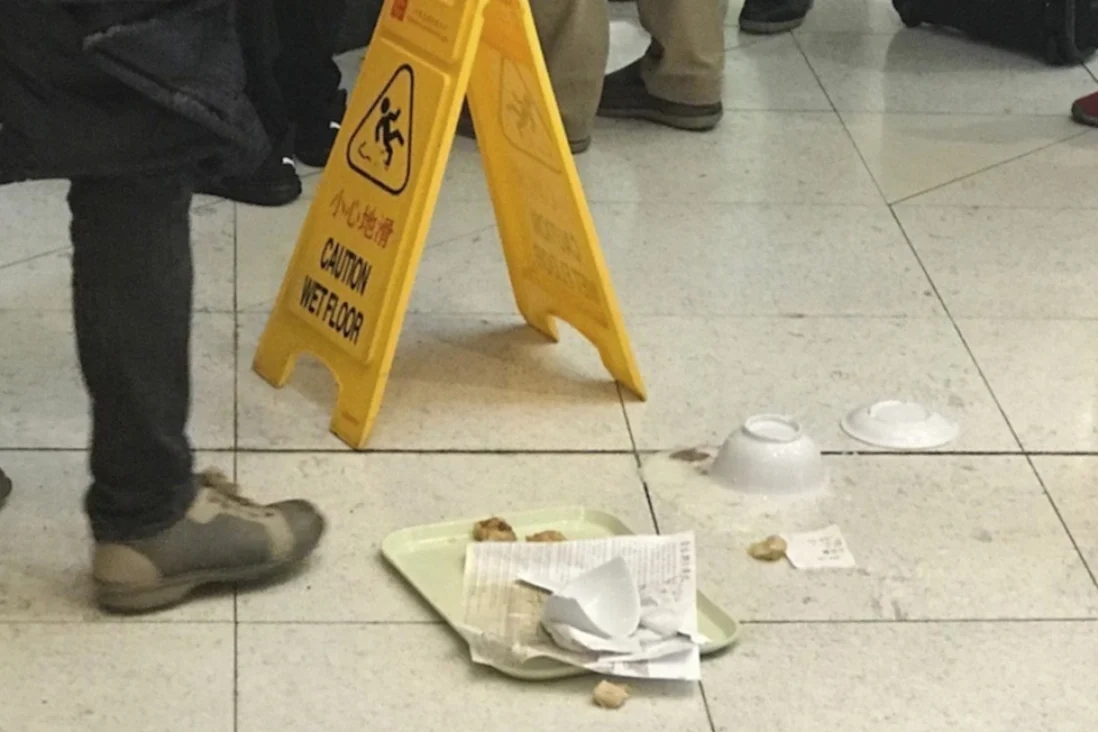
At the café, waiting for their homebound flight, they got into a scuffle with a member of staff. They complained about poor customer service. He told them to stuff it and swore at them. Both sides, according to one witness, started throwing food around, until the man pushed a tray of congee and noodles at them, splashing some on one of the women’s clothes.
Reading between the lines: it was post-Christmas/New Year rush, people had probably been working overtime and covering for winter flu. The café was crowded, and the staff under pressure to keep tables moving. Someone misses their number; someone takes their table; someone gets told to hurry up; someone says they wanted theirs without chili not with it. After some shouting, the women were refunded their bill and left, but a media footprint was already growing – including shots of the incriminating tray, left on the floor for mere minutes afterwards.
Social media magnifies and preserves such incidents in a way not possible in previous generations. The pictures and the online footprint of something that would have otherwise been forgotten in moments provided enough material for newspaper follow-ups. It is a story I can access years later, and part of a narrative that continues Hong Kong’s cross-cultural stand-off of “dogs and locusts.” I remain in two minds about whether this is a good thing, and here’s why.
In 1991, I was witness to a hysterical altercation at a family-run fish restaurant in Kending, Taiwan. As best as I could tell, someone had married someone they shouldn’t, and granny’s inheritance risked being frittered away and someone should have cleaned out the pumps, and in what seemed like mere seconds, a scrum had developed at the front of the restaurant, open to the warm summer-night air and the beach beyond. The old granny grabbed a meat cleaver and smashed its blunt corner into the glass fish tanks, inundating the plaza outside with water and gasping trout. The crabs made a break for it into the street, scuttling through swerving traffic, as the old lady sat sobbing at one of the empty tables. Her children scattered back to the kitchen and rushed to clean up the tables, and everybody pretended there weren’t a dozen huge fish dying on the patio.
I had no idea what was going on. At the time, I lacked the Chinese or the authorial pushiness to really ask. But the only evidence of this is me telling you. I didn’t have a film studio in my pocket that could document it all. Access to the World Wide Web was still a year in my future. I’m sure that the Great Kending Fish Restaurant Fight was an order of magnitude of drama and controversy above a scuffle in an airport café in 2018, but the technology we use in our everyday lives has changed the way that we prioritise and remember. In the 21st century, such technology can be used for the evils of fake news and filler, but it can also be used to swiftly escalate issues in food safety and law. Access, accountability and archives are a feature of modern social media, and the way we talk and think about food and the food industry.



 The Official Schoolgirl Milky Crisis Blog