
Ryosuke Takahashi, in his own words.

“Osamu Tezuka was… well, ninety-nine percent of the time he was a nice guy. At Mushi Production he’d say to us: ‘You’re creatives! Go and create, draw your hearts’ desire.’ So we’d draw whatever we wanted and we’d be nearly finished, and then he’d say: ‘No! Do it again!’
“We worked so hard. There would be times when we wouldn’t even go home. But we all had footrests under our desks, and you could put your coat on it and use it as a pillow. There was one time when I crawled under my table, just to get a little nap. I opened my eyes, and saw that Tezuka was sleeping under the next desk.
“Tezuka was the life and soul of Mushi. Mushi without Tezuka was like North Korea without Kim Jong-il. It fell apart.
“I wasn’t there, though, not then. I’d fallen in with Juro Kara, a playwright who’d briefly worked at Mushi Production as a scriptwriter. But whenever Tezuka asked him to change something, he would just glare back at him, and after a while, I think Tezuka was scared of him.
“Anyway, Kara and his wife were also avant-garde theatre performers, and they would be onstage with a bunch of dancers, painted gold. After the show, they would all jump in the bath together and scrub each other down naked, to get all the paint off. I realised that if I joined the troupe, I would have to jump in the bath with all the actresses. So I volunteered for that and ended up on a European tour, although nothing came of it. By the time I got back to Japan, Mushi Production had collapsed.
“But it wasn’t long before other companies started up using people from the old studios. Most of the managers at the newly established Sunrise had been lower down the pecking order at Mushi. This meant they could learn from their former bosses’ mistakes.

“The Sunrise studio was founded by people who had been middle managers at Mushi, who’d seen what went wrong. At Mushi Production, the animators were on a salary; in a sense, it didn’t matter if they worked or not and many abused that system. A lot of them had no sense of loyalty; they’d be freelancing for Toei under the desks, and at Toei, they’d be freelancing for Mushi! At Sunrise, everyone got paid for what they did.
“You ask me what the difference was between Mushi and Sunrise. Largely, it was that Tezuka wasn’t there. He had a real faith in artists and animators. The trouble with artists and animators, is that they often don’t like to work! Artists weren’t salaried at Sunrise. They had to produce work in order to get paid, and that made a big difference. All the companies in the 1970s were set up, to some extent, in reaction to the failure of Mushi, but it was only Sunrise that perfected it.
“Toy tie-ins were important to them. They had Yoshiyuki Tomino working on Gundam. If Tomino is a star, then I’m… well, I guess I’m just a street lamp! They said to me: ‘Gundam has done well for us; we want something like Gundam, but different. We don’t much care what it’s about, just make sure there are robots in it!’
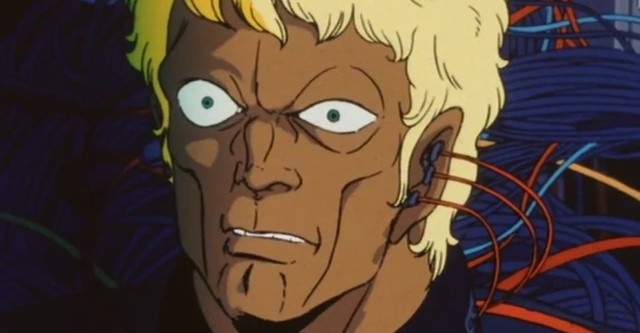
“Gundam had robots fighting, but they were in space. They didn’t really have to touch the ground. My earlier Fang of the Sun Dougram had robots fighting on the ground, but they were big, stompy, slow machines. For Armored Trooper Votoms, I wanted something faster. I made them smaller. I put skates on their feet. That wasn’t about budget; that was so they could really zip around. Then one of my animators suggested that we could get them to slalom, like they were skiing… and we were off!
“Of course, toys became even more important. In the 1990s, a lot of the founders of Sunrise were approaching retirement. In order to protect their staff, they sold their interests in the company to one of their clients: Bandai. It kept everyone out of trouble.
“The ‘Japanese’ animation business today sustains maybe seven thousand employees in Japan, but maybe another fourteen thousand outside it, in Vietnam, Taiwan, China and other places. I teach three days a week, at the Osaka University of Arts. I teach the students how to make entertainment animation. By which I mean commercial stuff. Not art-house cartoons, but animation that they can actually make a living on: anime that can actually help them survive! I don’t have time to write a book. I am sixty-eight years old and professors retire at seventy. Maybe then I’ll write down my experiences in the industry. Maybe…
“I’ve got a place in the countryside. It’s a little house out in the middle of nature. What do I do there? Absolutely nothing! Drink a little whisky, walk around dressed like a British gentleman… Play golf. I look out in the garden, and I think it could do with a little statuette of a nature spirit. A Moomin or something like that. Yes, I worked on The Moomins, too.
“Why did I do it? I did it to survive!”
Jonathan Clements is the author of Anime: A History. This article originally appeared on the now-defunct Manga Entertainment website in January 2012, and was based on Takahashi’s onstage interview at Scotland Loves Anime 2011.

 The Official Schoolgirl Milky Crisis Blog