
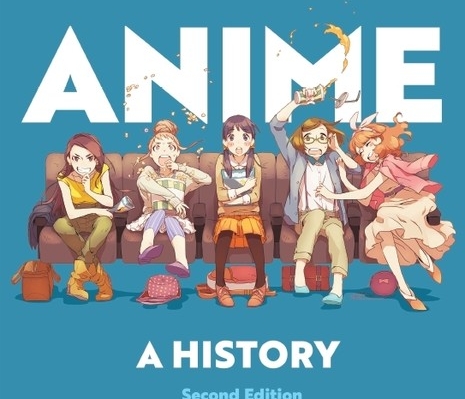
This interview with me by Shelley Pallis about my book Anime: A History was conducted for the Anime Limited blog, but got bumped and re-bumped and re-re-bumped as more pertinent topics got placed before it, until there was nowhere for it to go. I reprint… well, print it here with permission.
I want to talk about those moments in the book when you “break character” as a historian and talk about stuff that’s happened to you, in the context of anime history.
You mean Kyoto Animation?
Sure, that’s one.
That’s from the otaku economics chapter, where I talk for several pages about the particular way that Kyoto Animation was run as a studio, and the way in which it encouraged interactions with fans, offering the chance to be creators. Of course, that backfired terribly when one self-styled would-be creator burned the studio down.

I had to go on stage at Scotland Loves Anime to introduce a screening, I think it was of A Silent Voice, and I had no idea how I was going to do one of my usual stand-up routines about such a serious subject. So instead, I just explained that usually Andrew Partridge would introduce the final film of the festival, but he just couldn’t face talking about people that he knew personally in such a dire situation… and then I decided to read out the names of the people who had had died. I didn’t explain that was what I was going to do, I just said: “And so we’re going to do this…” and started.
You got this ripple through the audience as people realised at different times what I was doing, who these seemingly random names were. But also, the list goes on and on, and on… it takes a long time to read out all those names, and that starts to add real weight to the sense of loss in the business. So, yes, I kind of break the fourth wall in the book to talk about that, because these were real people, and we knew some of them, and someone killed them because they didn’t rush to adapt his isekai novel or something.

Your book is dedicated to Andrew Partridge, is that why?
It’s dedicated to him because he has so consistently put me in the middle of anime history to observe it. We’ve been all over the UK shilling for anime, and it’s put me into some situations that come back to form data in a history book. Scotland Loves Anime is hard work, but it also puts me in a room with some of anime’s movers and shakers. Ryosuke Takahashi takes me to one side to gossip about Sunrise. Mamoru Hosoda sits across from me at an Indian restaurant and reminisces about Gunbuster. Naoko Yamada needs someone to subtitle Garden of Remembrance in a hurry, and starts crying when I read out my translation. I don’t directly quote any of these incidents in the book, but you can bet that they inform so much of what I say, and the directions I choose to investigate.
You also drop in a mention of your Death Note audio drama.
I think it’s a really good example of “post-anime”, where the licensors rake off 5% of something someone else is doing in another medium. Lübbe hired me to write a ten-episode adaptation of Death Note, and said they wanted to go slowly, and to get the first two episodes to the Japanese for approval. When the notes came back from the licensors, they said that there were elements in the script that had clearly derived from the manga.

“Yes,” I said. “You hired me to adapt the manga of Death Note into an audio drama.”
“No,” they said. “The licence we granted was to adapt the anime of Death Note into an audio drama.” Which was something that Lübbe had neglected to mention, because like a lot of mainstream producers, the difference between anime and manga wasn’t something they really appreciated.
As it happens, it took about ten minutes to change my scripts. I think there were two scenes or something in my first two episodes that derived solely from the manga. After that, the licensors were super-happy, and let me get away with all sorts of stuff.
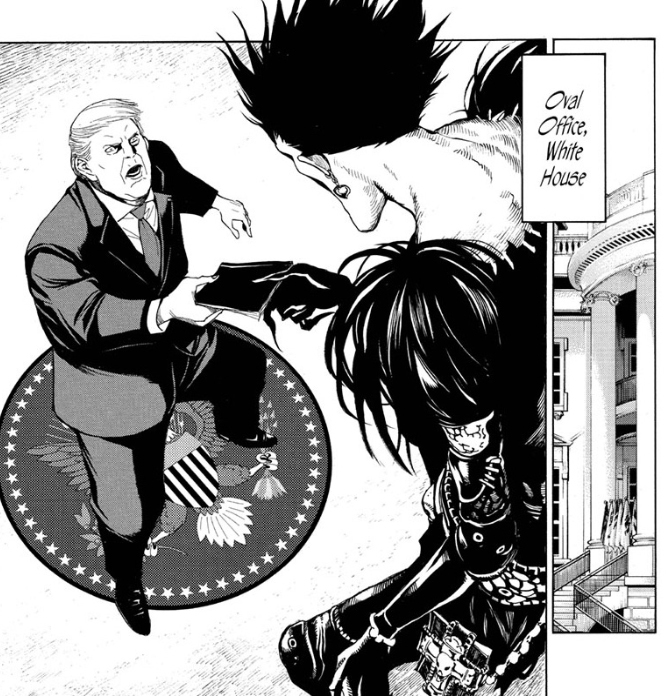
Like making the American president Donald Trump?
I didn’t do that. America did that. In the original, the American president is just an anonymous, patrician white man. But if Hillary Clinton had won, I would have totally made it about her. Instead, we were stuck with Trump, so I thought: how would someone like him react to this kind of weaponised curse, to the revelation that magic existed, and that demons did, too? How would he try to steer it to his own advantage? How would he let it affect US foreign policy?
Did that date the show? I mean, he’s not president any more.
I have often wondered if that’s the reason it never got picked up for an English-language broadcast. It was released in German and in French, and Audible contacted me to ask for casting suggestions for an English-language version, but I never heard anything more about it. I was writing Death Note as a contemporary drama, in the year 2017, and that’s what the American president looked like then. [Subsequently, a Trumpalike president also appeared in the 2020 one-shot Death Note spin-off a-Kira, pictured].
It was very important to me that I wrote Death Note in the context of the new times, not simply repeat what the anime people came up with in 2006. There were new factors to consider, like social media, metadata and privacy, #MeToo, and I threw all those in.
Your Death Note deviates considerably from the original by the end, particularly by keeping L in it all the way through. There’s a really goose-bumpy scene where he has that interview with the counsellor…
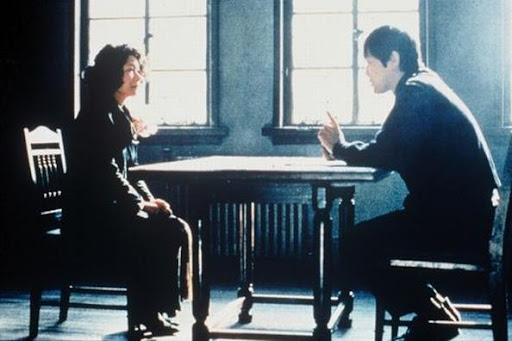
That was a total rip-off from Hirokazu Kore-eda’s After Life. The film starts off with this entirely everyday, bureaucratic person-to-person interview, with a guy going through someone’s papers, and checking date of birth, and name-spelling or whatever. And then he says, very matter-of-factly: “And just to be clear, do you know you’re dead?” And the person he’s talking to nods in a similarly matter-of-fact way.
And this is going to sound super-weird, but the other thing that inspired me was the last-ever episode of One Foot in the Grave, where we all know that Victor Meldrew is going to die, and [the writer] David Renwick completely wrong-foots the audience by beginning with him already dead.
And so, when we reach the episode where L dies, I figured that in the world of this story, death is no obstacle. Things just keep on rolling, and L gets to comment upon and steer the action back in the real world, like a kabuki ghost. And that starts to push things off kilter in a way that I thought was interesting.
Did the listeners in Germany agree?
Most of them!
You seem a bit bitter in your materials section, when you talk about Funimation taking over Manga Entertainment.
Well, I think it’s an interesting element of the “archive” of anime studies. Over the years, Jerome Mazandarani spent about £17,000 of the company’s money on articles about its products and anime in general, for the blog. When Manga Entertainment was acquired by Funimation, they also acquired all this third-party comment – reviews, obituaries and commentary – and it clearly didn’t fit their idea of what sort of sticky content a website should have. The rights situation was unclear, there was clearly nobody at Funimation who wanted to curate it, and so they just erased it from the web. I guess some of it might be on the Wayback Machine, but that’s a lot of content to suddenly disappear. And of course, if you can do that with some article I wrote about Yoshiyuki Tomino, you can do it with an entire anime series as well, as many fans are observing today.
You think streaming is vulnerable?
Sure it is. If you want to be sure you can watch your favourite anime whenever you want, you need to keep investing in Blu-rays.
Anime: A History by Jonathan Clements is published by Bloomsbury.
 The Official Schoolgirl Milky Crisis Blog