August Fixes Everything (1942)

Despite never making it that far up the promotional ladder, August Kivipaasi (Aku Korhonen) has become a much-loved figure at Nikkari Bank, where he has been a cashier for 25 years. He offers sage advice to the janitor Nuutinen (Anton Soini), who wants to buy himself a cottage in the forest (the Finnish dream), and frets that young Anna (Toini Vartiainen), in demanding that her would-be fiancé Hannes (Hannes Häyränen) scrape up a suitable nest-egg before marriage, will doom him to never marrying at all. August still carries a torch for his colleague Maria (Siiri Angerkoski), but the pair of them never married because he could never quite pronounce that the time is right.

With the tin-eared lack of tact common to management, director Visapää (Thure Bahne) shows up at August’s quarter-century employee celebration to tell him that he and Maria have to be let go in order to clear space for his personal cronies as chief cashiers. As the staff protest, the bank’s chairman Baron von Bergenbohm (Jalmari Rinne), hems and haws, and suggests that a note of thanks for August’s long service should be entered into the general meeting’s minutes, as if that will solve everything.

When it comes to present the bank’s accounts, August refuses to hand them over, claiming that he has been industriously embezzling funds for the last 25 years, in lieu of the raise he was never granted. Accusing upper management of corruption and incompetence, he offers to hand the matter to the police, which will mean all the money is gone for good, or to give half of it back if the bank agrees to his demands.

Hannes and Anna need raises, so they can afford to get married. The bank will loan Nuutinen eight thousand marks so he can have his dream shed. Johanssen the family man (Eero Leväluona) is to get a raise as well, so his kids don’t starve. The bank acquiesces, and August reveals that he was lying about the embezzlement just to get some leverage. He makes a final demand: that Visapää shows up fifteen minutes early each day, instead of an hour late, and all is well.

Hannes and Anna can get married, but with their increased salaries, so can August and Maria, acquiring in the process a ready-mix family in the form of two Winter War orphans. As the cast gathers at Nuutinen’s cottage for a sing-song, Maria warns them not to wait as long as they did to start making a family. “Finland needs many, many children now,” comments Nuutinen, “Girls and boys. So go forth and multiply!”

This was a remake of the Swedish film Blyge Anton (1940), itself based on Alexander Faragó’s play Der Herr Schlögl. It’s not clear when Faragó’s play originally was performed, but by the time it was adapted for the Swedish screen in 1940, the screenwriters had wedged in a reference to a Swedish woman who had served in Finland’s Winter War. The Swedish original was screened in Finland in 1941 as The Poor Groom (Kehno sulhanen), but clearly struck enough of a chord with writer-director Toivo Särkkä for him to buy the rights to make his own adaptation.

Ironically, the Swedes in this version are the bad guys – there are pointedly Swedish names for many of the upper-class twits that August and his angry bankers are striking against. In some fashion, this may reflect Finland’s steady drift towards the left – it was only three years earlier, in Scorned (1939), that an alliance of self-made industrialists took on the corrupt saw-mill bosses. But here, our have-a-go hero is a man of little means, relying purely on his charisma and goodwill to outsmart the bosses – whereas Scorned was critical both of the Swedes and the Reds, August järjestää kaiken is a gentle parable of socialist bargaining.

The Finnish version piles on even more pointed references to the aftermath of the Winter War, and closes with a rendition of several verses of the song “Suomen kevät” (Finnish spring): “Finnish spring has finally arrived / the summer of our north.” However, it omits a controversial verse written in a time of German-inspired desire for lebensraum: “For a peaceful tomorrow / like our ancestors / for the creation of greater Finland / in the land of Kalevala.” For extra timeliness, there is even a moment of self-referential humour, when Anna suggests they could go to the cinema to see Marriage Inc. (1942) – a gag that backfires a little, as it ends up sounding like even the cast wish they were in a different film.

In spite of Aku Korhonen’s enduring status as a much-loved icon of Finnish cinema, the box office receipts for August Fixes Everything were disappointing, and the newspapers chose to make an example of it. The anonymous “O” in the Ilta Sanomat let it have it with both barrels, saying that it: “…very clearly reveals one of the worst stumbling blocks of Finnish film, its incurable dependence on theatre. In fact, is August anything but filmed theatre? That slow tempo of action, those long discussions, explications and moods, gestures and movements, the pathetic, theatrical tone of the dialogue – when will Finnish cinema really free itself from this burden? This critic is also bothered by the film’s constant melodrama, its weighty sentimentality, its heavy-handed didacticism. Undoubtedly, the latest [Suomi Filmiteollisuus] novelty is no achievement. It is a strange mixture of histrionics, farce and melodrama.”

And it’s true. So much of the action revolves around August at his little cashier’s desk, which both frames him and imprisons him. The cast and crew only get out of the bank setting with great difficulty, for a stroll in the park and the grand finale in the countryside. Otherwise, the movie struggles to hide the fact that this is a story that more or less takes place in a single room.

Olavi Vesterdahl in Aamulehti was more forgiving, but also singled out the film’s origins as part of the problem. He wrote that he had never seen Faragó’s play (few people had, and looking at the Swedish sources, I suspect it may have been rushed into screen adaptation before it even made it to the stage), but that he assumed it to have been a farce. As far as Vesterdahl could tell, a light and witty confection had been ruined by attempts to shove in meaningful social commentary and unwelcome pathos. “[A] film that is half farce, half something else vague, somewhere between sentimentality and simpering banality, is a sad revelation. However, many similar films have dulled the taste of our film audience to such an extent that this film will probably sell out like a piece of counterfeit money.”

The regional press was more positive, although much of the commentary in papers like Vaasa and Uusi Aura feel to me like local hacks sitting on the fence because they were afraid they might have missed something. Kauppalehti hit the nail on the head, by describing a substandard script lifted out of the shallows by a reliable performer. “[Aku Korhonen] is undoubtedly our best film comedian, for whom the poverty of the script did not cause any difficulties. He brought his cashier to life down to the last lines and almost all the merits of the film must be attributed to him.”

With 21st-century eyes, this does look awfully like a comedy with the laughs taken out, although there is a touching finale as the main cast gather at Nuutinen’s cottage, for him to boast about his “very own potato barn” (at least, I think he said peruna talo) and for the camera to cut away to his hutch full of rabbits whenever he mentions the need to breed new Finns. Shot on a happy summer day in 1942, even as soldiers were fighting and dying in the Continuation War in Karelia, it represents a bright, and overly optimistic hope that by the time the film reached cinemas that September, the fighting would be over, and the Finns could return to their forest idyll.

Jonathan Clements is the author of A Short History of Finland. He is watching all the Finnish films so that you don’t have to.

The City of God in Asia

I’ve deliberately chosen this hotel in Zhuhai because it is in walking distance of Gongbei, the massive border crossing to Macao. I join the dawn hordes streaming towards the border, across the wide expanse of its square out in front. There are men in hi-viz jackets and schoolgirls in uniform, many of them joining the “Macao Residents” line – so, in fact, not Macao residents at all, but actually living over the border and commuting every day.

The kettling is designed for thousands of people, but there is only one person in front of me at the Foreigners line to leave China, and again at the line to enter Macao. I am through in fifteen minutes, and at first glance, I might as well be back in Hong Kong again. But the streets are narrower, there is more tiling on everything, and the first shop I see is St Mary’s Bakery.

In the course of my day in Macao, I manage to somehow walk across the entire old town, from the northern warren of tower blocks, past yet another statue of Lin Zexu, hero of the Opium Wars, through the tunnel that passes under Guia Hill, around the empty mall at Fisherman’s Wharf, and all the way to the statue of the Goddess of Mercy that faces the casino-riddled island of Taipa. The signage is all bilingual in Portuguese and Chinese, but while I hear Mandarin, Hakka and Cantonese spoken around me, I do not hear a single word of Portuguese all day.

Macao’s signature location is the Ruins of St Paul’s, a towering church façade at the top of steps in the old town, a magnet for hordes of selfie-taking influencers and girls who think that a V-sign, jumping in the air, or pointing poutily makes their photos more interesting. Google Macao, and the Ruins of St Paul’s is among the first images that show up. People show up, take their picture and then sod off back into the maze of side-streets, where pushy hawkers try to get them to buy Macao fridge magnets and pork cakes.

St Paul’s is not the name of the church. The church is called the Church of the Mother of God. St Paul’s is the name of the college complex that it was part of, founded in 1573 by the Italian Jesuit Alessandro Valignano. Valignano will be a name familiar to many in this parish, because he is a major character in my book Christ’s Samurai. Horrified that missionaries in Japan didn’t speak Japanese, he set up a Japanese-language boot camp in Macao, which he intended as “the City of God in Asia” – the centre of all Jesuit activities. St Paul’s College was the result, the site of Macao’s first printing press, which churned out Japanese learning materials and… Bible stuff. In the 1630s, it became a training ground for Japanese priests (exiles and the children of exiles) ready to undertake the one-way clandestine mission to enter Japan and administer to the underground Christian communities.

In fact, so many exiled Japanese were in Macao at the time that locals mistook them for the advance party of a Jesuit scheme to invade China, with their churches assumed to be forts and their seminaries taken for barracks. The church façade was partly built by Japanese masons, living in exile as their country turned increasingly anti-Christian. This has turned the extant stonework into one of the only surviving examples of what some have called “Japanese Baroque”, with a quirky take on Christian themes, and multiple appearances of Japanese chrysanthemums. The Virgin Mary is depicted subduing a seven-headed dragon, and a skeleton exhorts passers-by in Chinese: “Remember death and do not sin.”

The seven-headed beast of Revelation 17 is supposedly ridden by Babylon the Great, the Mother of Harlots and the Abominations of the Earth, so quite possibly the legend next to it that reads “The Virgin Mary Tramples on the Dragon’s Head” is a desperate attempt to explain why she’s there, which only muddles thing further, because there is an image of another woman on the dragon, and an image of Mary next to the dragon, and I sense we are looking at the 1630s equivalent of an argument between rival commenters in Google Docs as a priest frantically tries to stop Dave the Japanese Stone Mason from accidentally committing any further carved heresies.

An inscription on a cornerstone reads: “Virgini Magnae Matri Civitas Macaensis Libens Posuit an. 1602”[The City of Macao built this Church in honour of the Great Virgin Mother in the year 1602]. By the “City of Macao”, it refers to the Christian inhabitants, who were persuaded by the incumbent Captain-Major to donate a half percent of their earnings to build a church if the ship they were waiting for turned out not to have been destroyed in a storm as expected. It was the first wager in Macao’s long gambling history, and paid off a few days later. But work on the building continued until 1640, leaving ample time for new Japanese workers to flee their homeland and to work on the façade.

The interior was also once a triumph of oriental artistry, although we can only imagine the decorations as reported by Peter Mundy in 1637: “Carved in wood, curiously guilt and painted with exquisite collours, as vermillion, azure, etts., Devided into squares, and att the Joyning of each squares greatt roses of Many Folds or leaves one under another, lessning till all end in a Knobbe.” There were also numerous pictures, now also lost, thought to have been made by Japanese students of Father Giovanni Nicolao, who formerly taught painting in Arima and Nagasaki, but arrived in Japan, with his students, in 1614 following the latest anti-Christian prohibition.

At least one painting by Nicolao’s students is known to have survived the fire that destroyed the building in 1835. It now hangs in St Joseph’s Seminary, nearby, and is an image of St Michael, drawn as only a Japanese painter would imagine him, clad in samurai armour, wielding a katana, his helmet decoration a ring of bursting rays. Takashi Miyanaga, in a 1995 article, determines that it must have been part of a roof image above the “Altar of St Michael” where several prominent Japanese Christians were buried, which would imply that there was, at very least, a second panel depicting the dragon that Michael is supposed to be fighting, although in the extant image, there are only a few of its flames landing near his foot.

Jonathan Clements is the author of Christ’s Samurai: The True Story of the Shimabara Rebellion. You can hear him talking about Japan’s Christian Century on the Subject to Change podcast.

Calling Occupants

“Swept up in the UFO fervor of the era, aviation journalist Yusuke Matsumura derived a strong inspiration from the flying-saucer cult of George van Tassel in the United States, suggesting that aliens could be contacted through telepathy by chanting the mantra ‘Bentra, Bentra.'”

Over at the Encyclopedia of Science Fiction, I write up the Cosmic Brotherhood Association, a Japanese saucer cult that cast a long shadow in popular culture.

Miss Impossible

“Though in me you behold / the injury of many a blasting hour / Let it not tell your judgement I am old / Not age, but sorrow over me hath power.”

Penelope Clements (1947-2025)

All right, strap in.

We had some arguments about the order of service. The cover image was pretty easy to decide upon. That’s my mother, not yet 22 years old, on her wedding day. She always wanted to be remembered as being young and beautiful, and it’s such a striking image.

The back cover was tougher. I found a nice one of her in Austria, but her partner, Ian, wanted something else.

“I want,” he said, “a picture that shows her doing what she loved best.”

“What?” I said. “Moaning?”

“No,” he said, “I want a picture of her on the Orient Express, when she was at her happiest.”

I remembered that she told me that when they took their last trip on the Orient Express, it was the last time she remembered walking into a room and everybody turning around and staring, ‘coz she was all dolled up, like someone who was just about to get murdered in an Agatha Christie novel. That was very important to her, and it was something that diminished as she got older, and she felt that she was becoming invisible. I said she should suck it up, because that’s how the rest of us have to live all the time.

Of all of you here today, only her sister Wendy has known her for every iteration, every period in her life. For the rest of you, I am sure that something I say will be news. And let’s start at the beginning. We don’t know why she was called Penelope, but we do know that her mother knew the story of the Odyssey, and who the original Penelope was. We think that she was named in honour of a wife who waited for years for her husband to come home from the war, which is indeed what my grandmother had just done.

There was a line of shops along Victory Parade, near the street where she grew up, and the butchers and the bakers, but presumably not candlestick makers, all called her Miss Impossible. I asked Wendy why, and she said it was probably something to do with her being such a prodigy, and so witty and talkative, but was it? Was it, really? Wasn’t it more likely that they were all sick of her imaginary friends, Yibbits and Yubbets, for whom doors had to be opened otherwise they would remain trapped in the shops?

Cousin John is here, with whom she and Wendy formed a club that met daily on an imaginary pirate ship at the bottom of the garden. For some reason, it was called Donna, and to get there, they had to navigate the garden on rollerskates, while carrying beanpoles. I don’t know why this is important, but I was supposed to tell you.

I want to mention something more relevant, I think, which is the influence of the Bulgin family, for whom my grandmother worked. They were something big in avionics, and had a mansion in Westcliff, and for some reason, they took her family under their wing, and showered them with kindnesses. It was visits to the Bulgins’ that instilled my mother with a love of art, of music, of plays and the finer things. They would get a hamper every Christmas from Fortnum & Mason, inspiring her ever after to what her own mother called her airs and graces.

She represented Essex in athletics, and led bizarre school singalongs in the chemistry lab, standing on a desk and conducted her classmates in rowdy renditions of wartime hits, waving a ruler in the air. She already displayed signs of her later commanding form. On being confronted by a flasher outside the school, she simply shouted at him: “Oh for God’s sake put it away!” and ran off laughing.

With her friend Pam, she’d go to see Elvis movies at the cinema, clutching a loaf of Hovis to eat in their seats. No, I know it’s weird. What can I say, times were different. They went to see Roy Orbison play the Odeon, and his support act was the Beatles. She thought they had nice jackets, but filthy shoes.

She converted to Catholicism, because life isn’t difficult enough. Her friend Rosi’s mum Val said to her: “Oh, you’ll love it, Pen, it’s very theatrical.” Which I find interesting because I always assumed her dramatic streak manifested in her twenties, but clearly it was earlier.

Perhaps you, like me, are fascinated with the work of Holland-Dozier-Holland, the songwriting team who made so many of Motown’s classics. No? Okay, just me, then. So I’d better point out that they tried to tailor their songs to be as general sounding as possible, and tried to avoid mentioning specific girls’ names. They made an exception for their 1967 hit “Bernadette.” Which, quite by coincidence I’m sure, my mother chose as her confirmation name.

On what must have been one of history’s most boring dates, she came here to this church, St Mary’s in Stoke by Nayland, to make brass rubbings with my father. Somewhere in this church, there is an image of a long-dead lady… oh, it’s there is it? Yep, okay, over there. And that image has hung in her houses ever since. It represented for her a vague, but ever solidifying yearning, to one day return to this place and live here. It would be thirty years before she did, but that was when it all started.

She went to work in Austria with my father, at a hotel in Mondsee. She still has an Austrian accent when she speaks German. They used the money to tour Europe, which was a real eye-opener for her, and she fell in love with its history and culture, so far removed from her Essex upbringing. When she eventually had children, her two sons, she would dress them up in lederhosen every Sunday, an experience from which neither of them has quite recovered.

She became active in the Southend Shakespeare Company, eventually rising to become its secretary. She played Ariel in The Tempest, and Perdita in A Winter’s Tale, which is why there is a picture of her in the gallery trying not to laugh at an unconvincing bear. And from there she graduated to the Royal Shakespeare Company, not as an actor, but as a dresser. For those that don’t know, when your leading man comes off stage covered in blood and you have to get him out of his armour and into his nightshirt for the next scene, the dressers are the wardrobe minions who have it all ready in the wings.

It meant that she literally had a backstage pass to Theatreland. When I was a child, we’d be in the street in Covent Garden, and she would suddenly say: “Oh, they’re kicking out for the interval at the Twelfth Night matinee. Let’s go to the green room.” And we’d walk up to this door in a back street, where Gareth Thomas and John Matshikiza were chuffing on cigarettes and trying not to get ash on their doublets.

She went back into secretarial work in the 1980s. Simon Wakefield is here, who was the man who hired her at Canewdon Consultants. And as that’s where she met Ian, basically everything that follows this moment is his fault. Ian had high hopes of retiring to the Costa del Sol and learning to play the guitar, but none of that happened after he met my mother. Instead, he found himself buying a house in Provence, where they spent many happy summers before it was fashionable.

She ended up at Cazenove Capital, which was the highlight of her career. There are some of you from Cazenove’s here today, and I we had a lovely letter from her former boss, saying that she used to administrate a charity on his behalf that I had never even heard of. They handed us a cheque for £500, so although it hasn’t showed up on the memorial webpage, it’s enough money to double the donations made in her name to Shelter. As of yesterday, when Tony and Christine pressed Send on their donation, the official total for donations on and off-line has gone over a thousand pounds, so well done, everybody. [Time Travel Footnote: Cazenove sent another cheque, the total is now at over £2,200].

She was my current age, 53, when she was made redundant, ironically just at the time when she and Ian had scraped together the money to buy their dream house in Suffolk. She wrote in her diary of a desire to reinvent herself, although God knows what as. Instead, there was a degree of bitterness that crept in, and she became a Woman of Letters. Money was a struggle until their pensions kicked in, and she wrote of the brutal awareness that she was too anxious to enjoy what she did have. In particular, she grew steadily annoyed at encounters with people who still had jobs, but were no good at them.

And we have a ream, an actual ream of paper in her files, of her draft letters of complaint to various bodies: the Alliance and Leicester, Prudential Insurance, Oak Farm, Dedham council, Southend United… I did intend to give a reading of some her most cutting remarks, but the Reverend Stéphane says that’s not what a eulogy is supposed to be. Although one of the things that has been really comforting to us since she died is the number of people with a funny story.

We have people here today who have come from Switzerland, and California, condolences from New Zealand and France and Hong Kong. And so many of them involve stories about her colourful language and creative invective. They begin with: “We’ll always remember…” and then it will be something crazy. Like my Australian friends, who said, “We’ll always remember that time when she got into a fight with Thorntons the Confectioners, over whether she could have a four-letter word as a cake decoration.”

“We’ll always remember that time she punched a horse….” No, I made that one up.

These ripples that we make in life, how people remember us, the effects that we have on each other’s lives, are fascinating to me. So many of you have mentioned moments, or interests, or decorations in their life that they owe to her, and they can be the most ridiculous things. I have a writer friend, who was the only person in her circle who didn’t get chapped hands during COVID, “…because I always used L’Occitane soap, and I first encountered it with your mother.” Or my friend Kimbers, in Texas, who said: “I’ll always think of your mother when I have spaghetti carbonara.”

Apparently, I was told, she’d never had spaghetti carbonara before, but the first time she ate it, she was sitting across from my mother in an Italian restaurant, and my mother was in full-on Apocalypse mode, ranting in a four-letter frenzy about the Bishop of Brentwood.

Just ahead of Brexit, my mother sent a Fortnum & Mason hamper across the border to me in my Finnish home. The natives crowded around it like jackals, peering in incomprehension at jars of Piccalilli and bespoke marmalade. It was a distant echo of the Bulgins’ kindnesses, half a century after they were dead. And I see some wag has actually put some of the flowers today in a Fortnum & Mason hamper… bravo.

You’ve told me about the effects she has had on the pictures on your walls, the books on your shelves, the music you listen to and the food you eat. And that’s been very comforting for us, to see fragments of her in other people’s lives.

Some of you have been surprised at the fact that she is being buried here, in the church she first visited as a twenty-year-old woman. You all listened to her witter for decades about how she wanted to have her ashes scattered all over Cornwall or something. But no, in 2022, she changed her will. She decided not just to live here, but to die here as well, which is why I invite all of you to walk with me down the Crown, where there will be Scotch Eggs for me and some sort of buffet nonsense for the rest of you, and to share more stories of her colourful, influential and often sweary life. Because when we are gone, the ripples we leave in the eyes of others are all that remains.

I didn’t know for sure what I was going to say when I stepped up to the lectern, but this was it as best I can remember it. Photos by Michael Clements, Kati Clements, Peter Finlay, and some others lost to time.

Time Out

“Film writer Jonathan Clements’s book Anime: A History explores the symbiotic relationship between the Chinese and Japanese animation industries, and the way in which the Chinese have recently disengaged from Japan to go it alone. He notes that China’s latest Five-Year Plan encompassed not only nuclear power and tractor parts, but also the animation industry.”

I’m back punditing about Ne Zha 2, this time for Dave Hughes over at Time Out. Before anyone asks, when I said “Chinese original” of Kung Fu Panda, I was rushing out the door and groping towards the original culture and themes that inspired it: kung fu, wuxia and whatnot. My comments on the film remain resolutely industrial, because that’s what I do, but if you want a more aesthetic take on the movie, Mihaela Mihailova looks at it here at the Association for Chinese Animation Studies blog.

The Lyemun Battery

When the British first occupied Hong Kong in the 1840s, their main enemy was malaria, which killed a quarter of the garrison within months. But there was also the prospect of an enemy showing up from the sea.

It took them forty years, and the prospect of Russian agitation in the region to persuade London to front the cash for a gun battery facing the Lyemun channel that led to Victoria Harbour, although rather embarrassingly, it never got used. It was installed in 1888, but someone soon realised that the emplacements were too high, and it couldn’t actually hit any ship in the channel at all.

In fact, if the Lyemun Battery opened fire, the only thing it stood a chance of hitting were the suburbs of East Kowloon, which had been British territory for the previous two decades.

Today the Lyemun Battery is home to the cumbersomely titled Hong Kong Museum of the War of Resistance and Coastal Defence. What would have otherwise been a relatively obscure museum about a gun on a hill that never got to shoot at anybody has been rebranded and expanded to take into account the story of the defence of Hong Kong since the time of the Mongols. This, in turn, has been aimed at reminding everybody that (a) Hong Kong is part of China, and (b) it also was an enemy of the Japanese in the Second World War, just like China… which Hong Kong has always been part of.

Unfortunately, such protestations unpack in the galleries to recount centuries of complete indifference shown by the Chinese authorities towards Hong Kong. There wasn’t even a concept of sea defence until the Ming dynasty, claims one exhibit. The gallery about the People’s Liberation Army’s 17 years in the territory doesn’t have a whole lot to say, and limits itself to pictures of them marching up and down a bit.

There are some interesting stories about the anti-Japanese underground in WW2 and the Hong Kong Volunteers, who became a sort of guerrilla organisation, celebrated here in a quirky statue that appears to be emerging from a manhole. There is also a memorial to the sad story of Joseph Hughes, the twenty-year-old soldier from Glasgow who was killed desperately trying to put out an ammunition fire on the truck he’d been driving, and was awarded a posthumous George Cross in 1946.

Jonathan Clements is the author of A Brief History of China.

Graves on the Hill

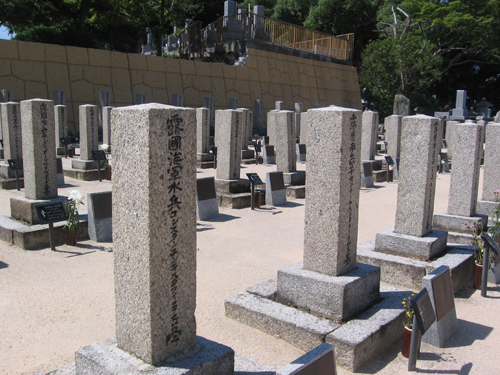
A tram-ride away from the main train station in Matsuyama, set on the side of a hill, there is an array of 98 stone pillars, each bearing the name of a long-dead foreigner. All were Russian prisoners of war, held by the Japanese from 1904-5.

Some 4000 “Russians” were interned in Japan as the war went on. Louis Seaman, a reporter from the Daily Mail, was scandalised at how many of them weren’t really Russians at all.

“The prisoners at Matsuyama were all from White Russia, mostly Finns and Poles, with a decided sprinkling of Jews. Pondering on… the woes of these people in their own unhappy land, the thought was forced upon us that his Imperial Majesty the [Tsar] of all the Russias was emulating with emphasis the illustrious example of David of old with Uriah, in sending these people as cannon fodder to the Orient, where the more killed the better for the safety of his throne at home.”

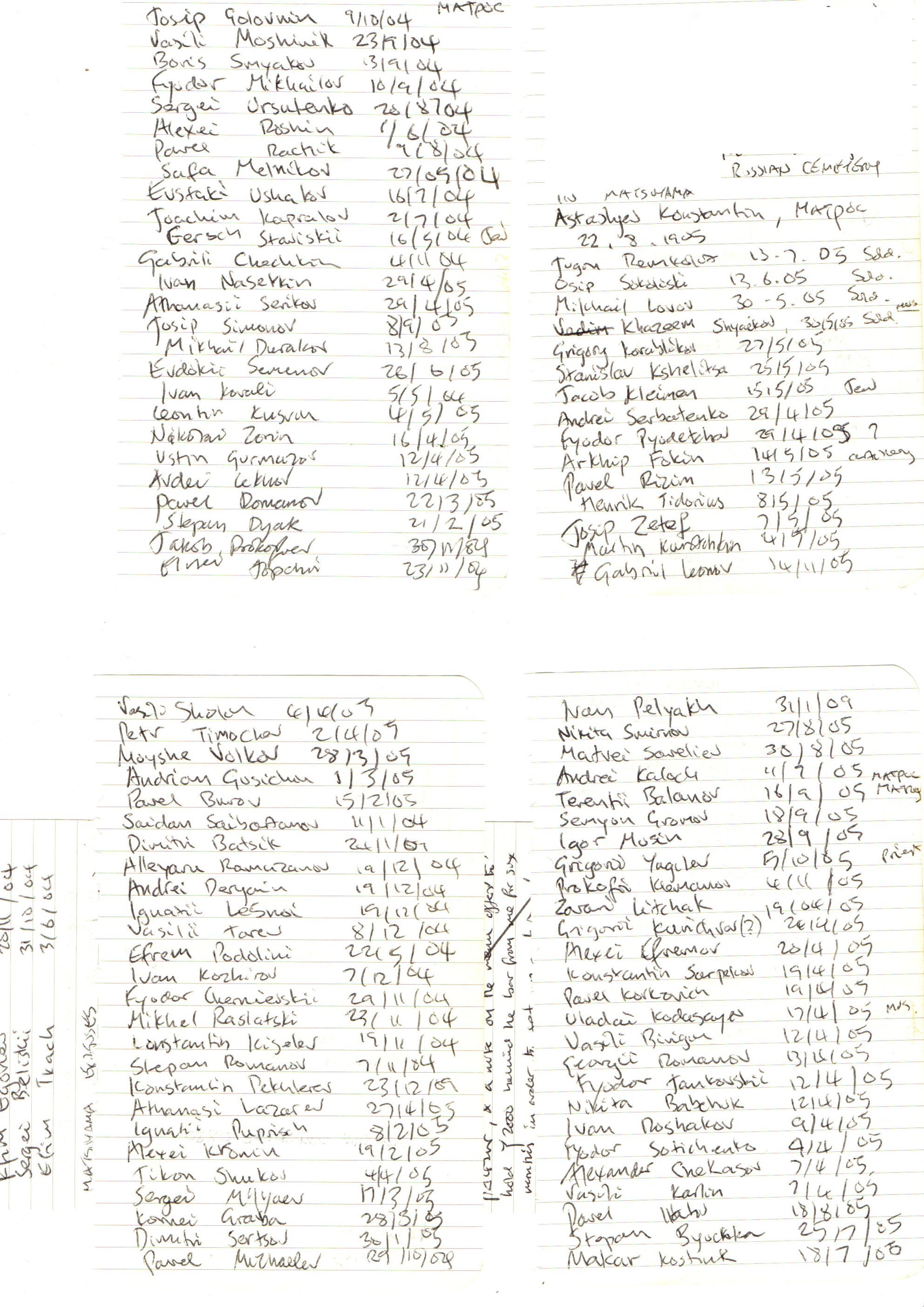
Although many names on the headstones are Konstantins, Sergeis and Dimitris, the graves evoke the multi-racial mix of the Tsarist war machine that was defeated by the Japanese. Uladai Kodasayev (d. 17th April 1905), a Muslim, is plainly from West Turkestan, as is the soldier Khazeem Shayekov (d.30th May 1905). Jakob Kleinman (d. 15th May 1905) is a Jew, perhaps from Poland; Henrik Tadorius (8th May 1905) might have been a Swedish-Finn. Moyshe Volkov (d. 28th March 1905) has a Jewish name but a Christian grave-marker – did he convert or did someone mix things up? All these men died thousands of miles from home as part of the Tsar’s ill-fated attempt to take on the Japanese in Manchuria.

The Russian graveyard is a relatively obscure pilgrimage site in Japan. Even I can read enough Russian to see that the Cyrillic nameplates have been written by someone from Japan, muddling through with a dictionary and crossed fingers. Sixteen years later, as I am clearing out my desk drawer, I find the notebook in which I wrote down the name on every “Russian” headstone in the Matsuyama cemetery. It’s not a whole lot of use to me at the moment, but someone out there in the internet may find it useful, so I have made it available here.

Jonathan Clements is the author of Japan at War in the Pacific: The Rise and Fall of the Japanese Empire in Asia 1868-1945.


Ningbo Attack Monkeys

The main approach towards Guangzhou on the Pearl River is dominated by a midriver island, called the Big Tiger because it is shaped a bit like one. The waters around came to be known in Chinese as Humen, the “Tiger Gate”, although Europeans tended to refer to it in allusion to a slight Portuguese mistranslation that called it the Tiger’s Mouth. In the days of Guangzhou as a trading port, the sole point of access for most Europeans in China, both the midriver island and the banks that flank it were festooned with forts and cannons, in the vain hope of keeping foreigners and pirates in check.

It was here, at Humen, that the Chinese anti-drugs tsar Lin Zexu famously showed the British that he meant business by destroyed 200,000 crates of confiscated opium, hurling them into two large ponds, mixing in copious quantities of salt and lime, and then repeatedly flushing the stinky mess out into the river. As I sign my way into the Opium War Museum, the security guard mentions that the ponds are still there, visible right through the window next to me. Today, they are two unassuming bodies of water strewn with lily pads, each about twice the size of an Olympic swimming pool.

“Are you German?” he asks me, oddly. “What country are you from?”

“England,” I say.

“Ah, then that’ll be your opium that was out there!” he says, patting my shoulder with a sad smile.

The Lin Zexu Memorial Pavilion in Humen is an official “Patriotic Education Base.” To hear some of the shrill internet punditry about it, you would be forgiven for thinking that it was a monument to shouty propaganda, but I found it to be carefully even-handed. When British parliamentarians themselves were calling the Opium War the lowest deed in British history, it’s hardly surprising that the museum calls the drugs trade evil. But it also celebrates Lin Zexu, the brave official who wished he could be a freight and logistics policy-maker, but ended up chiding the British for flogging an addictive drug to the Chinese.

A whole wall is devoted to portraits and potted histories of the British and American authors, missionaries and diplomats who publicly argued that the opium trade was shameful, including, to my great surprise, the future governor of Hong Kong, John Bowring. Meanwhile, although the Chinese story reflects the position of Lin Zexu in the modern Chinese school curriculum as the first herald of a China that could stand up for itself, the museum does not shy away from the fact that he was cancelled after dragging the English into war, packed off to a remote posting in the western desert, as far from the sea as it was possible to go. Included in the exhibition is Qing Xiaohong and Huang Qiannan’s painting Lin Zexu departs for exile in Xinjiang, in which the proud hero to be found in multiple statues and portraits elsewhere in the museum is reimagined as a haunted failure.

The story of the Opium Wars and their aftermath, notes the exit sign in the museum, leaves “a lot of question churning in our brains.” It ponders why the opium crisis, which could have easily been a global phenomenon, was so conspicuously limited to China. It wonders why a drug that had been safely used as a medicine for centuries would suddenly become a dangerous recreational narcotic. It pointedly asks if the blame really lay entirely with the feckless outsiders who made their fortunes as drug-dealers, when the vainglorious, collapsing Qing dynasty seemed unable to police its own subjects.

I’ve been reading Julia Lovell’s history of the opium war. She is very good on both the politics back home in Britain and the reports from the Chinese. She also has an eye for bonkers details, my favourite being the decision of one mandarin in Ningbo to acquire a barrel of monkeys, strap fireworks to them, and find some way of flinging them at the Royal Navy so they could scramble around the ships spreading fire. His genius scheme for the Ningbo Attack Monkeys was thwarted because none of the Chinese could think of a way to get close enough to the English, even if furnished with a monkey-flinging catapult.

Lovell is clear-eyed about the evils of the drug trade, the craven nature of most of the British, and the extinction-level incompetence and corruption of the Chinese. What does surprise me, however, is the message of her closing chapters on the historiography of the war, in which she argues that the Chinese did not give much of a toss about it until 1990, when it was suddenly squirted onto the school curriculum as part of a concerted effort to create a narrative of the “Century of Humiliation.” Somewhere in Beijing, a meeting of policy wonks had concluded that the protestors in Tiananmen Square were lacking in sufficient national spirit, and that the next generation needed to be spoon-fed a narrative of foreign oppression and Chinese resistance, with the Opium Wars as the obvious starting point. That’s all very well, but wouldn’t it have been obvious before 1990 as well…?

Jonathan Clements is the author of A Brief History of China.