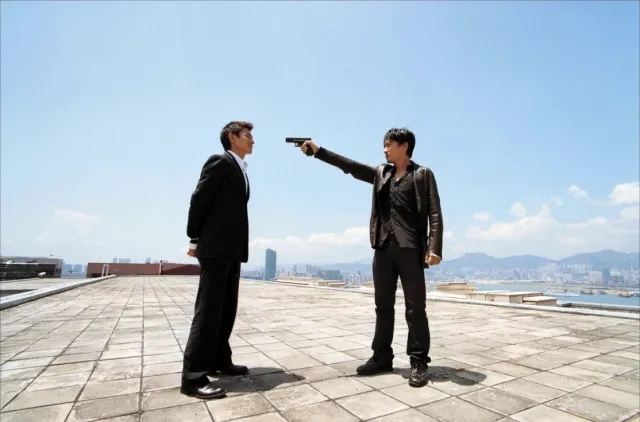
Reporting on Triad activities in the 1990s took on a new cross-border tone, as new arrivals from the People’s Republic refused to play by the carefully negotiated “rules” of Hong Kong’s local criminals. Even as the movie business struggled with the implications of complying in advance with likely post-1997 censorship restrictions, the criminal world, too, faced the possibility of an invasion by a different kind of gangster.
Hong Kong was stuck in the middle, its 1997 change in sovereignty described as a grudging “Handover” by the British media, as if London was being mugged for its lunch money, and an exuberant “Return” in China, as a long-lost sibling returned to the Beijing family. But by this time, Hong Kong had spent 150 years under British rule. Could there ever be any going back? Could it just revert to being “fully” Chinese, whatever that meant, as if it had simply been undercover on enemy turf for a long, long time? As Chan (Tony Leung) comments: “Everything will be okay after tomorrow,” but the idea comes loaded with misplaced optimism, and is repeated on several occasions in the series.
Excerpted from my sleeve notes to the new 4K Blu-ray release of Infernal Affairs by Umbrella Entertainment (Australia), which goes deep into the shadow line of different kinds of gangster operating in 1990s Hong Kong. I’m so pleased that Umbrella continues to recognise the value of meaningful extras, while so many other video labels are succumbing to the false economies of bare-bones releases.
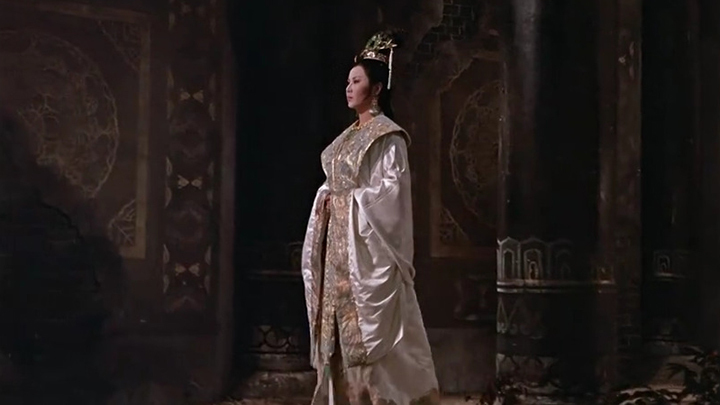
“Without enough bulbs to adequately light the set, Nishimoto focussed on key-lighting the principles, rendering many backgrounds into moody shadows. The resultant film, The Magnificent Concubine, was a visual triumph, going on to win the Technical Grand Prize at the Cannes Film Festival, although Nishimoto kept away from the celebratory party, in order to preserve the illusion of the film as an all-Chinese achievement.”
From my article on Tadashi Nishimoto and other Japanese film-makers working under false Chinese names in the Hong Kong industry, included in the Arrow Films Shawscope #4 box set.
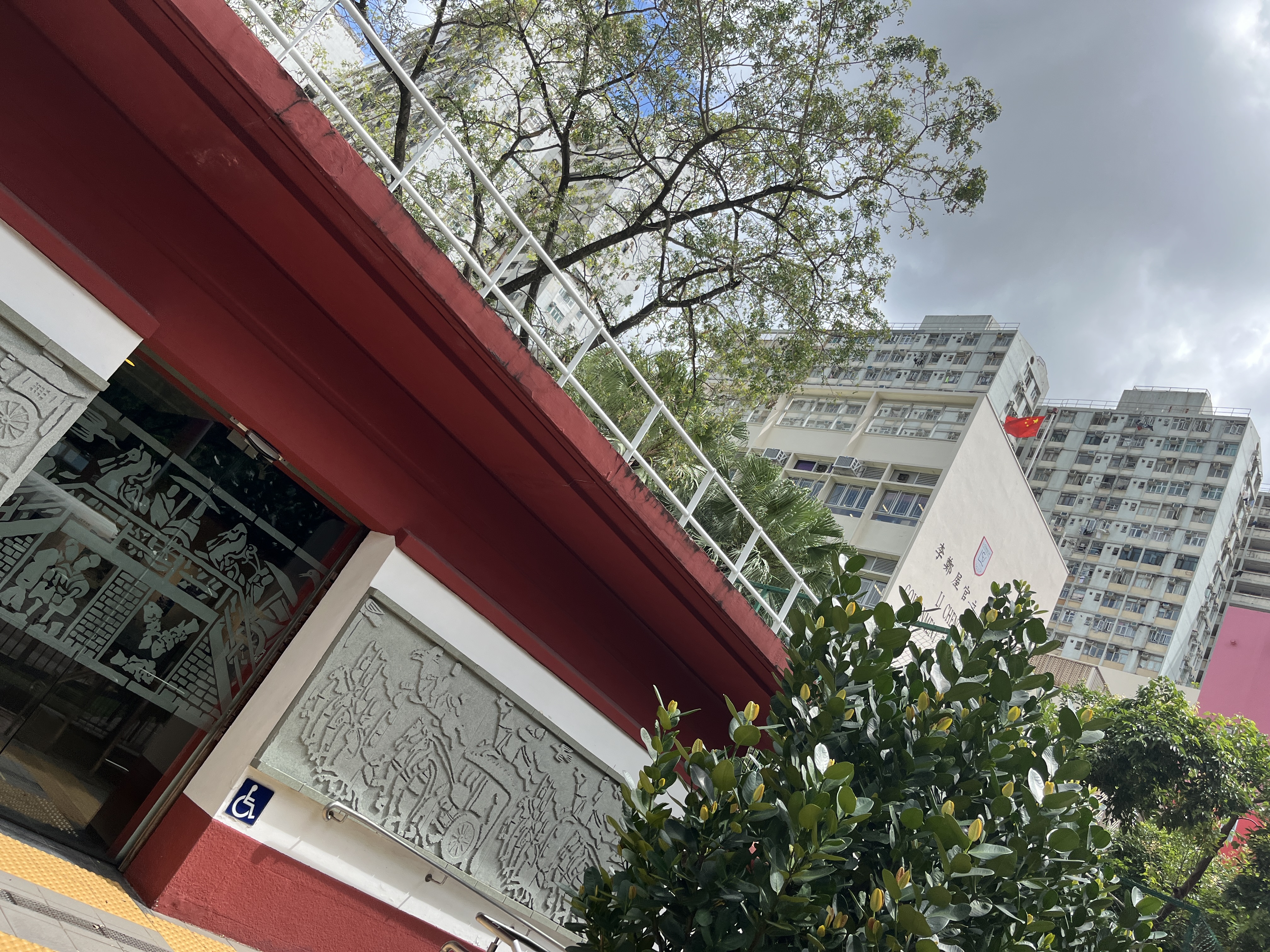
In the 1950s, a fire ripped through the illegal Hakka communities clustered in the hills near Cheung Sha Wan (Long Sands Bay) north of Kowloon. Scrambling to house the displaced locals, the Hong Kong government authorized a rapid resettlement scheme to create massive housing estates in the area. These were austerely functional buildings – shared toilet facilities, and kitchen ranges on the balconies to keep the fires out of the interiors. The local children were schooled on the rooftop. These estates are largely gone now, but in the meantime, they have created their own contribution to Hong Kong history.
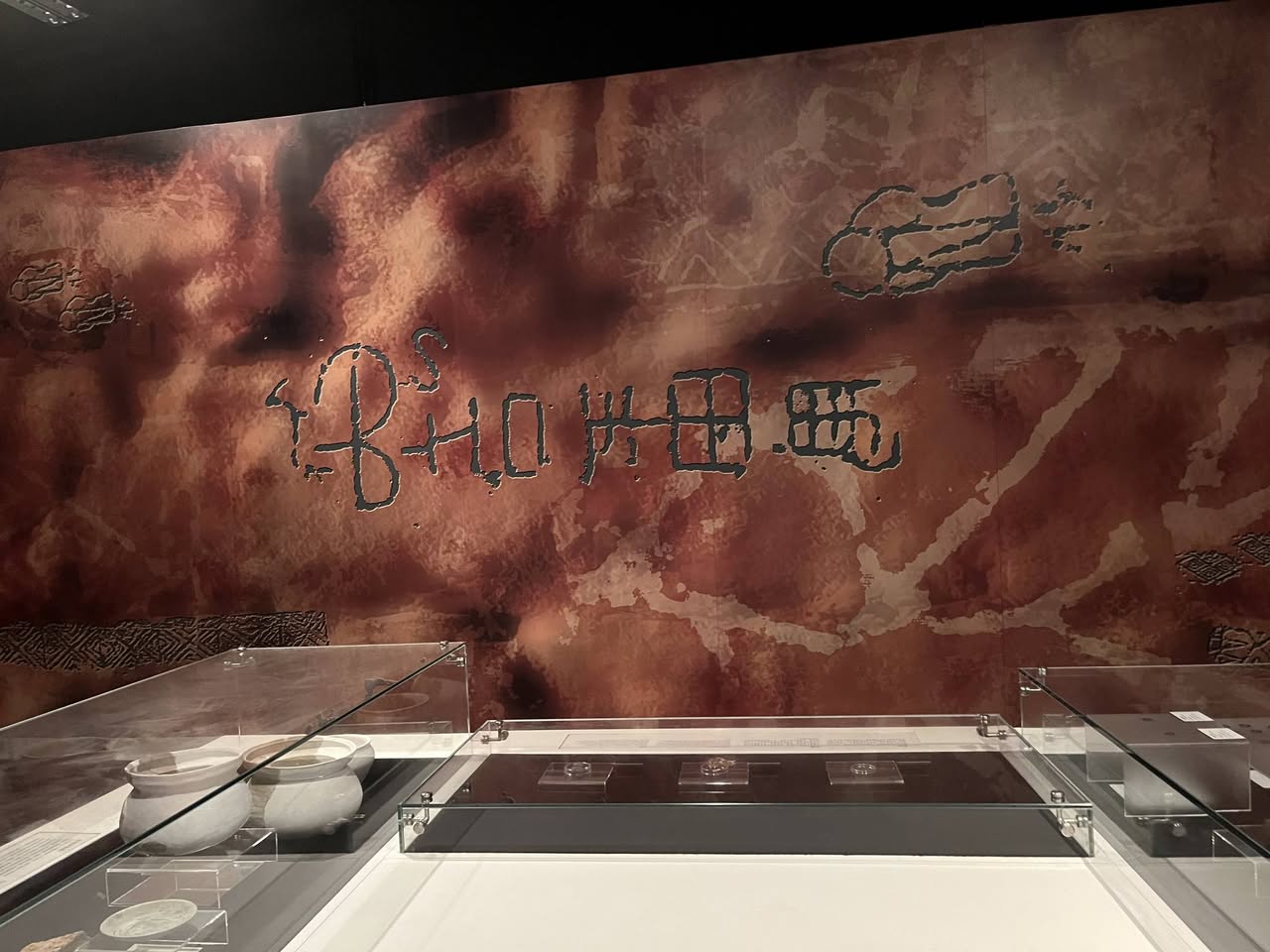
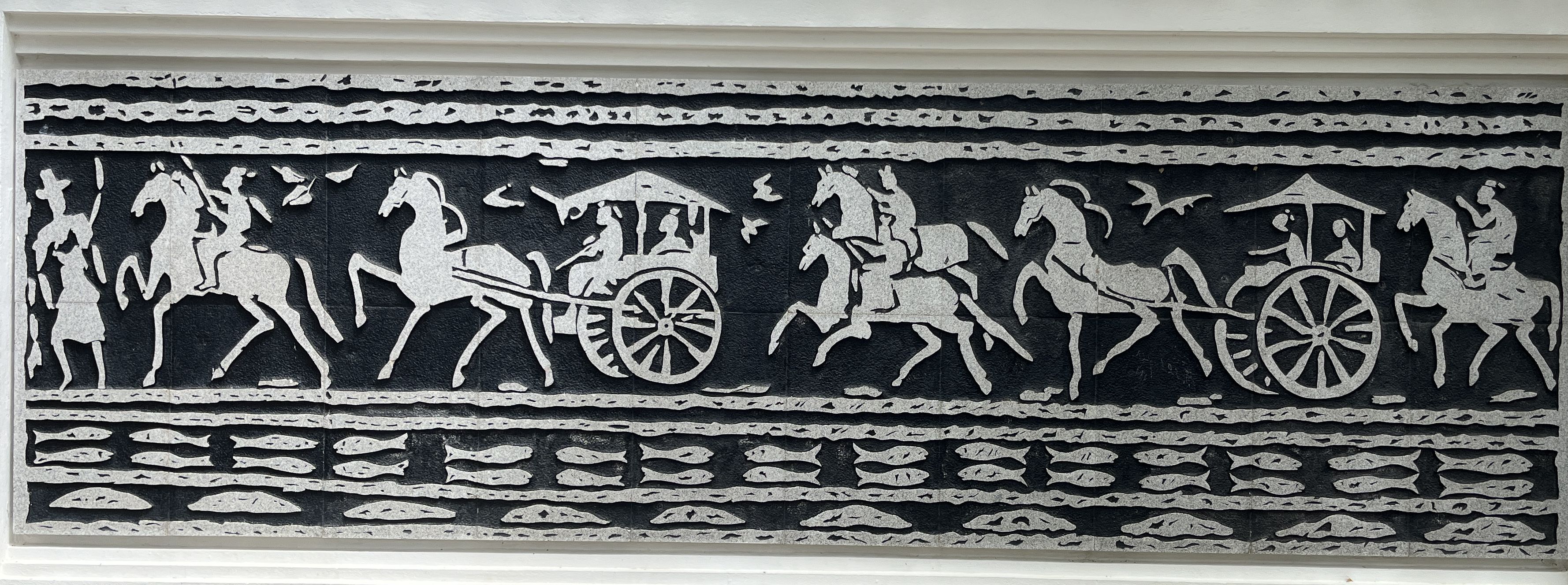
In one area, the “houses of Li and Zheng” (lei cheng uk), builders uncovered a brick tomb as they were laying the foundations. It turned out to be an unprecedented archaeological discovery – a tomb from the end of the Han dynasty, with its grave goods unplundered. The bricks on the wall bore the words GREAT FORTUNE TO PANYU, suggesting that they had been made either in what is now Guangzhou, or by craftsmen dispatched to the area to work on the project. The discovery locked Hong Kong into the orbit of China 1800 years before the present, even though there was perilously little inside the tomb.
Mainly, it contained pottery, and a tiny handful of bronze artefacts. There was no actual body in the tomb – possibly its intended occupant was never even interred there. “There were crowds all around,” comments Michael, one of the archaeologists in the on-site documentary. “Every time we brought something out of the dig, they would all cheer. I think they were having a lot more fun than we were.”
I am the sole visitor on a muggy Monday morning, to the modest little museum that now sits in the shadow of towering skyscrapers. The tomb, ironically, has outlived the emergency housing estate that led to its discovery, and is now an oddity in the middle of an all-new urban development. There is not even a Long Sands Bay any more – when the Lei Cheng Uk tomb was first built, it was on a hilltop by the sea; today, it is a mile inland, largely because of twentieth-century land reclamation projects. Long Sands Bay gives its name to the local metro station, but there is no sea in sight.
When the British first occupied Hong Kong in the 1840s, their main enemy was malaria, which killed a quarter of the garrison within months. But there was also the prospect of an enemy showing up from the sea.
It took them forty years, and the prospect of Russian agitation in the region to persuade London to front the cash for a gun battery facing the Lyemun channel that led to Victoria Harbour, although rather embarrassingly, it never got used. It was installed in 1888, but someone soon realised that the emplacements were too high, and it couldn’t actually hit any ship in the channel at all.
In fact, if the Lyemun Battery opened fire, the only thing it stood a chance of hitting were the suburbs of East Kowloon, which had been British territory for the previous two decades.
Today the Lyemun Battery is home to the cumbersomely titled Hong Kong Museum of the War of Resistance and Coastal Defence. What would have otherwise been a relatively obscure museum about a gun on a hill that never got to shoot at anybody has been rebranded and expanded to take into account the story of the defence of Hong Kong since the time of the Mongols. This, in turn, has been aimed at reminding everybody that (a) Hong Kong is part of China, and (b) it also was an enemy of the Japanese in the Second World War, just like China… which Hong Kong has always been part of.
Unfortunately, such protestations unpack in the galleries to recount centuries of complete indifference shown by the Chinese authorities towards Hong Kong. There wasn’t even a concept of sea defence until the Ming dynasty, claims one exhibit. The gallery about the People’s Liberation Army’s 17 years in the territory doesn’t have a whole lot to say, and limits itself to pictures of them marching up and down a bit.
There are some interesting stories about the anti-Japanese underground in WW2 and the Hong Kong Volunteers, who became a sort of guerrilla organisation, celebrated here in a quirky statue that appears to be emerging from a manhole. There is also a memorial to the sad story of Joseph Hughes, the twenty-year-old soldier from Glasgow who was killed desperately trying to put out an ammunition fire on the truck he’d been driving, and was awarded a posthumous George Cross in 1946.
On Christmas Day 1953, a huge fire tore through the slums and squats of Shek Kip Mei in Hong Kong. The blaze left 53,000 people homeless, and galvanised the authorities into a rapid building scheme to create new housing for the refugees and migrants that had been clogging the hillsides of the New Territories.
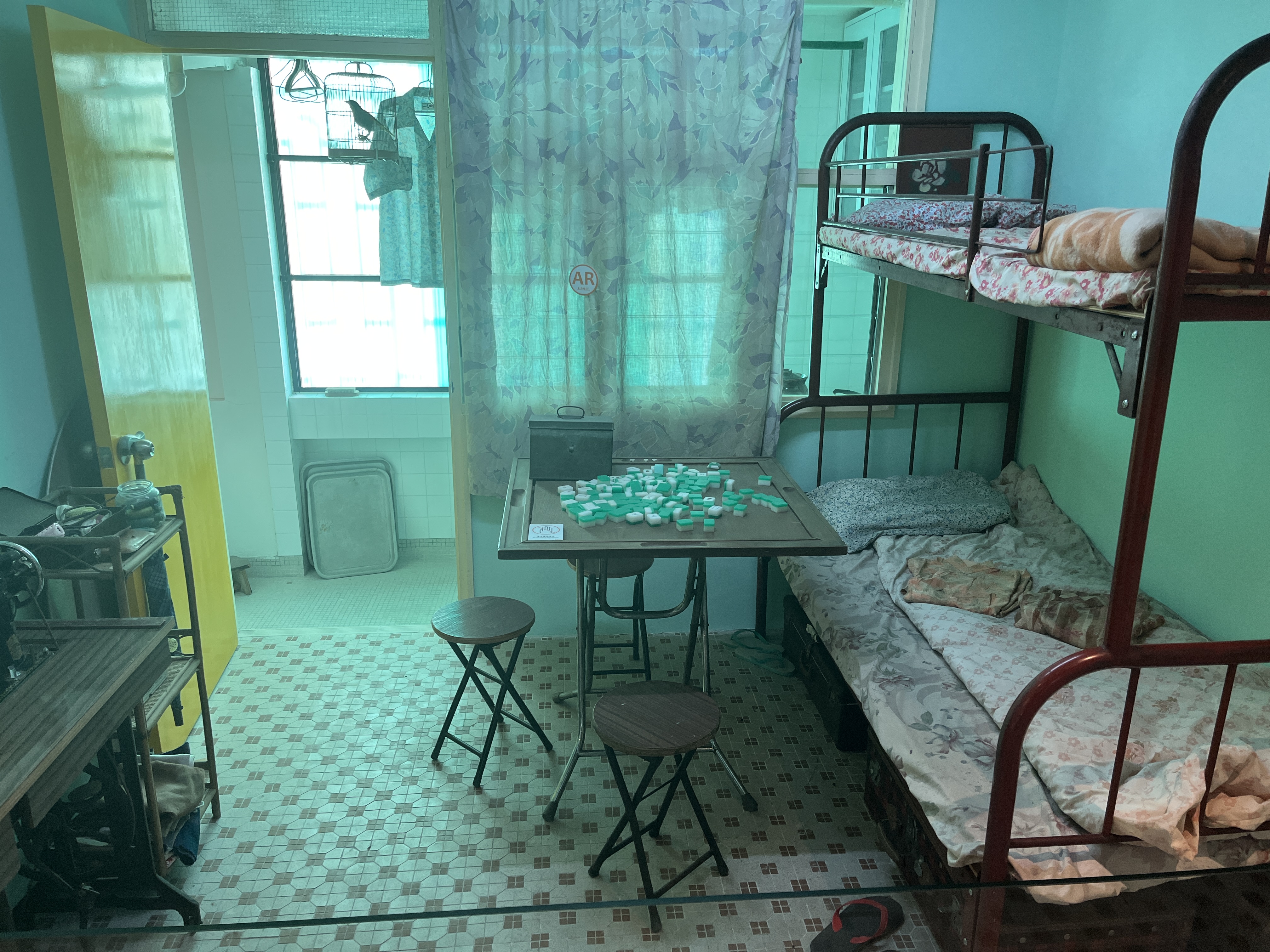
Mei Ho House is an unassuming apartment block in Berwick Street, but it is actually the last surviving example of these emergency housing blocks. Half of the H-block tower is a youth hostel today; the other wing has been preserved as a museum to daily life for thousands of Hong Kong residents in the 1950s, schooled in open-air rooftop classrooms, cooking on open fires on their balcony stoves, and sharing centralised washroom facilities at the building’s core.
The numbers of rehoused locals actually climbed higher in local reports, as they assimilated several thousand more refugees who were evicted from their shanty towns in order to make space for the “Mark I” estates like Mei Ho – several pundits noted that the speed of the government response might have been humanitarian, or might have been the sudden excuse to pull the trigger on an urban renewal project that was already in the pipeline.
A simple public housing project unpacks into the many stories of the 800,000 refugees who formed a third of Hong Kong’s populaton by 1957, a cataclysmic number of new mouths to feed and people to house. A section of the Mei Ho museum pauses to wonder how they were entertained, providing a wealth of stories about the Hong Kong film industry in the period.
For the older generation, newly uprooted from what had become the People’s Republic, the Hong Kong film industry offered a huge number of filmed performances of Cantonese operas – between 1913 and 1990, Hong Kong churned out 1,092 filmed versions of Cantonese opera – and that’s straight ports of the stage shows, not action-movie adaptations like 14 Amazons. Only 800 of these films survive today, but they are largely overlooked. Their heyday was in the 1950s, when the aging population of migrants in Hong Kong, including the tens of thousands of refugees fleeing the People’s Republic, thrilled to old-time entertainments – in 1958 alone, Hong Kong produced eighty-nine of them. A generation later, their grown-up children were entertained by a hybrid of the old stories with a new mode of filming, what you and I might call kung fu movies.
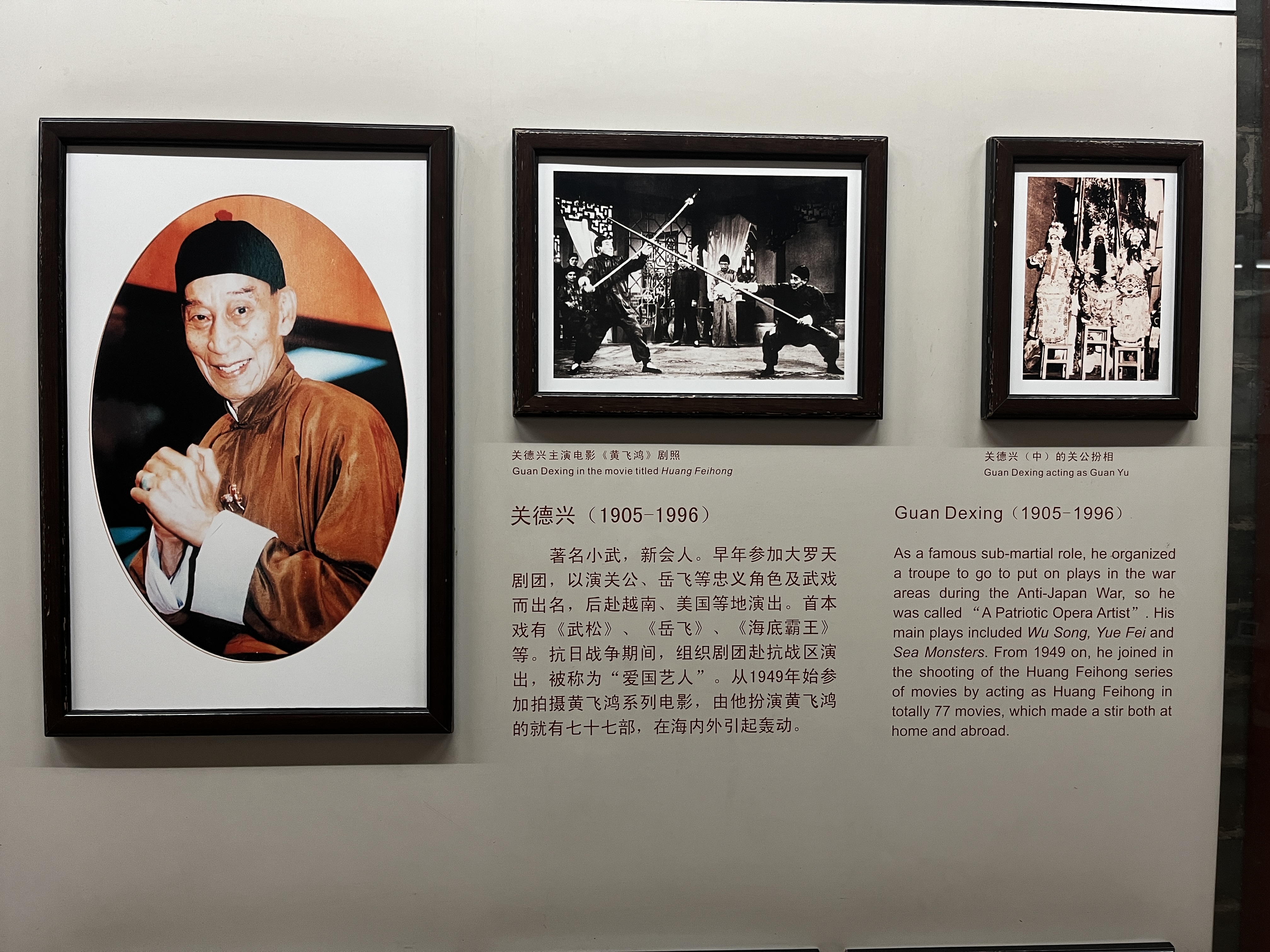
Upriver in Foshan, at the Guangdong Museum of Cantonese Opera, many of the galleries are dedicated to the cross-over between Cantonese Opera and Hong Kong film, not merely in subjects, but in performers. I recognise one of the actors immediately: the sign gives his name as Guan Dexing, but he is better known in Cantonese as Kwan Tak-hing, who played the hero Wong Feihong in 77 Hong Kong movies. I am, in fact, quite astonished that I have been in Foshan for two days and only once heard his famous theme song being played in a restaurant.
Wong Feihong has a whole museum dedicated to him inside Foshan’s Ancestor Temple – and his fame is widespread enough that it has separate galleries for his life story as told on television, in comics and in movies. The list merely of Wong Feihong movies is currently at 101, but the curators have left space on the wall for it to go up to 120.
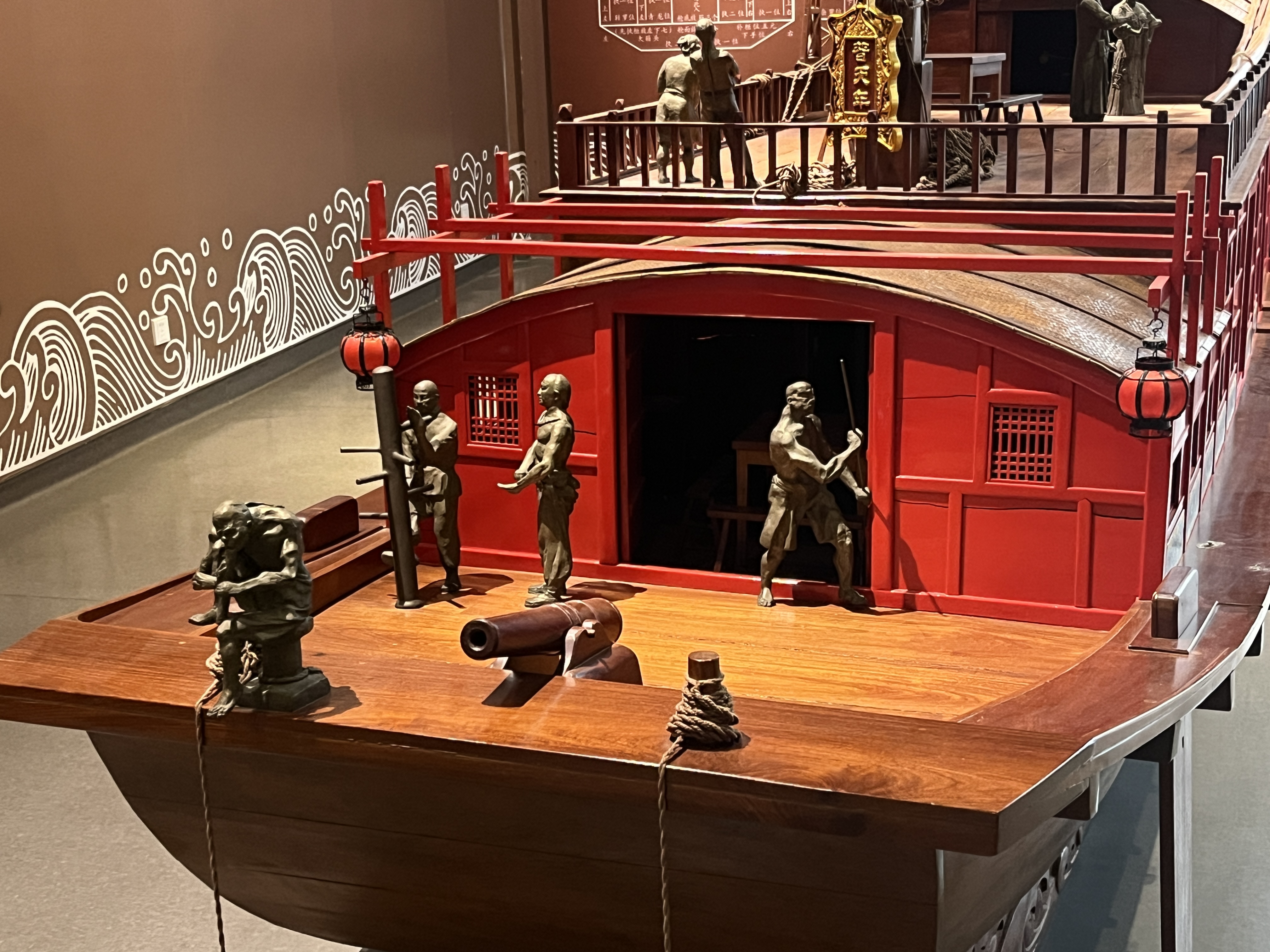
But Wong is not the only figure to unite Hong Kong film and Cantonese Opera. At Guangzhou’s Museum of Cantonese Opera Art, there is an extended display on the Red Boats – itinerant troupes of opera performers, who plied the waters of the Pearl River Estuary and its tributaries, putting on shows, wowing the locals, and so it was said, harbouring dissidents and revolutionaries.
The model ship in Guangzhou even features a group of martial artists practising with a Wing Chun dummy on its stern, whereas the museum in Foshan dedicates an entire gallery to the most famous of the Red Boat performers, Li Wenmao, who briefly led a rebellion and declared himself king of part of South China, before a savage government reprisal wiped out the theatre in the region for a decade. Li’s generals, so it was said, went into battle in their Cantonese Opera costumes, which must have been a sight to see.
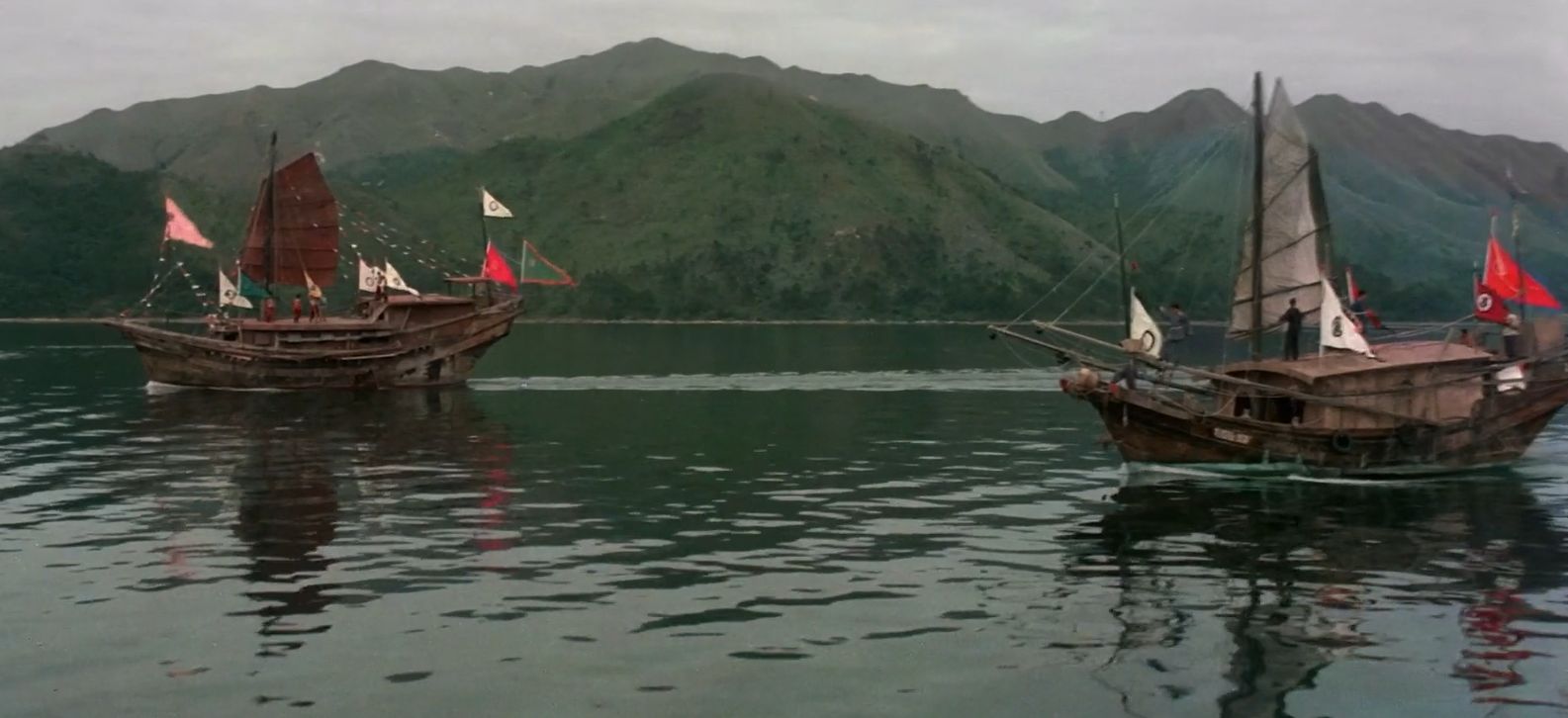
I’ve written several times about the Red Boats, mainly in my work for Arrow Films explaining all the real history behind their appearances in kung fu movies. There’s some fascinating stuff to be found out about life on these wandering minstrel ships, including timetables of shipboard life, and the logistics of being travelling players on the water. Most boats travelled in pairs – a Heaven and Earth boat that tended to reflect the division between drama players and the action troupe. The larger companies added a third vessel, the Picture Boat, which transported sets and extra props — the picture I have included below is a historical reconstruction, a screenshot from the Shaw Brothers film Executioners from Shaolin.
The average boat had its dockings booked two years in advance, and the culture is riddled with all sorts of interesting lore and ideas, such as the presence of four all-female troupes, and the fact that the term in Cantonese for a backstage prompter is a “local ghost.” The full list of Cantonese opera plays tops 11,000, but most Red Boat troupes had a revolving repertoire of just 18, of which ten were performed most often, with the final eight dragged out for special occasions. The first play performed in most venues was Tribute to the White Tiger, a staged fight between an actor and the spirit of onstage cock-up, who would depart chastened and defeated, and hence bless the performance. The last play performed each night was Sealing the Stage, a ten-second ritual in which a masked actor closed the performance and shut down the magic, in the fashion of Shakespeare’s “for their sake / In your fair minds let this acceptance take.”
Largely unexamined by theatre historians, for obvious reasons, are the Outline Plays, improvised operas for which the actors were handed a possibly randomised series of stock characters and situations and told to wing it. So there might be a board in the wings that reads (very hypothetically): “Comedy refugees from war / Farmboy argues with Uncle / takes them to the Hermit (old man with secret) / thence to harbour to seek passage with Pilot.” And if you were lucky, you might get something like the first thirty minutes of Star Wars. Sung. With six tones.
The Red Boats were wiped out in the Manchu retaliation after 1858, which toppled Li’s rebel state and murdered a million people in the region, outlawing theatre for a decade. They did return in the 20th century, and were a feature of local entertainment right up until 1938, when almost the entire fleet was unluckily anchored in Foshan harbour during a Japanese bombing raid. A cryptic comment in Toa Wong’s Time of the Red Boats notes: “The last known pair of Red Boats were spotted near Macau in 1951,” as if they might still be out there somewhere, haunting the coast.
Jonathan Clements is the author of A Brief History of China. He has recorded several film commentaries on Hong Kong movies, including Martial Arts of Shaolin, Heroes of the East and 14 Amazons. He is the writer and narrator of the Arrow documentary Rivers and Lakes: History, Myth and the Martial Arts Film.
“Hong Kong is so crowded already. Where do ghosts live?”
Asian psychiatrists learn their trade in English. Like Dr Jim Law (Leslie Cheung) in Inner Senses, the books on their shelves are in a foreign language, as are their lessons and interactions with their peers. They have a scientific, westernised outlook that differs from the countrymen they often treat. Jim takes this to extremes, reducing even happiness to simple terms of chemical secretions.
His patients, like the audience for Inner Senses, are steeped in folklore and movies, such as Dracula and the Legend of Sleepy Hollow, with which Jim taunts his fellow psychologists at a conference. When Yan (Karena Lam) says “I see ghosts”, her words echo not only The Sixth Sense, but also its Asian imitators, particularly The Eye.
Inner Senses is concerned with the spinning of tales and the active imagination. Yan only seems to see ghosts after she hears scary stories; she is primed to believe. A failed writer who must subsist as a translator, she retains a writer’s readiness to be spooked and inspired by what goes on around her. And yet Jim tells stories, too. In their first meeting, he lies about his belief in ghosts, and helps her construct an alibi for her attendance, ostensibly to placate her cousin, but actually to lure her back for further sessions.
Inner Senses teases its audience with false trails of movie folklore. Its early moments invoke Dark Water or The Amityville Horror with creepy scenes of house-buying. Jim alludes to a wartime graveyard below his building – an Asian variant on the old “Indian Burial Ground” cliché. Even the leads’ first meeting seems contrived along B-movie horror lines, with a new patient dumped on Jim by a vacationing psychologist. But there is a reason for everything, and the bad lie of Jim’s fellow doctor is the white lie of Chinese match-making – even though he risks breaking the rules of psychiatry by encouraging a relationship with a patient, the deceptive doctor is still doing what he can to set up his wife’s cousin with a suitable spouse.
Inner Senses places so much value on stories because its leading man believes in the power of suggestion. It is not spirits that bother Jim, but the people who believe in them, for their hysteria can be contagious. Jim speaks like a psychologist, but also like a filmmaker, of inspirations and memories that write and draw themselves. Part of his planned therapy involves a video camera, the chance for Yan to exorcise demons by proving they aren’t real on film.
There are two films within Inner Senses. Its first hour relates the case of Yan, before turning on the case of her therapist – Jim’s own inner Scully telling him that there must be a perfectly rational explanation. But his inner Mulder wants to believe that there are ghosts, for such a romantic decision would mean that Yan was sane, making her more of a potential mate.
But even the calm, rational Dr Jim Law has skeletons in his closet, and whether he believes in ghosts or not, he is certainly being haunted by something, something not from the spiritual world at all. Inner Senses takes an hour to set up Jim’s relentless rationality, and then confronts him with a terror born of the mundane world. Despite its obvious parallels to Sixth Sense, it is part of a psychological horror tradition that goes back to The Shining and beyond, of men who haunt themselves.
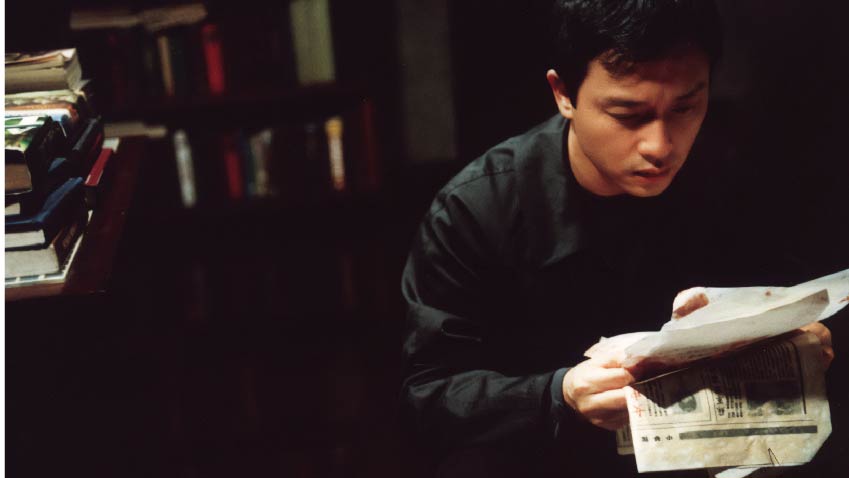
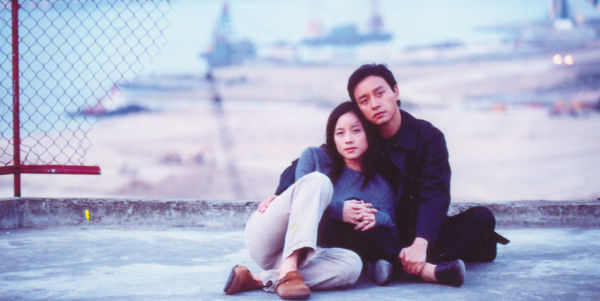
If one is truly mad, one is often too mad to tell. Therapists pity the mild or worsening cases, aware that they are losing their minds but unable to stop it. Leslie Cheung himself wrote of “experiencing emotional difficulties” in his personal life during and after the filming of Inner Senses. Shortly after his haunted performance in this movie garnered him a Best Actor nomination in the Hong Kong Film Awards, Cheung went into the 24th floor café of the Mandarin Oriental Hotel and asked for a notepad. He wrote a brief message thanking his own psychotherapist for his efforts, but complaining of a year of suffering. He then jumped from the balcony to his death.
Jonathan Clements is the author of A Brief History of China. This article originally appeared in the sleeve notes to the Tartan Video release of Inner Senses.
Minding its own business on the eastern side of Kowloon Park is Hong Kong’s Avenue of Comic Stars – a parade of statues of iconic figures from the local comics scene, winningly presented along with plaques detailing their backstories, their creators’ biographies, and QR codes where the interested passer-by can find out more. It is palpably more fun and informative than the much more famous Avenue of [Movie] Stars on the Tsim Sha Tsui waterfront, which is much less forgiving of anyone who needs reminding who people are.
So there’s characters I immediately recognize, like Ma Wing-shing’s Cloud (from the story usually referred to today by the title of its film adaptation, Storm Riders), along with one’s I don’t, like James Khoo’s Dragonlord, and ones I really should, like the slightly cartoony version of Bruce Lee as drawn by the comics artist Vincent Kwong.
The statues range from the hyper-real anime-influenced heroes of many a game tie-in, to the more cartoonish local figures like Wang Xiao Hu from Tiger & Dragon Heroes, and the buck-toothed spinster Sau Nga Chun. A long mural nearby includes a slew of other artists’ work, including Wong shui-pan’s comics adaptation of John Woo’s A Better Tomorrow, complete with a cartoon Chow Yun-fat, and Mark Tin-kit’s Tao Zero.
The entire installation is a fantastic introduction to the world of Cantonese comics, although I was not quite superheroic enough to withstand the June sunshine for long enough to take it all in. I’ll be going back when there are more clouds over Cloud.
I meet the people I dubbed Victor and Margaret in the hotel elevator, where he is shouting at her.
“For God’s sake, woman. You have to tap the card on the thingy or it won’t go anywhere.”
She fumbles in her purse and he stares, fuming, at me, as if to say I don’t believe it.
“It’s all right,” I say. “If you’re heading down, the lift is already going that way, so you don’t need to tap your card.”
“How about that, dear?” says Margaret. “He speaks Chinese.” And she finished with a little smirk that I translate as: And he knows how the fecking elevator works.
The 260 express bus goes straight from Central, Hong Kong’s version of Liverpool Street, through the Aberdeen tunnel to the south side of the island. Where there were once skyscrapers and teeming millions, there are suddenly winding mountain roads and secluded beaches. The bus goes past Deepwater Bay, where the beach is protected by a shark net, and two superyachts lurk ominously in the roadstead, and then Repulse Bay, where what first appear to be bungalows turn out to be the tops of twenty-storey towers, reaching up the steep slopes from a tiny bit of flat land at sea level.
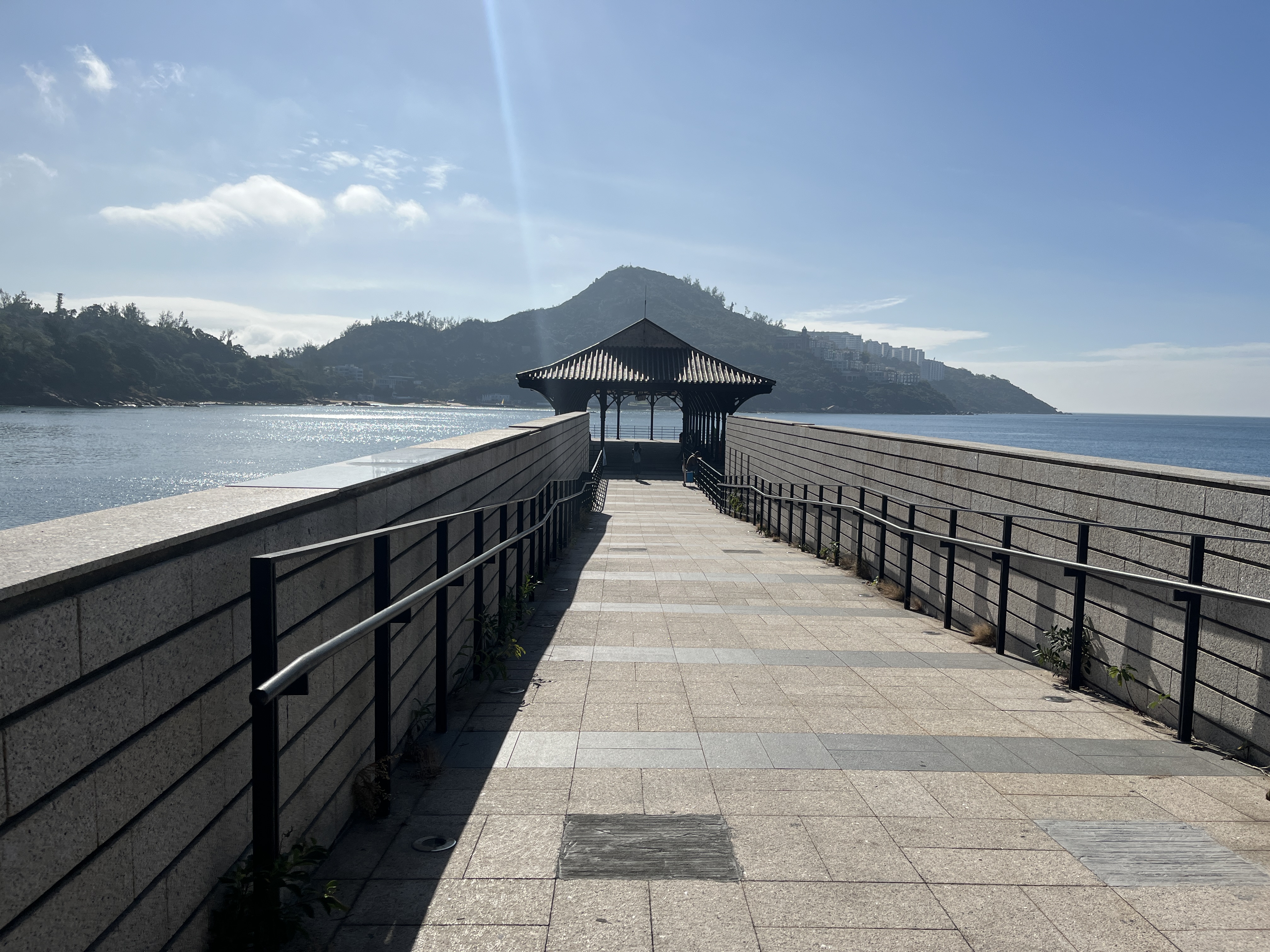
This is where the smarter bankers and brokers live, in little villas on the hill-tops. And there, at the end of the bus line, is Hong Kong’s Leigh on Sea, the seaside town of Stanley. A little shaded pier juts into the bay – it is ten o’clock in the morning and it is already crowded with half a dozen fishermen. There’s an old colonial government building now converted into a seafood restaurant, and – surprise, surprise – a pub called the Smuggler’s Rest that offers fish and chips.
I’m here because the internet makes it sound like a shopper’s paradise, “the place to buy all your souvenirs.” But it isn’t. There are exactly none of the souvenirs I want, nor is there the promised calligraphy master, as someone on the internet has confused “calligraphy master” with “guy who will write your name on a grain of rice.” There are polyester cheongsams and Bruce Lee T-shirts, and I want exactly none of it.
I share the bus on the way back with a soft-spoken broker from Edinburgh and his half-Chinese son, whose name I don’t catch, but I presume to be But Why, because it’s all he ever says. They’re off to Specsavers for But Why’s first ever eye test, and his Dad is explaining why there are men cutting down trees, and why there are cars in the road, and why the bus has stopped at traffic lights. What a life it must be, living by the sea but being able to be in Bank of China building 40 minutes away… except that is surely true of anyone who lives in Leigh as well.
Just back from a trip to Hong Kong, Guangzhou [and now Shanghai], where I tested out digital apps and payment systems. In Hong Kong, I only needed cash money on my way home, for the taxi to the Kowloon airport express station and the strangely traditional left luggage office there. The rest of the time I used Apple Pay, my credit cards, and the wonderful Octopus for Visitors, which is a top-uppable travel card that also functions as a payment app in a number of handy situations.
China was the big test, as I hadn’t been for several years, and post-Covid, the country has gone almost entirely cashless. Mercifully, Alipay worked right out of the box, happily beeping at the 7-11 counter at Guangzhou station as I bought myself a coffee on arrival. However, the vast majority of retailers and services favoured WeChat Pay, which also worked straight away. I’d only installed it as an afterthought, but it turned out to be much more useful for me in Guangzhou. Up north in Shanghai, it was Alipay for almost everything. You can find both these apps in the Apple Store or Google Play, and while they won’t work until you are in China, it’s best to get them early just to familiarise yourself where stuff like the Scan QR Code button actually is.
The big disappointment was my Bank of Shanghai virtual debit card, on which I had pinned huge hopes, but which embarked upon a Maoist self-criticism session and suspended itself the moment I tried to use it, claiming to have detected “suspicious behaviour.” This turned out to be “buying a ticket on the metro”, and I couldn’t really afford the day’s wait for an appeal, or indeed work out how to appeal when standing in front of a ticket machine in Guangzhou, so I gave up on it. I had been expecting it to be my default payment method in China, but I ended up not using it at all and getting a full refund. Your mileage may vary, but don’t rely on it.
My Alipay/WeChat digital payment apps worked as local interfaces for several non-Chinese Visa and Mastercards, as well as debit cards, although in one store they failed me and I had to resort to cash, while a crowd huddled around to look at the strange pieces of paper that once bought things, but were now more like museum pieces.
The thing that really did prove vital was my eSIM — a virtual SIM card that could be loaded onto my phone and activated when needed. It allowed me to keep my usual phone number, but to use the internet without breaking the bank. I bought one for Hong Kong and one for China, and they allowed me to save money on data roaming and internet access. I spent just $10 on two gigabytes of data in two countries, whereas my mobile phone provider would have charged me $40 for the same, and data roaming would have gone off the charts. None of the digipay apps work without efficient access so I do recommend it. The company I used was a Canadian outfit called aloSIM, and if you want to give them a go, you and I both get a $3 discount if you use my sign-up code: M74D4V9. I’ve bought eSIMs for Europe as well, and I’ll get myself one for America next time I go.
My top ten do’s and don’ts for for travellers in China in 2024 using digital payments are:
(1) Get Alipay and WeChat on your phone, before you travel. Some of the set-up requires real-name verification, such as an uploaded ID page from your passport, and you don’t want to be doing that in an Arrivals concourse while a line backs up behind you at Pacific Coffee. Likewise for your credit cards and debit cards, some of which will require verification from your provider before they can be installed. When they work, they work just like Apple Pay.
(2) Take some spare old-fashioned money for emergencies. Nobody will have change, but they will have to go and find some if all your apps suddenly fail you for some reason. In Shanghai supermarkets, it was possible to pay in cash at the customer service desk, but since that usually was staffed by a lone human pig-piled by pensioners waving banknotes, you were better off using the digipay-only roboterminals if you could.
(3) Install an eSIM on your phone. If you are travelling to more than one Asian country, I recommend aloSIM’s regional package, which will cover you in 14 countries and save you the bother of toggling your data provider at each border. It will save you a fortune in roaming costs, and is sure to be cheaper than the deal you are offered by your phone provider.
(4) If you want to use Google Maps, Gmail, Facebook, or various other pernicious agents of the capitalist west, they will be blocked in China. You will need to put a Virtual Private Network on your phone that allows you to tunnel around the Great Firewall. I couldn’t possibly comment, but if you want to use ExpressVPN, this link will give you (and me) a free month. But remember to turn it off when you are using the digital payments, otherwise your phone will tell your bank that you are in Singapore while you are buying a jacket in Xi’an, and it will immediately assume foul play.
(5) Make sure your phone is up to date. I clung for years to an iPhone 7 that was perfectly good for my everyday needs, but a lot of these new apps require iPhone X or above. If you are going to China, in particular, you may want to double-check that your old phone is capable of handling some of the new services, and if necessary, do what I did and reluctantly embrace the 2020s with a phone upgrade. I presume there is a similar technology event horizon with older Android phones.
(6) In Hong Kong, it’s much less hassle because Apple Pay and credit cards work normally, as indeed does old-fashioned cash. But the real joy of Hong Kong travelling is the Octopus card, the tourist version of which can be installed on your phone as a handy key to open access to buses, trains, and ferries, and also used to pay in convenience stores and many other retailers. Get it before you arrive, and you can march straight onto the Airport Express without pausing.
(7) When travelling in China, and in many other countries, I swear by Trip.com. I’ve been using it since back when it was called cTrip, and it has a very handy English-language user interface. Make sure your passport details are uploaded beforehand, and you will be able to book train tickets and hotels on the fly. Trip allowed me to reserve a first-class ticket on the high-speed rail to Guangzhou before ticket sales opened; it booked the ticket for me using the ID details it had on file, which meant my passport was my ticket.
(8) Try to use your card providers’ facilities to notify them in advance you will be in China. Mastercard, Aktia, Nordea and Natwest took it all in their stride, but MBNA, despite assurances that everything would be fine, froze my card in a panic while I was trying to buy a cup of tea. All was resolved in a single phone call, but since I was kept on hold for over an hour at a premium rate and long-distance, it was a phone call that cost me £187! In future, I shall just ignore it until I get home, but that’s why you need more than one card linked to your app.
(9) Alipay’s Travel feature allows you to connect directly to the metro services in certain cities, removing the need for, say, a separate Shanghai travel card. I’ll miss my little wallet of different metro cards, but I won’t miss wasting money when tail-end amounts expire: I’m pretty sure that I’m sitting on three Beijing Yikatongs that have gone past their three-year use-by date, forfeiting the cash left on them.
(10) And while this may sound like a statement of the blindingly obvious, do make sure that you are travelling with adequate charging facilities — cables and a power bank for a top-up on the move. If your phone runs out of juice, you’ve effectively lost your wallet, so you can’t afford to be cavalier with the power bars.
“I can make you look taller,” says Tarzan. “I can make you look thinner.”
“Can you make me look more fun?” I ask.
“Almost certainly,” he says, pretending not to notice my Marks & Spencer’s trousers.
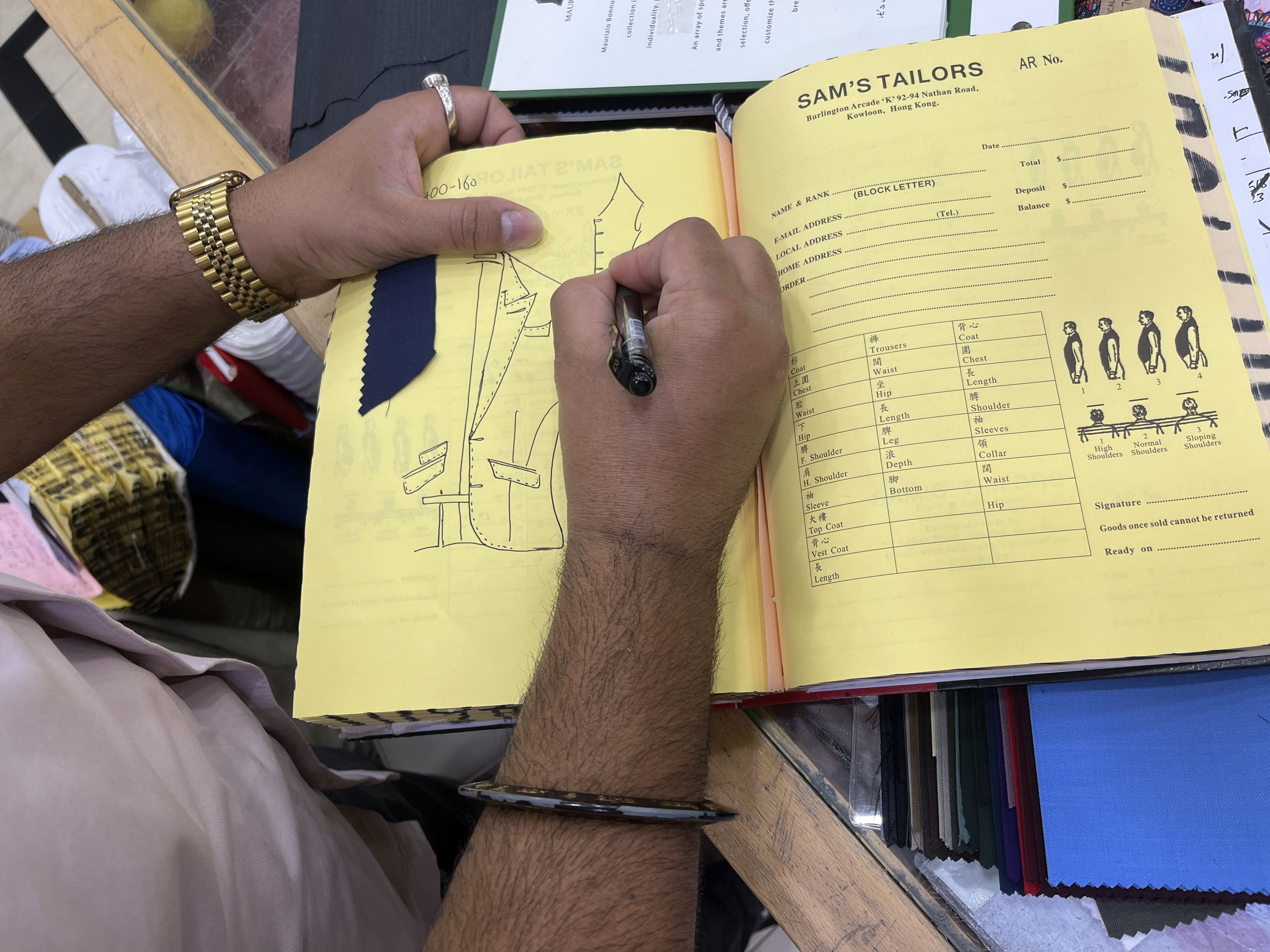
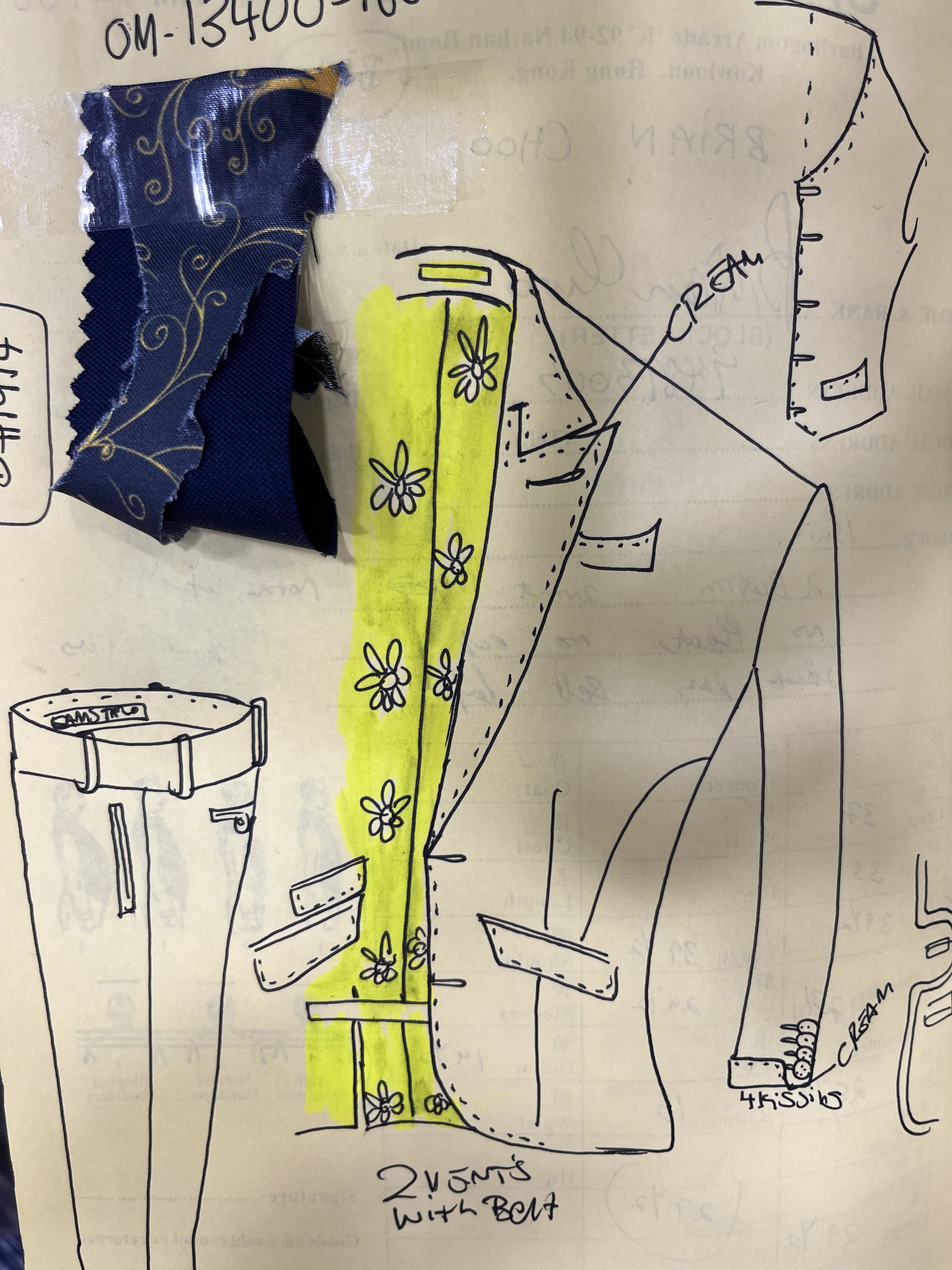
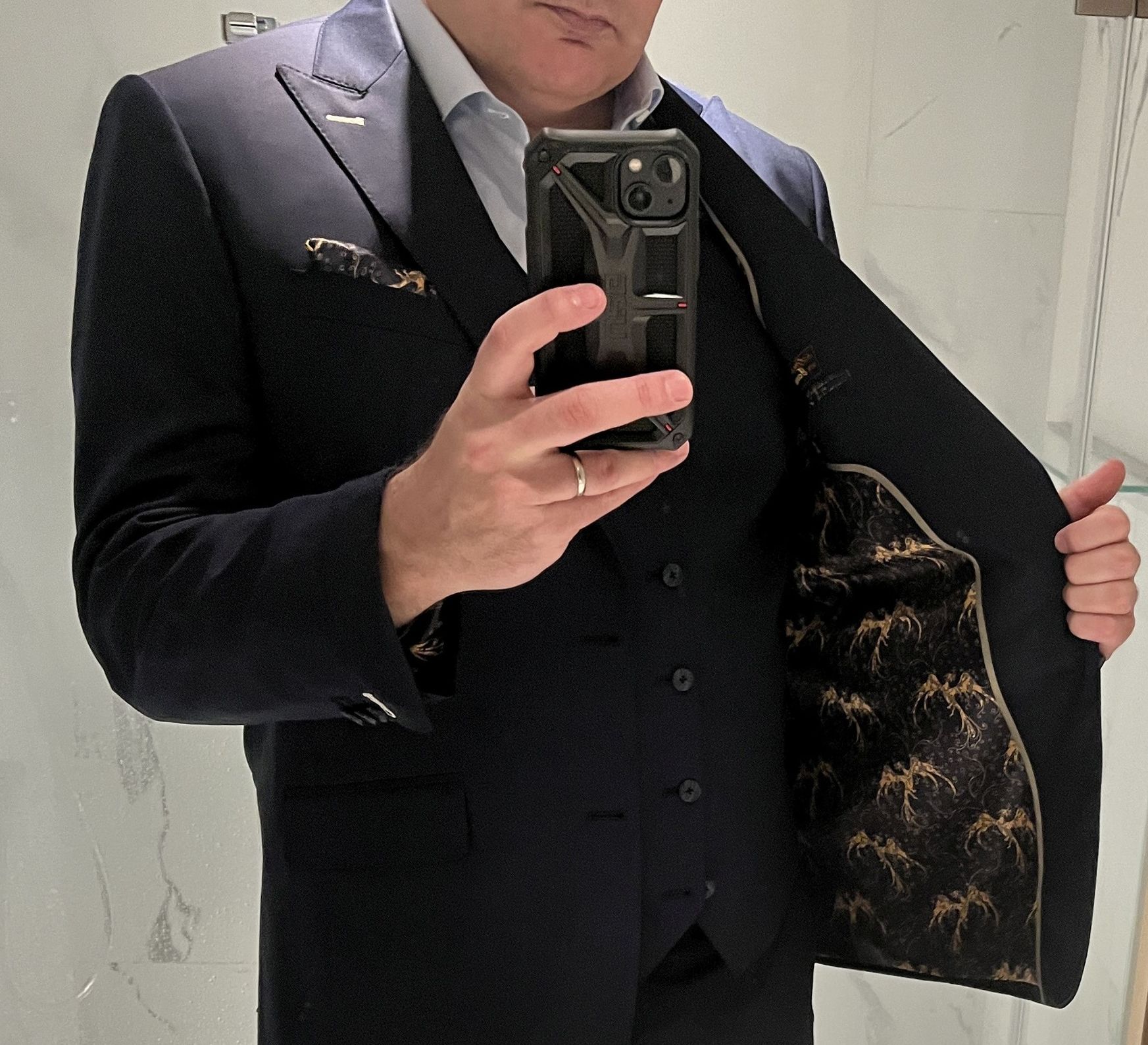
He is already leafing through samples of cloth discarding the plaids and herring-bones that would create a distracting moiré effect on camera. He sketches out a plan for a three-piece suit, with peak collars to draw the eye, and a ticket pocket to… keep a ticket in. When I can’t make up my mind between cufflinks and buttons on the shirt, he offers to do both, like I have become an international plug adapter for wrists.
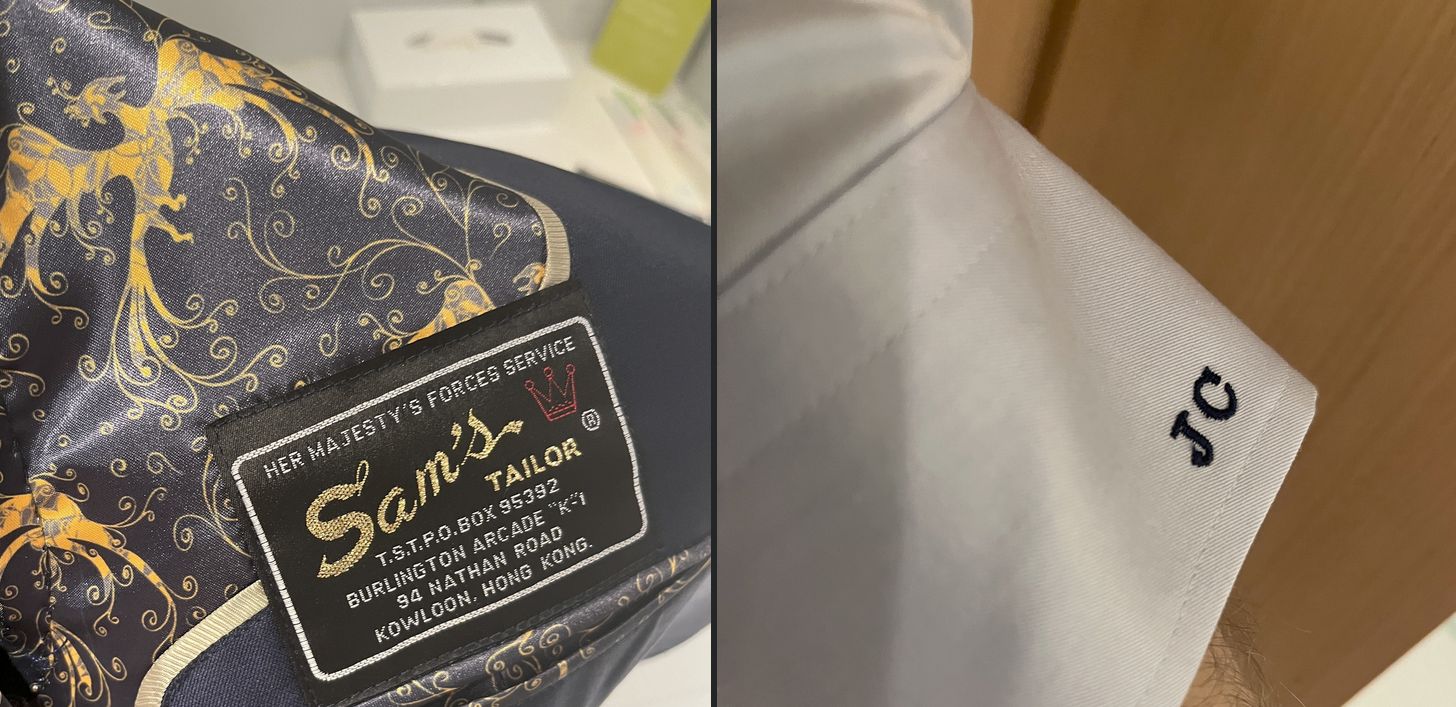
“You can have a little JC monogram,” he adds, “and I think some cream edging on the buttonholes. Thick buttons. Do you want thick buttons?”
“I don’t know,” I say. “Do I?”
“Yes,” says Tarzan. “Now what about the lining?”
“Something Chinesey would be nice,” I say.
“You mean like dragons or something?”
“Yes. Can you do that?”
“I can do anything you want. You’re in charge.” He hands me a scrapbook of wacky silk linings, including the Bitcoin logo, skulls and crossbones, the poster for The Godfather, and some dragons.
“Oh yes,” I say. “Those.”
“You like them now,” says Tarzan. “But will you still feel that way in a few weeks?”
He’s right, the dragons are a bit naff. I keep poking around in the book until I see a pattern called “Queen of Dragons”, which is actually a series of repeating phoenix designs, gold on black.
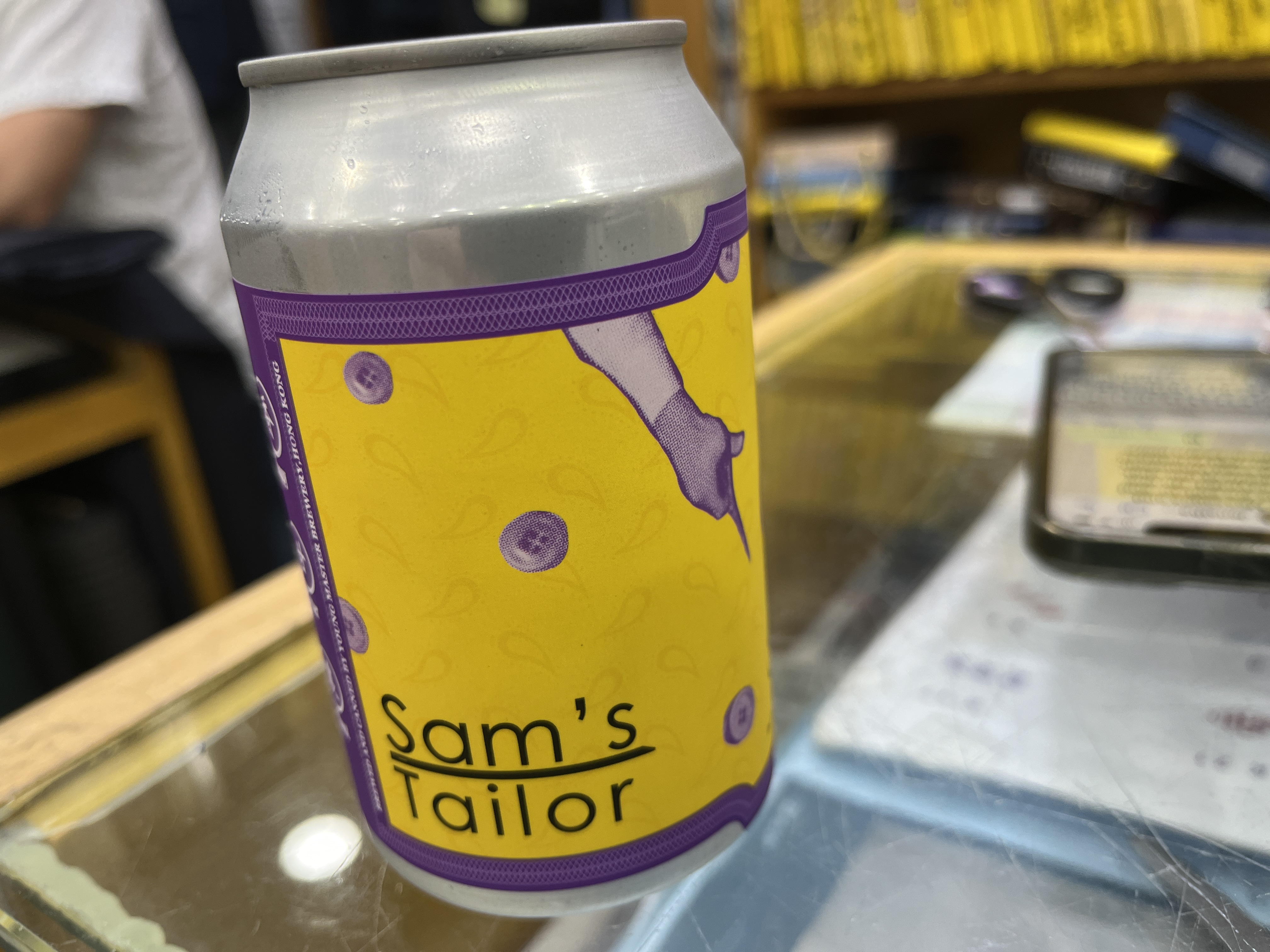
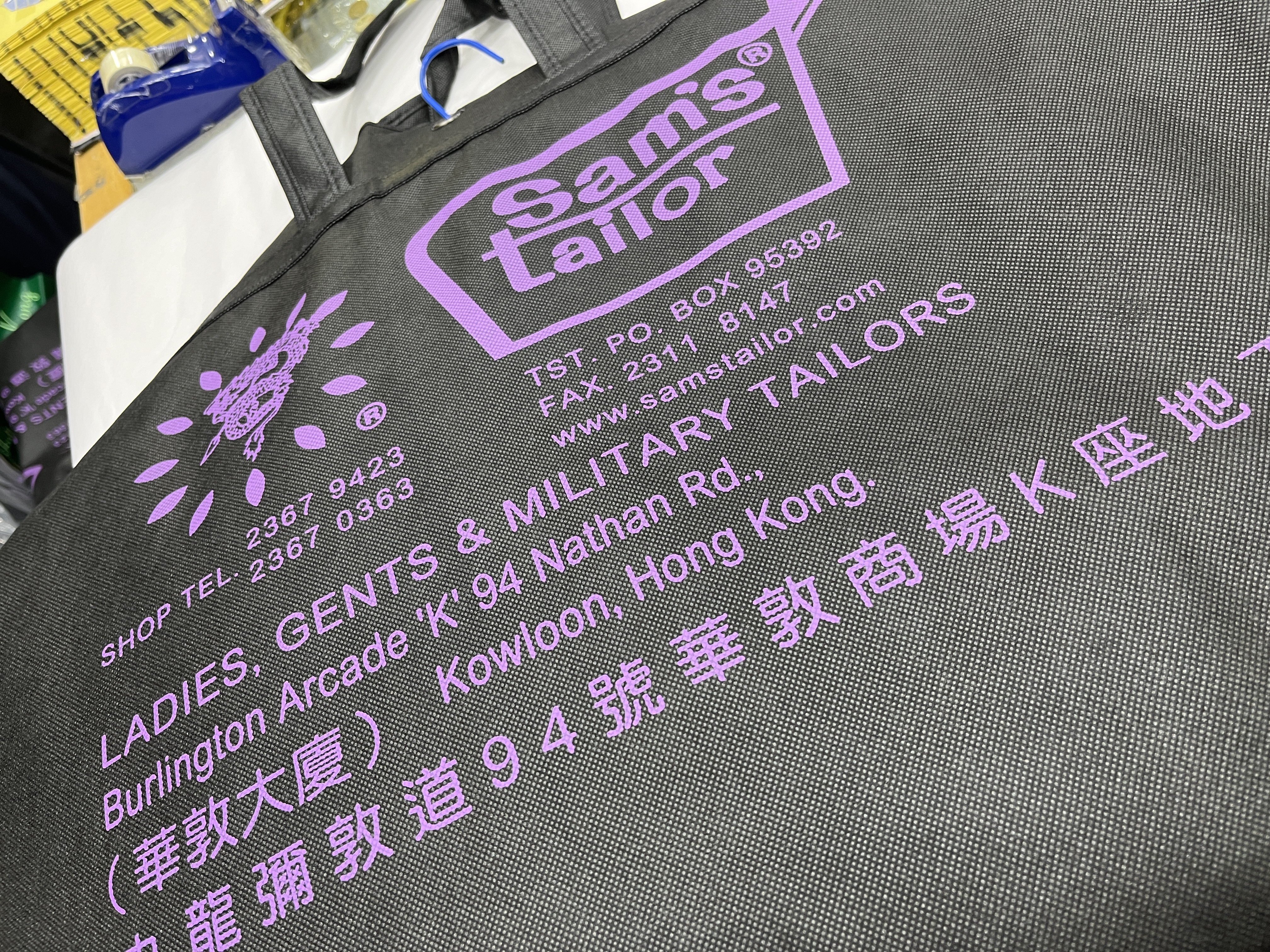
“Thatsh the one,” I say, slurring a bit, because Sam’s Tailor, on Hong Kong’s Nathan Road, also make their own signature beer, and it’s a terrifying imperial IPA with 8.8% ABV. I’ve had three cans while Tarzan is talking through the design, and now I can’t feel my legs.
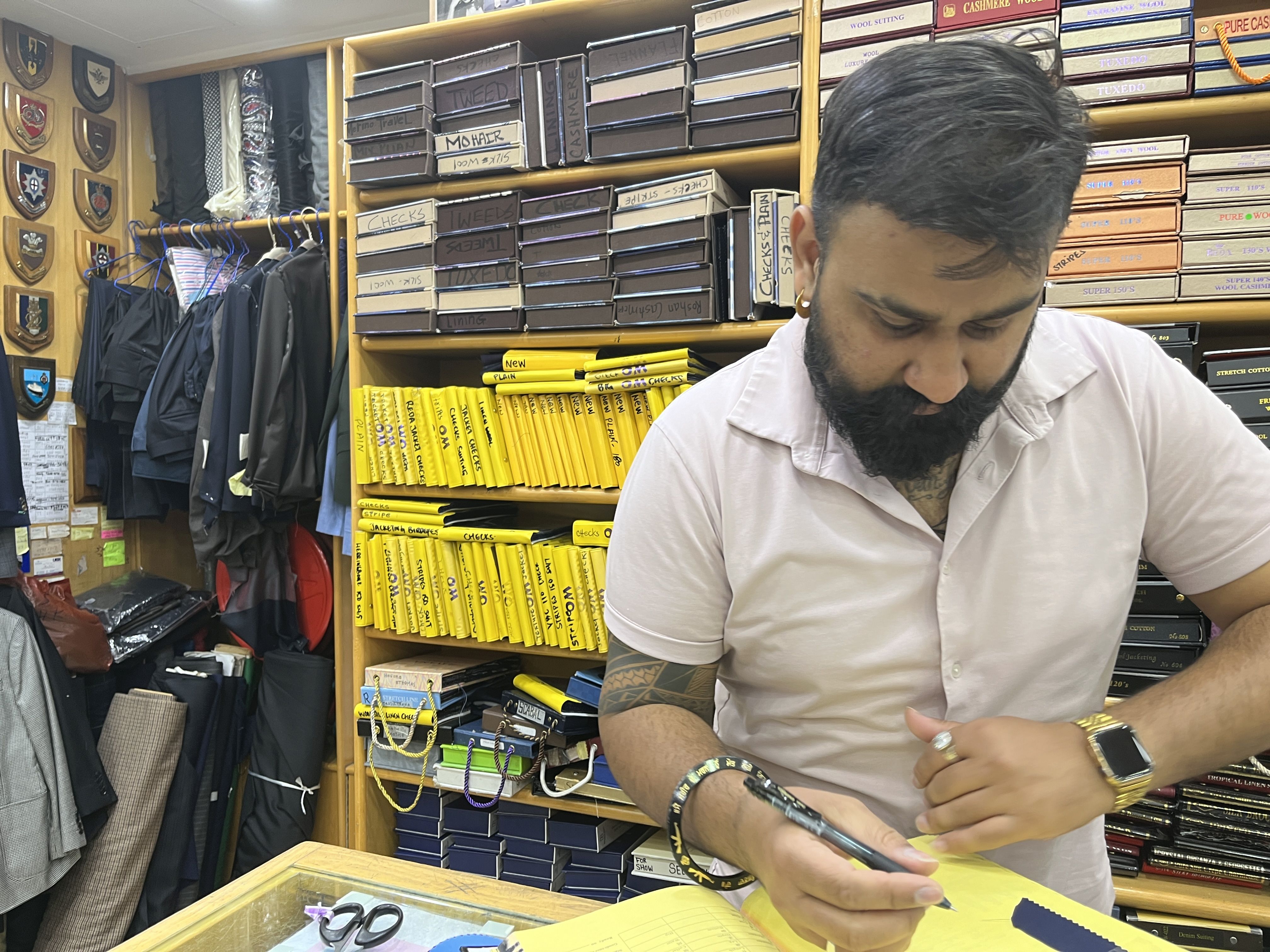
The first-generation founder, Sam Melwani, arrived in Hong Kong in 1952, and worked for another tailor before going it alone in 1957. By the end of the decade, his son Sham tells me, he had cornered the lucrative market in uniforms for the servicemen of the colonial administration. Which explains why the form I am filling in includes a space for my rank. Sham and his brother Manu can still be found lurking on the premises – it’s Manu who hands me what might have been my fourth beer, but by that point I had lost the ability to count. But it’s Manu’s son Roshan who is the modern face of the family business, rocking a waistcoat design that Tarzan has already sold me as “boss-style” (I realise now that he meant his boss), and with a clash of vibrant patterns on a shirt that has elbow patches just to show off.
“We get staff discounts on fabrics,” says Tarzan with a shrug. “We try stuff out.”
“Covid was a disaster for us,” says Roshan. “It used to be there was a queue going out the door. We were so busy. But then we had month after month where nobody was coming.”
I ask about the regulars. Because one of the delights of Sam’s is that they now have all my details on file, and I can literally send a WhatsApp message asking for a two-piece safari suit in Marimekko camo pattern with a purple paisley party shirt, and they will post it to me three days later, possibly just before they call the fashion police.
“Yeah,” says Roshan thoughtfully. “But everybody spent a year indoors. Nobody needed a suit.” Even so, he pursued them on social media. One of the reasons I can reach out to Roshan at seven thousand miles distance is that he has spent the last couple of years perfecting online consultations. If I do ask for that Marimekko safari suit next week, he’ll be there on a digicam trying to discreetly talk me out of it and save me from myself. But if I insist, he will do what I want and let me endure the ridicule.
And business hasn’t picked up?
“Maybe only twenty, thirty per cent of what it was,” says Sham.
Which makes me wonder what chaos there must have been pre-Covid, because when I come back a mere five hours later for my first fitting, the shop is heaving. There’s a picky Frenchman who isn’t sure he wants a suit at all (testing even Roshan’s patience), and a thick-necked man with a crew-cut who seems likely to be a holdover from the military days; a repeat customer dropping in to pick up something new and he’s arrived with three friends of his who all want suits of their own. They’ve never had a tailor before. I’m a bit surprised I got through the first five decades of my life without one myself.
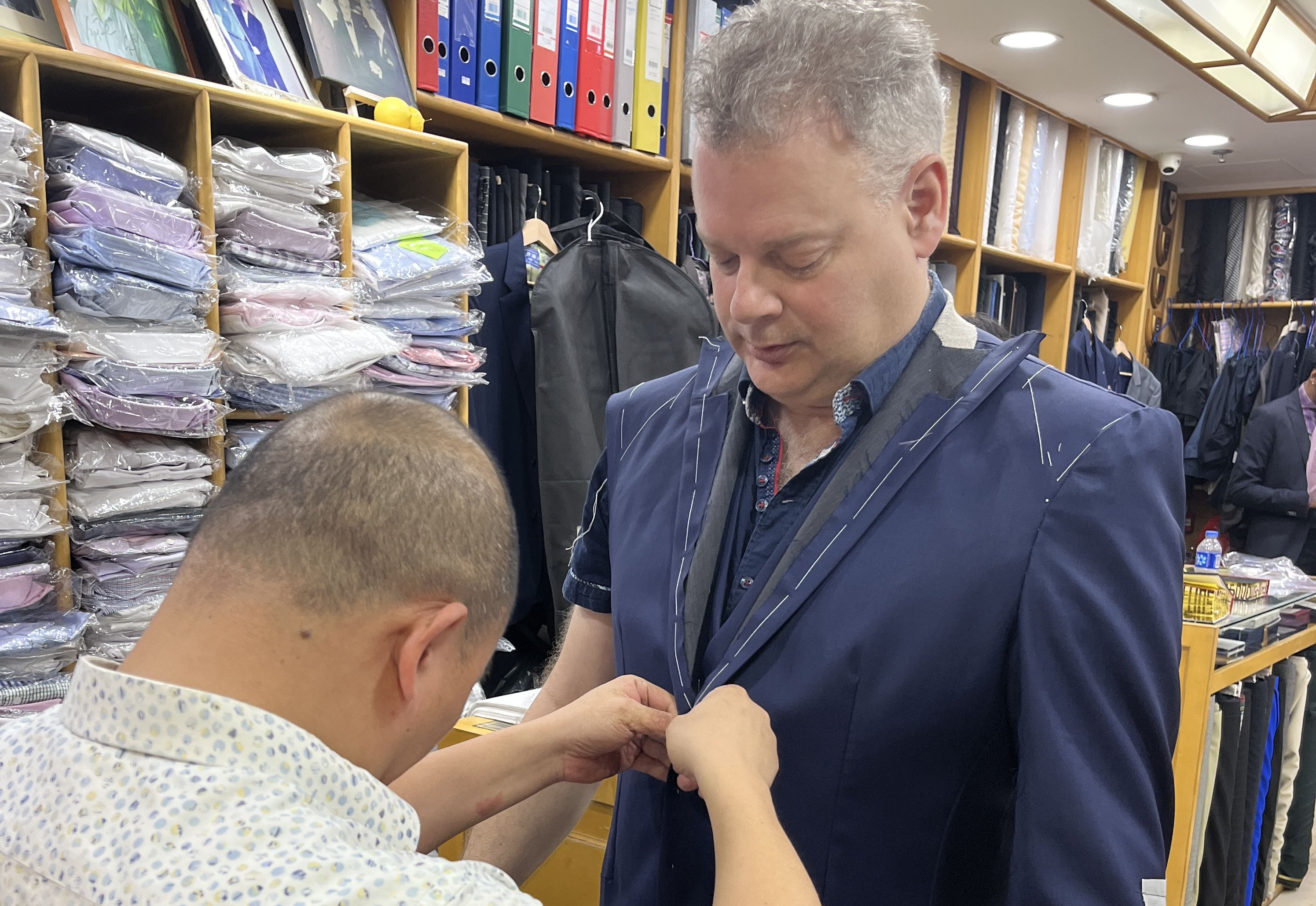
In the last five hours, a Nanjing-born tailor called Mr Zhang has run up the first draft of my suit, and now he wants to stick pins in me to make sure that the cuffs show just enough shirt.
“Can you tell him to stand up straighter,” he mumbles at Manu.
“Tell him yourself,” laughs Manu in perfect Cantonese, “he speaks Mandarin.”
“No, he doesn’t,” says Mr Zhang.
“Yes, I blimmin’ do,” I say in Chinese, and we’re off, with Mr Zhang interrogating me thorough a mouthful of pins about how I could have possibly ended up in Xi’an, and what kind of temperatures I had at home, as that was going to affect the way the suit was built.
“I doubt very much,” I say, “I will ever have a chance to wear this suit at home. It’s probably only going to get outings in Scotland and on telly.”
“Ah yes,” says Tarzan. “The other shirts!” He is intrigued about the mechanics of shooting a television series, and his eyes light up at the thought of a schedule so punishing that I need up to five duplicate shirts for continuity purposes. One on; one off; one in the wash; one supposed to be in the wash but actually held hostage by a chamber maid in Gansu; and one irredeemably spattered with mud from a tribal fish-throwing ritual. I learned my lesson after my first big National Geographic job, where the shirt I wore on day one had to be worn again on days two, three and four, and never quite recovered. And on the Confucius shoot in Shandong, my biggest problem was our sound-man’s lavalier microphone glue, which ruined several mercifully cheap shirts as well as a few sizeable clumps of my chest hair.
I bring Tarzan one of my current crop of shooting shirts, and he sets about it with professional precision, tutting at the sleeves and scowling at the edging, and telling me that a shirt worn tucked out needs to have a certain kind of pointy thing. Tarzan knows his stuff, and if I let him steer me, it will look like I do, and that is surely the nature of good tailoring.
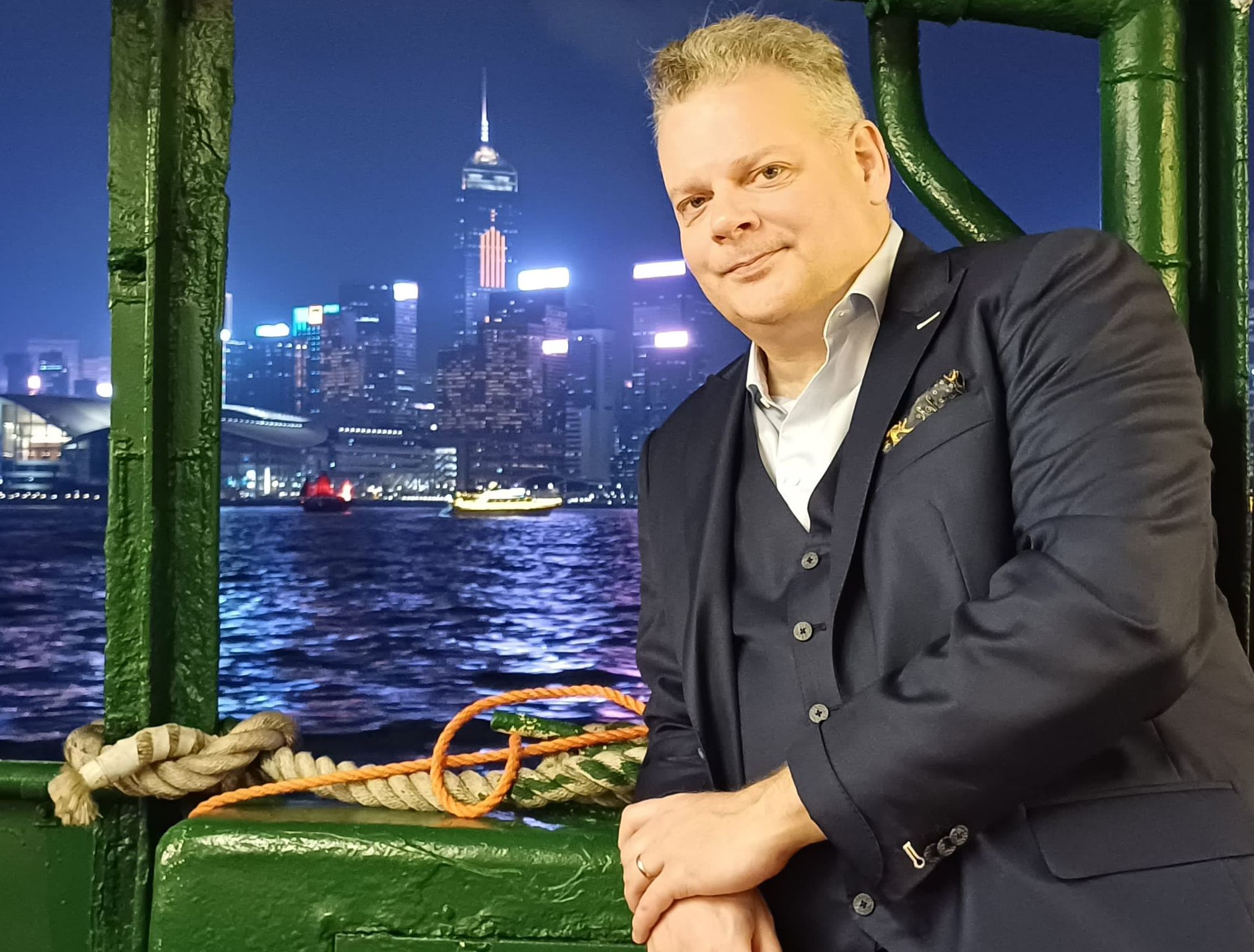
I walked into Sam’s on Wednesday morning. My suit is ready by the Saturday. When I walk back into the office, there is a small crowd admiring it as if it is a painting on the wall.
“I love the gauntlet cuffs,” says one man to me. I mutter something about not knowing what they are but… ooh, that’s what they are. Tarzan insists on putting the waistcoat and jacket on me himself, in order to demonstrate his dual cufflink/buttoned cuffs, the secret band that holds the suit in place, and the way to adjust the waistcoat shape.
The finished item comes complete with carefully stitched piping, a little pen pocket, and the Queen of Dragons motif repeated throughout. The shirts have my initials on the cuffs, and the act of putting them on feels strangely familiar… as if they had been made for me… which they were.
I am similarly happy with the sample shirt for on-camera appearances, and approve two more duplicates on the spot. Tarzan asks Tony the shirt-maker if he can turn them around before I leave tomorrow, and Tony tells him it’s too much of a faff — so they will just send them to me at home. Now I know I can just ask for whatever I want, and they can just make it happen, I fear they may have created a monster.
What if, I ask Tarzan, I come back with my wife? Can they fit her out with whatever she wants?
“Yes, we can,” says Tarzan. “But we can’t turn it around as fast as your suit. Women’s clothes can take one to two weeks. There’s more…. variables.”












 The Official Schoolgirl Milky Crisis Blog