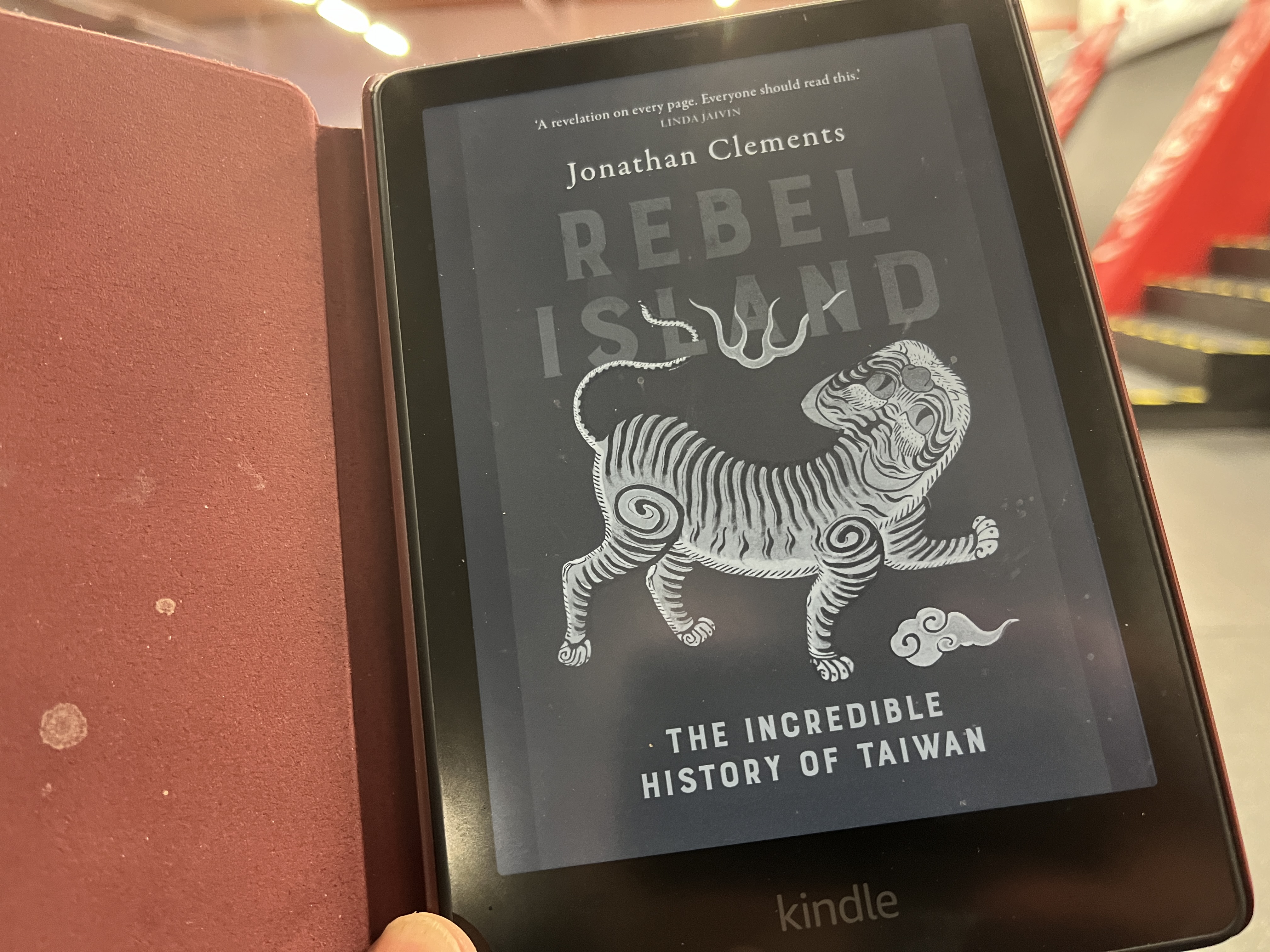
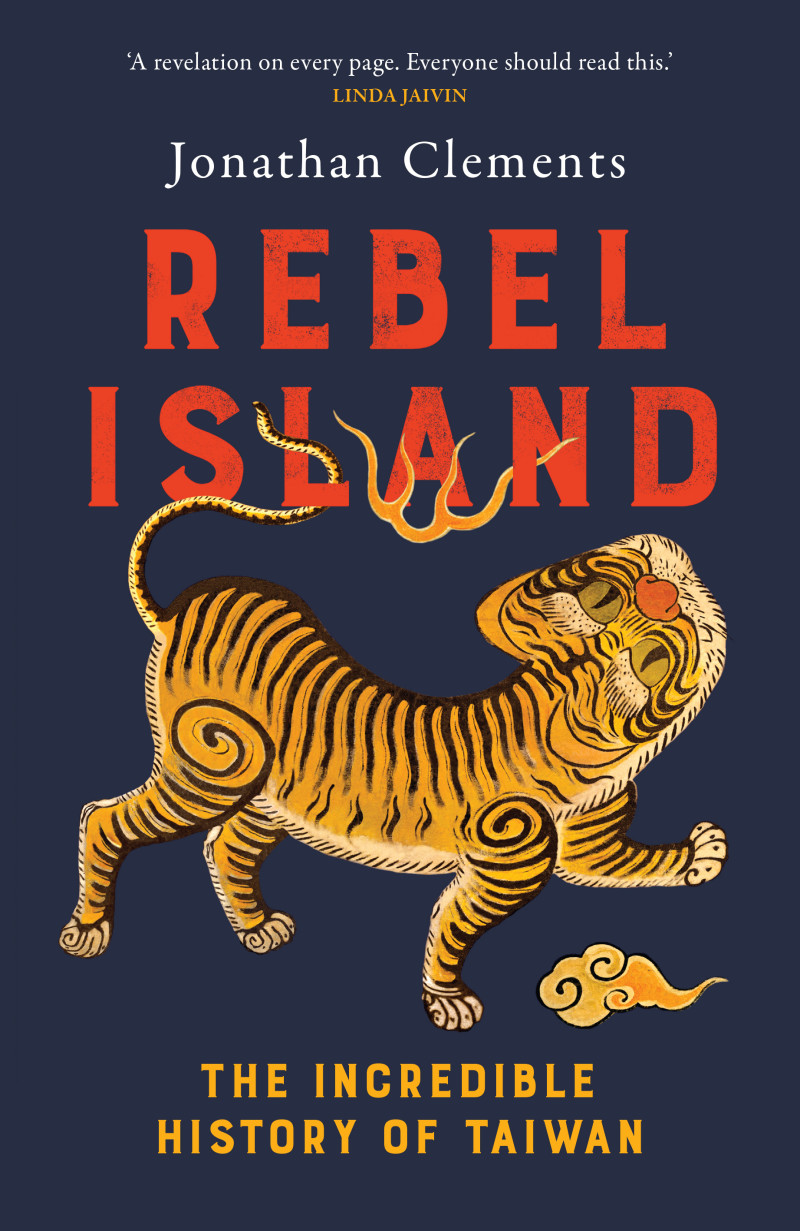
Today’s Sunday Times (paywall) picks my Rebel Island as one of its Five Essential Books on Taiwan.
“Jonathan Clements’s Rebel Island: The Incredible History of Taiwan takes a concise journey through the island’s complex history and all the different ethnicities, refugees, mavericks and nationalities that have come together to make modern Taiwan.”
Over at the Irish Times (paywalled), Oliver Farry calls my book Rebel Island “…a brisk narrative… related with style and brio… a splendid portrait of the layers of identity and resistance in what is no less a settler society than the United States, Australia or Argentina.”
This isn’t the first time I have boggled the people at History Hack with tales of Taiwan. You can also hear my archived interviews about The Pirate King of Taiwan and the historical importance of two obscure shipwrecks.
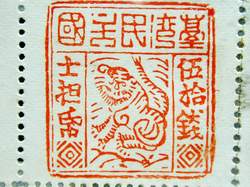
The picture shown is one of the hastily created Republic of Formosa postage stamps: “whether it represents a dragon or a squirrel or a landscape or anything else or even which is the right way up we have not been able to discover,” according to the Stanley Gibbons Monthly Journal. It is, of course, the tiger of the republican flag.
Christopher Harding in The Telegraph is first off the blocks with a newspaper review of my new book, Rebel Island: The Incredible History of Taiwan, calling it “a compelling portrait of a perennially fragmented place.” Article here (paywalled).
“A revelation on every page. Everyone should read this.” – Linda Jaivin, author of The Shortest History of China
“Rich with fascinating details, Jonathan Clements’ Rebel Island is an engaging introduction to the complicated and astonishing history of Taiwan.” – Shawna Yang Ryan, author of Green Island
“Taiwan has become a stresspoint of global geopolitics, and Jonathan Clements has done the world a favour with his indispensable account of its complex history. This illuminating and endlessly fascinating book can’t help but change the way we see the Taiwanese people and what they have built.” – Clive Hamilton, author of Hidden Hand
“Rebel Island narrates the long arc of Taiwan’s history in vivid prose and with admirable sensitivity to contemporary views regarding the island’s politically charged past. Clements provides an even-handed treatment of controversies old and new, while engaging readers with revealing anecdotes and his trademark wit.” – Paul D. Barclay, author of Kondo the Barbarian
Once dismissed by the Kangxi Emperor as nothing but a ‘ball of mud’, Taiwan has a modern GDP larger than that of Sweden, in a land area smaller than Indiana. It is the last surviving enclave of the Republic of China, a lost colony of Japan, and claimed by Beijing as a rogue province — merely the latest chapters in its long history as a refuge for pirates, rebels, settlers, and outcasts.
Jonathan Clements examines the unique conditions of Taiwan’s archaeology and indigenous history, and its days as a Dutch and Spanish trading post. He delves into its periods as an independent kingdom, Chinese province, and short-lived republic, and the transformations wrought by 50 years as part of the Japanese Empire. He examines the traumatic effects of its role as a lifeboat in 1949 for two million refugees from Communism, and the conflicts emerging after the suspension of four decades of martial law, as its people debate issues of self-determination, independence, and home rule.
On 15th May 2022, a sixty-eight-year-old man turned up late for a church service at the Geneva Presbyterian Church in Laguna Woods, California, and sat through the ceremony conspicuously reading a newspaper at the back. When the service ended, he chained and glued the doors shut. He then pulled out a gun and started shooting into the crowd of aging Taiwanese people, in the middle of a church luncheon. One man, Dr John Cheng, heroically charged the shooter, but was shot dead. Having run out of bullets, the gunman paused to reload, at which point pastor Billy Chang hit him with a chair. Several other attendees then piled onto him, holding him down while he was restrained with an extension cord.
The incident was swiftly over, with one death and five people with gunshot wounds. The shooter was subsequently indicted on 98 federal charges, including murder, attempted murder with intent, weapons charges, transporting explosives (he had brought a bunch of Molotov cocktails) and hate crime.
Media reporting on the incident was confused and multi-faceted. Some outlets justifiably termed it a “hate crime” – an act by an individual who had singled out a group of victims specifically on the basis of their ethnicity or beliefs. But the shooter was himself a “Taiwanese” man, David Chou – born in Taiwan to parents who were refugees from the mainland. He had a master’s degree from an American university, and a former career as a translator. In later life, he had suddenly become an outspoken critic of “Taiwanese people”, referring not to his own kind, who were simply born there, but specifically to those who rejected the notion of themselves as “Chinese”. Earlier that year in Las Vegas, he had unfurled a banner calling for “ERADICATION OF PRO-INDEPENDENCE DEMONS.” Before embarking upon his shooting spree in Orange County, he had posted a manifesto to a Chinese-language newspaper, titled Diary of the Independence-Slaying Angel.
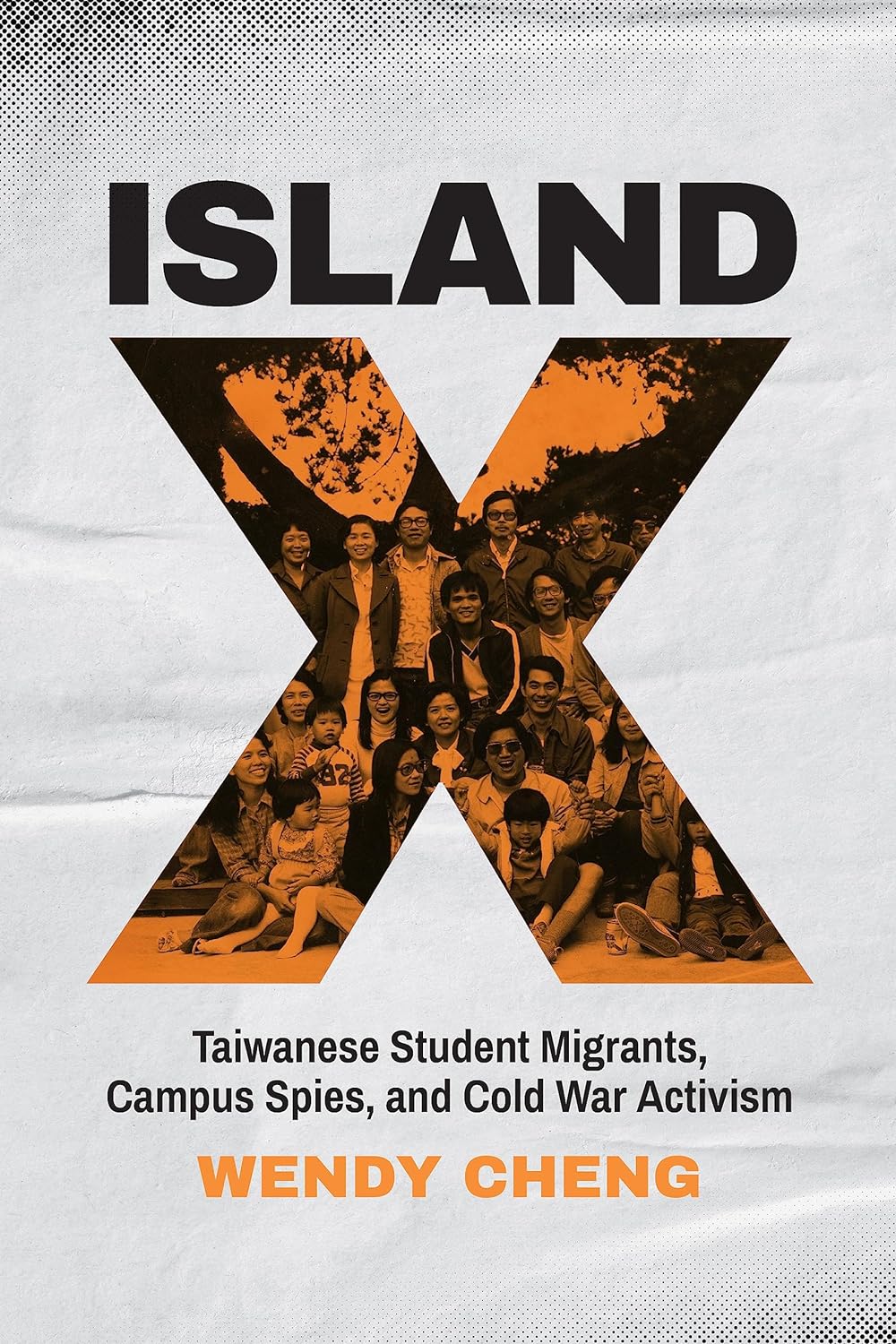
The incident was a shocking example of the way that foreign politics can suddenly manifest overseas, the playing out of decades of East Asian history in what first appears to be yet another crazy guy with a gun on the American news. Chou was, indeed, yet another crazy guy with a gun – but saw himself as the tip of the spear for a struggle that has played out in Taiwan for the last seventy years. As Wendy Cheng argues in her book Island X, it was also nothing new. Since the 1950s, America has been a crucible and a cradle for Taiwanese politics, and a battleground between its factions.
The name “Island X” derives from the codename given to Taiwan in the wartime training programme run by George Kerr, preparing a group of Allied officers for the island’s invasion and takeover. Cheng employs it in a broader sense, discussing the way in which the Nationalist government on Taiwan was so beholden to America that its very education system fatefully funnelled its best students towards the American university system. “English was taught beginning in junior high,” she writes, “and students were taught to ‘specialise in skills needed in the American job market’.”
A 1949 report by the US National Security Council suggested that the “indigenous population has a strong sense of regional autonomy… The Formosans are anti-Chinese, as well as anti-Japanese, and would welcome independence under the protection of the United States or the UN.” However, it went on to point out that fifty years of suppression under the Japanese, as well as the savage purges of the Nationalist government in the late 1940s, has left any potential independence movement rudderless, leaderless and “politically inarticulate.” Intentionally or otherwise, the United States then spent a generation nurturing not only the future leaders of the Taiwanese establishment, but their future opposition.
It was the hope of the American advisers on Taiwan that sending students back to the States would inculcate them with liberal values and support for the Free West. In some cases, this is what happened. In others, a sojourn in the US exposed Taiwanese scholars not only to life in America, but America’s own political turmoil, and the right of Americans to freely speak up about their misgivings. Like many other political movements both within the US and overseas, they were inspired by the United States’ own origin story – as a revolutionary democracy, taking a stand on broad philosophical issues, and demanding release from the bonds of colonial or imperial rule. As one student put it, it gave her “opportunities [to] actually identify myself as Taiwanese.”
They also became painfully aware that the Nationalist government on Taiwan was entirely buttressed by the United States. “They reached the island aboard American transports,” she quotes George Katsiaficas, “and American arms and subsidies enabled them to stay.” Such observations led activists to question the degree to which Taiwan was anything but an American airstrip in the Cold War.
To describe things in cheekily Maoist terms, America itself was in a state of “permanent revolution”, ready to self-correct and self-criticise, amending its own Constitution to reflect changing attitudes, and with a populace not above taking to the streets to protest about civil rights or the war in Vietnam. Many Taiwanese students were caught up in such protests, what Cheng calls a “contradictory but fantastic thing,” only to discover that their involvement in left-wing activism would lead to their cards being marked back home. Cheng’s own father was one such student, told that there would be no professorial job for him when he returned to Taiwan. Effectively blacklisted, he chose to remain in the United States. Another student observed that it took just six to eight hours’ informed conversation after arriving in America for him to cast aside “twenty-four years of Chinese education,” and to become an ardent supporter of Taiwanese independence.
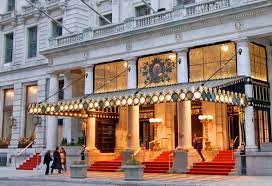
Such activism could take extreme forms on both sides. In 1970, the Taiwan-born PhD student Peter Huang attempted to assassinate Chiang Kai-shek’s son, Chiang Ching-kuo, at the lavish Plaza Hotel in New York. Shoved aside by a bodyguard, he succeeded only in shooting the hotel’s revolving doors, shouting: “LET ME STAND UP LIKE A TAIWANESE!” as he was dragged away.
Cheng’s book chronicles the aftermath of the White Terror on Taiwan, and the undeniable fact that the surveillance and control of Chinese citizens extended far beyond the island itself, under martial law from 1949-87, to the activities of Chinese people abroad, particularly in the United States of America. For if you were a Taiwanese exchange student at an American university in the third quarter of the twentieth century, you were subject to the unwelcome intrusions of a party cadre, not from the Red Book-waving People’s Republic, but from the “free” government of the Republic of China on Taiwan.
These paid informants or “professional students” were the strongmen (and women) of Taiwan’s “Rainbow” project, so named because the word for rainbow, caihong, is also a homonym for “destroy the Reds.” And by “Reds”, they did not merely mean the proportion of students who were taken in by the rhetoric of the PRC – some did indeed embrace the ideals of the mainland regime, even in the midst of the Cultural Revolution – but anyone challenging the one-party rule of the Kuomintang on Taiwan.
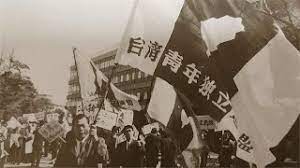
In 1971, the American hosts let down their Taiwanese guests in a spectacular fashion, by proposing to hand over the Diaoyu (Senkaku) islands off the coast of Taiwan to Japan. This has famously become one of the few issues that unites both Communist and Republican China, both of which regard the islands as Chinese. Such a betrayal was soon followed by Nixon’s famous visit to China, which set the United States on the path of recognising Beijing, not Taipei, as the rightful government of the country. And it was not merely the Americans who swung towards Beijing – the news propelled a bunch of Taiwanese students in America to give up on Taiwan as well.
Someone participating in the “Protect the Diaoyu Islands” movement, or Bao-Diao turned out to be super-triggering for the Nationalists, who instituted a new “blacker blacklist” that not only barred people from certain jobs or positions in Taiwan, but rendered them stateless. In several case studies, Cheng chronicles the persecution of students on trumped-up charges, their arrests on returning home for having merely participated in a discussion on Taiwanese independence, the removal of their civil rights and the harassment of their families. She also notes a “rash of bombings” in 1979-80 by WUFI, the World United Formosans for Independence, which led to WUFI being added to the State Department’s list of terrorist organisations.
The Taiwanese authorities fought back, also on American soil. In the most infamous incident in 1984, Henry Liu, a naturalised American journalist who had published a biography critical of Chiang Ching-kuo, was murdered in his own driveway in Daly City, California. He was shot by members of the Bamboo Union Triad, who had been working under orders from Taiwanese military intelligence – a fantastic jackpot of dodgy deals, which, as Stephen Solarz noted, amounted to “frightening examples of the long arm of Taiwanese martial law tearing at the fabric of American democracy.”
Cheng’s book is a fascinating exercise in, as she puts it, “locating Taiwanese-Americans in global history”, and reclaiming the lost stories of a generation of activists and students before it fades away and takes it memories with it. One would be forgiven for thinking that the lifting of martial law on Taiwan, and the subsequent swift rise of the Democratic Progressive Party, moved much of the action back to its homeland, but as the murderous act of David Chou demonstrates, there is no “over there” for Americans of Taiwanese origin if they are not safe in their own churches. The tensions in the Taiwan Strait, over whether Taiwan is part of China or a sovereign island, reach far beyond the local, and indeed, still threaten to engulf us all.
Peter Huang’s words as he was dragged out of the Plaza Hotel would become a touchstone of Taiwanese independence activism. Their most conspicuous appearance is in “Supreme Pain for the Tyrant”, by the death metal band Chthonic, which ends with the words “Let me stand up as a Taiwanese” repeated several times, like a mantra of resistance.
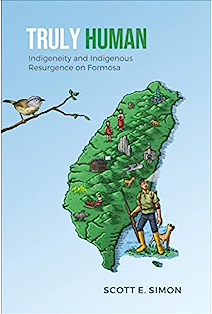
One of the most illuminating moments in Scott Simon’s Truly Human comes with the account of a sister and brother on opposite sides in Taiwanese politics. Igung is protesting against the local cement factory, which is on tribal land. Her brother Kimi thinks that the cement factory is a good thing, because it gives him a job that helps pay for his tribal tattoo website, and the managers are happy to look the other way when he goes hunting, which is otherwise illegal on former Truku territory. Eventually, the sibling stand-off becomes so strident that both of them run for political office on rival tickets, fatefully splitting the local clan vote between two members of the same family.
The title “truly human” derives from the term seediq bale, a native term that can be unpacked in multiple directions. Simon begins his book with a kindly villager who points out that everyone is human, really, including the nice anthropologist. But this gesture of cordial friendship rather ignores that fact that almost all the Taiwanese indigenes have terms for themselves in their own languages that simply mean “people” – and woe betide those non-people from the next valley if they wander onto our hunting grounds. Simon gets a sense of this himself when villagers start feeding him morsels of food, joking that in times past they would be doing so as part of the ritual to welcome his disembodied skull.
In chapters that focus on several crucial terms of indigenous language, Simon investigates how they have been misunderstood by the Taiwanese government. Across seven decades under the Republic of China, indigenous people have shifted in state consciousness from being idle savages, to suspiciously Japanese-speaking yokels, to “mountain compatriots”, to an invisible underclass “passing” as Han Chinese, to a weaponised minority that helps bolster the voting register. Simon is particularly compelling on their voting record, pointing out that contrary to the image fostered by the media, many of them skew “blue” towards conservativism, on the grounds that only the Nationalist (KMT) party is Chinese enough to appease the People’s Republic, and hence keep them out of their hair.
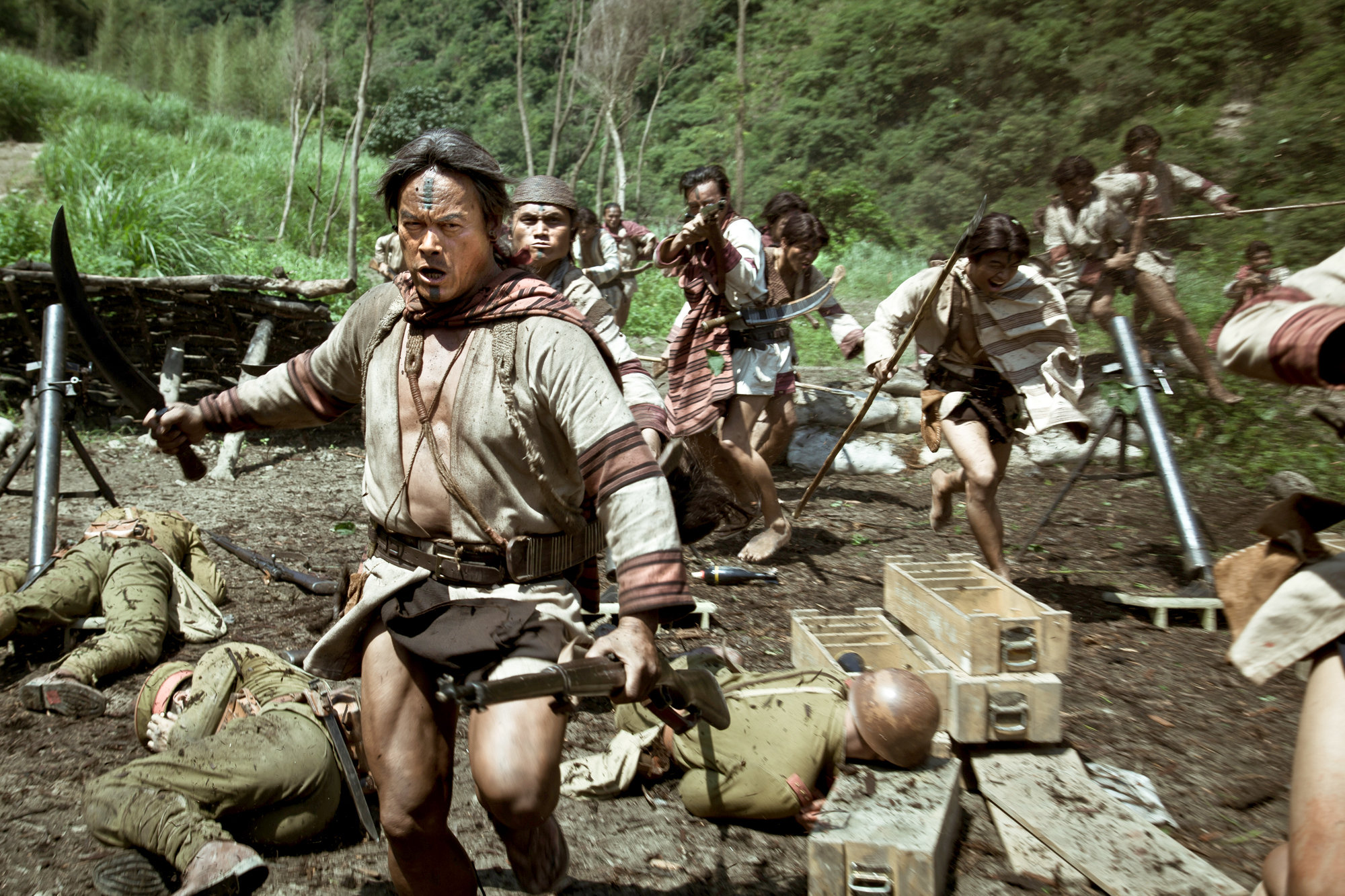
Seediq Bale, of course, was also the title of the 2011 film better known abroad as Warriors of the Rainbow (pictured), an account of the 1930 Musha Incident in which aggrieved tribesmen massacred Japanese colonists at a school sports day. Simon winningly investigates the way that story has spun out, noting for example that being “truly human” for tribal youths meant finding an excuse to be worthy of their ancestors by taking a human head. “It is no longer practised,” observed Simon wryly, “and thus can no longer be directly experienced through participant observation.”
Such a belief is part of the indigenous habitus known in many native languages as gaya – the same set of beliefs and taboos that regulated hunting, tattooing, weaving, marriage customs and funerary rights. Simon is ideally placed to examine what gaya seems to mean, not only for historical Truku and Atayal peoples, but for their modern descendants, one of whom confides in him that it was “really terrible.”
At some level, Simon’s account sits uneasily within the frameworks of academic publishing. So much of this material might have been better presented as a memoir, rather than snippets of fieldwork, leavened with historiographical commentary. But this is a common factor of much writing on indigenous peoples – many of the books on my shelves about Australian Aborigines and Canadian First Nations struggle to defy the tropes and traditions of the Euro-American structures that have been imposed on them. The further to the philosophical left one goes, the more such dialectics turn into endless nit-picking and hand-wringing, but mercifully Simon steps back from a precipice of self-doubt that might have stopped him writing anything at all.
In the process, he refers to Glen Sean Coulthard’s Red Skin, White Masks, which confronts the language of indigenous rights, noting that it is hardly a victory when native people win “concessions” from the state, since the very concept tacitly accepts that those rights were ever the state’s to concede. Simon applies this with particular value to the drawn-out spats over hunting in Taiwan, in which the Republic of China piously turned the Truku homeland into a national park (Taroko Gorge, spelled as per the Japanese mispronunciation) … and then announced it was illegal to hunt there.
Hunting is of vital importance to the Truku. As with many other indigenous people, it forms not only the basis of acculturation, but also a form of bonding, socialisation, and education – Simon’s accounts of the what he learns from the sounds (bird divination) and smells (there are cobras nearby) of a hunting expedition are a snapshot of thinning native knowledge, lost to a younger generation working in urban convenience stores and on factory assembly lines.
Forbidding the Truku from hunting deprives their menfolk of a rite of passage, emasculating them in the eyes of their potential brides. Nor is it a simple matter of telling the troublesome Truku to just go and hunt somewhere else. As Simon learns, hunting is not merely a matter of wandering through the forests taking pot-shots at deer. It is a matter of careful, long-term husbandry of the local environment – the carving of passages and blinds, even the local year-on-year cultivation of plants that will lure prey to specific spots.
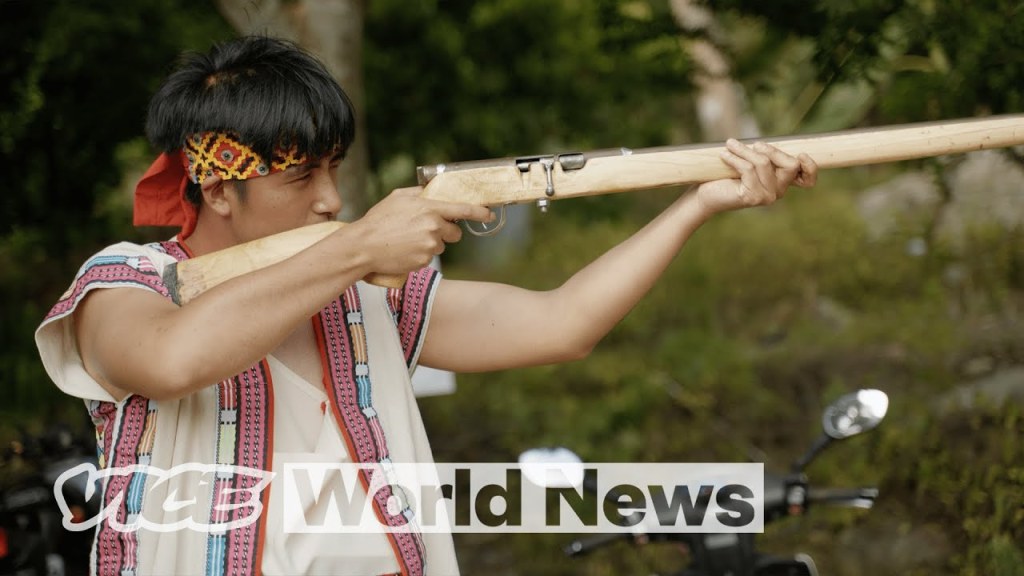
Simon brings up several landmark cases in hunting law, particularly the cause celebre of Talum Sukluman, a 54-year-old Bunun man arrested in 2013 for poaching, but also for using the wrong sort of gun. It’s this latter charge that is the most illustrative, since as Simon points out, indigenous people can go hunting, but only if they use an antiquated and home-made musket design – which, as one tribesman points out, is technologically inferior to the matchlocks that the Dutch carried in 1634! Simon argues that such laws literally force indigenous people to place themselves in physical danger by using jury-rigged explosives.
Talum’s case was finally resolved when he was pardoned by the newly elected president Tsai Ing-wen in 2016. But his freedom did nothing to allay the frustrations and criminal charges brought again uncountable other hunters, nor the fact that many hunting laws were introduced in reaction to dwindling wildlife habitats and populations – a 1990s problem now at least partly resolved by eco-policies and rewilding. In one telling incident, a meeting flies into uproar when told that tourists in Taroko Gorge have complained about the sounds of occasional gunshots – “We are killing squirrels,” shouts an angry Truku tribesman, “not people!”
As a technological determinist, I was particularly won over by the way that Simon relates such issues to the evolution of available weaponry. In the good old days, he suggests, hunting of both heads and hogs was a visceral, dangerous, immediate experience. The colonial-era arrival of better-quality knives increased the efficacy and frequency of what were once “sustainable” once-in-a-life-time expeditions, while improved gun technology turned hunting trips into forest massacres. But it’s the imposition of outsiders’ law that has most transformed local life.
“In the past,” complains one elder, “they would bring back the animal openly, with loud calls of joy, to share the meat with their neighbours. Nowadays they must conceal the animal in a canvas bag, kill it secretly in their home, and share the meat only with the immediate family and most intimate friends.” I was struck by this comment, not merely for the image it presents of thinning tribal traditions, but of the way that criminalising such actions can drive such people into associations with true criminals. It is, after all, the bushmeat (ye-wei) trade that forms one of the cornerstones of organised crime across east and south-east Asia, and which has been implicated in recent years in geopolitical scandals that stretch far above the heads of mere forest hunters, even into the murky origins of the Covid pandemic.
There is much more in Simon’s book – my weightless Kindle copy of which belies a main text of over 400 pages. But I’ll leave you with one of his many illuminating insights into the world and life of Taiwan’s indigenous inhabitants. Much as the French began referring to British football hooligans as “les fuckoffs”, the Atayal and Seediq called the Chinese settlers kmukan (“motherfuckers”) on account of their readiness to refer to the taboo sexual activity of a relative in one of their most common swear-words.
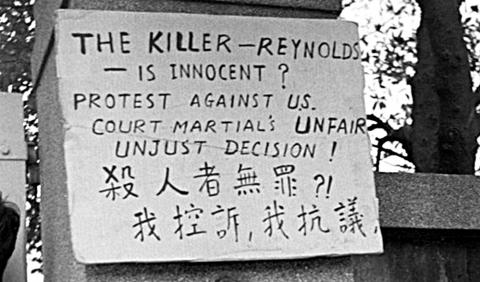
On 24th May 1957, a Chinese widow and her daughter began an angry vigil outside the US embassy in Taipei. Ao Tehua held up a bilingual sign protesting at the decision by a US court martial to find her husband’s killer innocent. Asked to move on, she pointed out that the street outside the embassy was Chinese territory, and it was her right to stand wherever she pleased. By the time a force of twenty-two police officers arrived to persuade her, a mob of 400 onlookers had gathered. A local reporter interviewed the tearful widow on tape, and then broadcast her words through a loudspeaker to an increasingly fractious crowd.
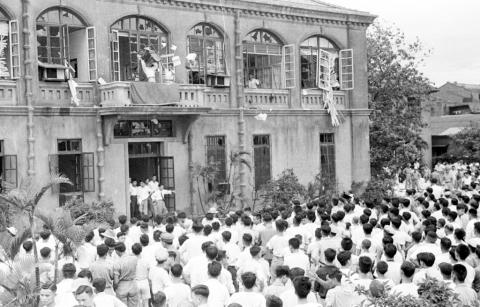
By the afternoon, the crowd had grown to more than 2,000 people, storming the embassy gates. They smashed the windows, ransacked the offices, and patrolled ominously outside the iron door protecting the staff in their panic room. The Stars and Stripes was torn down and shredded, and the flag of the Republic of China raised on the embassy flagpole in its place, to loud cheers from a crowd that now numbered six thousand.
In a moment of gripping cinematic tension, eight men bolted from the embassy through a gauntlet of “clubs, stones [and] fists.” They reached their escape vehicle, a military jeep, only to discover that one of the rioters had stolen the keys. As the mob charged towards them, their Chinese driver tried to hotwire the car with a pair of pliers and the tinfoil from a packet of cigarettes. Police officers started to push the car down the street, at an excruciatingly slow walking-pace, as the driver tried frantically to jump-start the motor. As the rioters caught up with the still-unstarted vehicle, the men reached the safety of evacuation buses, while the crowd yelled at them: “You killed Chinese. We kill you.”
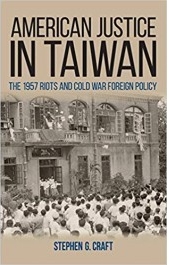
Stephen Craft’s book American Justice in Taiwan is a fascinating snapshot of Cold War politics in Taipei, during the era that the US government vainly attempted to prop up the exiled government of Chiang Kai-shek, in the forlorn hope that it would one day retake the Mainland from Chairman Mao’s Communists. He starts with the shooting that precipitated the embassy attack, a fateful evening two months earlier, when the 41-year-old Master Sergeant Robert Reynolds had rushed out of his house after his wife Clara claimed to have seen a man peeping through the window as she took a shower.
Giving chase in his yard and the street outside, Reynolds apprehended and fatally shot Liu Ziran, an officer in Taiwan’s army and a member of the Institute of Revolutionary Practice. When the authorities arrived, Reynolds confidently admitted to having shot the man whose body was lying in park 200 feet from his house, noting that he had done so in self-defence. That was his next mistake.
In the case of the Reynolds incident, the real issue was a huge disjuncture between Chinese and American legal practice. American law recognised that “a man’s home is his castle” – if Reynolds could prove that the intruder was a threat, he might get away scot-free. Chinese law, however, regarded all violence as a crime that needed to be answered, even if committed in self-defence or without malice. This, observes Craft in an illuminating aside, was why British diplomats were not allowed to drive their own cars in China, as “accidents became incidents.”
So, when Reynolds immediately announced that he had shot the intruder in self-defence, under American law this an argument for his innocence, whereas in China it was an admission of guilt. In similar cross-cultural misunderstandings, the Reynolds inquiry seemed more ready to accept the testimonies of white interviewees, who swore to tell the whole truth, than those of Chinese ones, who were not obliged to swear on a Bible. Following Reynold’s controversial acquittal, it was suggested that he follow Chinese custom in paying compensation to Liu’s family, but his representatives refused, on the grounds that in American eyes it would make him look guilty.
The result was an escalating tension on Taiwan, in which the mob stormed the embassy, and armed military police escorted American children on their school buses, while the authorities warned that “rumour agitation” was a capital offence. And there were rumours galore, enough for a whole mini-series of alternate facts, with claims in the Chinese press that Liu and Reynolds had been secret love-rivals duelling over the same woman. Meanwhile, American intelligence pointed to a number of incredibly suspicious coincidences and happenings, that suggested Ao’s protest sign and the embassy attack itself might have been orchestrated with the help of the secret police, run by Generalissimo Chiang Kai-shek’s own son.
Trying to mollify feelings on both sides, Chiang Kai-shek gave a broadcast in which he called it “one of the most shocking and most regrettable things” that had happened in the last five decades – something of an overstatement, considering that the period included two World Wars. As for the embassy staff, they felt “they have been kicked contemptuously by friends for whom they have risked and spent much.”
Craft’s book is a whodunnit, poking around in Reynold’s testimony, and the forensics of Liu’s death. He delves into gendered arguments in both the court and the press, in which commentators seek to question the evidence on the basis of the attractiveness of Liu’s Chinese wife. Why on Earth, they argued, would he want to look at a naked American woman, particularly the frumpy Clara Reynolds – their words not mine! Why, the very idea was an insult to Chinese womanhood, while the argument in Liu’s defence was an insult to Clara Reynolds.
But Craft also turns the story into an examination of the history of justice for Americans in East Asia, all the way back to the Terranova Incident of 1821, in which a naturalised American sailor killed a boatwoman by throwing a pot at her. He talks through numerous similar moments in the record, where illegal foreign activities have gone lightly punished or even unpunished, as well as similar cases in Japan, which were resolved very differently. For a century, Americans and other foreigners enjoyed the umbrella protection of “extraterritoriality” – the right to be tried by a court of their countrymen, rather than the Chinese. The Americans finally renounced their extraterritorial status in 1943 as part of wartime concessions, only to start re-asserting it in a new form by rushing to claim “diplomatic immunity” every time they needed to. But as Craft notes, in a lovely anecdote, the attitude of the US military was still occasionally tin-eared when it came to local issues.
In February 1957, a visiting American general made the error of asking his Taiwanese hosts why the locals were not celebrating the birthday of George Washington.
“We are not a colony yet,” came the beautifully understated reply.
This is a movie waiting to happen, unravelling from two midnight gunshots in a Taipei suburb, into a consideration of the history of justice itself, the Cold War, and the very real possibility that everyone – Reynolds, Liu, the mob and the embassy staff – were all unwitting pawns in a power-play between Chiang junior and his father the Generalissimo. Craft’s narration expertly zooms in on tiny moments of human interest, like Japanese vagrants scavenging for shell casings on a military shooting range, or junior officers pleading with their jeep drivers to use their horn less into order to make more friends, out to grand pivots in geopolitics. With a winning grasp of historical context, he closes with the October 1957 launch of Sputnik, setting the Soviet Union ahead in the space race, and pushing the US and the Republic of China to entrench even deeper in their reluctant alliance.
Rewarding on many levels, American Justice in Taiwan is a book that offers a sweeping view of thorny issues in international justice, which continue to reverberate today.
The distance from Puli to Hualien is 40 miles as the crow flies. You can drive it in just three hours, although, tellingly, today’s bus and train routes still take seven, edging all the way around the north of Taiwan, rather than making a beeline across the towering central mountains. But there was a time when it was a track unknown to all but a few aboriginal hunters, until one brave Japanese frontiersman, Katsusaburo Kondo, led a surveying party through the jungle.
That, at least, is what Kondo claimed, in a series of 1930s newspaper articles in which he chronicled his experiences among the tribesmen of the Taiwanese hinterland, a life-long association that led him to acquire the nickname “Kondo the Barbarian”. His memoirs have now been published by Camphor Press, a small publishing house that punches way above its weight in Taiwan Studies, responsible for much of the best and most original material in the field in recent years.
In October 1930 a group of Taiwanese Seediq tribesmen infiltrated the sports day at a Japanese-run high school and massacred over 130 Japanese, as well as two Chinese observers who had fatefully decided to cosplay in kimono. The “Musha Incident” became a touchstone of Japanese-aboriginal relations, and would lead to a brief colonial war that claimed hundreds of Seediq lives. The Musha Incident was a shock to the Japanese system, but has also been framed as a form of indigenous apocalypse, as the last generation of Seediq warriors, deprived of their traditional manhood rituals, went hunting for their colonial oppressors in a last, desperate attempt to merit the killers’ tattoos that would entitle them to join their ancestors in the afterlife.
Suppressed for decades under the Kuomintang government, the story of Musha sprang back into life in the 1990s, as the Taiwanese media gained increasing interest in indigenous issues. It was adapted into a comic by a native artist, which itself became a major source for the film Seediq Bale: Warriors of the Rainbow (2011, pictured), an epic action movie that reframed the story along the lines of Braveheart or the Native American “ghost dance” cult.
The Musha Incident, in fact, remains such a huge presence in reports of Taiwan under the Japanese that it still accounts for 10% of all the material published in Japanese relating to the fifty years of colonial rule. Paul Barclay’s new book digs down into one of the ur-texts that inform so many of these stories, the reminiscences of an unreliable narrator who tried to place himself at the centre of the story.
Katsusaburo Kondo is that most dangerous of conmen: an evocative and persuasive writer. He begins his story with the aftermath of the Musha school massacre, when he visits his estranged aboriginal stepdaughter, who confides to him the true reason for the war, before hanging herself in her prison cell. He then leaps back in time to tell the story of his relationship with Taiwan’s indigenous people, as an interpreter, explorer and trader.
In particular, Kondo is keen to insert himself into the narrative of the Fukahori Expedition, an ill-fated platoon murdered by head-hunters in the Taiwanese hinterland. He frames much of his subsequent adventures as a quest to avenge the lost soldiers, and to retrieve their bodies and possessions, finally striking it lucky when he stumbles across their skulls on display in a tribal longhouse. But as Barclay notes in his meticulous annotations, Kondo’s life-long claim that he, too, would have perished on the expedition were it not for a fortunate bout of malaria, was part of his ongoing attempt to appear far more involved than he really was.
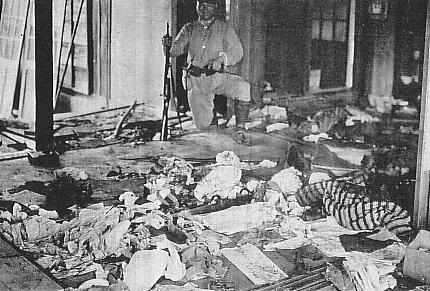
The scene of the Musha massacre, 1930.
“Despite… many inconsistencies, falsehoods and implausible claims,” observes Barclay, “Kondo’s writings wedged their way into discourse, by hook or by crook.” However, they are also loaded with tantalising and convincing glimpses of aboriginal culture, including a chilling account of the “guardian of heads” (the crone priestess who welcomes a new skull to the tribal shrine), and a charming anecdote in which an indigenous girl confides to Kondo that her people are “afraid of the Japanese people who tick-tock.”
It takes Kondo a while to realise that she is frightened of his pocket watch, which makes him, too, seem like an otherworldly creature bearing haunted devices. This is catnip to the historian in search of local colour, but Barclay is on hand to warn that it seems suspiciously close to another story told by one of Kondo’s associates, and was quite possibly something that he ripped off. In another part of the tale, he recounts a horrifying attack by several tribal youths, who decide to lynch him for his skull. He fights them off, but is so grievously wounded that he writes his will… except he is “fully healed” within two weeks. Well, which is it?
And yet, and yet, there are moments in Kondo’s story, translated here in full, that are truly illustrative of the stand-off between the aborigines and the Japanese, such as the sight of tribesmen going cap-in-hand to the local police station to plead for meagre parcels of gunpowder and a couple of bullets, merely so they can continue their livelihoods. Kondo tells tales of the Seediq hardening the soles of their feet by walking on hot iron rods, and of the strict lumber merchants whose insistence on unmarred timber is the cause of much misery among tribal log-carriers. Finding a corpse on their mountain mission, he asks his tribal companions if they want to eat it, and they look at him in horror – cannibalism being taboo among them, despite claims to the contrary made by the foreign media. These observations are so mundane, so everyday that they have to be true. Right?
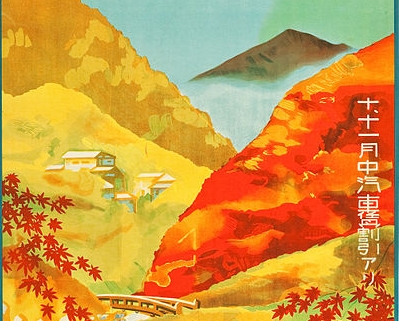
Taiwan as imagined in a 1930s Japanese tourist poster.
With Barclay as our guide, Kondo’s tall tales become an object lesson in text-critical analysis, as we get to grips with the lies he tells others, the lies he tells himself, and some of the truths that are still revealed. His account of his divorce from his common-law wife, in which he delivers a pig’s head and a keg of rice wine to her father, seems faithful to tribal traditions, although one wonders just how happy the former Mrs Kondo was with it – Kondo claims she waves him away with a laugh. Barclay even gently makes Kondo more relevant to modern historians, by redacting some of his hand-waving racist dismissals of everyone as “savages”, replacing his blanket descriptions with more exacting classification of tribes and sub-groups.
Sometimes, one thinks, the tribesmen have the last laugh. Kondo writes sneeringly of a moment on his expedition when he convinces his tribal companions that he has a magical amulet that will turn a single grain of rice into a full belly for each of them. “So simple-minded,” he scoffs when they appear to fall for it. And yet he also tuts in annoyance when they attempt to delay the mission by waiting for a new-born baby to grow up so that its mother is free to accompany them. Kondo decries this as a moment of savage sloth, but one wonders if the tribesmen weren’t concocting an excuse to delay the city boy’s dangerous mission for another season.
Resistance to the Japanese authorities was futile. Barclay has some winning data on the nature of colonial wars, pointing out that the Musha Incident was such an embarrassment to Tokyo that the soldiers who avenged it were handed the most desultory of medals and rewards. Even as the Hague Convention attempted to limit the savagery of modern warfare, colonial campaigns were somehow exempt, subjecting the Seediq to some of the very worst of modern weaponry, including aerial bombardment of their forest hideouts.
Kondo writes vividly of some of the attempts to get the aborigines to understand how pointless it was for them to fight back, with a tribal delegation brought to visit Japan itself to show them the power and might of the Land of the Rising Sun. Put aboard a train for the journey to Keelung, the Seediq scream in fear, protesting at the dizzying speed, pointing in terror at what appears to them to be “dancing trees” beside the tracks. It is a beautiful image, but Barclay points out that while Kondo’s early writings describe the aborigines as brave, hardy trackers and hunters, his later work transforms them into clueless, whiny man-children, reflecting Japan’s own drift towards imperial condescension. In Barclay’s hands, Kondo the Barbarian transforms from an account of the Taiwanese indigenous people to an even more revealing narrative about the Japanese who were writing about them.







 The Official Schoolgirl Milky Crisis Blog
