
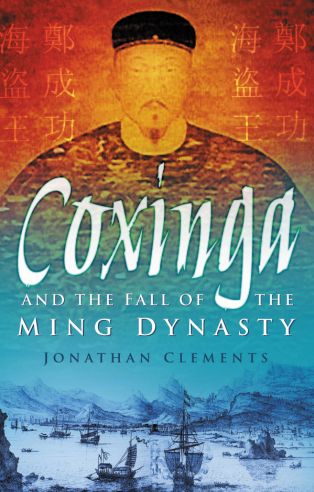
In the last week I have been interviewed by Chinese TV, press-passed my way behind the fences and up into the rafters at the boat launch, and chased down the street after two rival Goddess of the Sea processions with a stills camera. I’ve walked along a beach interviewing an eminent professor, and poked around an illegal temple to Coxinga, literally built on the shifting sands of the Taiwan Strait. I’ve also notched up many hours of talking headness, wittering to camera about Coxinga’s rebellious life and explosive conclusion.
The crew from Marc Pingry Productions was based in the super-swish Tayih Landis, a film-makers’ dream of a hotel with wireless internet throughout, a producer-proof business centre, bellhops eager to cart around a truck full of camera equipment and the best breakfasts I have ever had. And a gym, and a pool. And insulated beverages in the tea house that allow us to periodically say: “Let’s go and drink from the furry cup.” It also had a convenient six-floor shopping centre next door, for all those handy last minute runs to grab a hacksaw, three rolls of gaffer tape, a CD of devotional music dedicated to the Goddess of the Sea, and a crate of beer.
With 5am calls and midnight finishes, I am lucky I saw any of the city at all. But for a workaholic like me, it was the best possible way to see Tainan. Get up, drive to location A, shoot two set-ups, drive to Location B, repeat, back to the hotel for breakfast. Then out again for the next shoot… rinse, repeat, from location scout to shooting, to equipment hire, to scriptwriting.
Our fixer Johnson Hu was on hand to drive the van, argue with the natives, run for iced tea and twirl a boom mike. Thanks to him, I had the most wonderful Coxinga fanboy experience. I got to see the beach where Coxinga’s troops came ashore, to poke around the halls at the place where he died, and to clamber over the ruins of the castle he took from the Dutch. I was also pushed in front of a crowd at an academic forum on Chinese marine history, where I spoke about Coxinga’s Japanese relatives, some of whom witnessed key moments in 19th century history, and one of whom opened the first coffee shop in Japan in 1889.
 We’re still in an ongoing debate about what this documentary should be called. A Hero’s Legacy? Sailing into History? The Master of the Seas? Defiance Deified? Ship Floats? Since the reconstruction of the 17th century boat is the centrepiece, I have suggested Whatcha Gonna Do With All That Junk? But I don’t think anyone is going with that.
The people in Tainan have built a replica of the Taiwan Boat, the junk that made the long trip from Taiwan to Hirado in Japan. There is a lively and incredibly entertaining debate underway about what a replica should be, how faithful it should be in order to satisfy historians; how practical it should be to satisfy health and safety; how durable it should be to satisfy the money-men. The camera crew are back in June to film the re-enactments of Coxinga’s life, and I’ve had so much fun I’m ready to volunteer to carry sandbags if it’ll get me back there.
But no rest for the wicked. Off to Sweden today to discuss the career of Major General Peng Liyuan, the Chinese soprano who looks ever so good in uniform. And back in London next week for meetings about my next book: I’m not done with maritime China yet…

 The Official Schoolgirl Milky Crisis Blog