
I am awake for dawn in Songyuan…. It is a city spattered with ice and snow and wreathed in poisonous mist. Identical breeze-block, seven-storey buildings stretch away into infinity, as if the entire city has been dropped out of the sky by God’s cloning tool. As a river confluence and the crossing point for five railways, Songyuan has been a hub of sorts for the last century, but it still seems odd to imagine that anyone would want to live somewhere so crushingly dull, where the boulevards are glum corporate landscapings, and the houses seem designed for people who never look up from their phones. This is a city of 2.8 million people, half the size of Finland.
I keep telling people I am in Inner Mongolia, but that is not true. I am actually in the Front Gorlos Mongol Autonomous County, which is in Jilin, just over the border from Inner Mongolia.
“Our ancestors had to move,” says Mr Bao, the cultural attaché, a chubby, avuncular man, who is very excited to have a film crew in town. “They picked a fight with Genghis Khan when he was a youngster, and their shamans told them: ‘this guy is going to be the king of the world; you’d better run. So we left Mongolia and took ten towns from the Manchus here. Then the Mongols took over the whole of Asia, and we were absorbed into one of the banners of the army. We are the Front Gorlos, who fight in the vanguard. There are Rearguard Gorlos as well, somewhere.”
My first meeting with Mr Bao is in our residence, The Gorlos Hotel, which is riddled with Mongol motifs, curlicues crawling up the pillars and thunderbolts in the walls. The gift shop sells horse-headed erhus and little Mongol dolls, and the convenience store has lots of yoghurt.
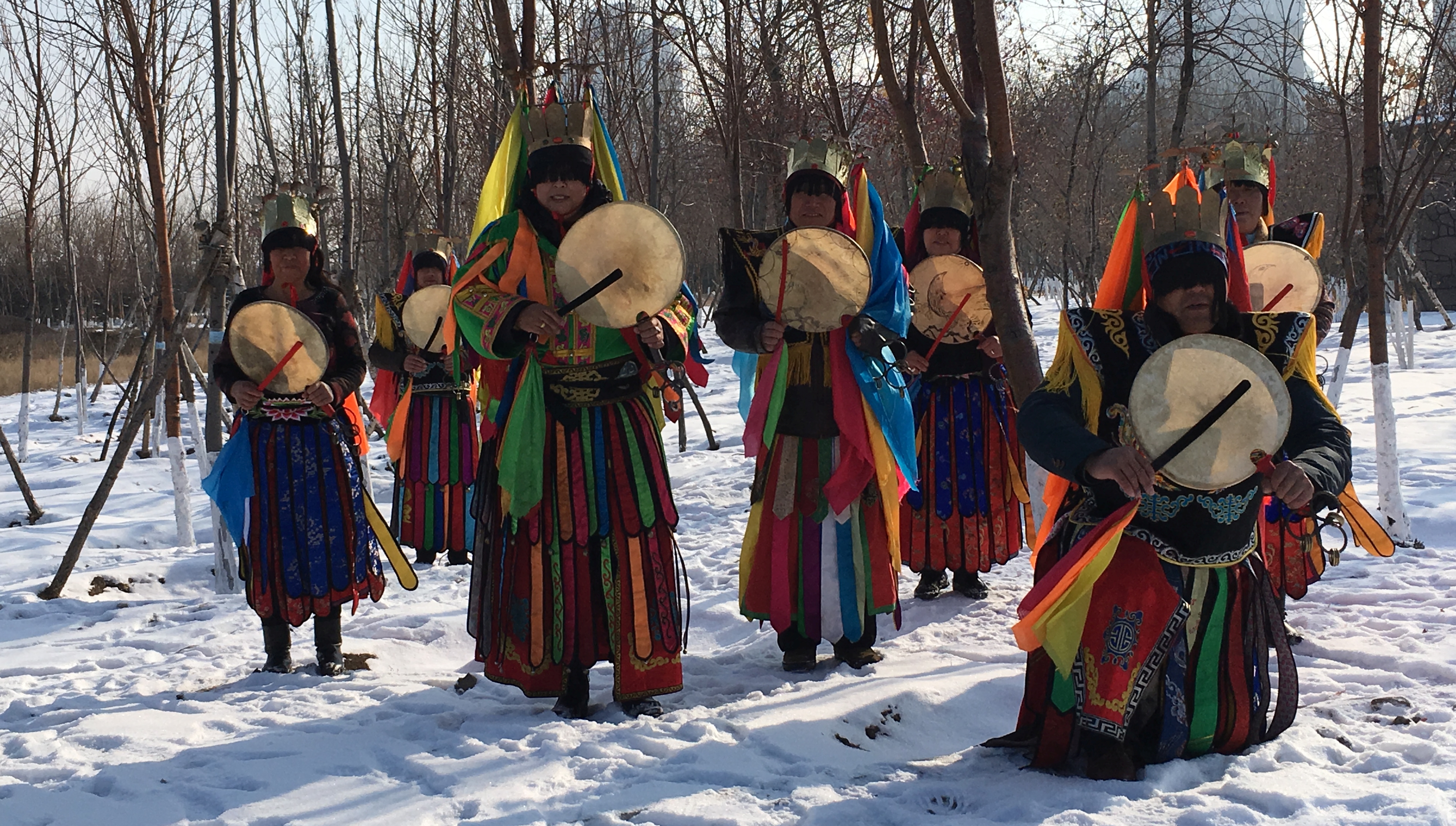
Today, we are filming a welcoming ceremony in the local park, next to the windswept waters of the icy Songhua river, dominated by eleven massive Mongol stupas. Each has a base of a circular stone cairn, topped by a flower bed planted with fir trees, superseded by a pole that holds aloft a sort of sacred umbrella, itself surmounted by a shamanic trident. Each takes on a writhing cone-shape, caused by all the flapping prayer flags that stream from the top like a multi-coloured rainbow.
It is cold. Our oh-so-high-tech thermometer broke after counting down to minus five degrees, and I suspect we are looking closer to minus ten.
“Stop complaining,” scoffs the cameraman. “You live in Finland.”
“Yes,” I point out, “but we don’t stand around in the fecking cold all morning.”

Mr Bao has gone full-on Mongol gangster. He turns up in an ankle-length dun-coloured robe with Vulcan shoulder pads and a Russian style furry hat. But he is veritably under-dressed when compared to the eight shamans he has brought along. Each has a skirt of rainbow ribbons, from which dangle jingly bells. Each has an embroidered tunic with twisting dragons on it, with shoulder pads that reach out for half a foot on each side, and a golden crown topped with metal butterflies, from which rainbow streamers depend down their backs like kabuki battle-flags. And to complete the ensemble, each wears a fringe of black beads that hangs down to their nose, completely obscuring everything above their upper lips.
For some reason, people stare. We are trying to film the shamans banging their tambourines and shouting at the gods, but the producer has to keep dragging gawpers away by the scruff of their necks. One particularly irritating passer-by has a camera that goes BING-BONG every time he tries to sneak a photograph, and lacks a telephoto lens, which means he keeps wandering into shot.
A far more sinister rubber-necker is a woman in a white snood who is nonchalantly toting a Canon 5D with massive grey telephoto lens, which the director identifies from 100 paces as a ten-grand EF200-400mm f/4L IS USM Extender 1.4x. Snood Lady then proceeds to spend the next two hours pointing it at us from the shrubbery, making her the most obvious tail we have ever had. Even Mr Bao eventually tires of all the attention, and gently admonishes her that she is wasting her time, as we have all the correct papers. She pretends to be photographing a bench for a few minutes, and then returns to her old ways.
Mr Bao and his eight wizards, men and women, dance around the stone cairns and burn incense, chanting in Mongol while the icy wind flaps at their prayer flags. The director hopes to get some aerial footage of them twisting and jiving on the brown grass in front of the stupas, but we discover after thirty minutes of false starts that the cold has done for the drone batteries. It takes a long while for the drone pilot to even get his phone to turn on, but by the time he has calibrated the drone software and launched it into the air, the drone’s own batteries are already flashing alerts, and it has to come down before it can shoot a scrap of footage.
The cinematographer reveals that his camera is similarly hobbled, and that he has somehow got through two batteries this morning. But at least we have the Welcoming Ritual in the can from the ground. What’s next?
“Next,” beams Mr Bao, “we need to find somewhere indoors to shoot the exorcism ritual. People get possessed, you know, and their bones ache, and they come to a shaman looking for help. And it’s from the ranks of the possessed that the shaman will select his future pupils. You don’t choose to be a shaman, shamanism chooses you, and you will dream of your master and seek him out. If he won’t teach you, then you will bleed to death from all seven of your holes.”
Nervously, the director asks him if he has a candidate for exorcism handy.
“Oh yes,” says Mr Bao. “His name is Ping. Can I bring him to your hotel this afternoon? We’ll need a room big enough to light a fire in, preferably with washable carpets.”
Jonathan Clements is the author of A Brief History of China. These events featured in Route Awakening S03E03 (2017).


 The Official Schoolgirl Milky Crisis Blog