If I Only Had the Power (1941)

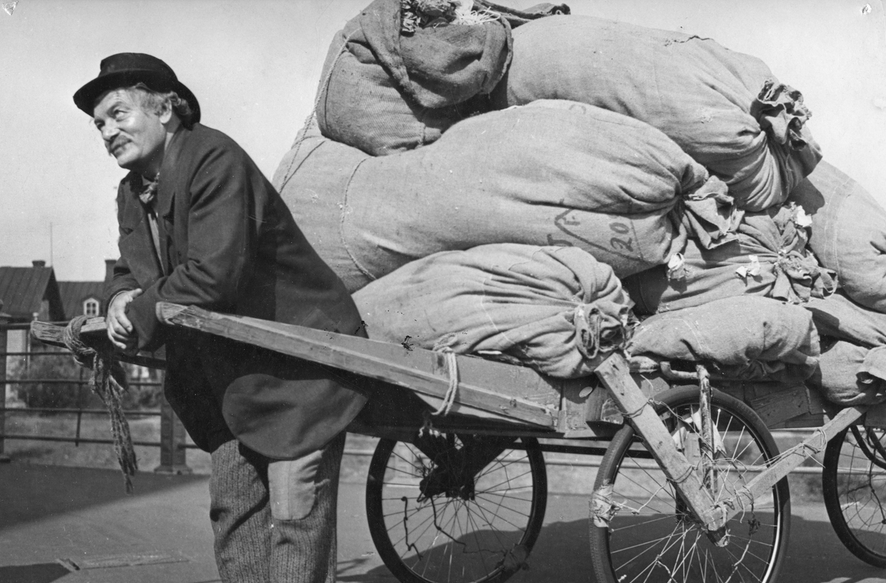
Cheery waste-paper collector Mikko (the ever-reliable Aku Korhonen) falls asleep in a bin and concocts a fantasy lifestyle for himself that incorporates the people who hit him with their car earlier in the day, along with some of the detritus he has found on his rounds – news of a company merger, a nickel-mine find, a lottery win, and the love of a good woman, in the form of Aune (Sirkka Sipilä) the attractive daughter of a wealthy industrialist.

It is, however, all a dream. The viewer has long enough to forget about the framing device that introduced Mikko as little more than a kind-hearted vagrant. We are encouraged to forget about his real-world problems, and instead to fret about the relatively low-intensity drama of whether or not he can win Aune’s heart. It is therefore something of a jolt in the final reel when Mikko wakes up again back in the real world, with Aune a stranger to him, along with any chance of money or power. He accepts this fate with a good-hearted shrug, and goes about his business.
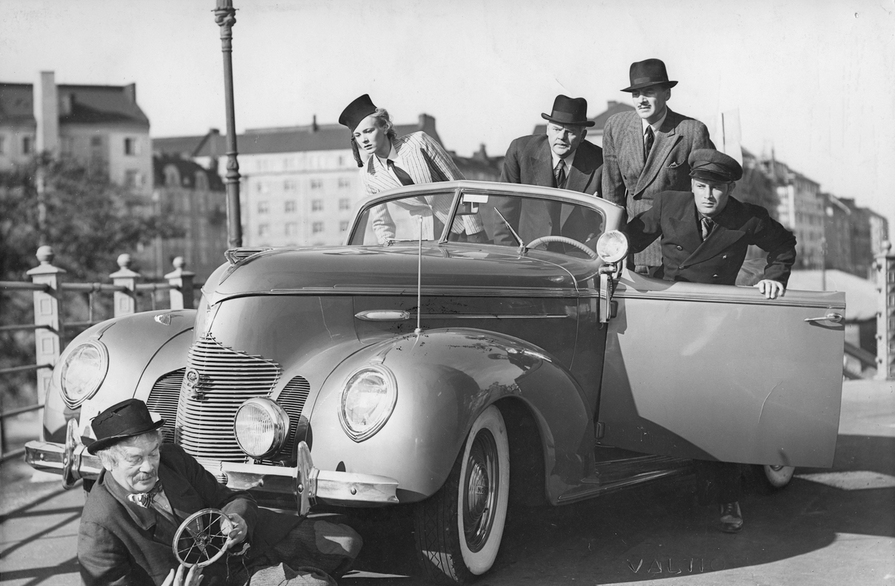
Many Finnish films of the period were obsessed with wealth and social climbing, which made Jos oisi valtaa’s gentle satire somewhat more palatable in the eyes of Finland’s left-wing press. Toini Aaltonen in the Suomen Sosiaalidemokraati called it “a rather modest and childish film” and praised it for disrupting the “postcard truths” of so many other romances and comedies. Paula Talaskivi in the Ilta Sanomat complained that “the dream should have started more clearly as a dream.” And she has a point – it’s not 100% obvious when Mikko’s dream starts. Is it when he is hit by Aune’s car, or when he goes to bed that night, or is it, in fact, that the whole movie is a dream up until the moment he wakes up? We see him regain consciousness in the bin, but we never actually see him go to sleep in it, meaning that an entire chunk of the early film may or may not be the reveries of a woozy rag-and-bone man.

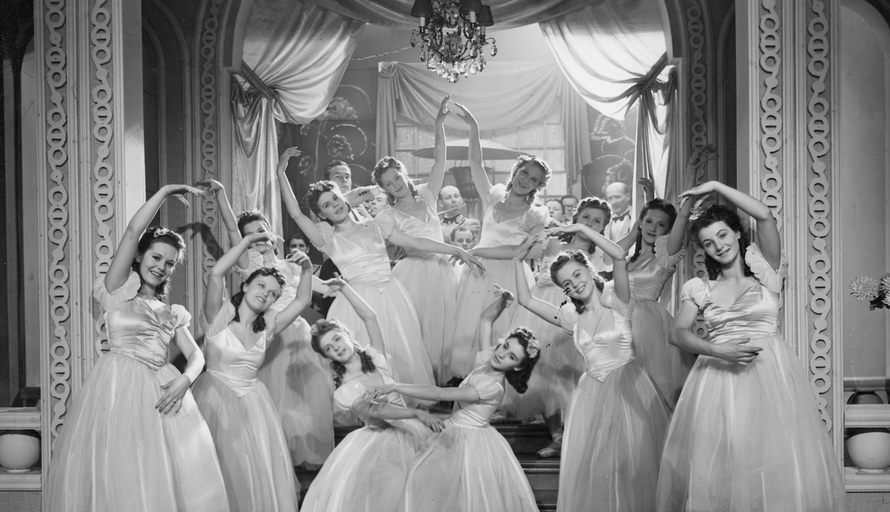
Like many a movie in the period, the film also shoe-horned in as much variety performances as it could, leavening its thin plot with several sequences of puppetry and opera. Olavi Vesterdahl in Aamulehti was unimpressed, noting that even though the film only lasted 93 minutes, it was still dragged down into “slowness and long-windedness” by a surfeit of unnecessary dance numbers and songs, including chunks of Puccini, Strauss and Bizet and a full-on ballet sequence shot at the Helsinki opera house. But one wonders if Vesterdahl had not seen the variety sequences for what they really were – not merely padding for the film, but a scramble to find work and publicity for Finland’s many performers and entertainers, fallen on hard times after a war in which dancing had been literally declared illegal until the soldiers came home.
If I Only Had the Power artfully encapsulates the contradictions of Finland in the days immediately after the end of the Winter War – our hero enjoys a meteoric success, a lavish lifestyle and a romantic denouement, only to wake up in dire straits, his happy ending revealed as a mere illusion. One can readily imagine austerity-era Finns thrilling to its allegory of their predicament, daring to dream of better days amidst the deprivations of the real world… but one would be wrong. The film under-performed at the box office, and it was the last to be directed by Yrjö Norta for Suomen Filmiteollisuus. His contract dropped by the studio bosses, Norta defected to Fenno-Film where his first work would be Maskotti (1943).

Jonathan Clements is the author of A Short History of Finland. He is watching all the Finnish films, so you don’t have to.
The Shape of the Turtle

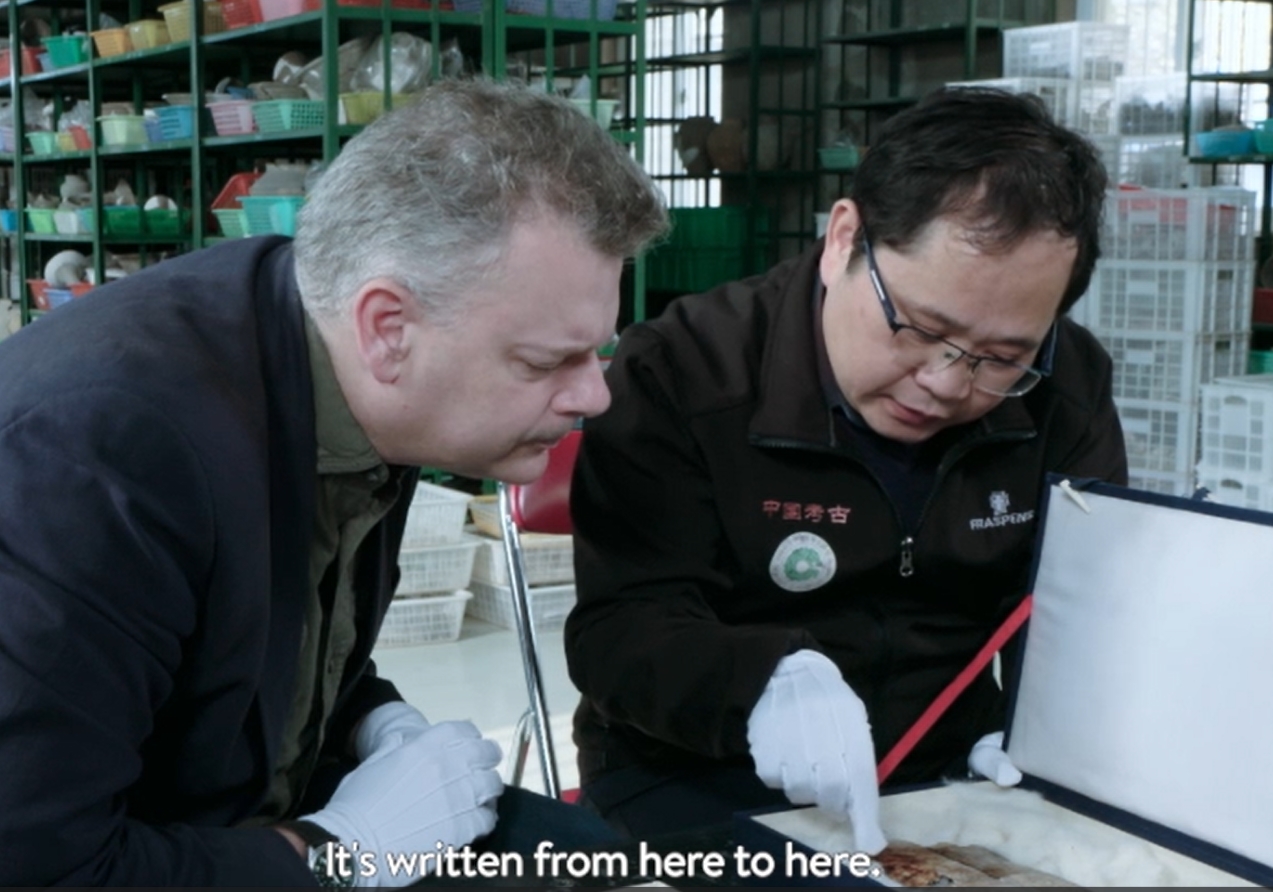
I must be getting good at this. Driving back to the Wastes of Yin, I know more about the site than the crew, because I already shot here once before. So I can direct the car and the van to the right institute, and point out Dr He, because I’ve met him before, and I can tell them that the meeting room is not the ideal place, because there is a warehouse upstairs full of relics that is more photogenic. I can also point out that if they want to get the lens really close to an oracle bone, Dr He has a bunch in a box that he will literally hold up to the camera.

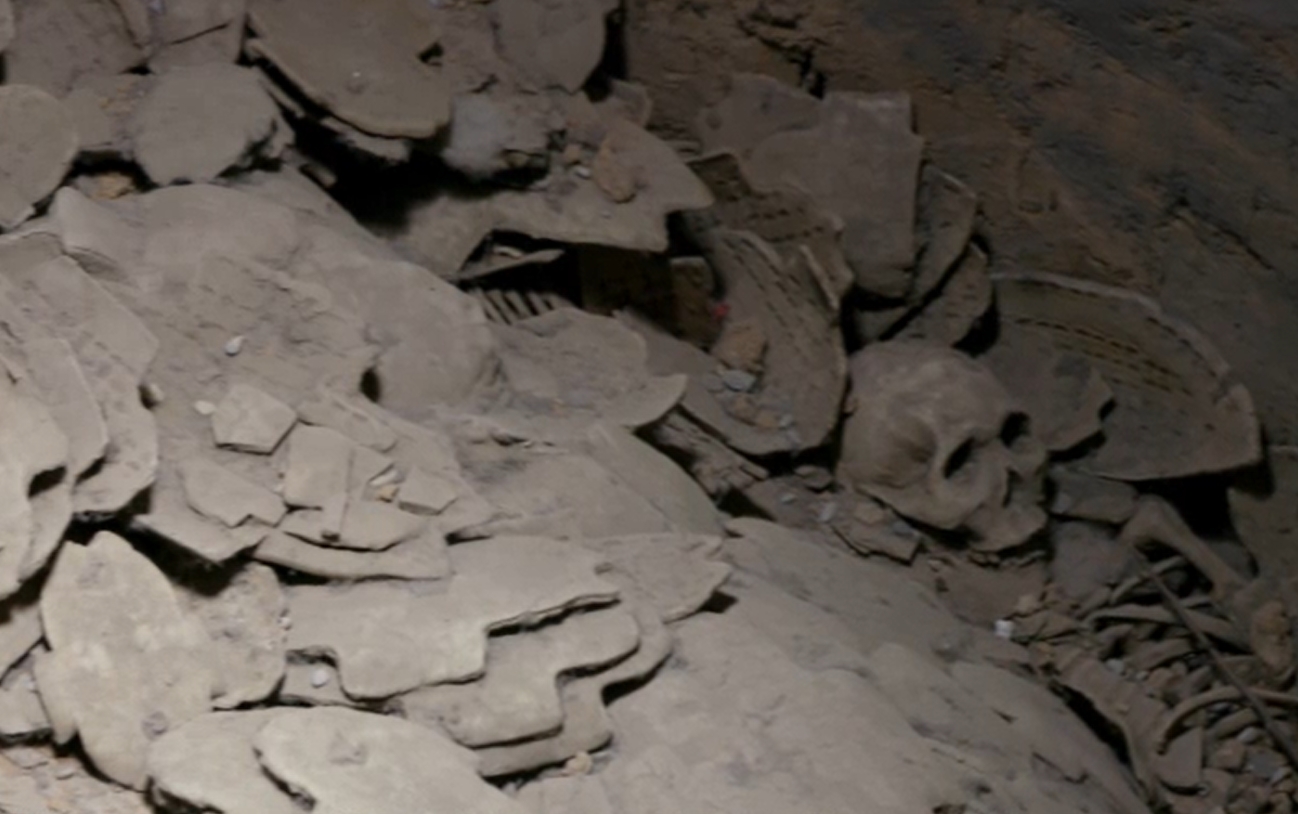
Dr He remembers me from the Chinese chariot shoot a couple of years ago, and so he is immediately at ease and merry. When it comes to the interview, in front of boxes marked HUMAN TEETH, DOG BONES, HUMAN BONES, COW HORNS etc., we rattle through in a single long take. I quiz Dr He about the problems of reassembling oracle bones, and the fun he had tunnelling through a Sui dynasty tomb and a Han dynasty tomb in order to get to the Shang stuff two metres down. He tells me that the size of the turtle plastrons used in divination usually suggest that they came from the river, but some of them were so big that they were liable to be sea turtles, thereby suggesting that the Shang dynasty had trade links as far away as Malaysia.

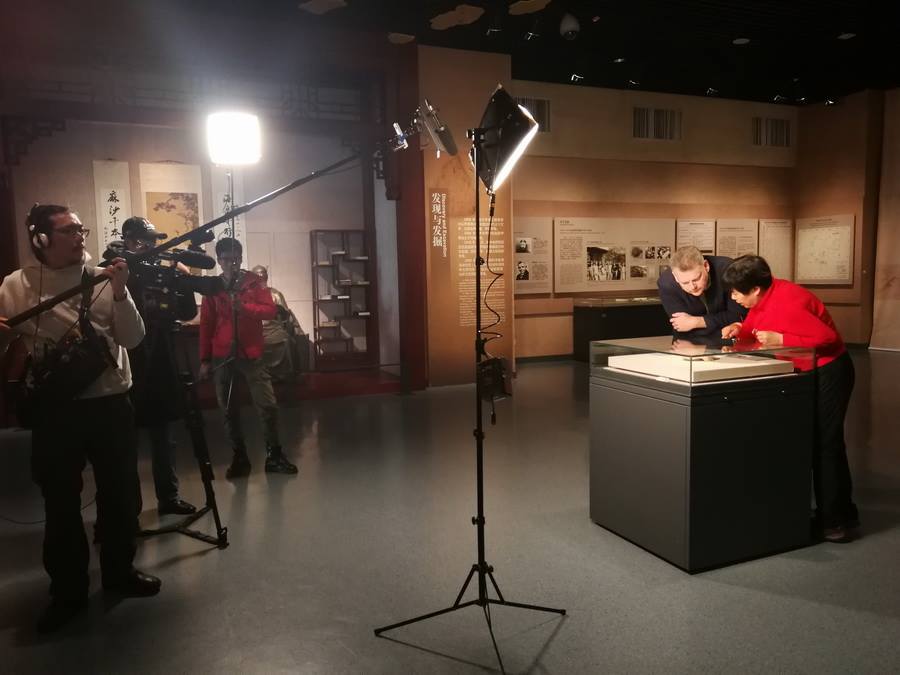
Of course, that doesn’t mean that there was some Malaysian Marco Polo who travelled all the way to Anyang. These things might have taken decades to drift from village to village until they ended up in the Shang capital. Dr He rattles on non-stop for 45 minutes, which delivers us 90 minutes of footage on two cameras. Time for the pick-ups and then we are out, as if we knew what we were doing.

Turtles are important, says Dr He, because they lived so long, but also as Sarah Allan has argued in The Shape of the Turtle, because they may have signified the shape of the cosmos to the ancient Chinese – a north, south, east and west around a central plain, and in the sky, a big dome overhead.

The Shang people were a bloodthirsty bunch. The Shang dynasty is the most popular topic among Chinese heavy metal groups, because after you hear about all the incest, human sacrifice and torture of the Shang kings, biting the head off a bat looks a bit everyday and soft. The on-site museum has trouble skirting around the fact that their royal graves are full of dead children, chucked in to keep them company in the afterlife, along with dismembered dogs and the usual dead horses, and a special ceremonial axe used for beheading enemies. I’ve read the oracle bones, so I know already about the boiled heads, burned slave-girls and other atrocities littering their tombs.

We finish up in the tomb of Lady Fuhao, the female general who led the armies of the late Shang, wife, or possibly sister, or possibly both to the king Wuding, who entirely by chance turns out to be the guy we know most about because Anyang was the site of oracle bone pits dating from his era. Fuhao’s tomb was miraculously undisturbed; she was buried not only with her signature C-shaped dragon rings and a gaggle of dead slaves, but a collection of bronzes that were already quite ancient when they went into the ground. Some of Fuhao’s bronzes were specifically cast as grave goods (we know this, because they included her posthumous title), but others were seemingly part of what today we would have to call her antique collection.

I felt today that I was really earning my money, and that the crew were really on top form snatching footage, sometimes, when the drone was up, with three cameras running at the same time. What with all the shooting on 4K resolution, as future-proofing against TV channels that might insist on higher quality film in future, we are generating two or three terabytes of data every week. Michelle the assistant producer has to stay up each night uploading it to a server in Hong Kong so the editors can get to work.

Jonathan Clements is the author of A Brief History of China. These events featured in Route Awakening, SO5E02.

Smith, Toren

“Toren ended up living in a ‘room’ that was actually a walk-in closet that they had put a bed into. And during the time that he was there, the people of Gainax were working on Gunbuster, and decided that they needed a handsome love interest.”

Over at All the Anime, I explain the genesis of Gunbuster‘s love-interest, Smith Toren.

Confucius Says…

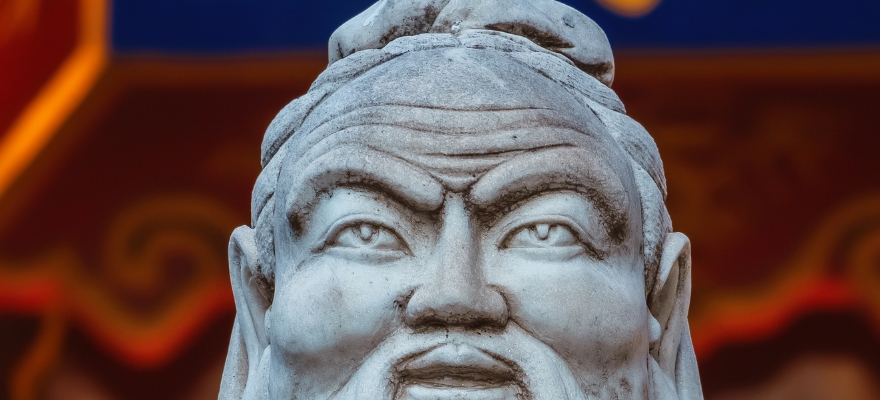
The Bradford Literature Festival has uploaded the audio from my 2022 speech on the life and impact of Confucius.


Often quoted but rarely understood, the thoughts of Confucius has shaped 2,500 years of history.

Author Jonathan Clements outlines the life and times of China’s greatest philosopher, concentrating on sides rarely seen – the younger years of Confucius, his interaction with his pupils, his feuds with his enemies and even his sarcastic wit.

He also examines the fluctuating fortunes of the sage after his death: how his work was almost lost entirely to posterity, before becoming the centre of centuries of Chinese government, and subject yet again to purges in the troubled 20th century.

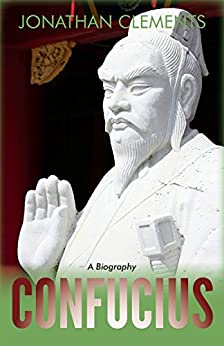
Jonathan Clements is the author of many books on East Asia, including Confucius: A BiographyThe Emperor’s Feast: A History of China in Twelve Meals, and an acclaimed translation of Sun Tzu’s Art of War. For the National Geographic channel, he has presented the documentary Shandong: Land of Confucius, as well as three seasons of Route Awakening, a TV series on Chinese cultural icons.

Gunbuster Easter Eggs

“A split-second shot of Japan from orbit, seen in the opening credits, actually shows the locations of all today’s nuclear power plants underwater, as if the nation has suffered a series of atomic disasters. When Okada mentioned this in a TV interview, it was mysteriously dropped from the eventual broadcast.”

Over at All the Anime, I reveal just some of the behind-the-scenes shenanigans on Gunbuster: Aim for the Top.

The Sea of Words

The National Museum of Chinese Writing looks like a newly landed alien spaceship, decked out with golden animal totems shining in the sun, and supported by striking red columns, the fabled taotie mythical beast that shows up on so many Shang-era cauldrons. The museum is in Anyang, of course, because Anyang was where archaeologists uncovered vast pits of broken turtle shells, inscribed with questions to the gods for the Shang dynasty rulers – a peek inside their archaic Google history, if you like.

It’s also closed today, so we technically have the place to ourselves, although a bunch of surly cleaners and key-jangling security guards seem keen to ruin any quiet moments that we might have. The director films me walking among the oracle bones, and I manage a couple of relatively long pieces to camera about the story of the discovery of the Wastes of Yin, and how Chinese history got 600 years added to itself practically overnight in 1928 after the discoveries in Anyang proved that the ancient stories were actual history and not a myth.

Ms Han is a happy lady who seems very animated and passionate about oracle bones, and subjects us to a 45-minute salvo of words about the meaning of the 150 most easily identifiable characters. She doesn’t seem to have been interviewed on camera before, and is fretful about “saying the right thing.” We have to explain to her what an interview is, which is to say that I will ask her questions, which she will answer. She seems to think that we will want her to give a one-hour lecture to the camera about her work. No, we insist, I will just ask her about stuff.

On several occasions, Clarissa the fixer has to practically walk her through the answer that we expect before she will deliver it, even though she just delivered it, word-perfect, off camera. Like a lot of Chinese academic interviewees, she has trouble understanding that we are supposed to be having a conversation, and it becomes easier to just mike her up, not tell her the camera is running, and let her talk away without the chance to get nervous. By the end, the director just wants us to walk through the museum gallery talking, but we keep stopping at displays to talk about the origin of the various characters, and the director shouts at us to keep bloody walking instead of finding out about things.

“Jonathan, stop being interested!” she yells from the other end of the gallery.

But I think Ms Han is enjoying herself. After previously saying that she could only fit us in on Monday afternoon, she has suddenly freed up all of tomorrow morning to invite us over to her college to sit in on a class, so I think she is starting to feel like a bit of a celebrity.

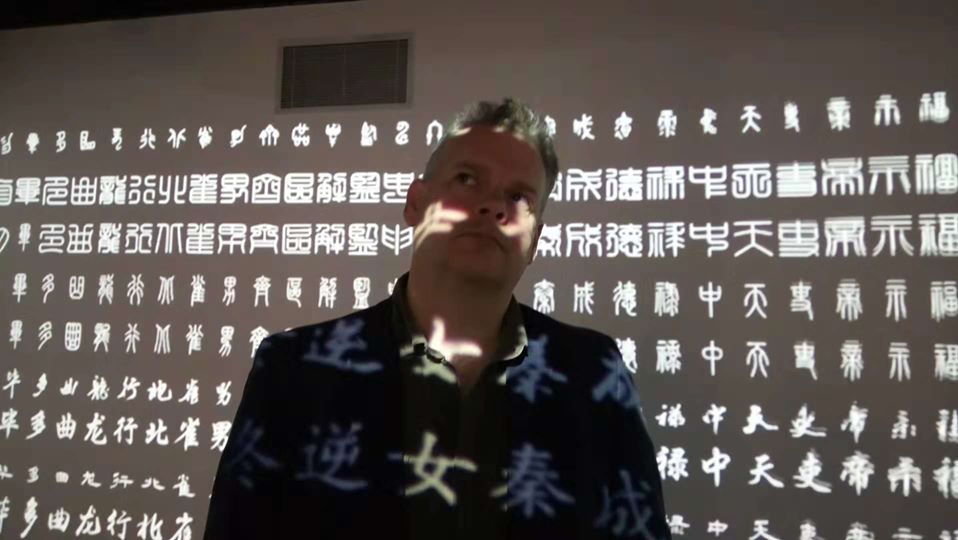
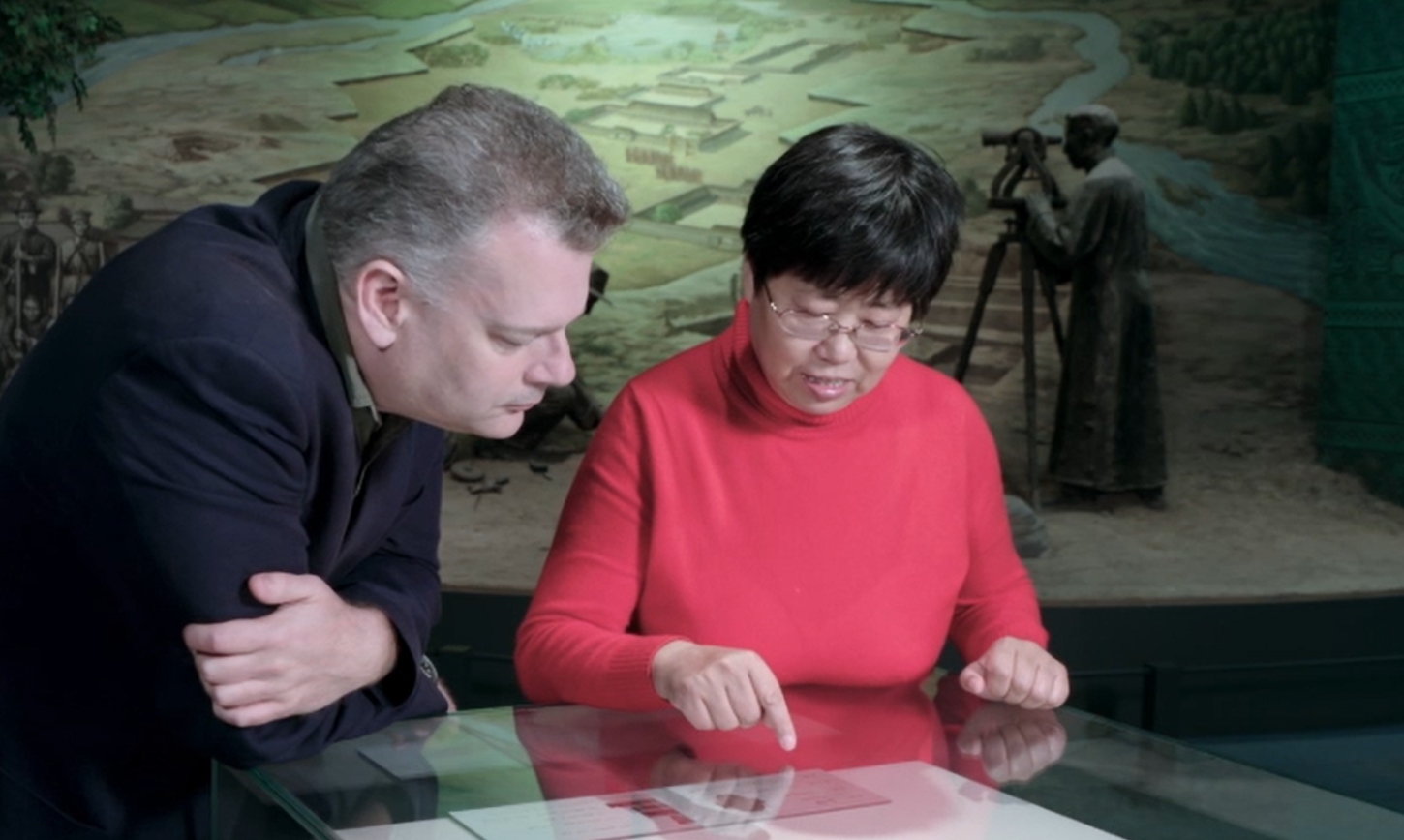
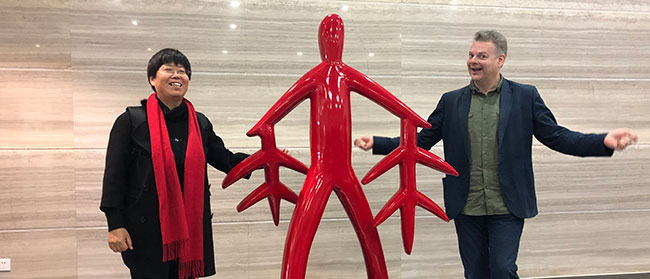
Ms Han’s faculty at Anyang Normal University is built around another museum of Chinese writing, which is far more immersive and engaging than yesterday’s. It’s got all sorts of fun art installations, including a four-wall display of animated characters that can be filmed playing across my face and surrounding me like a veritable sea of words. There are even life-sized statues based on ancient Chinese writing, such as the stick figure holding two oxtails that was the origin of the Chinese word for “dance”.

The Sea of Words, for those not part of the Chinese community, is the name of a famous dictionary of Chinese characters. I have a copy that used to belong to “Uncle” Don Rimmington of the Leeds University Department of East Asian Studies, although I am not sure he knows it ended up with me.

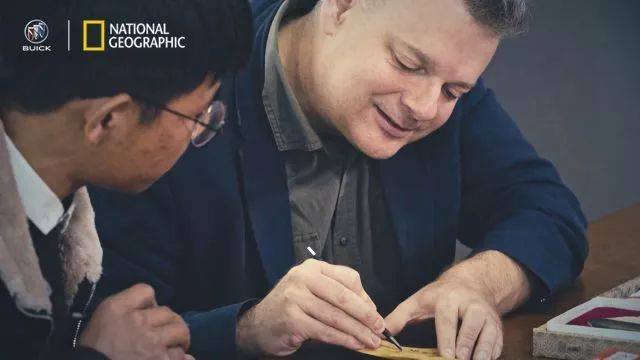
The university also have a little area where students can carve their own oracle bones, leading me to have a nice half-hour with a guy called Zhang, who patiently talks me through the process. He is very excited to see that I am deliberately getting things wrong so that he can correct the way I hold my chisel and the way I hold the bone. Unlike his teacher, Ms Han, he comes to realise that I am doing it to make him look smarter, and not that I am just irredeemably stupid.

Ms Han talks me through the simplest of characters from the Shang dynasty, the most basic 150 of which are simply pictograms.

“The Shang people tried to tag the simple points of difference between similar objects,” she explains. “So what is it that makes a cow different..?”

This is a difficult question to answer in Chinese when I don’t know the word for udders.

“The… nipples?” I suggest.

“No, you stupid boy. Everything has nipples. Cows have horns and a long face. Not like the goat, which has different horns, but still has nipples.”

All right, then. And the horse has a mane and a tail, and a tiger has a stripe. I get her giggling about some of my weirder guesses, and she gets so excited that she starts shouting “NO!” in English every time I get something wrong.

Jonathan Clements is the author of A Brief History of China. These events featured in Route Awakening, S05E02.

Mixing Work With Pleasure

Toshio Suzuki has spent the last 20 years carefully steering late-era Studio Ghibli, a company that arguably cannot really function without the input of its three greats – Hayao Miyazaki, the late Isao Takahata, and Suzuki himself. In 2008, Suzuki appointed Disney Japan’s Koji Hoshino to take over as company president – a smart move, finding a man with world-class knowledge of running a cartoon company’s legacy.

But now Hoshino has resigned, claiming that the completion of Miyazaki’s How Do You Live?, is a good time to go, particularly since Hoshino’s going to be 67 in May. An alternative version of the story in the Japanese tabloids has Hoshino leaving under a cloud because his predecessor needed to “properly separate his public and private life.” Suzuki might have stepped down as president in 2008, but never quite went away, functioning instead as a general manager, whatever that means.

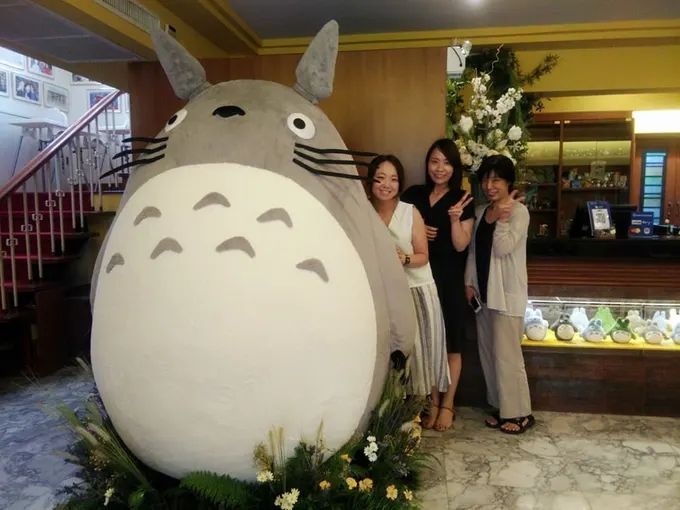
Suzuki, whose memoir of working at Ghibli carried the winning title Mixing Work with Pleasure, has been dishing out jobs to his Thai girlfriend Kanyada “May” Phatan. The two have allegedly been an item since she sold him some roadside chicken wings in 2013, after which Suzuki invested in her spa and restaurant. When those businesses went under, Suzuki steered Ghibli itself into authorising a Totoro café in Bangkok in 2018, May’s Garden House Restaurant, which shut down the following year just ahead of COVID.

Not to be deterred, Kanyada resurfaced as the mononymic photographer for The Ghibli Museum Story (2020), and for a book the same year of Toshio Suzuki quotations. She also writes a monthly poem for the Ghibli in-house magazine Neppu, and last month was feted at an Iwate exhibition of her photography, to tie in with a new, rather thin, compilation book.

In the era of Boris Johnson and Donald Trump, this barely moves the needle on the scandalometer. Some Ghibli staffers might bristle at the whiff of privilege, but it’s not like Suzuki hasn’t got form. He literally put a landscape gardener in charge of Tales from Earthsea because the guy was Hayao Miyazaki’s son. And nor is it all that unusual for people to get hired on the basis of personal connections, like that guy Roy Disney at Hoshino’s old company. Le Monde, of all places, fumed that Suzuki took the chance at the Iwate exhibition to “enjoy the hot springs with his girlfriend” which hardly seems like a crime.

If there’s any impropriety at work, it’ll be up to Hoshino’s replacement to clear it all up. That would be Toshio Suzuki, back as president after a 15-year absence.

Jonathan Clements is the author of Anime: A History. This article first appered in NEO #230, 2023.

Killpriest Country

My great-grandfather was one of the men that Tim Burrows writes of in his new book, one of the grime-smeared workers toiling in the Essex brickyards. He literally dug up the mud around him, compacting it and firing it into uniform rectangles of baked building material, shipping it west out of the county to build that ever-growing metropolis of London. Even as London looked down upon the people of the low-lying marshes to the east, those same people were working long hours, digging up the very ground they stood on, in order to raise their masters ever higher.

“Many nations have an Essex,” writes Burrows, “a much-mocked place that has grown up in the shadow of a major city to become the supposed spiritual homeland of the nouveau riche.” His book, The Invention of Essex is a well-told history of how this vaste swathe of what was once regarded as a “Home County” somehow became the butt of national jokes.

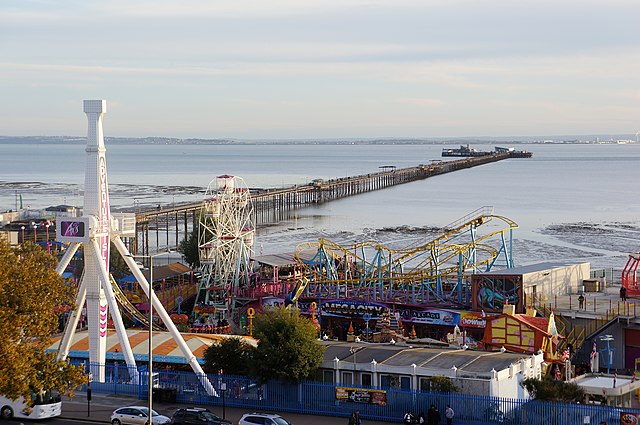
Burrows is in love with his birthplace. He recognises the many criticisms directed against it, but also takes infectious pleasure in recounting its tall tales and grotesque historical figures. In a gesture of heart-stopping romance, he chooses to marry his bride at the end of Southend Pier, transforming its mile-long stretch into the Thames Estuary into “the longest aisle in the world.”

Southend Pier forms a recurring topic in his narrative, not the least for the way in which it encapsulates the county’s long-running class warfare. Affronted at the sight of steamers passing the town by, Southend’s inhabitants built the first structure into deep water in 1830, extending and improving it repeatedly in the decades that followed. But just as Southend created a new anchorage for respectable middle-class travellers, the opening of the railway in 1856 suddenly brought the town within the reach of working-class day-trippers from the East End of London.

A local councillor, Alderman Brightwell, even made the modest proposal that Southend should practice some sort of class-based apartheid, with the hallowed pier as the line of division. In a demarcation that still can be glimpsed today, he suggested that the west of the pier should comprise the pursuits and habitats of Victorian ladies and gentlemen, while the east of the pier – today’s “Golden Mile” of amusement arcades and chip shops that stretches down to the remnants of the Kursaal amusement park (now a rough council estate), should be the playground of the shit-shovellers, factory-workers, barrow boys and slappers of the London “excursionists”.

But Burrows has a winning sympathy for that same underclass, taking the time to observe the awful conditions of their London lives, and the transformative effects that a trip to the “Essex riviera” might offer them. His history of Essex county thrills in the technological determinism of new inventions that transform daily lives and of new laws (such as the invention of the Bank Holiday in 1871) that create new opportunities.

Modern history is his main interest – particularly the two hundred years that saw Essex as we know it “invented” – but he also harks back to many earlier moments. There’s time for the bold Saxon noble taking a stand against the Vikings in Maldon; for the Boleyn family whose daughter Anne was the first infamous and defamed Essex girl; the experiments in social housing and new lifestyles, many of which were subsequently perfected elsewhere with no credit given to the pioneers. There’s the King of Bling whose Saxon grave put my own native Prittlewell on the map, and the historiography of Essex as a place “much-maligned”, from several centuries in the past to the year 2020, when the Oxford English Dictionary tardily removed the term “Essex girl” from its lists.

Burrows offers fascinating glimpses of the changes in the landscape, from its prehistoric origins in meltwater and retreating ice, to its many centuries of malarial swampland – no wonder the locals love their G&Ts, since the medical use of quinine was also discovered here. But before the marshes were drained of their mosquito-harbouring ponds, the “ague” fever was so notorious that the churchmen began to dread an ill-starred posting to “Killpriest Country.”

His book has a nobility to it, and a sympathy for its subject, as well as a ready eye for those moments in history and literature that have a poetry all of their own. In William Morris’s News from Nowhere, a time-traveller arrives in the 19th century to warn its inhabitants of the perils of the future.

“I come not from heaven,” he says, “but from Essex.”

Jonathan Clements is the author of The Emperor’s Feast: A History of China in Twelve Meals, which begins and ends with the Garden of China restaurant in Southend-on-Sea. Tim Burrows’ The Invention of Essex is published by Profile Books.