“There was… an initial explosion of Japanese animation on Chinese television, spearheaded by Osamu Tezuka’s Astro Boy, which Li characterises as a delivery system for adverts for Casio watches and calculators. It, like many others – including Transformers, and outside anime, Mickey Mouse and He-Man – was practically given away free to the Chinese networks in order to seize control of the all-important advertising space in between the programmes. In the case of Astro Boy, he even starred in the commercials, bragging that Casio used the same technology that made him (presumably without the arse-mounted machine guns).”
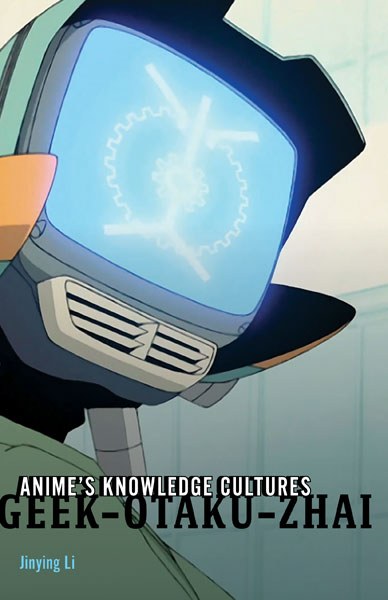
Over at All the Anime, I review Jinying Li’s new book Anime Knowledge Cultures: Geek – Otaku – Zhai.
I’m finding it a little bit difficult to breathe. Kunming is a mile above sea level, which makes itself felt in the time it takes to boil water, the dryness of the air, and the fact that I am out of breath after racing up a flight of stairs. But it is a wonderfully clean city, there are lot more pretty girls here than in most other parts of China (our director says the boys are good-looking, too), and the people are oddly friendly. At one point today we were mobbed by ten policemen, who had not been informed that we would be filming outside the museum, but they were all very polite and smiley, and once our credentials were proven, bent over backwards to help us, stopping the traffic and even giving our sound man and his gear a lift to the entrance.
The new Yunnan Provincial Museum glows red-gold in the sunrise. It has been designed, supposedly, to resemble the famous Yunnan Stone Forest. But it is packed with materials from the culture that once flourished on the shores of Lake Dian, which had largely faded from view by the end of the Han dynasty.
Nothing survives of the Dian people but the stories about them in the Grand Scribe’s Records, and whatever has been pulled out of their graves. And with the caveat that the graves reflect the lives and attitudes of the ruling elite, it shouldn’t surprise us if their artefacts come across as a bit, well, cruel. The Dian kingdom, at the time it was assimilated into the empire of the Han Chinese, was home to a peaceful race of cattle herdsmen, ruled over by an equestrian elite who seemed to take an odd pleasure in depictions of violence.
Their shell kettles (cowrie shells were money) come decorated with intricate battle scenes, featuring captives being dragged away for sale, victims pleading for their lives, and a wounded man crawling from the battlefield, unaware that a mounted cavalryman is bearing down on him. In one of the tableaux, an enemy soldier appears to have the upper hand, not seeing the man on the other side of the battlefield taking aim with one of those new-fangled crossbows.
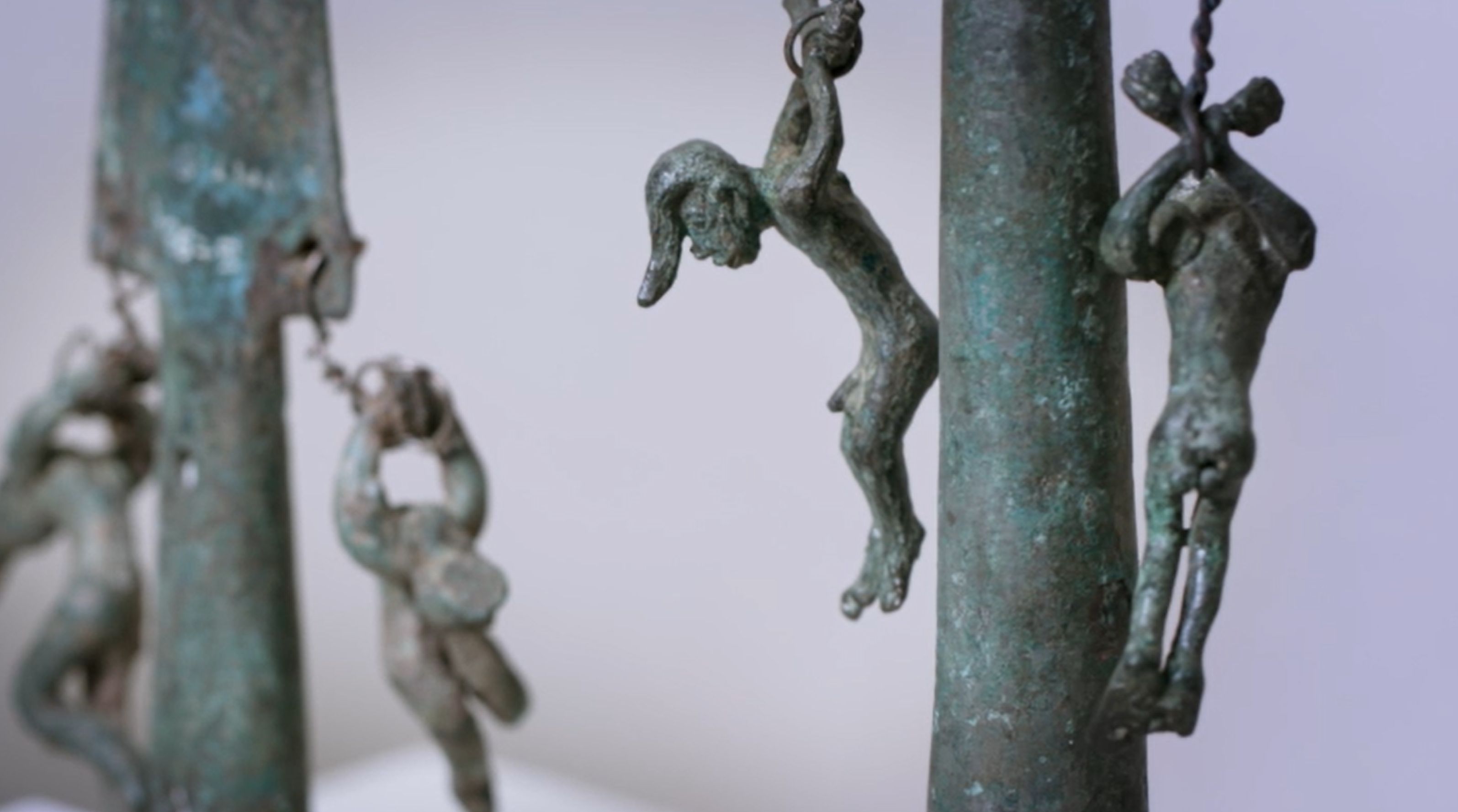
The glee in which the Dian seemed to take in the suffering of others is repeated throughout their artefacts. Twin spearheads feature decorations of dangling slaves, hanging by their wrists. Belt buckles feature scenes of boars fighting panthers, and lions locked in combat. The most famous Dian artefact is a low bronze ritual table in the shape of a cow being mauled by a tiger, and yet still standing protectively over its calf.
Several archaeologists have suggested that the Cow and Tiger Table is loaded with symbolism – that the cow represents the locals, while the tiger stands for their horrid overlords, and the calf for local traditions that refuse to be snuffed out. The rulers of Dian, it has been suggested, were originally a band of Scythians, pushed out of Central Asia around 200 BC, who lorded it over the locals in Yunnan until the Chinese turned up to turn the tables.
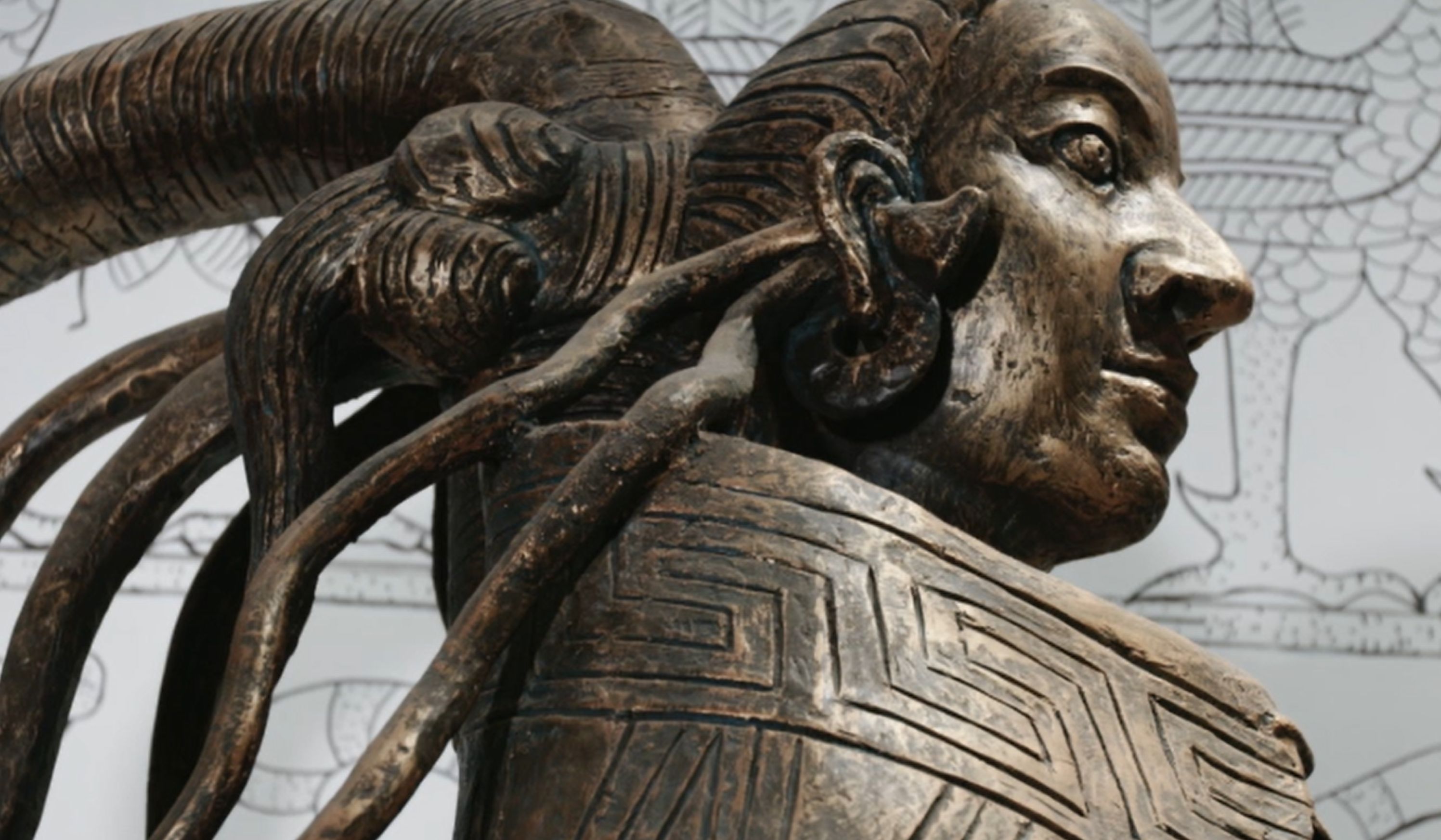
The Dian themselves disappeared from history around the time that the Grand Scribe’s Records wrote them up. They were invaded by warriors from Chu in the late Warring States Period, and the victorious general was just about to report home when Chu fell to the First Emperor. Rather than return to an uncertain future, he turned his army around and settled by the Expansive Lake (Dian), and his soldiers soon faded into the local population, whose former style favoured dreadlocked horsemen, barefoot in all statuary and carving, tattooed with writhing snakes. They enjoyed what UNESCO still describes as the most biologically diverse region in the world, spanning the upper reaches of the Yangtze (here known as the Golden Sands), the Mekong (here known as the Lancang) and the Salween (here simply called Nu, the Angry River). Since the Red River, which goes all the way to Hanoi, also rises here, the Dian kingdom sat the crossroads of several major cultures, trading with the Shu and Ba kingdoms of Sichuan, with what is now Vietnam, and towards the west.
Fan Haitao, who set up the Dian gallery in the Yunnan Provincial Museum, takes me through a small selection of the foreign objects dug up locally, including a buckle representing a winged lion (lions, winged or otherwise, being unknown in China back at that time) seemingly from Persia or Afghanistan, agate beads from Pakistan, and glass from India.
“Our biggest find,” he reveals, “was at a place called Yangfutou, which was under the flight path of the Flying Tigers.” The American mercenary airmen, famously posted to Yunnan to make life miserable for the Japanese, used to fly over a low hill near their base, and observe that it was a nice place to be buried. Yangfutou was turned into a graveyard for the Flying Tigers, which was when diggers started to unearth strange objects. It was not, however, until 1999, that Yangfutou revealed its greatest treasure, the grave of a forgotten Dian nobleman, complete with cowrie shell moneybags, bronze drums, and fiendishly decorated weaponry.
“The grave was under the water table,” he tells me, “so it was completely waterlogged. This meant that we didn’t just get the bronze, but some wooden pieces and the lacquerwork ancestors.” He points at a series of animal-headed dildos, the word “ancestor” also meaning “penis” in Chinese.
So, I ask innocently, what were they used for?
“I think,” he says carefully, “they had a… ritual quality.”
Why are they so small, I ask, pointing at the largest one, which is truly massive. But we can’t use the footage, because the crew was giggling so much at the look on his face.
Jonathan Clements is the author of A Brief History of China. These events featured in Route Awakening S05E03 (2019).
Everybody in the rival lands of Kalevala and Pohjola wants the sampo – a magical mill that can be set to put out grain, or salt, or gold. But to make it, one requires a series of magical ingredients. Louhi (Anna Orochko), the wicked witch of the North, thinks she has all the gubbins, but still requires the skill of the master-smith Ilmarinen (Ivan Voronov). In order to lure Ilmarinen to her lair, Louhi kidnaps Ilmarinen’s sister Annikki (Eve Kivi), locking her beneath “a hill of copper”. Ilmarinen and Annikki’s would-be husband Lemminkäinen (Andris Osins), take the advice of the bard-wizard Väinämoinen (Urho Somersalmi), and build a magic boat to get them to the north.
Louhi, however, has a bunch of tasks for them to fulfil, including ploughing a field full of vipers, and forging a sampo for her, before she is prepared to release Annikki. Realising that Louhi intends to monopolise the sampo’s bounty for herself, Lemminkäinen returns to the north to steal it back, returning with a small piece that sort of works.
The angry Louhi gatecrashes the wedding of Lemminkäinen and Annikki to steal the sun itself from Kalevala, locking it back in her mountain fortress. Ilmarinen starts work on a new sun (he’s a sort of mythical MacGuyver), but Väinämoinen argues that the coming battle will be fought not with swords, but with songs, demanding that Ilmarinen knock him up a magic kantele to win the culture wars.
In the final confrontation, Väinämoinen’s song puts Louhi’s troll army to sleep, and Louhi herself is eventually turned to stone. Lemminkäinen smashes open the mountain fortress, and frees the sun to shine down on Finland for, well, at least a couple of months a year, it turns out.
This real-time blog of Finnish film history shouldn’t get around to Alexandr Ptushko’s 1959 epic for several years. But it screened on Finnish television on Kalevala Day in February 2024, leading two readers of this blog to immediately complain that I hadn’t covered it. I was mainly shocked that this blog had two whole readers, but immediately put it next on the watch-list, greatly aided by the fact that the Elonet website not only had the film in its entirety, but a set of built-in English subtitles.
I say I saw the film, but I saw a version of it. Sampo was shot in four different editions, Finnish and Russian, standard and anamorphic. It also exists in a hacked-up American edit called The Day the Earth Froze, about which the less said the better.
The most fantastic, goose-bumpy moment in this fantasy film begins with the opening credits, as Suomi-Filmi, the long-standing Finnish film company, shares the title logo with the Soviet Union’s Mosfilms. This international co-production is an amazing sight to see, considering the Finnish film industry’s long-standing antipathy for all things Russian. Now, we have Lenin’s real-life god-daughter, Anna Orochko, done up like Bob Hope in drag to play the baddy, facing up against a scattering of actors from Russia and the Warsaw Pact countries (two Lithuanians and an Estonian), along with the lone Finn, Urho Somersalmi, from Those Golden Days of Yore.
There had been multiple discussions of the possibility of a film based on Elias Lönnröt’s epic poem, but the decision to embark upon this fragment as an international co-production began life in earnest in 1956, when a Finnish film week in Moscow put producers from both countries in the same room with enough vodka to make the Cold War go away. Shooting on location in Finnish beauty spots began in 1957, before production moved to the Soviet Union for the studio work. A few Soviet locations do sneak in, and would strike a discordant note with critics who were thrilling to the sight of Finnish legend in its natural habitat, and didn’t like the occasional interpolation of Ukrainian scenery (a similar fudge rather ruined The House of Flying Daggers for me).
But it was misleading to get too excited about the sight of Finnish myth “re-enacted” in Punkaharju, Kemijärvi and Kuusamo when much of Lönnröt’s material was collected on what is now the other side of the border, in what is now Russian Karelia. This, of course, was why the Soviets were so enthusiastic about making this movie in the first place, because while the Finns were braying about their epic “Finnish” movie, the Soviet press was lauding it as a celebration of “Russian” legend. One of the authentic Finnish locations was, for example, Petrozavodsk, which was only Finnish for a brief time in the Continuation War, before the Russians snatched it back. It was a town in what was then the Soviet Republic of Karelia, where Finnish remained a recognised language up until the 1980s.
For the Finnish press, the film was probably more exciting in prospect than on release. While it was underway, with a budget multiple times higher than the average Finnish movie of the day, with a film crew cropping up all around Finland, there was much to speculate about. When it finally arrived, many critics were underwhelmed by the po-faced, ciphered nature of the characters, most of whom were just clothes horses to hang some speeches on. To be fair, as Heikki Eteläpäa conceded in the Ilta Sanomat, that was really a failing of the original poems, and not really something that could be blamed on the movie.
Lönnröt’s original is also to blame for the haphazard storytelling, which, as noted by Ilkka Juonala in Aamulehti, resulted in a film that “seemed to end at one point, only to start again from the beginning.” And indeed, it’s basically all done in the first 60 minutes, only for Louhi’s return to steal the sun to kick it all off again.
For the Finnish critics, and indeed for audiences today, the lingering appeal of Sampo lies in occasional glimpses of fantasy coming to life. Annikki interrogates literal wind-bags, chained in the fortress where Louhi has stolen the spirits of the various breezes. Lemminkäinen’s mother nonchalantly walks on water as she searches for her son by the side of a lake. Louhi’s cloak flies with its own power, transforming into the sail that drags Annikki’s boat away to captivity. Ilmarinen forges a red horse that will help him and Lemminkäinen plough a field of vipers. Every now and then, there is a moment, a costume, a tableau that recalls the paintings of Akseli Gallen-Kallela, and repeatedly, the characters squabble and bicker before a real Finnish landscape, as alive with lakes and trees as the Kalevala itself, and no less magical.
Jonathan Clements is the author of A Short History of Finland. He is watching all the Finnish films, so you don’t have to.





 The Official Schoolgirl Milky Crisis Blog