Consul Ahrman (Paavo Jännes) and his son Timo (Tauno Majuri) believe that they are being followed by enemy agents. Timo is dispatched to Muursalo with a sealed envelope, and confesses to the family’s loyal military friend Rainer Sarmo (Joel Rinne) that he might need help in outrunning would-be saboteurs. Nor are the men paranoid – it turns out that their housemaid Leena (Rauha Rentola) is indeed working for foreign powers, as is revealed when Sarmo catches her doctoring the consul’s tea so she will have time to search his safe.
Sarmo apprehends Leena, only to be disturbed in turn by a masked agent (Hilkka Helinä), who helps her escape. Later on, Sarmo runs into Berita Lopez in a restaurant, falls in love with her, and also realises that she was the masked agent. Berita is the daughter of Luigi Lopez (Wilho Imari), once the richest man in Bueno Aires, ruined by the machinations of the enemy agent Thomas Gardner (Santeri Karilo), who is somehow also responsible for Timo’s fiancée breaking up with him.
Oh dear, what a mess, like trying to make sense of Casablanca through its reflection in a dented kettle. Believe it or not, this was the winning entry in a 1940 script competition hosted by Suomi-Filmi, netting a 50,000-mark prize for its author, the journalist Uuno Hirvonen, who would go on to pen two further adventures for Rainer Sarmo, a.k.a. Dettman, a.k.a. Deadman, in international espionage. The miracle, of course, with Casablanca, which was made a year after this, is that it, too, went into production as a forgettable retooling of the conventions of bedroom farce into espionage with papers and letters of transit and whatnot. It happened to work, in exactly the same way that this film… doesn’t.
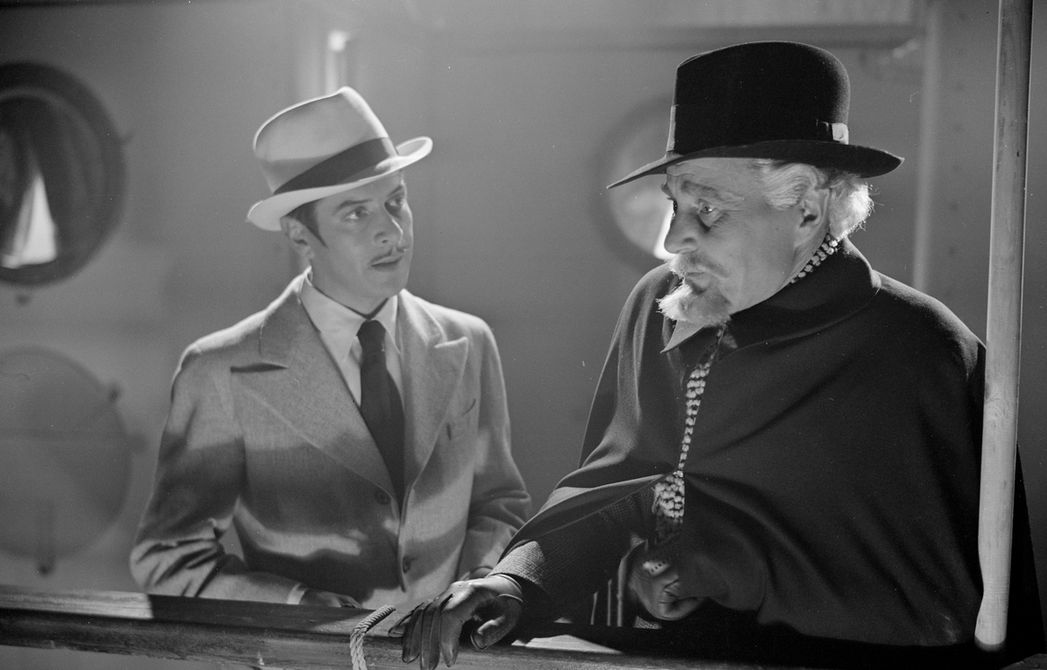
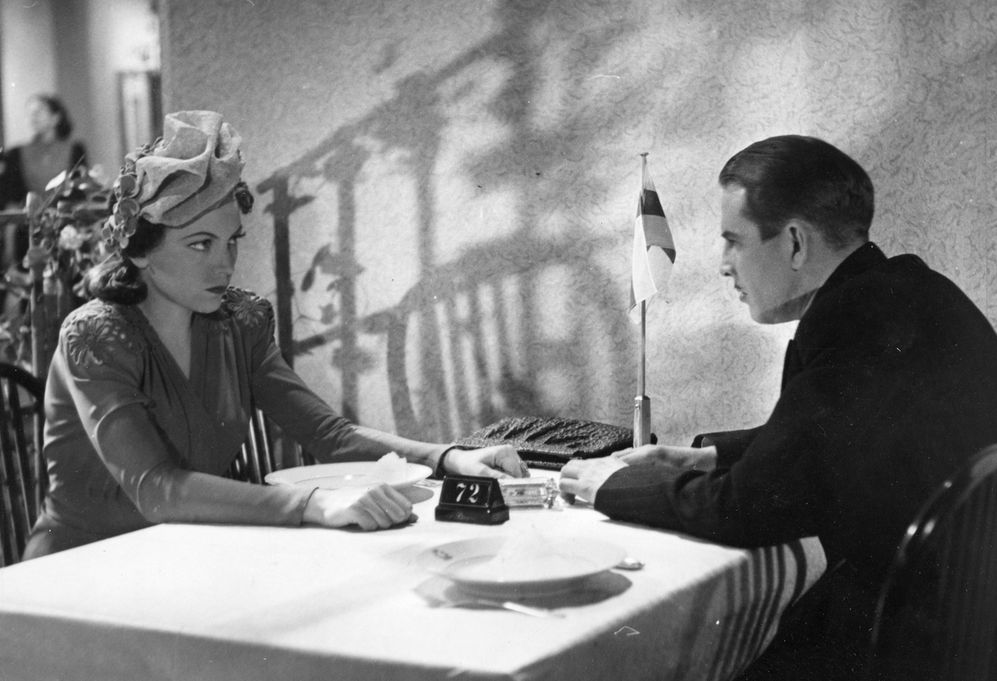
The critics, however, loved it, like a breath of freshly noir air, a worthy successor to the earlierThe Last Guest (1941). “”The suspenseful atmosphere is especially enhanced by the excellent cinematography,” enthused Toini Aaltonen in the Suomen Sosialidemikraatti. “The camera angles are varied, the lighting effects are inventive and generally the dark tone of the filming is so effective that you are startled when you come out and notice the bright daylight around you.” And, indeed, while the script might be an incomprehensible garbage fire, further compromised by the traditional coyness about revealing who the dastardly enemy power might be (Russia – it’s always Russia), the camerawork is superb. The stills from the film make it look far, far more exciting than it actually is. Hilkka Helina, in particular, is a smoldering onscreen presence, managing to make even an argument over coffee look like a battle to save the world.
Posterity has been less kind. When the film was released on television in 1989, Tapani Maskula in the Turun Sanomat let it have it with both barrels: “Watching the film today, one inevitably wonders about how bad the other stories submitted to the competition must have been when the one that won first prize doesn’t even make any sense.”
Jonathan Clements is the author of A Short History of Finland. He is watching all the Finnish films, so you don’t have to.
“He had little time for magic swords or charmed arrows, since any everyday weapon could become ‘magical’ in the hands the right martial artist. Indeed, as he noted, the higher echelons of martial artists should have no need for weapons at all, since they had become so at-one with the universe that they could draw upon the qi around them to fashion their bodies into deadly weapons. Perhaps out of a sense of deliberate contrariness, he even bucked against the trend for morose, troubled knights errant, pushing instead for libertine, sensual ‘happy heroes,’ an idea which would itself form the basis of his novel of the same name, inspired in part by John Steinbeck’s novel Tortilla Flat (1935).”
Out today from Arrow, the majestic Shawscope #3 box set, which includes my long article on the writer Gu Long, and my feature-length commentary track on the Song dynasty historical epic 14 Amazons (1972).
Noriko Ohara, who died in July, truly spent her whole life in the media, starting as a child actress, “retiring” as she reached her teens, but unable to resist the school drama club and sneaking back onstage after graduation. After starting a family in the 1950s, she drifted into voice acting, initially specialising in breathless, sexy roles. She became the Japanese dubbing voice of Bridget Bardot and Shirley MacLaine, as well as Hotlips in M*A*S*H and Miss Moneypenny in the David Niven Casino Royale. Inevitably, she also lent her voice to cartoons, including Penelope Pitstop in The Wacky Races.
In the anime world, her early women’s roles soon gave way to a newfound talent for putting on boys’ voices. Anime often records at unforgiving times, making the most of all-night, round-the-clock recording facilities, excluding genuine child-actors from all but the most high-budget of movies. After playing the hero Nobi Nobita’s mother in Doraemon, Ohara took over the role of Nobi himself, inhabiting the part for decades. She appeared as many other iconic figures, including the Peter the shepherd boy in Heidi, the titular Future Boy Conan and multiple roles in the Time Bokan series.
As a mark of how far anime has come during her long career, her death was marked by obituaries as far afield as the Straits Times in Singapore and the New York Times. Nobody, however, mentioned her unique position in anime history as an author, as the co-writer of the 1978 memoir The Frontline of Television Anime with the director Noboru Ishiguro. Ohara’s presence in the book, alternating Ishiguro’s chapters on animation with her own memoirs of acting, made her one of the inadvertent curators of the anime industry’s historical memory, and one of the first figures to set down backstage stories in an enduring medium of record.
It’s Ohara, for example, that we have to thank for what we known about the shenanigans in the dubbing booth on Future Boy Conan, as the cast fell in love with a show that they were sure would go onto great things – although they were right, they had to wait a long time for it to attain cult status. In Ohara’s case, determined to honour the vision of Hayao Miyazaki, she struggled in the studio to cling onto her voice, toking on an inhaler between lines, and saving her big scream, “Lana, don’t die!” to record very last at three in the morning.
As she did, her voice gave out. A doctor subsequently signed her off work for two weeks with bleeding vocal cords, causing the part of Nobi to fall to a stand-in for several weeks on Doraemon.
“Conan was important to me,” she confesses. “I know I should have known better, but I could not resist the charm of the boy who so infatuated me.”
Jonathan Clements is the author of Anime: A History. This article first appeared in NEO #244, 2024.
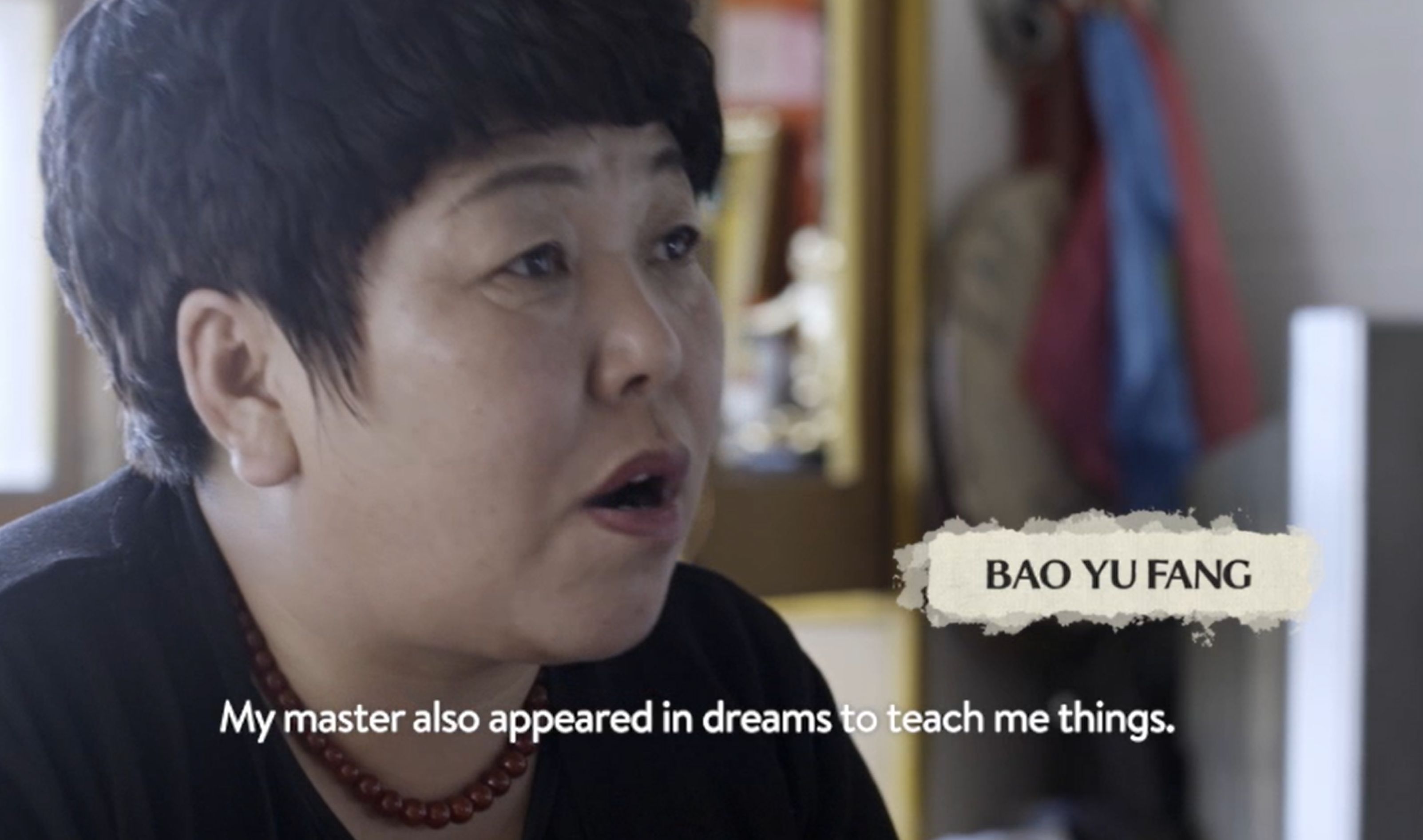
Yufang, the instigator of the infamous “OKAY, OKAY” dance, has invited us out into the countryside to witness a qingshen ceremony, in which the gods are invited into someone’s home. The director accepts, figuring it will be more shamanic mentalism.
Yufang and her long suffering husband live in a single-room cottage two hours outside of Songyuan, next to a pig sty, and with a back yard that swiftly turns into a field of maize. Their single room is dominated by a kang, a traditional Chinese heated dais that functions as central heating, stone sofa and warmed-up bed – I lie on it, enjoying the sense of history and attracting the unwelcome attentions of the local cat. There’s plainly not a lot to do out here in the countryside. Yufang, along with all the other people we meet here, has an odd notch in one of her front teeth, which I first mistook for a shamanic initiation symbol.
“Oh no,” she giggles, tapping her gappy tooth. “That’s where we bite on the husks of sunflower seeds. It wears down over the years.”
It slowly sinks in that the foreign idiots she has invited to her house are actually a film crew, and that far from merely hanging out with us to prolong the fun from our days in Songyuan, she will actually be appearing on camera. The interview is postponed for five minutes while she slaps on some lippy. In all our dealings with the shamans, Yufang has been the clown and the Head of Morale, ever ready with an impersonation or a piss-take to liven things up when we’re standing around in the cold waiting for Mickey the drone pilot to warm up his batteries. But when the camera is pointed at her, she is suddenly all business, prim and serious.
“There’s no way I can make a living here as a shaman,” she sighs, gesturing outside her window at the tiny huddle of nearby houses. “Maybe if I was in the big cities, there would be more work, but less people in the big cities actually believe in this.”
I am not sure that all that many of the locals believe it in, either. The neighbours soon gather to gawp, standing not only around the Buick as the crew try to film me, but wandering unbidden into the house, where they have no compunction about hawking up a mouthful of phlegm and spitting it onto Yufang’s kitchen tiles.
Yufang shows me her shamanic credentials, since Gorlos shamans are now accredited by the government, and also by the committee that runs an annual wizard school at Changbaishan, (Long White Mountain) on the border with Korea. There are nine grades to attain, none of which have anything to do with actual religious belief at all. Instead, the government recognises shamanism as a cultural performance, and insist on shamans achieving acceptable levels in dance classes, paper cutting, knife walking, costume, and sundry other handicrafts.
These include drum-making, which Yufang’s long-suffering husband (I think it’s fair to add the prefix “long-suffering” to all the witches’ husbands I have met) has apparently got himself a qualification in. He shows me a rancid bucket in which a sheep’s skin has been soaking for several days.
“The hairs are much easier to pull out if you soak it for a couple of days,” he says brightly. “And the bonus is that in winter it doesn’t smell so much.”
Yufang’s husband and I sit glumly pulling hairs from the wet skin in the bucket, which feels like I am sticking my hand into the cold bathwater of an entire pack of wild dogs.
We then piss about hammering designs into the metal crown, but the sun is already setting and our hearts aren’t really in it. Yufang is already cooking dinner, ready for the big event, which will be a four-way qingshen after dark.
A crowd gathers. The entire village empties itself of a bunch of wizened crones and tubby men, with a couple of hot-looking yummy mummies and a one-eyed granny, all of whom pile into Yufang’s kitchen and start staring variously at either the shamans or the film crew. For once, the director doesn’t call for quiet, but gets me to do a piece to camera in the middle of all the hubbub, surrounded by snickering yokels who believe my name is Foreigner.
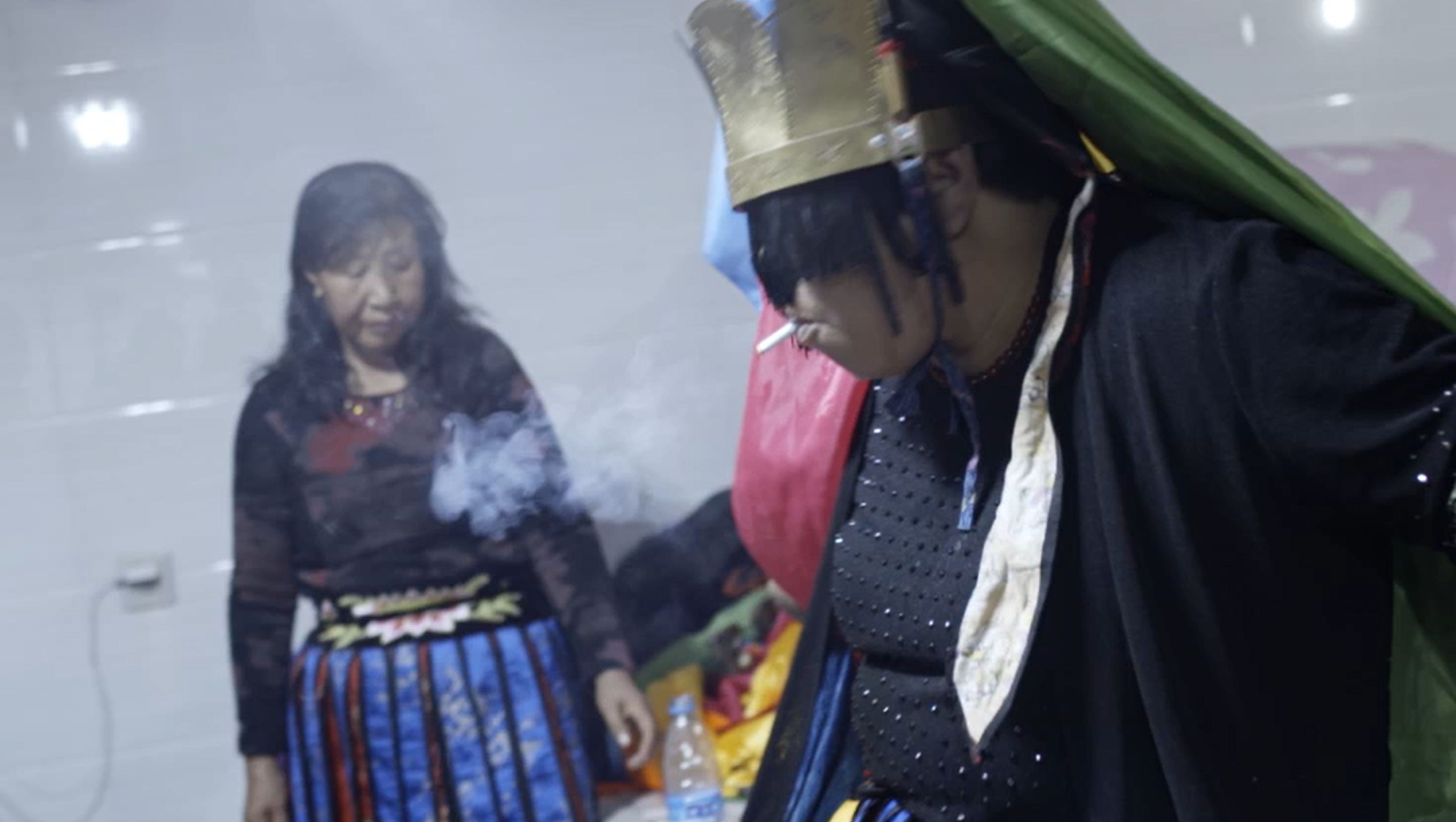
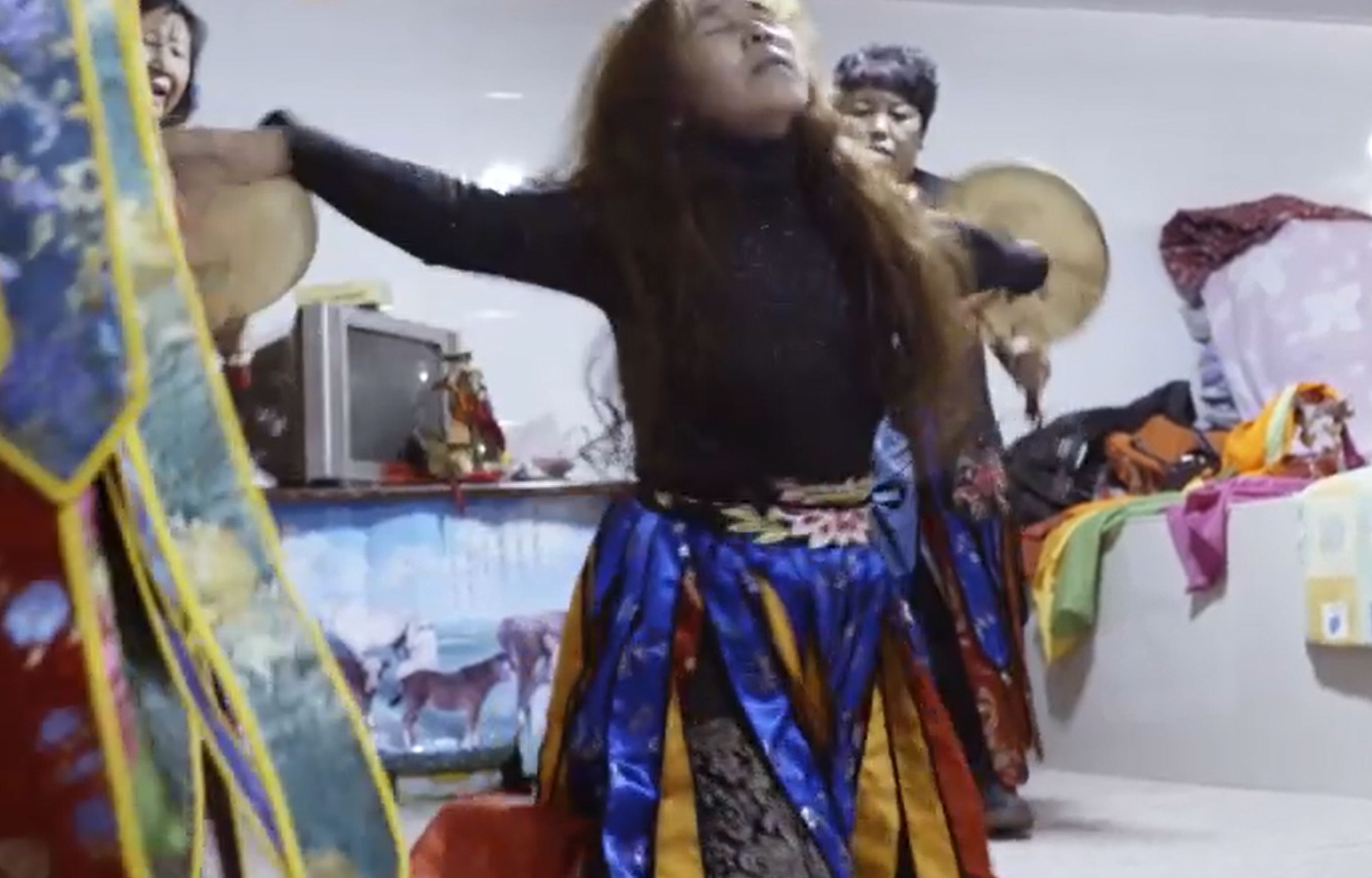
The shamans start chanting and skipping in circles, spinning ever more wildly. In each case, the person to be possessed is the only one in full finery, including the all-important beaded fringe that hides the host’s eyes from incoming spirits. The first up is a woman I refer to as Wallflower, who seems very quiet, but has always gamely jumped into all the ceremonies, and has been there for everyone. As the door to the icy fields outside is opened, she spins and whirls, her arms suddenly outstretched in an imitation of wings.
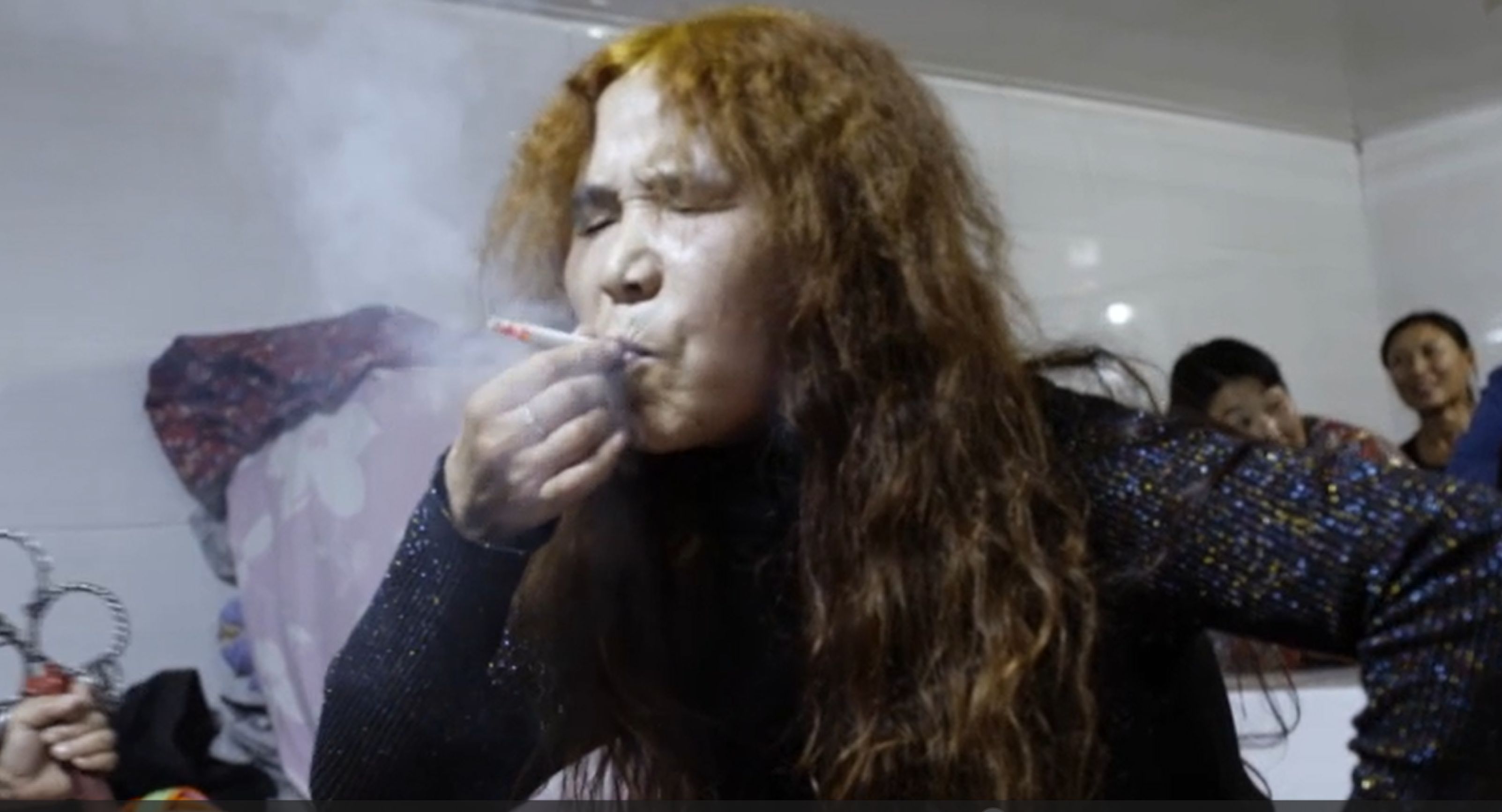
She throws herself back onto the kang, and sits there panting, and growling repeatedly: “FIRE! FIRE! FIREFIREFIRE!” Yufang’s husband lights a fag and hands it to her, and she smokes the whole thing down in seconds, rotating it rapidly as she puffs. Suddenly, when most of the cigarette is ashes, she flips it around and sticks it in her mouth, chewing on the ashes and the lit embers and chasing them with a few mouthfuls of the local hooch. She whispers a few words in guttural hisses to Yufang, revealing that she is an Eagle Spirit who has popped in to see what’s happening, and then she announces that she is leaving.
She jumps to her feet, spinning and flapping again, and two men position themselves by the open door, to stop her flying away along with the soul inside her. Wallflower charges at ramming speed straight for the door, but she is physically stopped while, we are told, the Eagle spirit flies from her mouth. The room is quiet once more, except for the sound of Wallflower retching and throwing up on the doorstep, as you might well do if you’d gargled a lit fag with a vodka chaser.
Next up is Red – not her real name, just what I have ended up calling her – a sour-faced old lady with a ginger dye job, who similarly dances in circles and similarly welcomes an eagle spirit. But when she grabs a lit fag, she immediately inverts it and puts the lit end in her mouth and blows, which turns out to have an effect not unlike a smoke machine. Then, she is also hunched over the doorstep, throwing up.
Yufang is next, and apparently receives the spirit of her own grandfather, who doesn’t have much to say, but does neck an awfully large amount of booze before coughing a lot and growling.
Afterwards, there is a break when Yufang asks to see the director’s monitor, as she has never seen what happens to her when she is in a trance. She stands there, clutching the small TV as Daniel plays back from the camera. She shakes and weeps at the sight and sound of her grandfather’s spirit.
The last of the women is simply called October, a name of such startling lack of interest that it suggests an entire lifetime lived as a parental afterthought. She turned to shamanism in her late thirties after an unspecified illness, and reports that she, too, had no interest in it until it cured her. Shamanism has plainly given her something to shine at, and she is the big finish, in which she will not merely invite a spirit to pop into her body for a bit, but will actually swap souls with it for a while. This looks not unlike the process from before, except she flings herself around with somewhat gayer abandon, and doesn’t ask for any fags, which is a relief, because the place is starting to smell like a fire in a sofa factory. Instead, she downs three quarters of a bottle of firewater, makes a few bibbling noises, and jumps up to her feet. The two catchers rush to stand guard at the door, and October makes a run for it, but is so munted by this point that she actually misses the door by three or four feet, instead running straight into the wall next to it, and bouncing off like a drunken clown with a gold crown and rainbow streamers, smelling of hard liquor and carrying a tambourine… if you can imagine that.
The day before, I had joked with Mandula the musician that his 20-a-day habit must be have been a boon for throat singing. “Oh yes,” he replied, straight-faced. “And so is booze.”
I bring this up because one of the unique selling points of shamanic performances is that the women suddenly speak with the voice of men, which, I suggest to you, is easier if you’ve just smoked three tabs in a row, stuck the last one into your mouth while still lit, and gargled with a bottle of industrial-strength vodka. I will also observe the odd way that Wallflower smoked her cigarette, twisting and twisting as she puffed… possibly an odd spirit-world affectation, but perhaps more likely to be a way of keeping all the ashes balanced in place, instead of allowing them to fall on the floor before she could stick them in her mouth. In other words, an oddly organised approach from someone supposedly in a trance.
Michelle our associate producer was very impressed with it all, and as an exorcist’s daughter, she is usually the crew’s go-to girl for spiritual matters. But I found the whole thing to be an elaborate carnival of parlour tricks and stunts, performed rather than enacted, by a bunch of women who can pack the whole village into their living room if they purport to be consorting with talking eagles. The sceptical reader might also note the degree to which Yufang was waving around her stack of credentials from the Long White Mountain School of Wizards, which strikes me as about as useful as a loathsome “Team-Building Exercise” in a Northampton adventure playground.
But there was something about the look on her face as she watched herself on the monitor, and the tears on her cheeks as she heard her grandfather’s voice, that made me doubt myself.
Jonathan Clements is the author of A Brief History of China. These events featured in Route Awakening (S03E03), 2018.
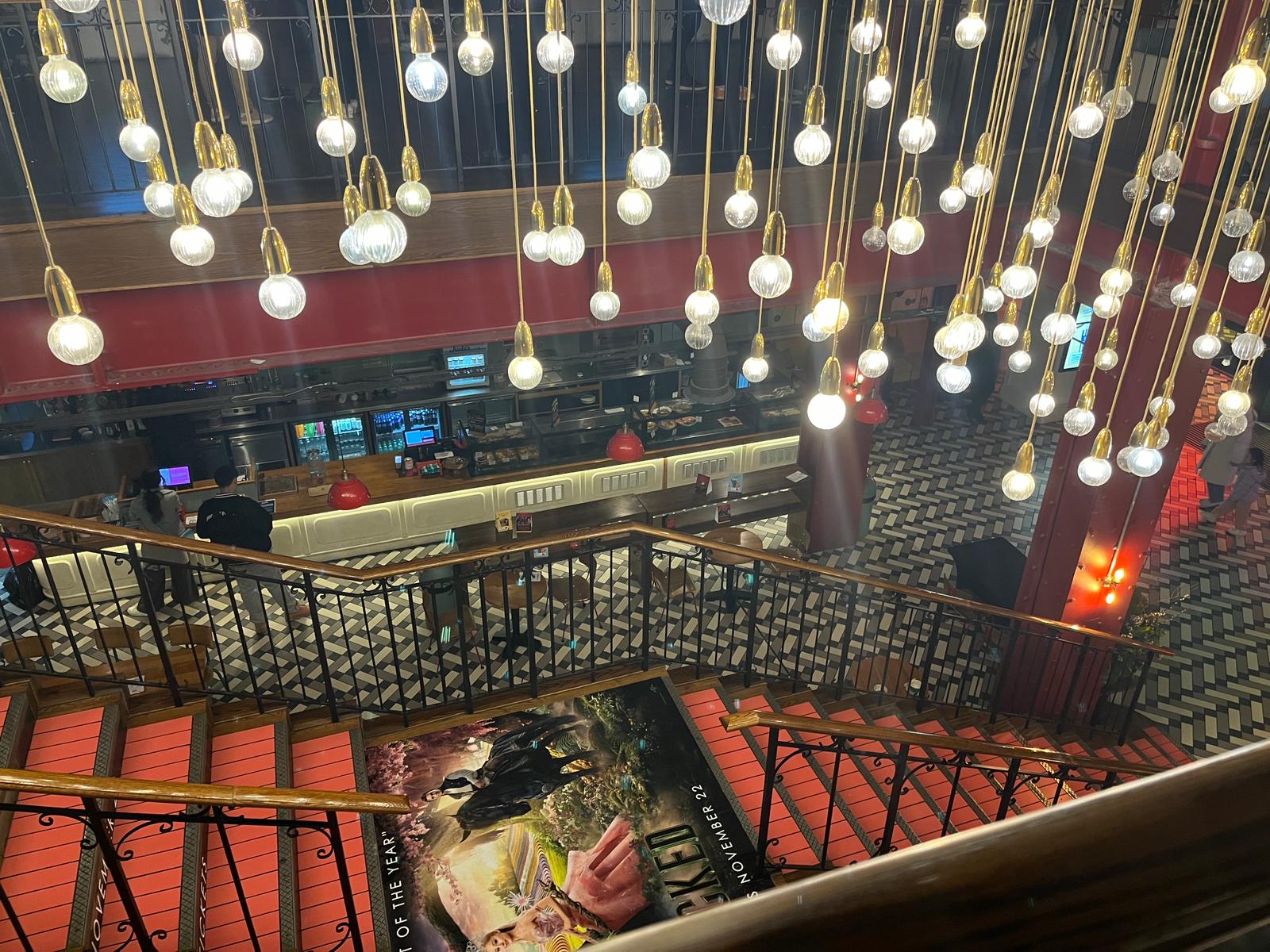
And you may ask yourself: “How did I get here?” Somehow I am at the Picture House Central, just off Piccadilly, for Scotland Loves Anime (London), the unwieldily titled experimental spin-off from SLA proper, that ships a bunch of this year’s films down south of the Wall.
Last night I conducted an onstage interview with Totto-chan director Shinnosuke Yakuwa about the fate of refugee Jewish musicians in wartime Japan, the colour palette for growing austerity, and his love of Charlie Chaplin — he’s off on a three-day pilgrimage to various sites from Chaplin’s life, starting with the former Trocadero restaurant off Piccadilly, where Chaplin once ate as a child, which is where we came in.
The SLA people are calling this a “soft launch”, wherein some of the elements of the Scottish festival — the films, the Audience Award, er…. me — run in London to see if there is a big enough market to make it a regular thing. So if you are at the Picture House today and enjoying yourself, be sure to tell your socials.
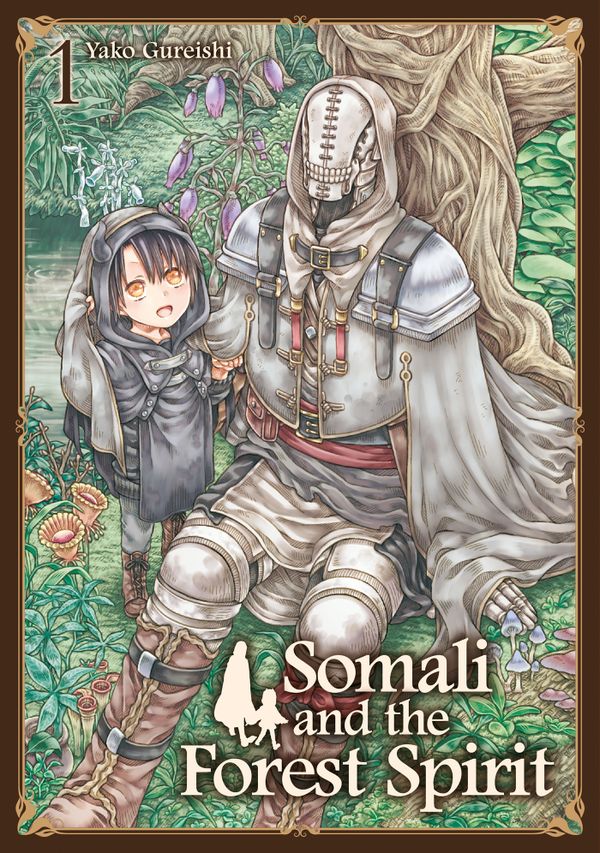
Explore a world from the hit anime of the same name, a world ruled by goblins, spirits, golems, and all types of strange creatures… but not humans, who were nearly persecuted to extinction for their reckless disregard of the natural world.
When a golem, a guardian of the forest chances across a young girl lost in the woods, he vows to take care of her… despite his life coming to an end. He must find other humans for her to live with, but in a world that despises them, is that even possible?
Yako Gureishi’s Somali and the Forest Spirit, translated by Motoko Tamamuro and me, and out soon from Titan Comics in manga form.
Festival director Andrew Partridge is seen here trying to run a triple-venue film event in two countries from a table in a cafe at a cinema. We’re coming to the end of the Edinburgh leg of Scotland Loves Anime, which has included a landmark event in which Japanese animation was running in all three screens of the Cameo cinema at the same time. We’ve had Naoko Yamada and Kensuke Ushio up onstage in Glasgow discussing 1980s UK electronica, and Maho Takagi from Comix Wave trying to explain why their studio’s relaxation room has a hammock and an open bar.
But there’s still another weekend to go, because Scotland Loves Anime is counter-intuitively in London from next Friday at the Picturehouse Central, just off Piccadilly, featuring a live interview with the director of Totto-chan: The Girl at the Window, me quizzing POPREQ, the impossibly young director of A Few Moments of Cheers over Skype, and all the films competing for the coveted Golden Partridge Award.
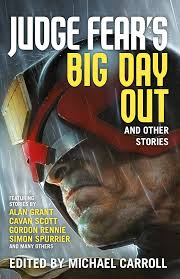
To my great surprise, three short stories that I wrote 20 years ago for the Judge Dredd Megazine have been reprinted in an anthology. I would have told you about this back in 2020, but the publishers never contacted me about it, and I only found out about it this weekend.
Which probably explains why their About the Author section was unimaginatively scraped from the internet, and concentrates on my scholarly work as a historian of the Far East, rather than, say, all the scripts I wrote for Judge Dredd.
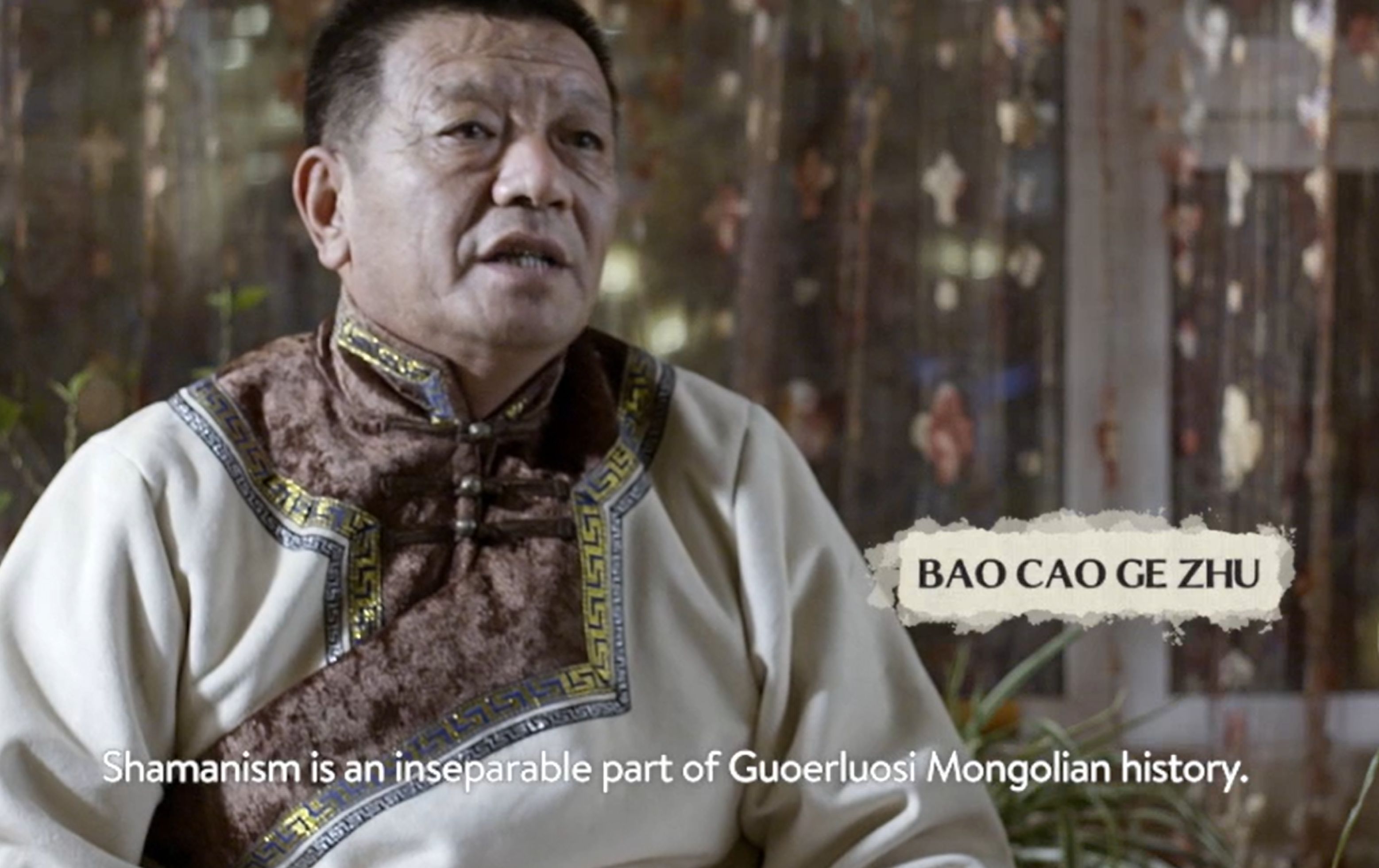
Mr Bao has turned up in a long Mongol robe with a trilby perched incongruously on the top. He is here to talk about the intangible cultural heritage of Mongol epics, which he sings and talks through while playing a sihu.
The sihu is a fiddle-like instrument, like the erhu, with a soundbox at the base, a long shaft held perpendicularly, and four strings, played by a double-stringed bow so that two strings are sounding at any one time. Mr Bao’s performance includes a bunch of little tricks, adding vibrato by shaking the shaft rather than the strings, adding a drumbeat by clicking the edge of his bow on the soundbox while he fiddles, and flicking the strings to make them thrum. All the while he sings and yells through the story of Toqta-Temur, the last non-Muslim leader of the Golden Horde and the great-great-great grandson of Genghis Khan. Toqta spent a large part of his “reign” fighting off civil war with other Mongols and insurgencies by the peoples of Eastern Europe, which leaves plenty of time in his epic to talk about his attacks on the Russians his war with his cousin and former ally, Nogai, to whom he had once rashly given the Crimea.
Late in his reign, around 1304, he and his cousins accepted the authority of the grandson of Khubilai Khan, thereby restoring peace to the Mongol Empire that had, in fact, not been peaceful at all at any previous point. He declared war on Italian merchants in the Caucasus, and eventually married a weeping teenage bride, Maria Palaeologus, the daughter of the Byzantine Emperor. But none of us get much of the above, because Mr Bao is singing in Mongol.
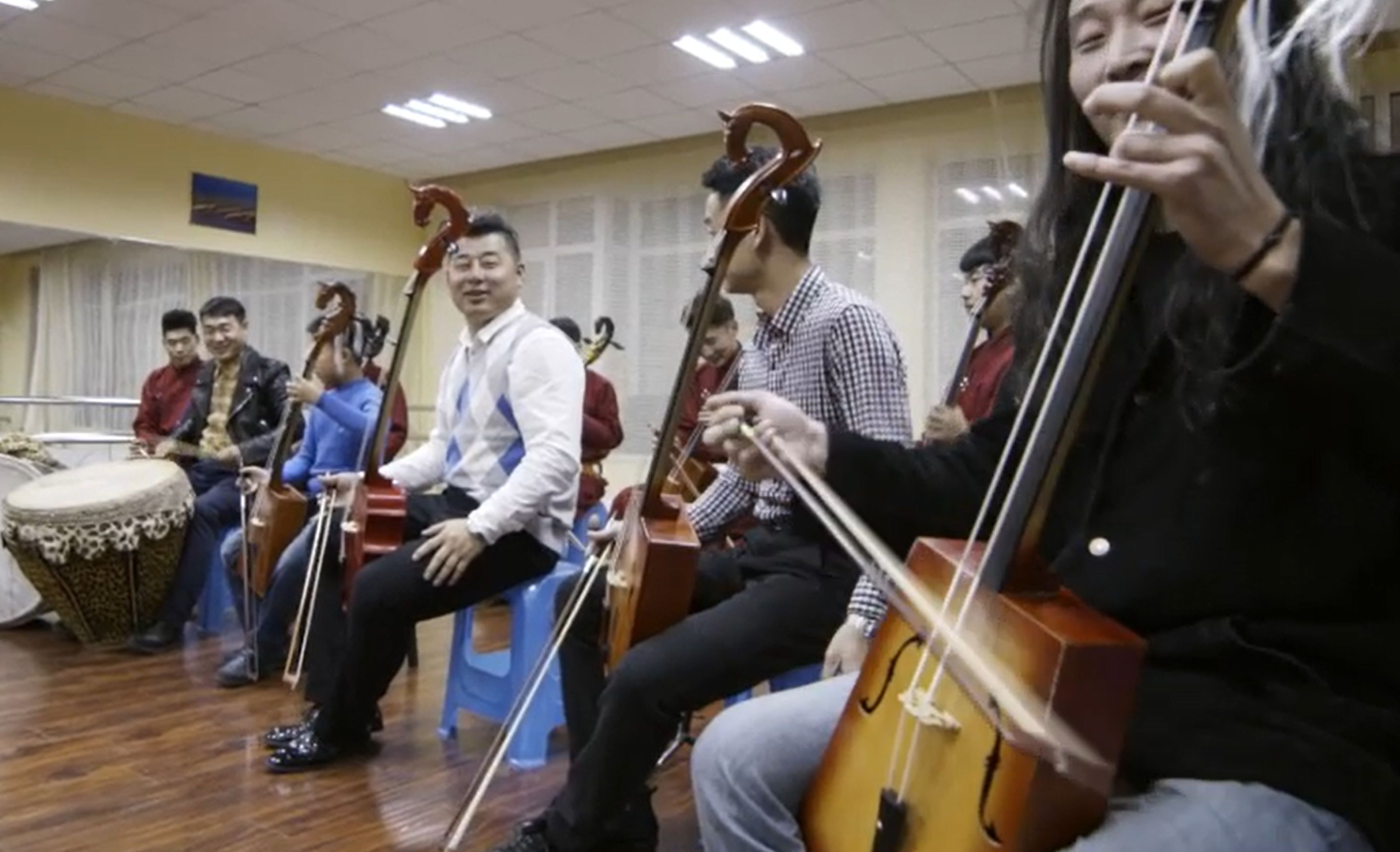
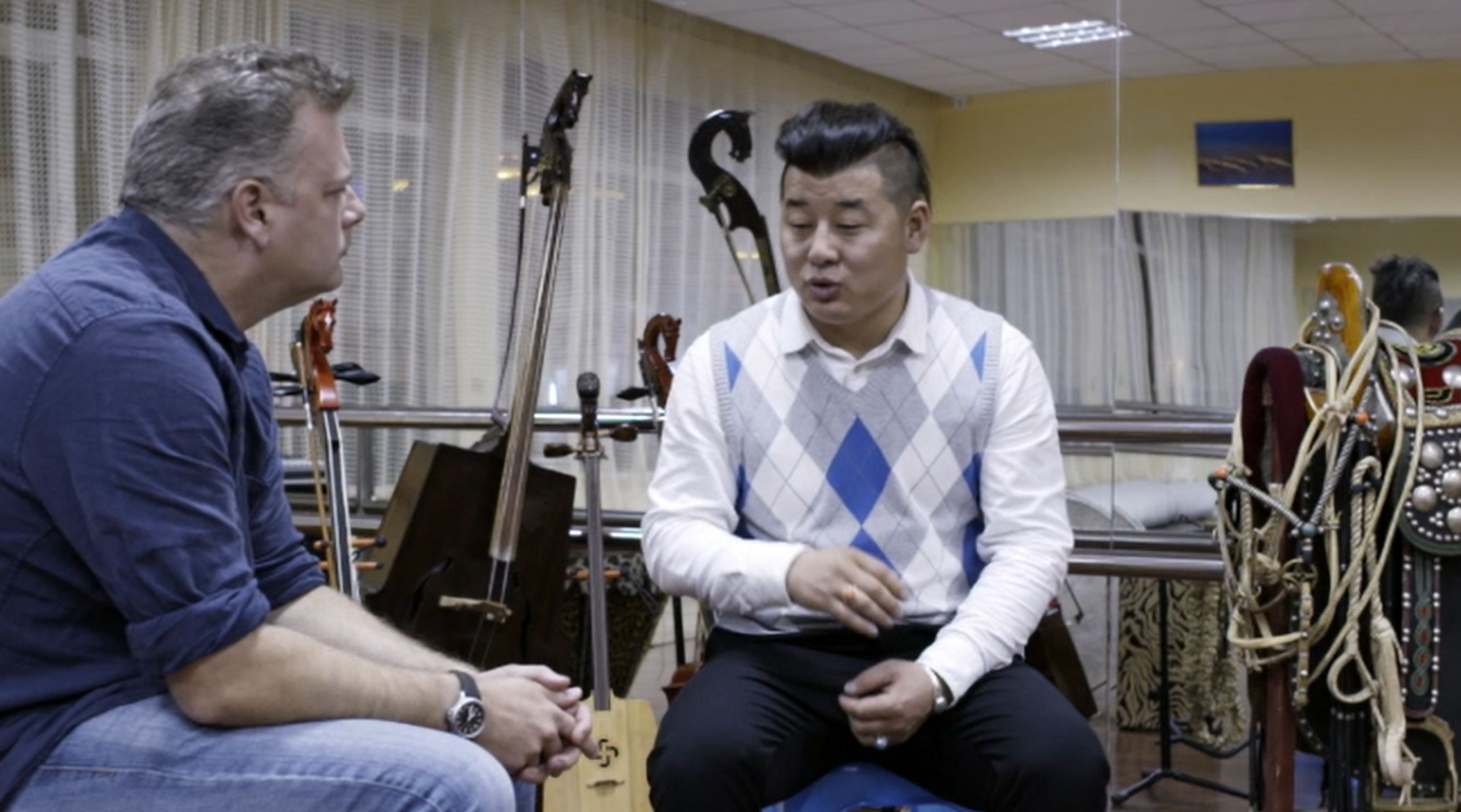
Late in the day, we relocate to the Mandula music school, where a man called Mandula leads the Mandula band. It’s a proper hothouse for the musically gifted. Lessons start at half past seven each morning, with normal schooly-type stuff up to lunchtime. From one o’clock to half past eight each afternoon, the tuition is entirely musical. Mandula is something of a teddy boy, favouring a long purple coat and well-polished winkle-pickers, as well as an impressive mohican. He has something of the rock star about him, but has accreted an impressive array of students – a bunch of youths playing erhus and sihus, as well as a statuesque singing girl in a searingly white slinky dress and a Mongolian dildo hat, several drummers, a man who plays an instrument made from a string of sheep’s kneebones, and a gaggle of groupies. This last group seems to serve no actual purpose, but clutter up the practice hall, sneaking photographs of the camera crew on all occasions. I am sure that within a few weeks, framed pictures of the National Geographic crew will join those already on the wall of his students with various C-list celebrities, and/or clutching prizes for princely sums like £10.
We shoot them playing a 20-minute set that I wish I could have bought on CD, although sadly we will be unable to use the moment when Mandula got bored and decided to break into the Game of Thrones theme – music clearances.
I am really enjoying being with the Mongols. They are easy interviewees, talkative and friendly. One doesn’t feel that one is dealing with a hostile witness, but instead with someone who enjoys the attention and is keen to make a good impression. Mandula in particular, who has written a book of horse-head fiddle music and appeared several times on some sort of national show like China’s Got Talent, has got plenty to say for himself, and gamely tries to teach me how to do the droning Mongolian throat-singing called khöömi. It takes three months to learn, apparently, so there is not much hope of me getting it right in ten minutes, but there is plenty of fun footage of us growling at each other, bibbling our lips and impersonating goats.
Mandula then reveals that as well as leading a band of Mongols, he has attempted to integrate ancient and modern by combining khöömi with rapping. This seems too good to resist, and so the director asks him to give us a whirl. He throws his teddy boy coat behind him, where there is a minion poised ready to catch it, and launches into a beatboxing horror that sounds like a herd of goats falling down some stairs in an echo chamber.
The director gets us to finish by droning at each other: OOooooOOoooOOeeeh, OOowowooowowo, Errrrrrgle. I’ve had worse Wednesday nights.
Jonathan Clements is the author of A Brief History of China. These events featured in Route Awakening (S03E03), 2018.











 The Official Schoolgirl Milky Crisis Blog