
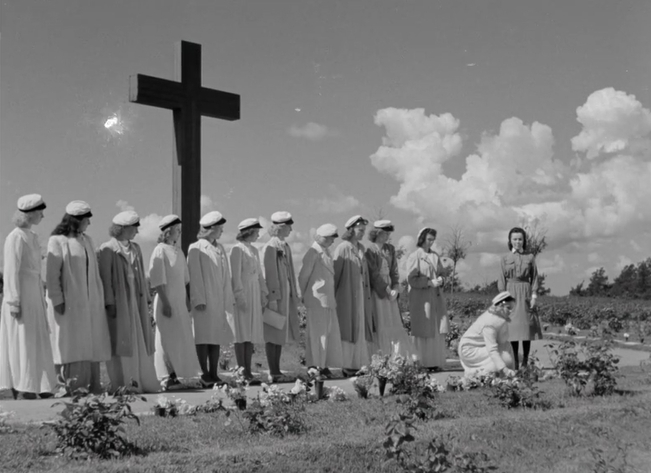
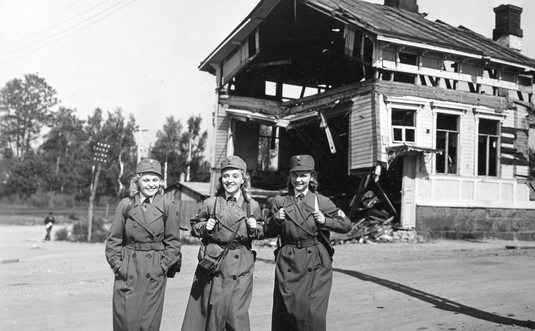
In the summer of 1941, Finland is in the midst of its Continuation War with the Soviet Union, and girls at a Helsinki college are laying flowers at the graves of fallen classmates. Maija (Mervi Järventaus) is clad in the distinctive grey uniform of the Lotta paramilitary auxiliaries, and tries to encourage the students to join up. Instead, she is veritably snarked at by Elli (Ansa Ikonen), an entitled rich girl who only has time for parties and fun.
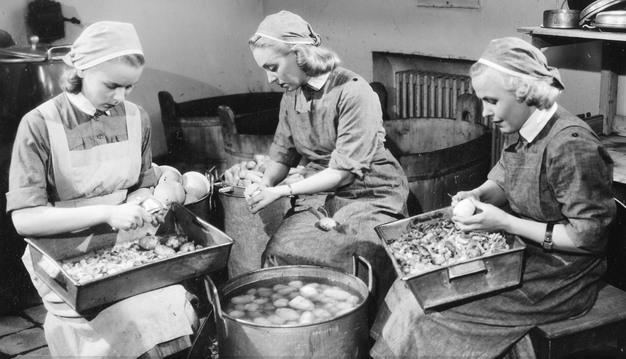
Elli changes her tune when she runs into Maija collecting for the Lottas at a restaurant, where her male dining companions eagerly make donations. Joining up, she finds a newfound satisfaction in cooking for large groups of people, and is fast-tracked through a series of promotions until she finds herself on the front line, ducking away from artillery bombardments in between stirring the soup.
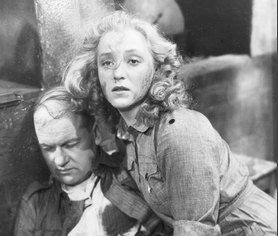
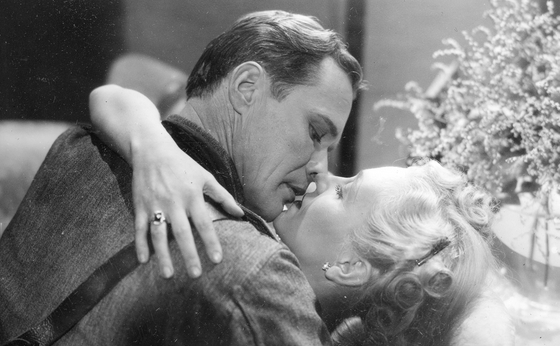
A Soviet patrol breaks through the lines, leading to a fight in the kitchens, where Elli’s co-worker Mälli (Ossi Elstelä) dies protecting the women. Evacuated to Helsinki, Elli realises that her old life of parties and booze no longer appeals. She introduces her parents to her new boyfriend, Lieutenant Tani (Eino Kaipainen, sure to be the male love-interest the moment he walked in), and the couple return to the front line, ready to do their duty.
Drawing their name from Lotta Svärd, the fictional helpmeet of a fallen soldier in a poem by Johan Runeberg, the Lottas began as an all-girl auxiliary service to the White Guards in Finland’s Civil War, and mushroomed into a huge component of the war effort after 1939, as bakers, cooks, nurses, truckers, and anti-aircraft gunners.
Mika Waltari’s film scripts rarely disappoint, and Tyttö astuu elämään pokes around the experiences of hundreds of thousands of Finnish women, usually overlooked in the background in many a male-centred movie. It plays like a retort to the smug peacetime romances like Rich Girl (1939); while Elli does indeed get her man at the end, it is hardly a happy-ever-after when there is still a war to fight. There are some lovely touches and reversals, like the revelation that one of Elli’s louche dining companions, presented at first as a drunk and a waster, is actually a veteran himself, which only becomes apparent when he gets up to leave and produces his crutches from under the table.
Such moments speak to a writer grappling meaningfully with the contradictions of war and human character – how bastards can be heroes, and heroes can be arseholes, peacetime failures turn into wartime martyrs; or former soldiers find it impossible to re-integrate. Waltari’s scene-setting presents wartime Helsinki as a glorious cacophony of such conflicting characters, refusing the easy option of making everybody a hero or a villain. I will note, as well, the subtle way in which Eino Kaipainen, the heroic male lead in many a previous film, is gently sidelined here. He still gets to save the day; he still gets the girl, but he is very much a supporting character in a woman’s story.
However, the Finnish film industry isn’t known for its grasp of nuance, and the press was almost universal in claiming that Waltari was phoning this one in. While they recognised the important and innovation of a theoretical “Lotta movie” sub-genre, the critics found Waltari’s storyline to be too overblown with pathos and big speeches, spending not nearly enough time on the nitty-gritty of Finland’s female paramilitary volunteers. For once, I think even the peerless Paula Talaskivi, writing for the Helsingin Sanomat, may have got it wrong. What she saw as “inconsistencies” in the script, I see as a glorious refusal to accept a one-note account of wartime society. There are oh-what-a-lovely-war moments where Elli thrills at the camaraderie and frisson of her posting, and others where she is confronted with anguish, danger and loss.
Ansa Ikonen’s performance is a triumph, beginning in the opening memorial scene, where she signals her insouciant lack of respect for the fallen by hanging onto one of the flowers in her bouquet, shoving it down the front of her dress to save for later. It is difficult to visualise quite how shocking this bit of early comedy business might have been for cinema-goers who had themselves lost loved ones in the war, but the film toys, however briefly, with the prospect that the snide Elli is on the right side of history, and the pious Maija is a bit up herself.
But as the Soviet soldiers ransack the kitchen, Elli shrieks in incoherent anguish as they start to loot the body of a fallen Finn. Interrogated in broken Finnish by an angry, gun-wielding soldier, she shakes in fear but refuses to answer him, sure she is going to die, but refusing to cooperate anyway. As someone comments in an early scene, there is more than one kind of sisu.
The film has its cake and eats it, too, fuming in quiet rage at Elli’s sordid nightlife, while also stopping the action so we can gawk along with her at a sultry belly-dancer (an uncredited Laila Jokimo, previously seen in The Activists, and as the acrobat Cleo in The Vagabond’s Waltz). Eighty years on, it also offers a fascinating glimpse of 1940s technology and logistics, as we see the earnest Lottas at work, peeling potatoes for an entire division of hungry soldiers, and Elli’s simple glee when her cooking meets with the dour nod of approval from her group leader.
Like many other films from the period, it was chopped around a little as political winds changed, and the version that exists today lacks several elements: discussions also excised from That’s How It Is, Boys (1942) of a “greater Finland”, as well as a sequence involving Soviet prisoners, and a radio address by president Risto Ryti, who was later cancelled for accommodating the Nazis.
The film has an oddly limited artistic heritage. It was screened in Germany under the much more poetic title, Ein Mädchen in Grau, but was unseen in Helsinki cinemas after 1944. There are very few archive stills (some of the best pics in this article are screen-grabs I took myself), and although a feature-length print exists, some of the key scenes are lacking sound. One can only assume, as with similar Russian-baiting curios like The Great Wrath (1939), that the curation of the film assets during the Cold War may have been aggressively incompetent.
Jonathan Clements is the author of A Short History of Finland. He is watching all the Finnish films so you don’t have to.

 The Official Schoolgirl Milky Crisis Blog