
My obituary of Toren Smith (left), prime mover in the American manga business, is up now on the Manga UK blog.

My obituary of Toren Smith (left), prime mover in the American manga business, is up now on the Manga UK blog.
 In 2009, the Chinese government decided it was time to protect its netizens from the dangers of the internet, by bundling a new piece of software with all new PCs. Green Dam Youth Escort was designed to keep life harmonious (and “green”) by filtering out any images with too many pink pixels (including pictures of pigs), and blocking a list of proscribed sites. It was notoriously buggy, and, well, annoying.
The Chinese internet community was swift to protest in an oddly creative way, knocking up images of a manga-style heroine called Lu Ba Niang (the Green Dam Girl). Clad in a quasi-military uniform with an ironically short skirt, Lu Ba Niang patrolled the interwebs with a paintbrush for censoring, and a red armband that read “Discipline.” Her perky little hat was sometimes depicted with a little crab insignia, since a “river crab” in Chinese is hexie, a homonym for “harmonisation”.

What’s interesting about the Lu Ba Niang protests is what they reveal about Japanese pop culture among the Chinese. The amateur artists and satirists co-opted the modes of Japanese artwork with apparent ease. It’s not just the moe look of Lu Ba Niang, but a dozen little touches, including Vocaloid censorship anthems and hentai spin-offs in which she inspects the bottoms of embarrassed anime girls. The tone and content of much of the protests seemed very much informed by hentai fandom, with some images even in  imitation of erotic visual novels, with text that includes Japanese characters. One even calls the character Lubako, as if she were a Japanese girl.
Download statistics and piracy complaints suggest that Japanese works have an “informal” following in China. The size and scope of the Green Dam protests suggest that there is a sizeable community of Chinese “otaku”, even today when Japanese material has supposedly fallen out of favour in the wake of ongoing territorial spats over the Senkaku Islands. Meanwhile, Green Dam never really took off; it became “voluntary”, and then lost its government funding when it was found to contain programming code plagiarised from an American software company. Oops.
Jonathan Clements is the author of Schoolgirl Milky Crisis: Adventures in the Anime and Manga Trade. This article first appeared in NEO #107, 2013.
 It is a scene straight out of Evangelion. At the offices of a secret government project, a stern-faced leader informs a reluctant young protagonist that the world is about to end. A clock on the wall counts down the seconds until disaster, unless… unless someone climbs into a dangerous, untested prototype machine, and does battle with the fates themselves.
But Japan is not under attack from avenging angels. The countdown clock is financial, ticking away the moments until Japan’s debts spiral completely out of control, and the country comes crashing down – collapsing banks, armies of starving ex-workers, and considerably less anime in the stores.
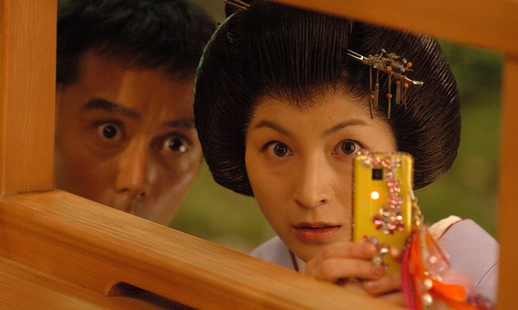
2007’s big Japanese sci-fi movie was the satirical Bubble Fiction, in which Ryoko Hirosue is catapulted back to the boom year of 1990 in a last-ditch attempt to save the Japanese economy. The effect is not unlike Back to the Future as written by accountants – Japan’s modern woes are tracked back to a tiny loophole in a proclamation by the Finance Ministry, and high jinks inevitably ensue.
Inevitably, there are sly digs at the fashions of yesteryear, and cameos from whichever future stars the producers could persuade to play their younger selves. Most notably, Ai Iijima, the future author of Time Traveller Ai, can be found dancing at a discotheque. Phones are the size of bricks, shoulder pads the size of helipads, tight ruffled dresses on body-conscious Tokyo ladies and men wear suits two sizes too big for them. Written by Bayside Shakedown’s Ryoichi Kimizuka, Bubble Fiction presents a fantasy view of the 1990s, in which people literally give money away in the streets, taxis need to be hailed with a ten thousand yen note, and champagne flows freely among the party set.
But there is also a sense of impending doom. It’s here, as Tokyo land prices soared to silly heights, that the seeds were sown of economic collapse. The Bubble, warned some pundits, was sure to burst, bringing disaster on the hedonistic Japanese.
Creatively, the Bubble years have a lot to answer for. Outside Japan, the economic might of Japan led Hollywood to make Black Rain and Rising Sun. The great growth in wealth among the Japanese turned them into the owners of video players, and hence helped drive the modern anime industry. The idea of a future economic implosion even gave us the name of a famous anime, Bubblegum Crisis. Deep pockets nurtured the garage kit and figurine industries. The largest disposable income of all turned out to be in the hands of the charmingly named “parasite singles”, twenty-something women living rent-free with their parents, hence a similar emphasis on bespoke cute. Hello Kitty might have been around long before the Bubble, but she certainly achieved megastar status with the help of all those yen with nowhere else to go.
But let us also remember the indirect effects of the crash. With profit margins constricting in Japan itself, producers and publishers became more amenable to foreign sales. Anime and manga abroad, particularly in America, are another side-effect of the boom and bust, and a generation on, the fact that the American market plays such a great part in Japanese business decisions is, at least in part, a result of deals done in the Bubble period.
But what if the American economy starts to slump…? Who’s going to pay for anime then? Sub-prime days ahead, my friends?
This article first appeared in Newtype USA in 2007, and was reprinted in the book Schoolgirl Milky Crisis. Bubble Fiction is screening at several UK cinemas as part of the Japan Foundation’s touring film season.
For those that didn’t see last week, the new Manga UK podcast is up.

00:00 Jonathan Clements reports on the weather in Xi’an and Beijing smog – dust storms from the desert, and the best job in China.
04:30 Former Japanese prime minister Taro Aso and his assault on “tube people” – a welcome return of anime and manga’s greatest political ally. But with friends like these… Increases in Japanese VAT and what that might mean for anime. See, everything is connected. It’s like Cloud Atlas, here, but with more swearing.
10:20 The politics of hard subtitles and grey importing.
13:00 And so we begin… with Brand Spanking New News, starting with Panty and Stocking on Blu-ray. The reasons behind combined DVD/Blu-ray releases. Reasons to shop at Shopmanga.co.uk.
22:00 Drifters of the Dead packaged with Highschool of the Dead and the mixed response online. Some plans to keep everybody happy.
27:00 The original Hellsing, on its way to you from Manga UK, along with Kenichi the Mightiest Disciple. The first season of Last Exile (but why…!?). Lupin III: A Woman Named Fujiko Mine. K-on the movie… which leads us onto a discussion of dog poo.
37:00 January and February releases: Shiki, DBZ, Bleach, Code Geass (not Code Geese, and certainly not Code Gay Ass), some side notes on the silent equals sign in Loups=Garoux, Journey to Agartha (not Agatha), Tiger and Bunny, Baka and Test 2, Eden of the East the Definitive Collection.
44:30 Ask Manga UK. Your questions answered, or occasionally dodged. Black Rock Shooter’s chances on Blu-ray (not much); the criteria for Blu-ray makeover; the sad story of the Perfect Blue rights; the precedent set in the 1990s by Studio Ghibli’s high rights prices; the changing attitude of the Japanese studios towards foreign investment.
51:40 Manga UK’s New Year resolutions, and a very brief discussion of changes at HMV and Play.
55:00 The chances for digital downloads in the future. Ghost in the Shell Arise, and matters… arising.
61:00 The possibilities and pitfalls of titles released with English-audio only. The “strategic error” of Afro Samurai.
66:00 What does Kaze actually do? And several questions dodged for now because we have to go away and look up the figures. And we’re done.
Available to download now, or find it and an archive of previous shows at our iTunes page. For a detailed contents listing of previous podcasts, check out our Podcasts page.
 When advertisers and sponsors first became involved in the anime business, it was tentative and haphazard. Masaki Tsuji reports phone early calls arriving at TV Asahi from pencil manufacturers and card companies, who wanted to stick some of the earliest 1960s characters on their merchandise. When he picked up the phone, he realised that, quite by accident, the TV channel completely owned the relevant rights in Eightman. By the time of Sailor Moon, interests in tie-ins had ballooned to such an extent that one beleaguered Bandai official complained he had “literally no time to go to the toilet” when the phone was ringing. Literally…?
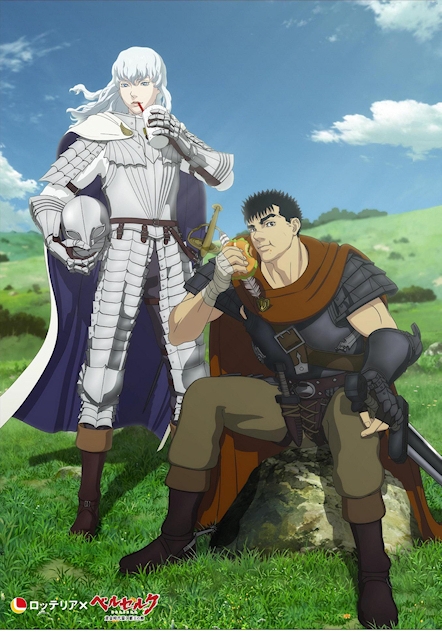
 But how can sponsors get returns on their investment, apart from advertising in the commercial breaks? There is, of course, simple product placement, where cans of soft drink, storefronts and even blatant advertising billboards are placed in-shot. This is mostly harmless, although if you have a fantasy film like Berserk, it’s difficult to have the cast setting aside their roast dolphin for a Happy Meal. In such cases, extra artwork is often generated, such as the Lotteria tie-up campaign, which featured the powerful mercenary Guts and albino general Griffith tucking into a hamburger and a milkshake. The androgynous Griffith was also depicted with a shopping bag over his shoulder, looking like a Lady Who Lunches, in a campaign for a department store.
But some anime go beyond product placement into context integration – imagine a hypothetical anime movie, let’s call it Schoolgirl Milky Crisis Goes to London, where five minutes are set aside for characters to travel on a well-known airline, and then get mixed up trying to locate their hotel, causing them to repeat its name a dozen times. But this has been going on in anime for decades, most notably with the Gundam series, for which a company wanted its toys to be part of the story. Yoshiyuki Sadamoto once called Yoshiyuki Tomino the “pro’s pro”, for being able to take such behind-the-scenes demands and to fashion them into a story that still entertained the viewers. It’s being able to still be creative, amid such immovable limitations, that contributes to the unique look and style of anime.
Jonathan Clements is the author of Schoolgirl Milky Crisis: Adventures in the Anime and Manga Trade. This article first appeared in NEO #106, 2012.
 One of the odd obsessions that has occupied me for the last decade is Mazu, the Chinese marine goddess, patron deity of all those in peril on the sea. She began life as a real person, Lin Moniang, a quiet, contemplative Song dynasty girl who used to legendarily stand on Fujian clifftops in thunderstorms, wearing a bright red dress to serve as a human lighthouse to her father and brothers in their fishing boats. Lin Moniang, so the story goes, walked into the sea, sacrificing herself so that her father’s ship could return safely, becoming in the process a personification of the sea itself. Deified by later emperors, her red-clad image can be found everywhere Chinese sailors drop anchor. There are statues to Mazu in China and Malaysia, and two temples to her in San Francisco’s Chinatown. Her most famous devotee was Coxinga, the pirate king of Taiwan, whose life is bracketed by portents of her favour and blessing, and whose island enclave was conquered a generation later by a one-eyed admiral who claimed to see Mazu with his blind eye, standing waist deep in the waters of the Taiwan Strait, and fighting for the Manchus.
In 2010, I stood in the shadow of a massive statue of Mazu in Tainan, as a lone monk chanted an endless sutra, and a replica of Coxinga’s ship was launched from the dockside. In 2009, I climbed a hill in Nagasaki to the temple maintained by Coxinga’s Japanese relatives, where a squat statue of Mazu glowered in the central hall. I keep meaning to write something, when I get the chance, about the Mazu cartoon film, as yet unavailable in English. But I’ve been prompted to mention her today because of the series on Chinese television at the moment, which dives headfirst into Mazu mythology with flying demons, heated debates among the immortals, and sea devils rising from the Taiwan Strait. Oh, to be a commissioning editor at the BBC with a mind to recreate the Monkey madness of years gone by… because Mazu is the series that might just do it.
The public-lending right results are in, totting up my royalties from British library loans this year, with no real surprises to regular followers of this column. My samurai history is at number one, but the Spartacus novel goes straight into the charts at a respectable number four, with only six months to earn that level.
1. A Brief History of the Samurai
2. Confucius: A Biography
3. A Brief History of the Vikings
4. Spartacus: Swords and Ashes
5. A Brief History of Khubilai Khan
6. Darwin’s Notebook
7. The First Emperor of China
8. Mannerheim: President, Soldier, Spy
9. Wu
10. Beijing: The Biography of a City
As ever, this is the list of books with my name on them. My top-earning book, for the tenth year in a row, is actually an obscure children’s work I wrote under a pseudonym in a long weekend. You never know what’s going to bring in the cash.
If you are a Kindle user in the UK, both my Brief History of the Samurai and Brief History of the Vikings are available now for download.
“There is a tension between the obstructions of getting things done, and the enormous decency and kindness and genuine humor of the people.” – George Bush, 1975
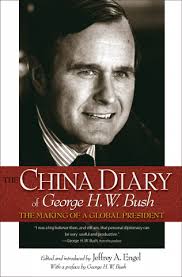 I read a lot of travel books about China, ranging from the sublime to the infuriating, from the clueless observations of disinterested tourists, to the considered memoirs of people who live and work in China for years on end. There’s also a wide range in intent, from simply telling one’s relatives about what one’s been up to, to the first book up for review today, which chronicles the “making of an American president” by publishing his forgotten account of a period spent as Our Man in Beijing.
George Bush Senior’s China Diary is fascinating, as the Party cadre flees America in the wake of Watergate, and volunteers, much to his superiors’ bafflement, for a posting to China, long before the US and China had normalised relations. Bush is hence an ambassador in all but name in the dying days of Chairman Mao, biking around Beijing and attending endless rounds of parties with other diplomats. Barbara Bush, meanwhile, risks causing an international incident at the hair-dressers, where she strikes up a friendly conversation with a woman who turns out to be the Cuban ambassador’s wife.
As a result of his non-official status, Bush represents a global superpower but comes lower down the pecking order than the ambassador of Gabon, and hence must exercise extreme diligence not to be caught out in the cold at photo calls and banquets. What struck me most about his memoirs was how many of the names of his fellow diplomats were familiar to me. Party politics will get you on the diplomatic track, but so will knowing a hell of a lot about the country in question, so I suppose I shouldn’t be surprised to see people like Jan Vixseboxe (Netherlands ambassador) and Ann Paludan (wife to the Danish ambassador), whose work I know better as “scholars”, popping in for tea and caviar.
Bush narrated his diary into a Dictaphone that was transcribed many years later. Jeffrey Engel edits and annotates the messy original by correcting solecisms and adding copious footnotes, sometimes critical of the author himself. Published in 2008, the China Diary is oddly obscure – I only stumbled across it by accident, and was rather surprised that I had never bumped into it before – it’s not on the shelves at the London School of Oriental and African Studies, for example. And it’s not available on the Kindle (time travel footnote: now it is), a device which has hoovered up £400 of my book spending since I succumbed to digital devilry in September.
 One of the joys of Kindle access is that it is possible to charge what the market will bear. I enjoyed and greatly appreciated the unique sections of Alan Paul’s Big in China that were about his expat life as a corporate househusband, but rapidly lost interest when he drifted into (for me) tedious reminiscences about his band. This isn’t any fault of the author; it’s plainly something that interests him greatly. Unfortunately, it interests him so much that he stops talking about China in order to talk about guitar strings and music clubs, about which this reader does not give a toss. Don’t get me wrong, Big in China was an enjoyable book, but I would have enjoyed it a lot more if it had cost me a third as much. I might have been similarly put off by Leanna Adams’s Pretty Woman Spitting, but in pragmatically charging me a mere 77p to read her China diary, the author ensured that I finished it with a smile on my face, feeling that my money had been well spent.
Despite conceding that she knows very little about China, and peppering her book with questionable statistics and outright apocrypha, Adams has an eye for detail and character that makes her writing entertaining and worthwhile. She also constructs a proper narrative for herself, turning what could have easily been a series of random diary entries into a character arc of growth, love, loss and learning. Pretty Woman Spitting is a well-written and carefully balanced account of an American woman in China – the title itself is a fair encapsulation of Adams’s innate ability to find drama and poetry in the most mundane of situations.
Sometimes it seems that everyone and his dog has a China memoir about the time they spent trying to pronounce the words for “I NO WANT CHICKEN HEAD” to uncomprehending waiters, but coming back such books after several years evaluating anime industry testimonials, I have come to regard them in a new and indulgent light. Historical researchers will sympathise, perhaps, with having to hunt around in obscure library collections for forgotten, hand-written travel diaries from the distant past, many of which only reach a larger public when a distant descendant or relative edits them for a PhD. The internet and e-Books makes such pieces immediately and widely available in real time, chronicling hundreds of snapshots of life in a fast-changing country. I find it fascinating, as a historian, that I can read such testimonials as reportage, and eavesdrop on the  contemporary China experience of total strangers. Rated in such terms, Chris McElwain’s Dispatches from Crazytown is similarly great value: informative about life in Xi’an, and laugh-out-loud funny, at a cost of approximately 15p per chuckle. McElwain, like Adams, arrives in China as a teacher, but approaches his experience with merciless snark. Openly confessing that his book is the ramblings of a “confounded yokel”, he seems to court trouble, initiating a Frisbee competition at the tomb of the First Emperor, and contemplating exactly what he is supposed to do with the live catfish he can buy at the local supermarket. There is a very fine line between hostility and humorous observation, but McElwain keeps resolutely on the right side of it – he loves China, but is unafraid of puncturing its pomposities when the opportunity arises.
Jonathan Clements is the author of Mannerheim: President, Soldier, Spy, now out on the Kindle.


