The Mongol Armada

From A Brief History of Khubilai Khan by Jonathan Clements, available now in the UK and in the US.

The attempted invasion of Japan was, with hindsight, the moment when the Mongols’ legendary invincibility was called into question for the first time – a sign that the tide of barbarian invasion had finally begun to ebb. The Mongols had experienced setbacks in the past, but had always, eventually, returned home with, at very least, the nominal submission of their enemies.

Logistically, the Japanese invasion project was no smaller than the Mongol enterprises to take the empires of the Tangut, Jurchen or the Southern Song. However, historically, it became literally world famous. It is in Marco Polo’s awestruck account of the plan to invade Japan that the island kingdom first enters European consciousness. When, 200 years later, Christopher Columbus waded ashore on a remote Caribbean island in search of ‘Cipangu’, he was merely the latest inheritor of Khubilai’s propaganda, convinced that Japan was an island of untold wealth, there for the taking.

Many Japanese accounts leap straight to the arrival of the first great Mongol fleet off the coast, and the heroic efforts by the samurai to hold them back. However, Chinese and Korean annals present a very different story, and show the size of the Mongol threat steadily growing throughout the 1260s. The first approaches to Japan were little more than honeyed words and oblique threats, escalating in severity as years passed without a direct Japanese submission to Khubilai.

The first signs of the Mongol invasion are rumours and tall tales from mainland visitors, the mere ghosts of direct contact, as careful Korean obfuscations kept the Mongols and the Japanese from making actual contact. Although history largely remembers the two great, apocalyptic battles in Hakata Bay and their almost supernatural ending, lesser accounts record a number of skirmishes long before the infamous days of reckoning. There were kidnappings and secret deals in the Korea Strait years before the Mongol armada officially set sail, and there was even a pre-emptive Japanese strike on the Korean coast, which saw part of the intended invasion fleet burned where it stood in the shipyards. Small parties of emissaries travelling aboard the ships of others, gradually transformed through the 1260s into an ambassador with his own honour guard and his own military escort: two ships, then a dozen, then hundreds.

If we piece together the scattered references to ‘Dwarf Pirates’ or the ‘Land of the Rising Sun’ in mainland chronicles, we become witness to the inexorable gathering of a terrible storm. The question that remains for the modern historian to ponder is whether the Japanese or Mongols ever appreciated the terrible odds they both faced.

Jonathan Clements is also the author of Marco Polo, available now in paperback and on the Kindle (US/UK).

Leaping Through Clouds

There’s always something new to say about Carl Gustaf Mannerheim. And I don’t mean lurid innuendo about his private life, or schmuck-baiting insinuations about his sexuality. Finland’s beloved Marshal is orbited by a publishing industry that now includes a Mannerheim cookbook and a Mannerheim comic, with a history that touches on a dozen countries. He was a truly cosmopolitan figure, the “last knight” of the Tsarist aristocracy and a hero of the nascent Finnish nation. He saw the prophetic trench conflict of that grotty little war between Russia and Japan over Manchuria, and he witnessed the twilight days of two empires.

His epic ride across Asia in 1906-8 would have been the crowning glory of his career, were it not for the intervention of wider world events in his forties. But with a life overshadowed by his role in the Finnish Civil War and World War Two, his arduous reconnoitring of China remains largely forgotten. Across Asia, his mammoth account of his journey, was not published until 1940, and even then in a limited run of only 500 copies. It has taken until the 21st century for the scholar Harry Halén to publish a restored retranslation that brought Mannerheim’s Asian adventure to a wider audience, and several further years for someone to publish the inevitable companion, a modern travelogue that traverses Asia in Mannerheim’s footsteps – The Horse That Leaps Through Clouds: A Tale of Espionage, the Silk Road and the Rise of Modern China.

Author Eric Enno Tamm is a journalist with firm ecological credentials and no fear of rattling cages. Applying for a visa in Vancouver, Tamm finds his path blocked by Chinese officialdom, but this only spurs him even more to imitate his hero. Forbidden entry as a Canadian journalist, he wings it in true Mannerheim fashion, by travelling under an Estonian passport. And off he goes, through Turkmenistan, Uzbekistan and Kyrgyzstan, leaving a trail of irritated guides, furtive contacts and frustrated jobsworths behind him, contrasting Mannerheim’s accounts of Chinese militarism with his own 21st century perspective on what China is doing to its own environment and citizens.

Tamm’s quest is resolutely, bullishly inquisitive. He is arrested and interrogated by the Turkmen police before he even reaches China. He pokes his nose into the activities of clandestine missionaries, quotes harsh criticisms from named sources, and chronicles ecological disasters along the way. He has an eye for the fabric of life in Central Asia: not only the subtle exclusion of Muslim locals from a hotel restaurant that does not serve halal food, but also giggling tourists in shorts blundering around a sacred mosque, and the zealots who think they should be murdered for it.

His journey is riddled with historical coincidences and parallels. He enjoys the allure of “new bottles for old wine”, such as the paradoxical insistence of Maoist doctrine on blind faith, or the suggestion that the Red Guards who once smashed temples of Confucius could only become such fanatics after being raised in an essentially Confucian culture.

Like Mannerheim before him, Tamm travels undercover. He gets annoyed with his interpreters and jumpy in the presence of the Army, ever unsure who has shopped him and who is watching. But he also meets the movers and shakers of his age, and powerful evocations of the past, such as his encounter with the great-great-grandson of the woman Mannerheim knew as the Queen of the Alai Kirghiz. Tamm’s text fleshes out Mannerheim’s journey with historical contexts and adds data unknown in 1906.

Tamm’s habit of adding tangents, breaking modern conversations with historical musings and flashbacks within flashbacks, creates a knowing pastiche of oriental story telling. Like the legendary Scheherazade, Tamm delays explanations and often throws in punchlines after long diversions. It is endlessly entertaining, but also a means by which some issues are first postponed, and then conveniently forgotten. It is, for example, unclear to me how he evades the canny diplomat Wang Jiaji, who rumbles him in Urumqi, and asks straight-up if he is “the Canadian travelling in Mannerheim’s footsteps.”

There is much written about photographs taken and images seen, but these are oddly absent from the book itself, at least in this hardback edition. For the full experience of “reading” Tamm’s journey, one must also have a web browser open to his richly appointed website of parallel resources. Tamm has shown himself to be a shrewd manipulator of modern media, and offers Tweets, Facebookery and a blog to enhance the experience. One wonders if The Horse That Leaps Through Clouds awaits a true destiny, perhaps after its US appearance, likely awards and hopeful best-sellerdom, when foreign rights buyers decide to incorporate pictures by both Mannerheim and Tamm into editions in French, Russian, Swedish, or Finnish – the most likely territories to jump at the chance for translation rights. I don’t see it coming out in Chinese in a hurry, though Tamm will take that as a compliment.

Tamm undertook his journey in 2006, and must surely have been planning to publish in 2008, on the centenary of Mannerheim’s return from the Far East, or 2009, the centenary of Mannerheim’s report on China. Perhaps because of the publication of Halén’s revised book, perhaps for complex reasons to do with award qualification and publicity, The Horse That Leaps Through Clouds has an official US publication date of 2011, but has sneaked out in hardback in its native Canada several months early, offering an irresistible temptation to anyone looking for an exclusive Christmas present for the Mannerheim fan in their life.

The book alludes to James Palmer’s Bloody White Baron as forthcoming, and includes Paul Pelliot’s Carnets de Route in its bibliography, although it does not dig too deeply into Pelliot’s rich veins of anti-Mannerheim invective. All of which I take to mean that Tamm’s book was delivered to his publishers at roughly the same time as my own – I only squeezed Pelliot in during the revision stage. If so, this would explain why there is no mention of Mannerheim: President, Soldier, Spy in Tamm’s otherwise thorough bibliography. My book must have come out while his was going through galleys, which makes it all the more fun to find him elucidating points I only skim, or asking questions that my own book answers. Both of us break with tradition by making Mannerheim’s Asian trip the centrepiece of his life, contrasted with earlier writers who place WW2 in the foreground. Moreover, we are both unrepentant in our assertion that Mannerheim was a Tsarist spy, a concept that has been vigorously denied by at least one diplomat, although even at the time, I thought he protested a little too much.

The Horse That Leaps Through Clouds is an anti-travel book, a guide to places no tourist in their right mind would ever want to see. Its author departs for home literally sick of China, coughing and spluttering, plagued by headaches and recounting multiple intestinal upsets. One sees, perhaps, what one wants to see, and Tamm has little time for uplifting local colour or heartwarming encounters. A trained observer of the land, but perhaps not of the people, he reads the environment well, even if his access to its inhabitants is limited. His book is a damning account of a China that looms over our future, a “coal-fired dragon” vastly more threatening than the tinpot empire derided by Mannerheim’s 1909 report, part of the onrushing, dark, satanic crescendo that Tamm calls the “din of the modern world.”

Jonathan Clements is the author of Mannerheim: President, Soldier, Spy.

The Courts of Chaos

Just back from Saint Petersburg, one of the most amazing cities I have ever seen, on the trail of Mannerheim as always, and also putting together material for another book project, about the activities of Japanese spies in pre-Revolutionary Russia. By the side of the glittering River Neva, I dropped in on Alexander Nevsky, at his last resting place near the Nevsky Monastery on Nevsky Place, at one end of Nevsky Prospect, the glorious boulevard that stretches all the way across the city to the Winter Palace.

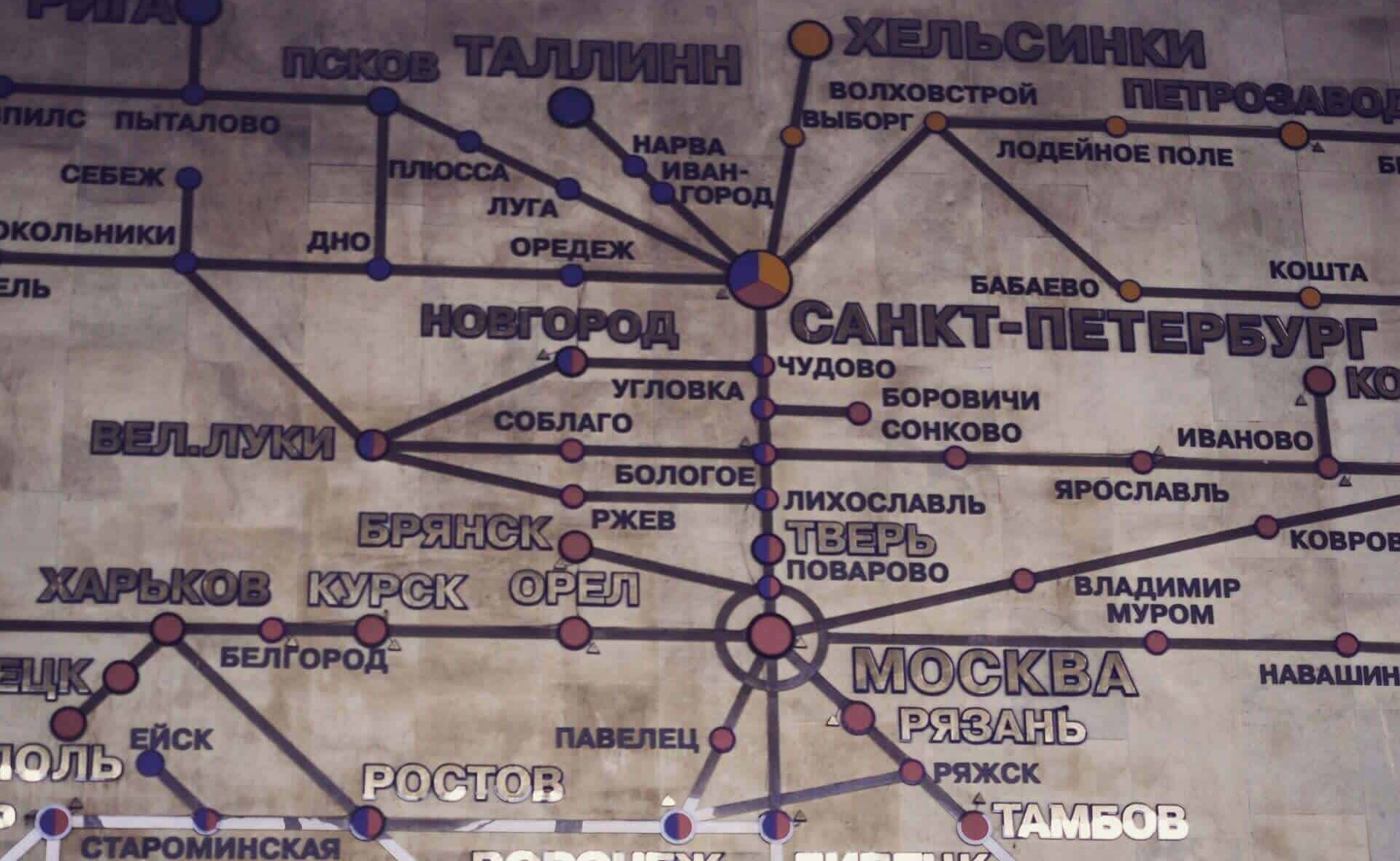
I walked the whole length of it, breathing in the ghosts of Mannerheim and Pushkin, Dostoevsky and Tolstoy, and stopped off at the Moscow Station, just off the Square of the Uprising with its soaring star-topped column, to see the schematic diagram of the Russian rail system, a hundred feet across. It is like a subway map of the gods, a to-do list for Princes in Amber, a Cyrillic alternate-universe version of the London Tube, where the East London Line terminates in Sarmarkand, and the Central Line stretches on not to Hainault, but to Alma Ata. After a name change and a switch in wheels, it continues on to Beijing and Vladivostok — and there is something wondrous about standing in a train station that will take you to the Far East. Near the Church on the Spilled Blood, I bought a copy of one of my own books in Russian, as a gift for our host Alexey.

This was where Mannerheim commenced his two-year trek across Asia as part of what the Russians called the Tournament of Shadows, a journey that took him out across the Sea of Death to the edge of the world. At a cafe near the Museum of Russia’s Secret Police, I ate a meal that would have charmed Roger Zelazny, of dumplings from the Ural Mountains dipped in smetana, and dumplings from Siberia sprinkled with dill, seeing a slow transformation from west to east. Add soy sauce and chili, and you have jiaozi. Look east from Saint Petersburg, and the next border you cross can be China’s. Or Japan’s.

It’s hard to believe this was ever Leningrad. Someone has twisted the time streams, allowing the old imperial capital of Saint Petersburg to reassert itself with a vengeance, cramming the 20th century into the shadows. Golden, double-headed eagles shine on the tops of the lamp-posts, and the former Museum of Atheism has been rededicated under its old name, Saint Isaac’s Cathedral.

Judge Dee

From Wu, by Jonathan Clements, available in the UK and in the US. Tsui Hark’s forthcoming Dee movie is out in Asia next month. You can never have enough films about Empress Wu, and in depicting Dee as a young man, they’re leaving things way open for many sequels.

—-

Another loyal official was the popular magistrate Judge Dee (Di Renjie). Posted to the remote western Gansu region, he had enjoyed the support of both Chinese colonists and the local population of non-Chinese. His career suffered a series of setbacks due to the enemies he made at court, and by the late 680s, he was serving as a magistrate in a remote southern posting. Judge Dee arrived to find a prefecture in chaos, with many administrative personnel carted away for show trials, while armies of secret police terrorised the population.

Wu’s secret police might have been behaving like storm troopers, but this was not necessarily with her knowledge or approval. In secret, Judge Dee wrote a letter to Wu herself, complaining that he was witness to daily persecutions of innocent citizens, but that if he protested, the secret police would be sure to frame him for an imagined crime. If, however, he remained quiet, then he would be doing a disservice to Empress Wu, since she would be held ultimately responsible for the crimes that were being committed in her name. Instead of reacting with the umbrage that her enemies would have us suspect, Empress Wu ordered for the release of many of the unjustly accused, and commuted the sentences of less clear-cut cases from execution to banishment.

Judge Dee would continue to fight for justice against some of the worst of Wu’s hatchet men. When a military governor took over the province, Judge Dee stood up to him directly. His case, like that of Xu Yugong’s back in the capital, was that the people were being punished for the actions of a handful of aristocrats. In fact, in the case of his own locality, peasants who had been oppressed and victimised by would-be rebels, forced on pain of death to carry out their bidding, were now being similarly pressured by the investigators. In fact, Judge Dee went so far as to suggest that the secret police were doing more damage in his region than the rebels ever had. With bullish predictability, the governor wrote to Empress Wu, claiming that Judge Dee was guilty of corruption. He was thus rather surprised when the reply came back, ordering him sent away to a distant and unpleasant posting, while Judge Dee was promoted with a summons to serve at the court of Luoyang itself.

Into Songland

companyI have been out into the wilds of Finland, up near the Russian border on the edges of songland, the place that supplied so much of the material for the Kalevala, the Finnish national myth. In the company of Mrs Clements, Delia Sherman and Ellen Kushner, I spent a fascinating day at Kalevala Spirit, a recreation of a medieval Karelian stockaded clan-house, wherein the inhabitants lived, worked and cooked using only the means and materials described in the pages of the Kalevala.

As regular readers will know, I have been writing on matters Finnish for several years, but there was much to learn at Kalevala Spirit, thanks to Akke Virtanen, a man with a mission to codify and preserve some atavistic sense of Finnishness. Able to answer questions on any subject, from skis to saunas, bears to berries, he demonstrated old-world skiing and the right way to grill a salmon, and we kept him busy with plenty of the sort of questions that only authors really need to know. While our fish was gently tanning by the fire, Akke’s colleague Ilkka led us into the forest to inspect bear traps and fox snares, and to spend an idyllic time fiddling with hammer, anvil and bellows in a reconstruction smithy. Our tour ended on a distant hilltop, where amid totem poles depicting the ancient Karelian forest gods, there was an incongruous metal cube carved with intricate sigils in classical Chinese. I recognised it as the legendary sampo as depicted in the film Jade Warrior, now on permanent loan to the Kalevala Spirit in thanks for their pre-production assistance. And I can believe it, too — I left the place with Finno-Ugric metre in my head and the sting of embers on my hands, with new words and new connections roving around my brain in search of places to turn into prose.

We were even getting poetic ourselves by lunchtime, as witnessed by my Heroic Omelette: “To the fridge went Lemminkainen / searching for the milky dregs / on the upper and the lower / shelves he sought for several eggs”. Akke talked at lunch about his Damascene moment, as an advertising man who realised one day that he lived his life in airports, turning back into his native culture with a vengeance, not merely to recreate it, but to do so from solid, empirical bases in surveys of national character. And to use a book of poems and legends as the blueprint for an entire community… just think of the possibilities! You won’t get *that* with Harry Potter. Or at least, I hope you won’t.

After taking our leave of Akke and his minions, we headed into nearby Kuhmo, the home of the Juminkeko Foundation, an organisation dedicated to the Kalevala itself. If there were any proof needed of the international appeal of the Kalevala, it came in the form the guides on duty that afternoon, Natalia from Russia and Giorgia from Italy, without a Finn in sight. Juminkeko was perfect for me; it had a collection of music that included an Inehmo CD I have meaning to buy for four years, but also a selection of in-depth documentaries on the collection and compilation of the Kalevala. We had the place pretty much to ourselves, so we just took the lot, sitting in the auditorium and watching one excellent film after another, until we sheepishly got to the end and filed out in the realisation that we’d kept the gracious staff waiting past closing time.

It was an inspiring, wonderful day, and fired all of us up with thoughts of Finnishness and Karelianism, and the glorious, quixotic mindset that bootstraps a revolution and an entire country out of a book of poems. Ellen, I know, is already percolating ideas around for a story based on her experiences; Delia is sure that something fictional will come of it in her own work… and so am I.

Magical Girls

Three years ago, I was interviewed by Lesley Smith for an article about “magical girls” in SFX Total Anime magazine. As per usual, I wrote far too much in my responses and only a tiny fraction turned up in the article. Also as per usual, I did so secure in the knowledge that if I put that kind of time into helping someone, I would be able to re-use the material at a later date, and hence now reprint it here.

Lesley Smith: Why do you think the magical girl genre is so popular (a) in Japan (b) in the UK/US?

Jonathan Clements: (a) “Magical girls” began on 1960s Japanese TV for two reasons: as a female variant on the transforming superhero that was already dominated in “boy’s” TV by Superman, and as entertainment specifically for girls that allowed them to play with the idea of being an adult, or at least a more grown-up version of themselves, even if only for a little while. The perennial appeal of magical girl shows is that there is always another generation of little girls who want to experiment with being grown-ups, or fantasise about having special powers and/or a secret noble destiny.

(b) It’s not. In fact, one well-known US company had an internal memo stressing to its staff that the way to maintain healthy company bank balances was to avoid “anything with the word Princess in the title”. A well-known Japanese company actually begged me to give a bad review to one of its flagship titles, otherwise they feared that upper management would force them to release it in the UK. Upper management forced them to release it in the UK anyway, and it bombed. Magical girls are often sold in the wrong market outside Japan – they belong on TV, for an audience of little girls. It’s very difficul to sell them, for example, on DVD, because the target audience for children’s entertainment doesn’t have direct control over the purchasing of titles. In the children’s DVD market, you don’t “sell” to kids so much as you sell to their parents and relatives.

What, for you, makes a good  magical girl series (the transformation sequences, the fluffy sidekicks, good versus evil etc etc)?

JC: It’s the playing with adulthood. Fairy tales appeal to children because they take real-world problems and approach them in a “fantastic” way — puberty, grief, parental separation, remarriage, siblings. The best magical girl shows are a modern variant on such fairy tales. Sailor Moon, for example, as I see you regard it as an example of the genre, is all about the ugly duckling asserting herself, and realising her potential, and there is this wonderful sense of the person she can become, and indeed of the daughter she can have, all safely tucked away in the future.

As many magical girl anime series have a set episode format (particularly when it comes to monster of the week), do you think they can ever become boring or too predictable or is that part of the fun?

JC: There’s two answers to that question. Continue reading

Nearly New

A question popped up on my Facebook page last week, regarding the second-hand book market. Many members of the public still assume that authors see no return from library books, although in fact, authors in the UK make a tidy sum from libraries.

I suppose I would prefer it if people bought new copies of my books, as new copies generate more sales for me, and show up as extra sales for the publisher. In the case of the Anime Encyclopedia, anyone buying a second-hand copy is 90% likely to be getting the 2001 edition, and will hence be swindling themselves out of 300 extra pages.

But when you buy one of my books new, you also buy the right to sell it on to someone else if you so desire, and an author would be churlish to complain about that. You can do whatever you want with it. You can write in the margins, you can give it to your mum, and you can sell it to someone else. When someone asks me to sign a book, it is, I suppose, with the presumption all round that a signed copy might be worth more one day when sold second-hand. Fine with me! Thanks for buying it in the first place, and if your grandchildren make £100 off it when we’re both dead, everyone’s a winner. But, equally, if you hate it and give it to Oxfam three days later, and they sell it, everyone is completely within the law; no complaints.

Certainly, it is now theoretically possible for rights-holders to limit second-hand sales of digital material. You can’t sell a second-hand copy of digital material… you just delete it if you’ve had enough. It would be my hope that digital material would be priced more like second-hand material from the outset anyway, as a reflection of this. I have no problem with that either. The second-hand books market has never been demonstrated to me to be a threat to book publishing itself. Physical books decay and fall apart, and there are even some people like my ex-girlfriend who just refuse to buy books that others have owned. One of the problems with digital piracy is that the pirate edition, once created, is potentially immortal, ageless and infinitely reproductive.

But if the tidal wave of digital destroys the second-hand market, what happens in a hundred years’ time? As a feature of my job, I spend a lot of money on books, and some are second-hand and long out-of-print, hunted down in obscure places where they have fallen through the cracks. We *assume* that digital material is permanent, but that assumes we’ll have, you know, electricity in a hundred years’ time.

Then again, if that’s the case, we’ll probably have other things to worry about.

Manga and Philosophy

Out now from Open Court, Manga & Philosophy, which contains my chapter “Living Happily Never After in Women’s Manga,” on the readership and reception of Japanese comic magazines for women aged over twenty. There’s plenty of stuff in there about the varying markets for women’s manga, and some hard data about exactly who reads them. It’s not always who you might think.

Other essays in the volume include studies of religion in the works of Osamu Tezuka, issues of life and death in Full Metal Alchemist and philosophical conundrums in Death Note.

White Lies

She was looking for documentaries about anime. Figuring that it did no harm to pass on the information, I sent her a list (there have been, what, five or six over the years, and I was in most of them) and heard nothing more… until yesterday, when she suddenly emailed me back, very keen on meeting me all of a sudden. Very keen. Can we meet over the weekend? Can we meet next week? Can we meet on Monday?

Er… no, I said, we can’t. Because I’m moving house. And no, you can’t have my phone number because I don’t just hand it out to strangers on the internet. If you have any burning questions, then you can email me.

She was an anthropologist of some repute, who was teaching a course on anime. She had also managed to get some money out of a Japanese funding body to make a documentary about it, but hadn’t got much material assembled yet. So she developed a sudden case of manners because she needed someone else’s footage to pass off as her own in order to keep her funding past the milestone.

You see, she’d been “very busy” for the last eight months and hadn’t got round to doing much work, but if she could just have some unused footage from other people that wasn’t “too well-known” she could pull the wool over the eyes over the people who funded her in the first place. Of course, once they coughed up, she promised to finish the documentary properly and normality would be restored. And why am I going to believe this…?

This is not the first time this has happened to me. I get bizarre academia-related requests every month. Very few of them say: “Hi, JC, would you like to come to our conference and talk about anime. We’ll pay you and stuff.” Normally, they say: “Hi Insertnamehere, we’re paying ourselves to do something, could you come and do it for us for free so that we can take the credit? Your tax dollars have been redirected to us so that we can claim to be experts.”

One guy got paid to go to Japan and read out a speech I had written. Another tried to talk his way into a job with an animation company by claiming to be working for me (They called and checked. That was fun). Another claimed to be working for me, and wanted free copies of a company’s entire anime collection (they emailed me to check, he is still apologising for the “misunderstanding”). So I wasn’t new to this.

Anyway…

No, I said. I can’t put you in touch with people who are clued up enough to make a documentary about anime, but not clued up enough to actually finish it, just so that you can hang onto a grant you plainly don’t deserve. And the implication that I might be so fortunate as to appear in said documentary myself hardly fills me with glee when it takes you eight tossing months to respond to an email. Good luck with your “teaching” post at some dumb college.

“I realise” she said, “that this might all sound a bit cheeky.”

(This article first appeared in NEO #73, 2010)