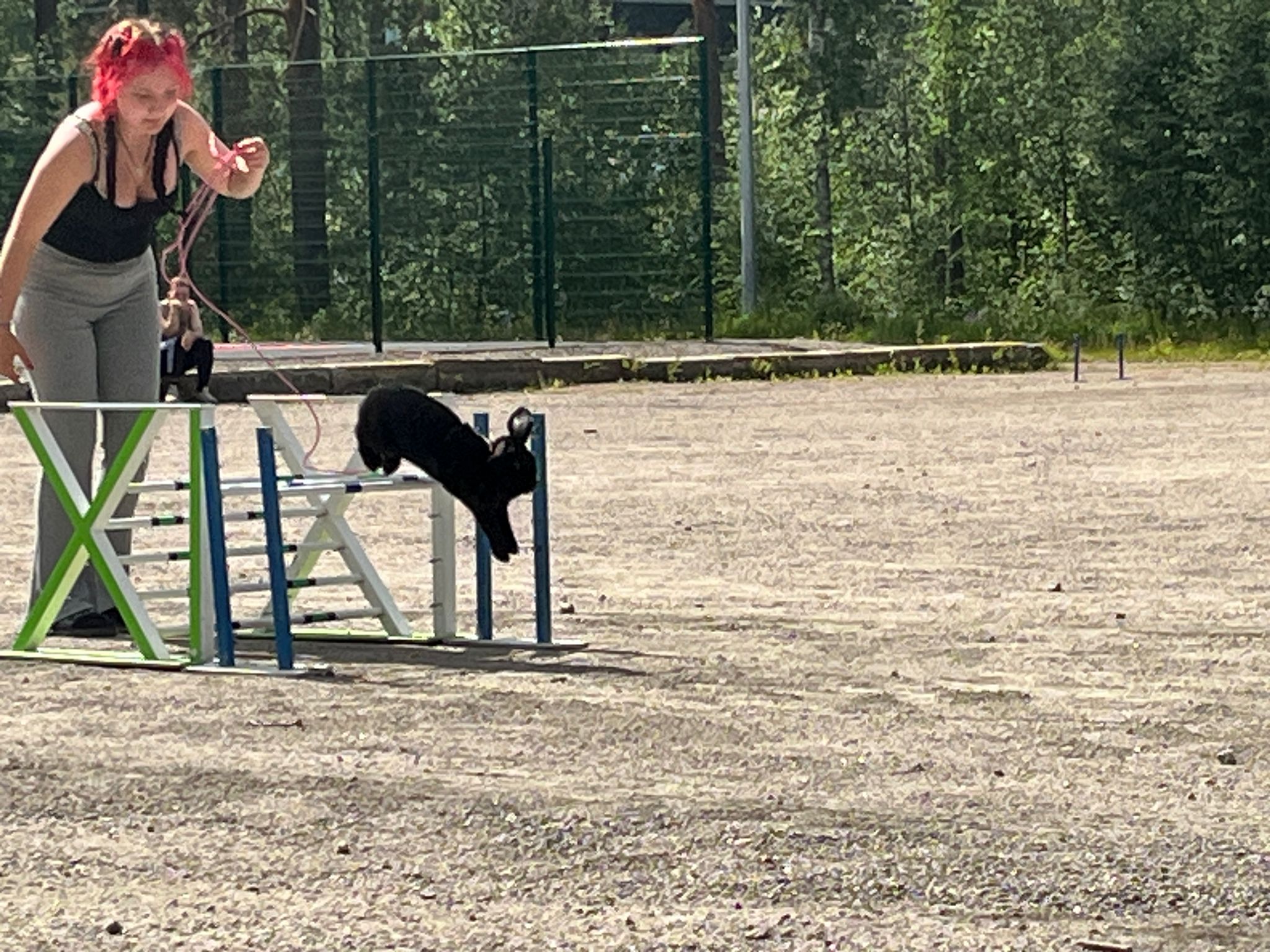
The Bunny Hopping championships are underway this weekend in Jyväskylä, Finland, where various bunny trainers get to pit their creatures (with names like wrestlers and gladiators) against each other on courses assessed for height and length. Today was the preliminary rounds, tomorrow at ten we see the elite finals and the distance heats.
Bunny Hopping has been a thing for twenty years, starting over there in That Fancy Sweden before migrating first to the Swedish-speaking west coast of Finland.
“The Swedes have been doing it for longer,” seethed one competitor. “So they’ve got the jump on us.”
Jonathan Clements is the author of A Short History of Finland. Just when he thinks there is nothing left to talk about…
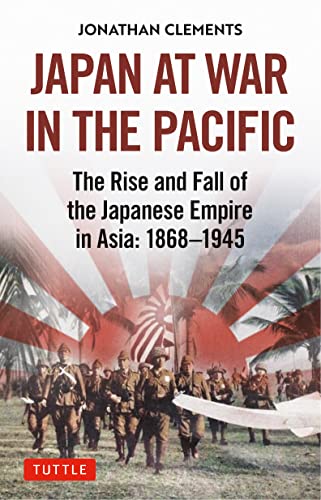
“The strength of this book, and its contribution to military history, does not lie in its periodisation scheme, nor in its assignment of various causes and motives to Japan’s military leadership and citizens. Rather, it is author Jonathan Clements’s flair for rendering complex ideas into readable prose, coupled with his eye for little-known historical details that are relevant to the story of World War II, that make this book an apt introduction to the Asia-Pacific War, or a fascinating read for those who consider themselves to be experts.”
Meanwhile, Ales Kotva in the West Bohemian Historical Review also writes a long and thoughtful piece on the book, placing it in the context not only of what has past, but what might be to come.
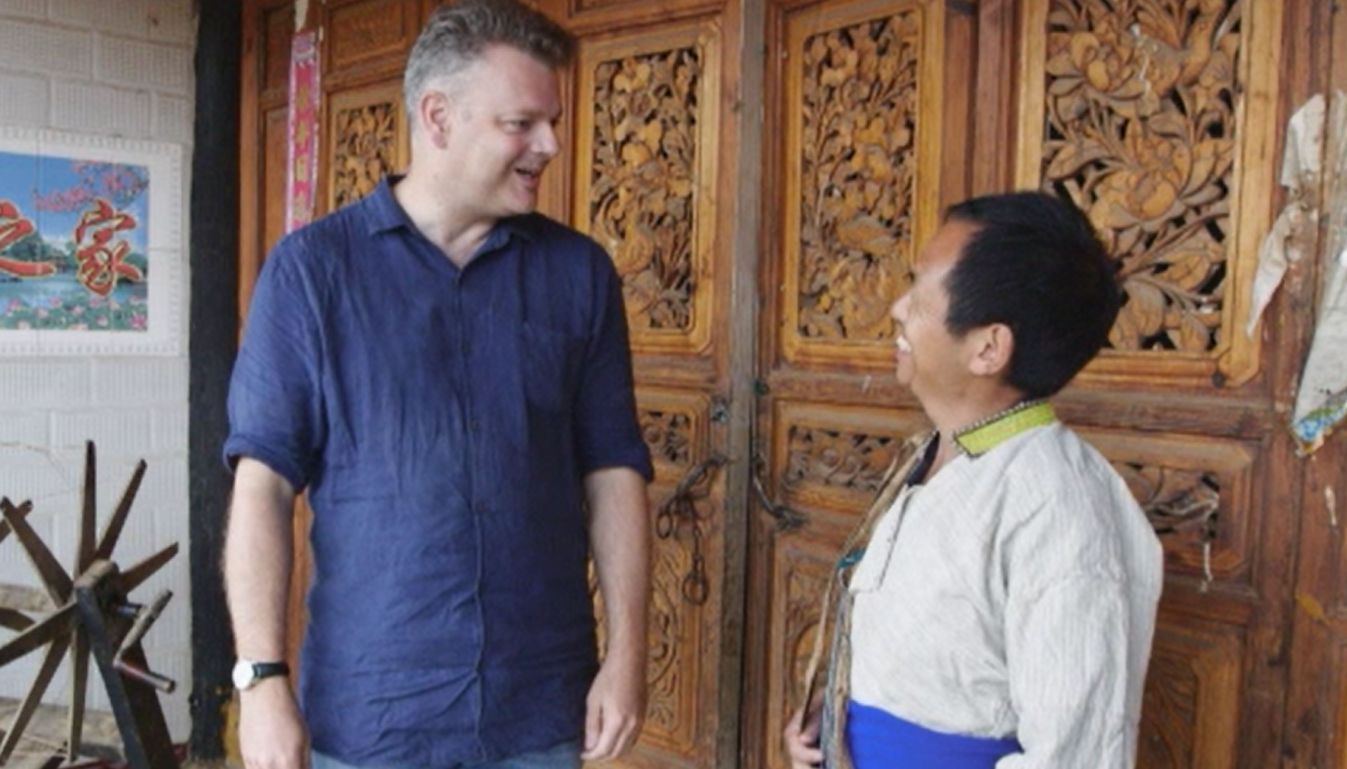
Today, Mr Jiao is supposed to be showing me the remaining parts of the process for making hempen Bai Yi clothes. We’ve been shooting the process out of order, so it’s only on day two that we get to harvesting the hemp itself. He takes us to a tiny little patch of weeds at the edge of a cornfield – it is no bigger than a minibus, but turns out to be the only hemp in the village. The director’s plans to have us wandering through acres of it has to be rewritten on the spot.
She decides instead to do an aerial drone pass of the pair of us reaching the patch, where three Bai women in their black wimples and blue tabards are hacking at the copse with sickles. But they are so quick at it that the director has to beg them not to cut it all down before we can get to the wide shot. I am told to stand in the field with Mr Jiao and talk to him about hemp, not the world’s most riveting subject. Our drone is supposed to sail over our heads, recording us and the village above us. Except suddenly I hear a sound like a hedge trimmer hitting a bucket of turtles, and realise that the overhead shot has failed to take into account the presence of terraces. Our Yuneec Q500 Typhoon has scythed its way several feet into a stand of corn before coming to a halt, meekly bleeping a distress signal. Mr Jiao fishes it out and returns it, minus one propeller. Luckily, we have spares.
Meanwhile, the wimple-wearing sickle-girls have got bored. One has wandered off entirely, and the other two are stripping some of the hemp stalks to make a basket. They have to be herded back to work. I manfully wade in with a sickle, and hack out a bunch of hemp stalks, stripping their leaves away and casting aside the long stalks. I put the leaves in a basket and head up to Mr Jiao, feeling pleased with myself.
“What are you doing with those?” he asks.
“These are to make the thread, right?”
“No,” he says. “We feed the leaves to the pigs. It’s the stalks that we use to make the thread.”
There is the sound behind me of furious crossings-out in the director’s notebook. As we move on to the huocao stripping and the hemp bark stripping. We are running so late now that the director just puts the camera on the ever-changing numbers of women in wimples, and tells them to get on with it.
“I can’t help but notice,” I hiss to her behind the camera, “that we have basically spent two days filming a documentary about string.”
At last, we have the result, or rather, one they made earlier. To great fanfare, I hold up Mr Jiao’s Bai Yi traditional tunic, a grotty thing which has not seen a steam iron in the last decade. Making it takes up half a harvest of hemp from their little plot, which turns out not to be theirs at all, but shared by the whole village, who must now wait six months for another crop.
He proudly puts his tunic on, while explaining that it used to be daily wear, but in a common refrain, “nobody can be arsed” and so now they only wear them on special occasions. He tops the ensemble with a blue belt and a man-bag made of leather, which he keeps his phone in.
“Suits you,” I can’t help saying, and he giggles in response.
We are already two hours late for the three-hour drive to Xizhou. The director pleads that we can’t stay for dinner, so we are waved off with a sack of pomegranates, some fresh-made poppadoms, and some nan bread. There is a cup of home-made chili sauce that goes with them, but our fixer drops it in a cowpat on the climb up the hill back to the minibus.
Back in March, Mark Schilling interviewed me as part of a piece he was writing for Variety. As ever, a long answer gets distilled into a couple of soundbites, so here is the unexpurgated version of my replies.
Deals are being signed between Japanese companies and their Korean and Chinese partners, but I’m hearing the pace is slower that might be expected due to everything from structural barriers (the Japanese production committee system) to political and cultural issues (Japanese fan criticism of Japanese anime adaptation of the Korean web novel “Solo Leveling” due to latter’s supposed anti-Japanese bias).
Ten years ago, Chinese investment was looking like it was going to be a game-changer in Japanese animation. We had Chinese companies bailing out troubled productions and snapping up ailing studios, and the potential market for Japanese animation in China was conservatively estimated at twenty times the size of that in Japan.
But China has become increasingly restrictive for foreign media. There was a lot of celebration in the foreign press about the likes of Kung Fu Panda and Mulan making it through to Chinese audiences, but they have come to be derided in China as unwelcome distortions of Chinese culture. The People’s Republic is becoming increasingly bullish about “cultural security” and there are calls in recent Five-Year Plans for it to become a “strong film nation”, in control of its own cultural content rather relying on whatever leaks in from overseas.
In 2020 China introduced the new Law on the Protection of Minors. There were a whole bunch of clauses in that law that gutted the potential for anime in China, including the banning of ownership of a streaming account for anyone under sixteen, and the forbidding of “obscenity, pornography, violence, cults, superstitions, gambling, inducements to suicide, terrorism, separatism, or extremism” for any viewers under eighteen. Now, of course, not all anime is sex and violence, but a good half of modern productions are aimed a late-teen demographic sweet-spot that is now forbidden.
That doesn’t destroy Chinese investment by any means, but it heavily skews the willingness of Chinese corporations to get involved in Japanese production. Pre-COVID, many were happy just to throw in some cash and distribute the result in their home territory. Now, they are well aware that if they pay out for the wrong sort of anime, their investment is worthless in the Chinese market. So, we get an increased focus on “anime with Chinese characteristics,” which won’t necessarily play well in Japan.
That’s the politics. Structurally, I think the real issue that we’re facing (and this applies to both Korea and China as outside investors) is an incredible choke-point in labour flows at the moment. There isn’t just the ongoing aftermath of COVID; there’s the fact that the big streamers like Amazon and Netflix have booked some studios up years in advance.
Meanwhile, Japan has introduced the new Work-Style Labor Reforms. These were actually passed six years ago, but they only phased in during 2020-1, and they severely curtail the amount of overtime that companies are allowed to authorise. Anime companies used to work miracles by working around the clock, but now they have their hands tied. They could bring in more freelancers, but freelancers are hobbled by changes to Japanese tax law (October 2023), which obliged them to collect sales tax on all their invoices. So, if you are a Korean or a Chinese company hoping to lean on Japanese labor, you have all these issues to contend with before someone’s even picked up a mouse.
It’s only then that we get to the content issues. Anime has been through many transformations in the last few decades, with a widely fluctuating relationship to overseas demand, or rather to the degree to which the producers were ready to acknowledge it. There was a point in the 2010s where it was all about making local, domestic content for Japan, and if foreigners liked it, too, that was gravy. Now anime companies talk about foreign investors as the “Black Ships” – comparing them to the American gunboats that rammed open the doors to Japan in the 1850s, imposing an international outlook on a nation that was trying to stay shut away in its own little world.
People are drawn to anime because it’s different. But so many overseas investors are trying to use anime talent to make shows that are focus-grouped to within an inch of their life to appeal to audiences in 70 countries at once. And if you are trying to please viewers in London and New York, Nairobi and Dubai, Buenos Aires and Beijing it can be incredibly limiting, artistically.
I don’t know if I want to get involved in the hoo-ha over Solo Leveling. Because you have people online getting offended at a hand gesture that they think means animators are making insinuations about Koreans having small penises, even though the studio that made the opening animation was Korean…. I mean, I am already boring myself. One of the corollaries of truly international, immediate streaming productions is that you now have the chance to offend several million people at once, and that they have the ability to make a stink about it in real time. Companies can be quick to pivot, not only in how they steer their content in production, but also in reaction to such drama after broadcast before their share prices drop. That’s the problem when everything is connected: everything is connected.
Do you consider Japan’s production committee system a co-production barrier? Or have foreign partners learned to live with it and even use it to their advantage?
In my experience, it is often a terrifyingly tedious chicane of obstacles, particularly with old shows where things that you could once agree with a handshake and a whisky now have to be run past a group of disparate strangers, some of whom are inheritors or purchasers of someone else’s intellectual property, with no real interest in making useful decisions. It’s one thing to be dealing with the original manga creator and the woman who runs the studio. It’s another to have to track down the dead producer’s ex-wife and the venture capitalist who accidentally purchased a dormant animation company.
I suppose the one way in which foreigners were able to use the production committee system to their advantage was by buying into one as a means of securing overseas rights without having to get into a bidding war. Manga Entertainment did that with Ghost in the Shell in 1995 in order to head off local competition in UK and European markets, and there were some similar shenanigans recently over who got to own the new Shinkai. So, in that sense, the ability to buy into the “ownership” of a new anime while it is being made can save a canny investor hundreds of thousands of dollars at the distribution end.
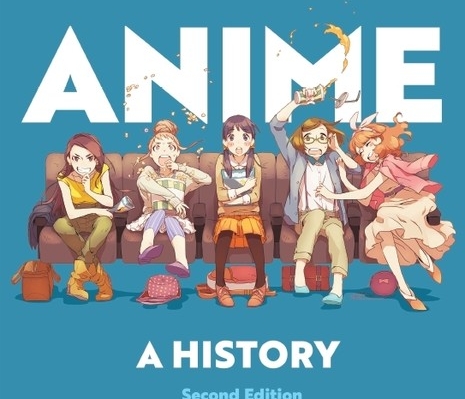
This interview with me by Shelley Pallis about my book Anime: A History was conducted for the Anime Limited blog, but got bumped and re-bumped and re-re-bumped as more pertinent topics got placed before it, until there was nowhere for it to go. I reprint… well, print it here with permission.
I want to talk about those moments in the book when you “break character” as a historian and talk about stuff that’s happened to you, in the context of anime history.
You mean Kyoto Animation?
Sure, that’s one.
That’s from the otaku economics chapter, where I talk for several pages about the particular way that Kyoto Animation was run as a studio, and the way in which it encouraged interactions with fans, offering the chance to be creators. Of course, that backfired terribly when one self-styled would-be creator burned the studio down.
I had to go on stage at Scotland Loves Anime to introduce a screening, I think it was of A Silent Voice, and I had no idea how I was going to do one of my usual stand-up routines about such a serious subject. So instead, I just explained that usually Andrew Partridge would introduce the final film of the festival, but he just couldn’t face talking about people that he knew personally in such a dire situation… and then I decided to read out the names of the people who had had died. I didn’t explain that was what I was going to do, I just said: “And so we’re going to do this…” and started.
You got this ripple through the audience as people realised at different times what I was doing, who these seemingly random names were. But also, the list goes on and on, and on… it takes a long time to read out all those names, and that starts to add real weight to the sense of loss in the business. So, yes, I kind of break the fourth wall in the book to talk about that, because these were real people, and we knew some of them, and someone killed them because they didn’t rush to adapt his isekai novel or something.
Your book is dedicated to Andrew Partridge, is that why?
It’s dedicated to him because he has so consistently put me in the middle of anime history to observe it. We’ve been all over the UK shilling for anime, and it’s put me into some situations that come back to form data in a history book. Scotland Loves Anime is hard work, but it also puts me in a room with some of anime’s movers and shakers. Ryosuke Takahashi takes me to one side to gossip about Sunrise. Mamoru Hosoda sits across from me at an Indian restaurant and reminisces about Gunbuster. Naoko Yamada needs someone to subtitle Garden of Remembrance in a hurry, and starts crying when I read out my translation. I don’t directly quote any of these incidents in the book, but you can bet that they inform so much of what I say, and the directions I choose to investigate.
You also drop in a mention of your Death Note audio drama.
I think it’s a really good example of “post-anime”, where the licensors rake off 5% of something someone else is doing in another medium. Lübbe hired me to write a ten-episode adaptation of Death Note, and said they wanted to go slowly, and to get the first two episodes to the Japanese for approval. When the notes came back from the licensors, they said that there were elements in the script that had clearly derived from the manga.
“Yes,” I said. “You hired me to adapt the manga of Death Note into an audio drama.”
“No,” they said. “The licence we granted was to adapt the anime of Death Note into an audio drama.” Which was something that Lübbe had neglected to mention, because like a lot of mainstream producers, the difference between anime and manga wasn’t something they really appreciated.
As it happens, it took about ten minutes to change my scripts. I think there were two scenes or something in my first two episodes that derived solely from the manga. After that, the licensors were super-happy, and let me get away with all sorts of stuff.
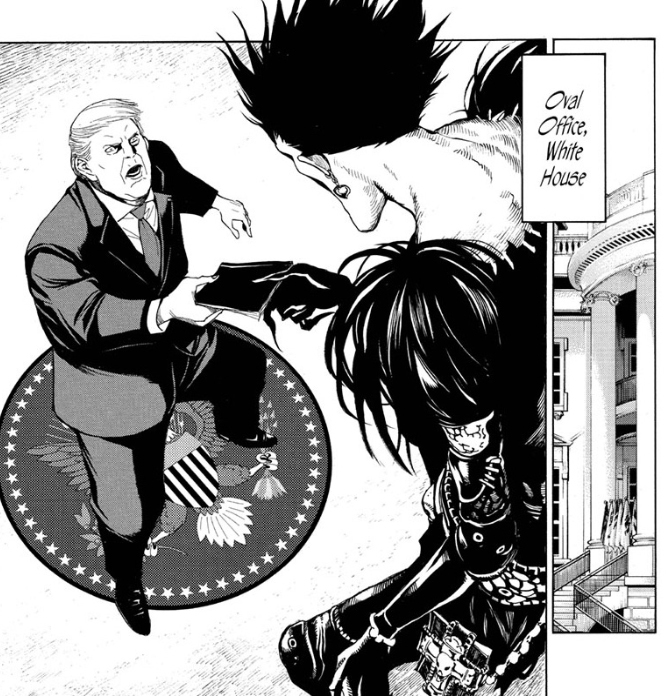
Like making the American president Donald Trump?
I didn’t do that. America did that. In the original, the American president is just an anonymous, patrician white man. But if Hillary Clinton had won, I would have totally made it about her. Instead, we were stuck with Trump, so I thought: how would someone like him react to this kind of weaponised curse, to the revelation that magic existed, and that demons did, too? How would he try to steer it to his own advantage? How would he let it affect US foreign policy?
Did that date the show? I mean, he’s not president any more.
I have often wondered if that’s the reason it never got picked up for an English-language broadcast. It was released in German and in French, and Audible contacted me to ask for casting suggestions for an English-language version, but I never heard anything more about it. I was writing Death Note as a contemporary drama, in the year 2017, and that’s what the American president looked like then. [Subsequently, a Trumpalike president also appeared in the 2020 one-shot Death Note spin-off a-Kira, pictured].
It was very important to me that I wrote Death Note in the context of the new times, not simply repeat what the anime people came up with in 2006. There were new factors to consider, like social media, metadata and privacy, #MeToo, and I threw all those in.
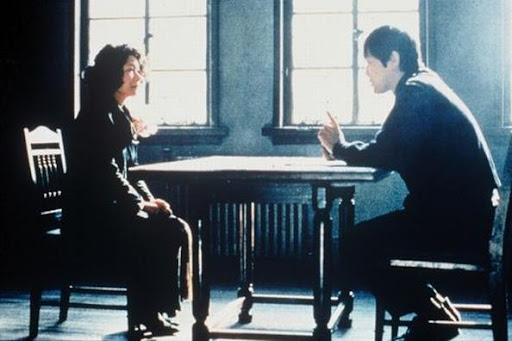
Your Death Note deviates considerably from the original by the end, particularly by keeping L in it all the way through. There’s a really goose-bumpy scene where he has that interview with the counsellor…
That was a total rip-off from Hirokazu Kore-eda’s After Life. The film starts off with this entirely everyday, bureaucratic person-to-person interview, with a guy going through someone’s papers, and checking date of birth, and name-spelling or whatever. And then he says, very matter-of-factly: “And just to be clear, do you know you’re dead?” And the person he’s talking to nods in a similarly matter-of-fact way.
And this is going to sound super-weird, but the other thing that inspired me was the last-ever episode of One Foot in the Grave, where we all know that Victor Meldrew is going to die, and [the writer] David Renwick completely wrong-foots the audience by beginning with him already dead.
And so, when we reach the episode where L dies, I figured that in the world of this story, death is no obstacle. Things just keep on rolling, and L gets to comment upon and steer the action back in the real world, like a kabuki ghost. And that starts to push things off kilter in a way that I thought was interesting.
Did the listeners in Germany agree?
Most of them!
You seem a bit bitter in your materials section, when you talk about Funimation taking over Manga Entertainment.
Well, I think it’s an interesting element of the “archive” of anime studies. Over the years, Jerome Mazandarani spent about £17,000 of the company’s money on articles about its products and anime in general, for the blog. When Manga Entertainment was acquired by Funimation, they also acquired all this third-party comment – reviews, obituaries and commentary – and it clearly didn’t fit their idea of what sort of sticky content a website should have. The rights situation was unclear, there was clearly nobody at Funimation who wanted to curate it, and so they just erased it from the web. I guess some of it might be on the Wayback Machine, but that’s a lot of content to suddenly disappear. And of course, if you can do that with some article I wrote about Yoshiyuki Tomino, you can do it with an entire anime series as well, as many fans are observing today.
You think streaming is vulnerable?
Sure it is. If you want to be sure you can watch your favourite anime whenever you want, you need to keep investing in Blu-rays.
Anime: A History by Jonathan Clements is published by Bloomsbury.
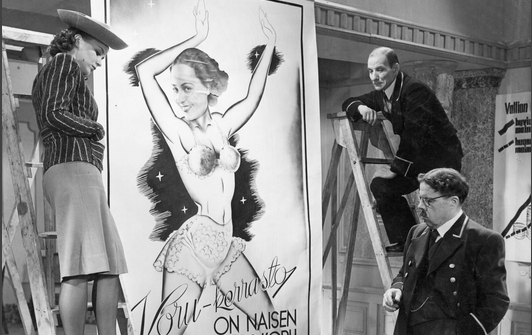
Unexpected controversy arises after the Original Advertising Agency’s new underwear poster is a hit all over town, leading to claims that the pert model featured in it is actually Margit Helleheimo (Birgit Kronström), the daughter of a government minister facing a mid-term election. Hoping to weather the storm, agency head Bruno Blomster (Toppo Elonperä) arrives at Mr Helleheimo’s office to pitch his ideas for a new campaign to push government bonds. This only drags him into political skullduggery, as underling Hilpeläinen (Thure Bahne) schemes to bring down cabinet minister Helleheimo (Sven Relander) by any means necessary, including slut-shaming his daughter.
Summoned to account for his artwork, advertising executive Kalevi (Tauno Palo) lies to spare Margit’s reputation, and claims that he based his pictures on a dancer he met in Helsinki. The doubting minister demands that he present the real model within 48 hours.
Thrashing about in search of a suitable Finnish woman, Kalevi lurks at the theatre company of the impresario Oikero (Ossi Elstelä), where he is amazed to discover Manta Mutikainen (a.k.a. Baby Peggy), a dancer who is the spitting image of Margit, mainly because she is Margit, who has donned an unlikely disguise to audition for the role of her own double. After a series of quick-change farces that threaten to reveal her true identity, “Peggy” wins over the ministers and drags everybody into a sing-along, whereupon Minister Helleheimo awards the advertising contract, and all is well…
But no! Because Hilpeläinen arranges a dinner date with “Peggy” where he tries to enlist her help with bringing down the government. Later, Kalevi escorts her home and makes his feelings plain by snogging her face off and giving her a dog (not a euphemism). You would think that this might be a happy ending, but now Margit is incensed that Kalevi is is cheating on her with another woman, even though she is the other woman. Eventually, all such concerns are settled, and Kalevi and Margit seek her father’s blessing to get married. When Helleheimo seems about to refuse, Kalevi blackmails him, threatening to disclose his daughter’s modelling past after all unless he relents.
“All is fair in love,” says Margit. “You’re a lucky minister.” And the couple kiss as the thespians kick off in a song-and-dance celebration, presided over by Oikero, who is inexplicably dressed as Napoleon.
Turo Kartto’s script for Suomen Filmiteollisuus’ Onnellinen ministeri was lifted from the 1937 German musical Das Ministerium ist beleidigt, and had previously been performed onstage in Turku in 1938. Suomi-Filmi’s last movie of 1941 turned out to be a remarkably clockwork intersection of daffy plots, jettisoning all the songs from the stage version and replacing them with a bunch of new ones, including “Katupoikien laulu” (Song of the Street Boys), which has become a much-covered classic, albeit with the original reference to the streets of Soho [London] snipped out to make it sound more Finnish.
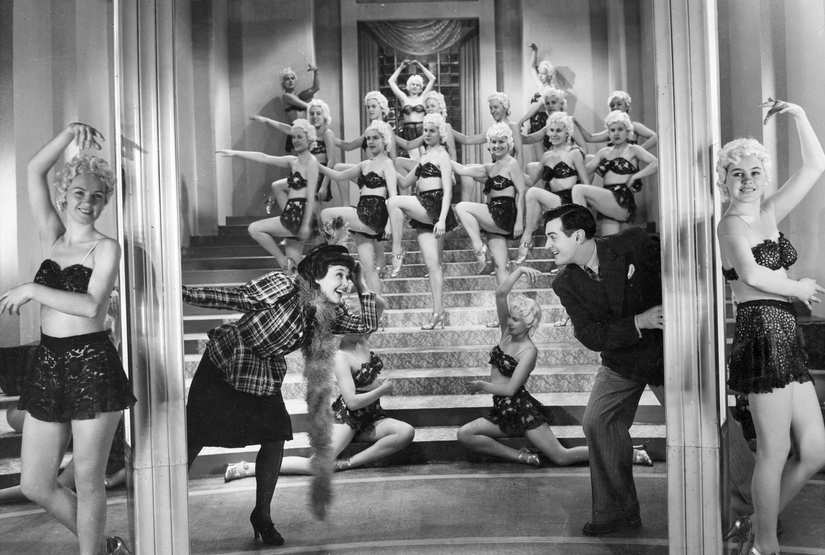
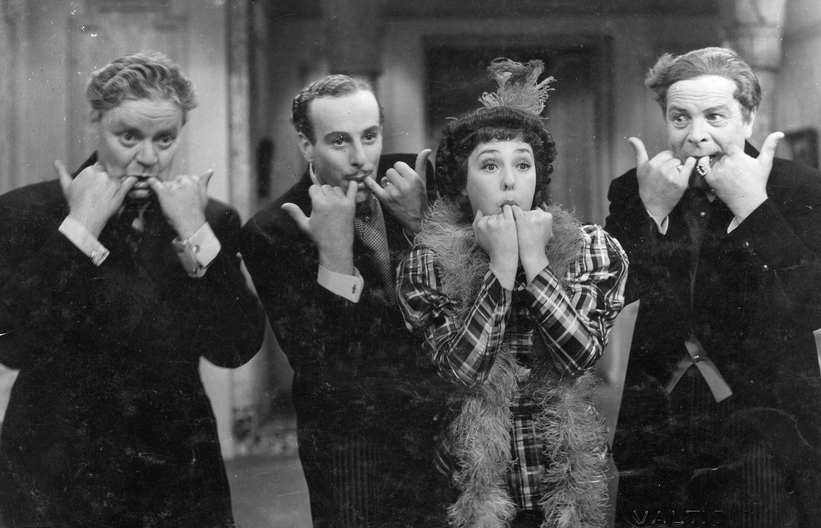
In fact, the film is crammed to bursting point with songs, starting off in the opening scene at the Original ad company, where the wartime starlets, the Harmony Sisters, cameo as singing telephonists, in a four-part harmony about how the boss can’t come to the phone right now. We’ve seen many musicals before over the last couple of years of this watchathon, but this one is the first to my mind that does anything more than ramming songs into the narrative. In The Lucky Cabinet Minister, dance and song are used to tell the story in all sorts of innovative and impressionistic ways – old news in the theatre, but rarely utilised in Finnish cinema until this point.
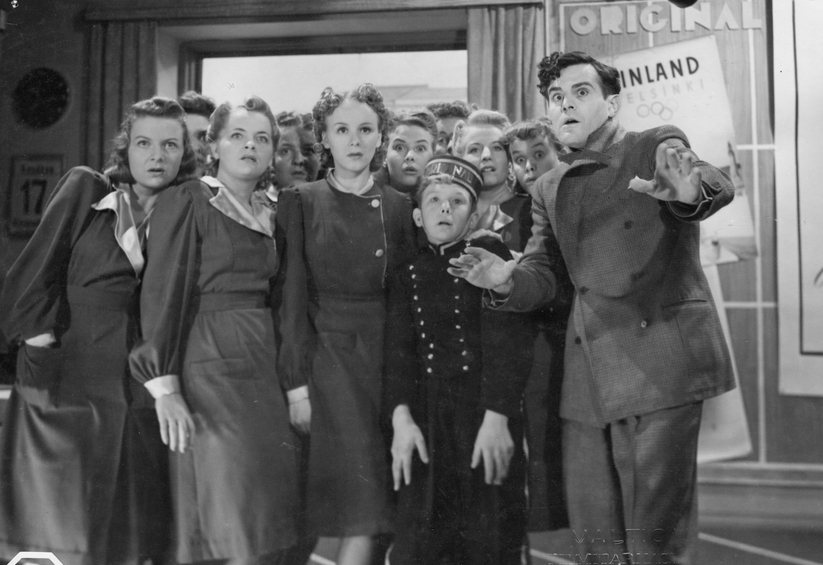
Take the opening number, “Mainostoimistolaulu” (Song of the Ad Agency). It doesn’t merely set up the bustle of the agency, but incorporates the arrival of Kalevi’s poster, and its distribution all around town. Proud of his company’s handiwork, Blomster walks briskly past admirers of the poster on the street, and buys a newspaper, and the camera focusses on his feet as he walks while reading, his jaunty pace coming to a shocked stop as he reads of the possible collapse of the government he hopes to take on as a client, flanked by a picture of the minister’s daughter in frilly knickers. Back at the office, the secretaries and their busboy (Lasse Pöysti, of The Suominen Family) are dancing around the poster in a Busby Berkley-esque group, alternately worshipping it and imitating it, as if to encapsulate the media fever around it… until the song is brought to a crashing stop by the arrival of Blomster.
Director Toivo Särkkä smartly leaves much of the singing in the hands of bona fide singers, as seen in a reprise in which Tauno Palo talks his way through his lyrics in a duet with Sirkka Sipilä and the Harmony Sisters. But that’s okay, because we know the Big Guns are waiting in the wings – Palo does eventually acquit himself in singing terms, but Birgit Konström, still coasting on her success after For the Money, has the dual singing and acting chops to carry the film all by herself. One expects that’s why she gets top billing, with a role that seems to have been written for a teenage ingenue, but which only the 36-year-old Konström could reasonably be expected to deliver.
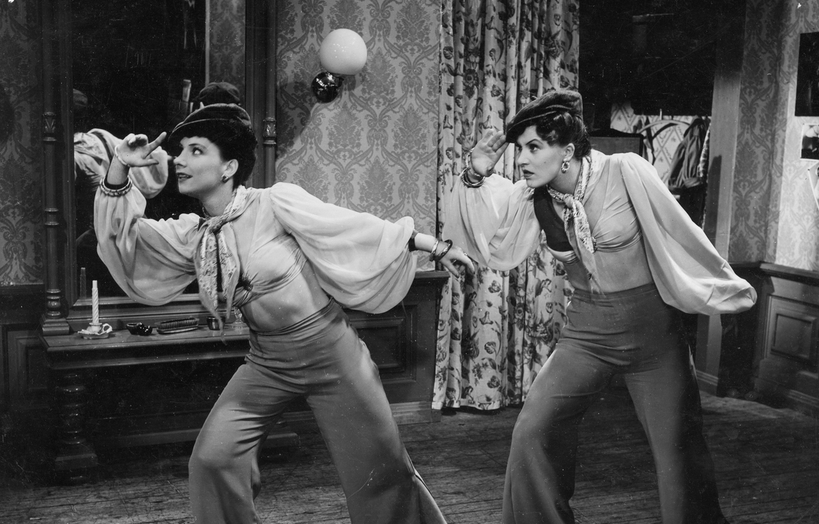
We might detect some vestige of the original theatrical production in the way in which the actors are given times to rest. The Harmony Sisters fade from view after the first hour, to make way for Konström and the Swing Sisters, who obligingly perform a shuffle-dancing striptease while the lead sings “Katupoikien laulu”. Much of the film’s location shooting comprises entertaining but unnecessary sights of the billboard all over contemporary Helsinki, cheekily shoved into a number of iconic spots, including all around the central statue of the Forging of the Sampo.
You would think that several stage incarnations would let the plot and execution be nicely matured by the time it made it to the screen, but this appeared to set many critics against this 124-minute film. Paula Talaskivi, in the Ilta Sanomat, bragged that she’d seen it twice on stage, and was left bored by this cinema version. Toini Aaltonen in the Suomen Sosialidemokratti commented that the original’s Parisian setting had been excised for Helsinki for no good reason, a comment which seems to deliberately misunderstand how films work. Olavi Vesterdahl in Aamulehti offered a far more incisive contextualisation of the film in terms of its era, noting that “idle celebrations and infidelities” seemed to be the touchstones of contemporary Finnish cinema, and that the film did itself no favours by relying so heavily on pratfalls and plot holes. “As such, the film is the lightest kind of entertainment, hardly even that, perhaps more correctly a waste of time from the viewer’s point of view.”
Posterity has been far kinder, with reviewers of the film’s later appearance on TV, untroubled be memories of the theatrical original, universally praising its vim and verve. I certainly found it much more enjoyable than I had been led to expect by the faint-hearted reviews of the 1940s, although in the woke 2020s, it is difficult not to take umbrage at the subtextual hand-wringing about a woman’s freedom to display her body. To be fair, the script depicts Margit as entirely uncaring about it, while the people of Helsinki, upon recognising her while out riding in public, literally break into applause. It is only the menfolk immediately around her who get in a tizz, before revealing how shallow their own perceptions are by failing to realise that Peggy and Margit are the same person. Meanwhile, there are some subtle suggestions of hypocrisy at work, particularly in a scene at her father’s home where Margit has a long conversation with a maid, in front of a massive rococo painting of a bunch of ladies with their baps out.
There is indeed, a certain class of Finnish women who all look the same, and it’s the thin, wriggly bright-eyed blondes usually favoured by foreign husbands (although not me). So much so, that at one Christmas party in 2003 for my beginner’s Finnish class when everybody brought along their Finnish wives, the pixie parade on display was so homogenous that I was genuinely worried someone might go home with the wrong Finn.
I asked our Finnish teacher if there was an equivalent language course where a majority of female students all had identical husbands.
“Yes,” she said with a sigh. “Swedish.”
Jonathan Clements is the author of A Short History of Finland. He is watching all the Finnish films, so you don’t have to.
“Clements delves into the creation myths and languages of Taiwan’s different indigenous groups and discusses their similarities with certain Pacific island peoples but also with some tribes in southern China. He describes the complexities of Chinese migration to Taiwan since the 17th century and the different settler groups’ interactions with each other and with indigenous groups.
“The reader encounters the powers that over the centuries landed on Taiwan’s shores and made shortlived attempts at setting up colonies — the Spanish and the Dutch — or otherwise exploiting its natural riches and strategic location — the British and the French.
“Clements, a British writer who has authored both fiction and history books about east Asia and benefits from his literacy in Mandarin and Japanese, makes all this come alive through the key characters whose stories he tells.”
Mr Jiao, the chieftain of the Yi village, wants to have dinner with us to discuss the shooting tomorrow. I dread these occasions, but it goes very well. He turns up wearing a regulation issue tribal nylon anorak, brings his big brother, who is the designated driver. Our own driver, unlike the sullen anti-socials we have had before, joins the talk (a huge benefit having another Mandarin speaker at the table), and they are clearly pleased with the attention they are getting. The chief is a small, small man with dark brown skin, more Burmese than Chinese, and with a high-pitched voice that could easily be mistaken for a woman’s. He will be interpreting for me, because his mother-in-law, who is the hemp spinner, only speaks Yi, an antiquated version of Chinese that sounds like someone throwing a pot of alphabet soup down some stairs.
The food is Chinese, but recognisably distinct – lantern-shadow beef, fried squid, a soup of river fish and mountain greens. Mr Jiao orders a bottle of Damaijiu, a local malt firewater that is supposedly 45% proof, and from which the crew recoil in terror. It is smooth and tasty, like vodka, and between us we down the whole (small) bottle until he is red-faced and giggly.
Our director looks Chinese, but she grew up speaking Teochew and Malay, and her Mandarin is understandable but error-riddled, such that if she gets tipsy she sounds like the policeman in Allo Allo. On the last shoot, she apparently mixed up her vowels so much that she ended up wishing a departing artist “a trip in which you suffer from permanent influenza.” Our fixer pleads with her not to open her mouth at all. Tonight at dinner with the village chief, she realised that he was making his own personal documentary about his tribe’s way of life, and offered to share with him whatever drone footage we got tomorrow. However, owing to some chance mispronunciations, she ended up saying: “And tomorrow, if you like, we will masturbate all over your village.” I thought he was going to spit out his tea.
But he seems nice enough, and toasts me with a story of his international friends. “You are only the third English person I have ever met,” he says to me. “The second was an ethnomusicologist who came to study our songs. And the first was Margaret Thatcher, your Iron Lady.” Apparently, she came to see some sort of ethnic dance he was in many years ago.
Today we are shooting the collection of wild huocao, literally fire-grass, i.e. tinder. It looks like a white-backed dock leaf, and forms the weft of their traditional clothing. The warp is hemp, which we will also have to harvest.
Mr Jiao has assured us that collecting the huocao is a two-man job. But by the time we set out, we have somehow acquired a dozen Bai Yi women in black wimples and blue tabards, clutching baskets and giggling at the thought of being on telly. The director is ready to blow a gasket, because she knows what will happen next. The Yi women’s love of telly will proceed in inverse proportion to the amount of time they are to stand there, no there, no over here, no, please be quiet. Nobody say anything; please stop moving; go and do that thing again; now go and do it over there. Only one of them actually speaks Mandarin; the rest only speak Yi, which means all the spoken directions wander at a leisurely pace through several stages of Chinese whispers, and are often countermanded before they reach the last in line.
Meanwhile, two men, wearing traditional hemp clothes over their tracksuits, burst into song on the mountainside. It’s a yodelling song, about how happy one is collecting huocao, wondering if there is anyone else on the mountainside of the opposite sex, who wishes to sing a refrain in response. It’s all very idyllic for about ten seconds, but then the women’s refrain drifts up as well, ruining the immediate sound recording. We go for another take, but now the men are singing in response to the women, and by the time we have shut them up, the women are singing back. This medieval tinder hook-up continues until it starts to rain, but Alvin the cameraman grabs some footage of the women puttering around in the grass, and of them trying to teach me their song with comedy clumsiness.
Gwyneth, my name for the only woman who speaks Chinese, is determined to stand close by, because she is the one who can show me what huocao is. Meanwhile, a cowherd wanders across the back of the shot with clanging cowbells. The director is starting to regret ever saying that she was looking forward to shooting in the countryside, since there is soon just as much noise pollution as in a built-up urban area, except here we are also hot and clammy with mosquito repellent and sun lotion, and there is nowhere to have a piss. You would think there would be handy bushes everywhere, but behind every one is a black-wimpled woman in a blue tabard, singing a song about grass.
Dinner is back at their quaint farmhouse, sitting on benches in the courtyard. The women eat separately, chattering in Yi about whether or not this will make them famous. The men dish out the Damaijiu malt firewater, and serve Yunnan food – succulent local ham, chicken and garlic, pumpkins and potatoes, and punguent home-made pickles. A sullen two-year-old boy wanders between the tables, gnawing balefully on a chicken’s head. He’s teething, explains his mother, and the beak is good for him.
“I can’t help but notice,” I say, “that your tribe is called the Bai Yi, meaning ‘white clothed’, but everybody’s wearing blue.”
“Ah yes,” says Mr Jiao brightly, “making the white clothes is such a faff, we can’t be arsed any more.”
To America, where Robert Woodhead and Natsumi Ueki, owners of the fan favourite video label AnimEigo, announce that they are selling their company and retiring. This would usually be where fandom clutches its pearls in horror and starts bemoaning the fate of a good company snapped up by some conglomerate, but this time the buyer seems ideally suited.
Founded in 1988, AnimEigo were the people who first brought Urusei Yatsura, Bubblegum Crisis and Otaku no Video to the west, initially as a subs-only boutique distributor – their titles first made it to the UK under the aegis of their sub-licensee, Anime Projects.
Justin Sevakis, whose disc-mastering company Media OCD is responsible for many of the Blu-ray presentations that eventually show up in the UK, has offered to take AnimEigo off its owners’ hands, kiting it along for another generation. Somewhat appropriately, the story broke on Anime News Network, the website that Sevakis founded back in his student days, long since sold on to other owners. The deal was done some time ago, but the parties involved first wanted to do a grand tour of all the anime companies in Japan, introducing the new boss and pleading for the change in ownership not to shut down contracts that dealt specifically with Woodhead and Ueki, rather than whoever it was that would take over their company.
So, this is no leveraged buyout or corporate takeover. Instead, it’s two much-loved fans-turned-pro, gently handing their company over to another fan-turned-pro, and sticking around to ease the transition along.
Sevakis announces that he intends to continue the AnimEigo policy of crowd-sourcing bespoke collectors’ editions of niche titles. Woodhead and Ueki will guide him through to the completion of whatever projects they had underway at the time of the sale, but I suspect that once Sevakis is fully in charge, the acquisition of his own distributor is sure to tempt him with new prospects. If you suddenly found yourself with a Blu-ray label, what would your dream acquisitions be…?
Of course, it might also Turn Him to the Dark Side. Watch out for the sudden appearance of a Mirror-Universe goatee, and a sudden desire to dub everything with silly voices and swearing. I suspect, however, that AnimEigo is in safe hands, and this is one acquisition that fandom won’t decry as the worst evarrr.
Jonathan Clements is the author of Anime: A History. This article first appeared in NEO #239, 2024.
I’m popping up at London’s School of Oriental and African Studies on Wednesday 29th May (7pm at the Khalili Lecture Theatre) to talk about one of Taiwan’s most famous residents:
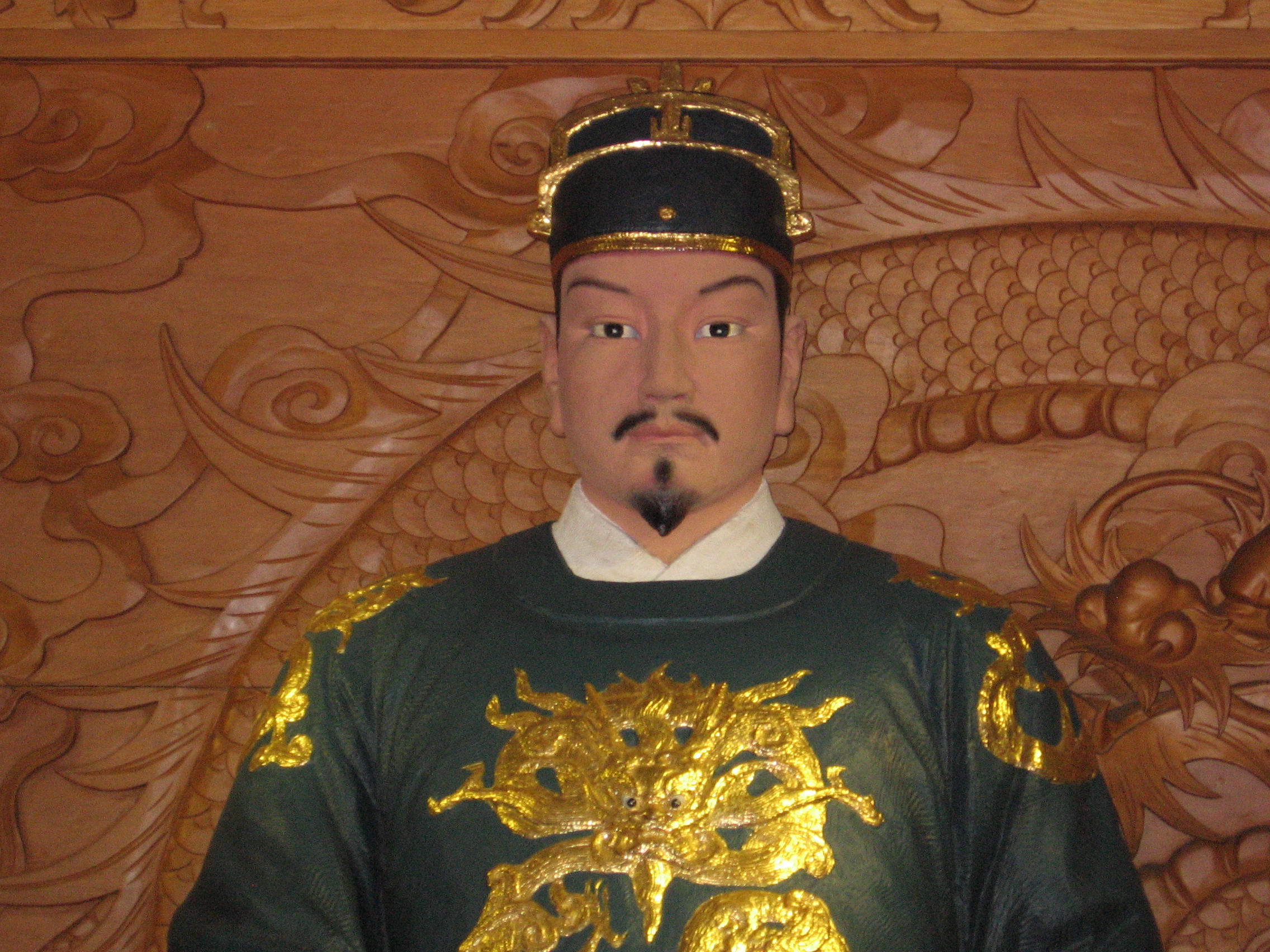
Jonathan Clements discusses the life, death and strange afterlife of the “pirate king” Koxinga (1624-62), the Ming loyalist and conqueror of Taiwan, variously derided as a pirate and a rebel; lauded as a resistance leader and prince, twice deified, spuriously reclaimed as both a Japanese patriot and a Chinese “People’s Hero”.
Along the way, there are some unlikely legends, some suspicious shenanigans, and his co-option into a 2010 mayoral campaign that threatened to turn into a fistfight among historians.
*All SOAS Centre of Taiwan Studies events are open to all and not needing to register.




















 The Official Schoolgirl Milky Crisis Blog